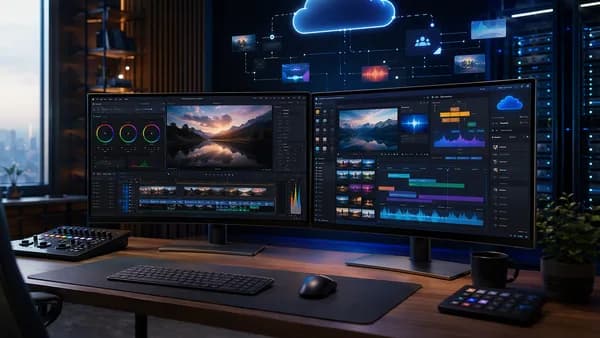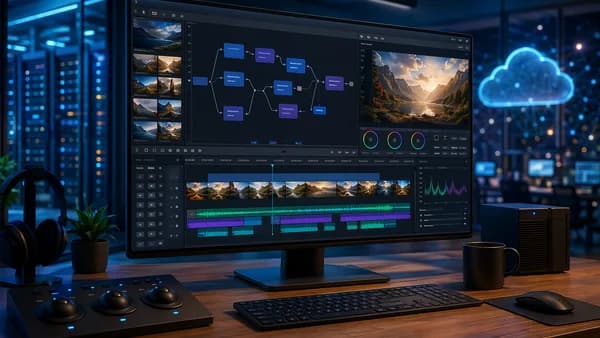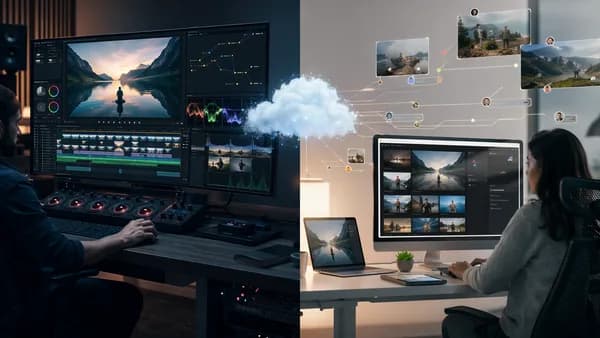
Choosing between DaVinci Resolve vs Premiere is a practical business decision for YouTube creators, editors, and small content teams. Both DaVinci Resolve and Adobe Premiere Pro can cut professional YouTube videos, but they differ sharply in pricing, color grading, audio, collaboration, motion graphics workflows, hardware behavior, and ecosystem support.
For creators publishing regularly, the best choice is not simply “which editor is more powerful?” It is which editor gets your videos finished faster, keeps your workflow reliable, supports your team, and fits your long-term budget.
Why YouTube Creators Compare These Editors
YouTube creators compare DaVinci Resolve vs Premiere because both tools now compete as full post-production platforms, not just timeline editors. Premiere Pro has long been a standard for editing, advertising, social media, and Adobe-based workflows. Resolve began as a professional color grading system and has expanded into editing, audio, effects, delivery, and collaboration.
The basic trade-off is clear:
| Category | Adobe Premiere Pro | DaVinci Resolve / Resolve Studio |
|---|---|---|
| Core strength | Fast, familiar editing and Adobe ecosystem | Color grading, integrated post-production, long-term value |
| Pricing model | Subscription | Free version or one-time Studio purchase |
| Color tools | Lumetri Color | Node-based grading, HDR tools, Color Warper, DaVinci Wide Gamut |
| Audio | Essential Sound, Audition integration | Fairlight DAW built in |
| Motion graphics | Strong with After Effects | Fusion built in |
| Collaboration | Team Projects, Creative Cloud, Frame.io | Blackmagic Cloud, shared libraries, bin locking, Cloud Presentations |
| Best fit | Adobe users, motion-graphics-heavy teams, client workflows | Cost-conscious creators, color-focused channels, all-in-one post |
The most important difference for many creators is cost: Resolve has a powerful free version, while Premiere Pro is subscription-only at the time of writing.
The decision often comes down to your channel’s reality. If you need captions, thumbnails in Photoshop, After Effects templates, and client files from agencies, Premiere Pro remains compelling. If you are starting fresh, want advanced color, and want to avoid monthly software fees, Resolve is hard to ignore.
Editing Workflow and Timeline Performance
For core YouTube editing—cutting talking heads, trimming b-roll, syncing audio, adding music, placing captions, and exporting—both editors are mature and capable. The sources consistently describe the editing category as close, with different workflow philosophies rather than a simple winner.
Premiere Pro’s editing workflow
Adobe Premiere Pro uses a traditional, unified editing workspace. Many editors are already familiar with its source/program monitor workflow, timeline behavior, customizable panels, ripple and roll edits, multicam tools, adjustment layers, and project-based organization.
For YouTube creators, Premiere’s strengths include:
- Fast Editing: Built for quick, content-focused workflows such as YouTube, commercials, corporate videos, reels, and social media.
- Customizable Interface: The interface is described as highly customizable, letting editors arrange panels for their preferred cutting style.
- Timeline Familiarity: Many editors, agencies, and clients already use Premiere, making it easier to exchange projects.
- Pancake Editing: Editors in the source discussion highlighted Premiere’s ability to stack timelines for select reels and fast assembly workflows.
- Multicam Workflow: One professional editor in the discussion reported Premiere’s multicam performance and workflow as smoother in their experience.
Premiere is especially attractive when editing is the center of the job and other Adobe apps handle graphics, audio, and design.
DaVinci Resolve’s editing workflow
DaVinci Resolve separates post-production into dedicated pages: Media, Cut, Edit, Fusion, Color, Fairlight, and Deliver. SproutVideo describes this as giving each part of the process its own space, while the Miracamp source describes Resolve’s workflow as structured and powerful.
Resolve includes two main editing environments:
- Cut Page: Designed for quick assembly, selects, and fast edits.
- Edit Page: Built for more detailed timeline editing.
For creators, Resolve’s workflow advantages include:
- Dedicated Cut Page: Useful for assembly edits, reviewing footage, and quickly trimming material.
- Traditional Timeline Editing: The Edit page supports detailed timeline work.
- Tape View: SproutVideo notes that Resolve can let editors review footage as one continuous stream for trimming.
- Smart Bins and Auto-Organization: Helpful for larger YouTube projects with repeated assets.
- Automatic Audio Syncing: Resolve includes waveform matching for dual-system audio workflows.
- Built-In Checksum on Ingest: SproutVideo notes Resolve has a built-in checksum tool to help copy footage without corruption or error during ingest.
However, Resolve’s structure can feel less flexible to some editors. In the source discussion, one editor described Resolve as feeling like several programs combined, even though they work well together.
Editing workflow comparison
| Workflow Area | Premiere Pro | DaVinci Resolve |
|---|---|---|
| Timeline style | Unified, traditional edit workspace | Separate Cut and Edit pages |
| Interface | Highly customizable | Cleaner and organized, but less customizable |
| Ingest | Industry-standard media organization | Built-in checksum tool |
| Dual-system audio sync | Described as more time-consuming and clunky by SproutVideo | Automatic waveform matching |
| Multicam | Reported smoother by one editor in source discussion | Excellent multicam editing; batch-syncing described as simpler |
| Best editing fit | Fast social, agency, client, and Adobe workflows | Structured editing, one-off projects, and all-in-one post |
For standard YouTube editing, the sources suggest both tools can handle the job well. The difference is whether you prefer Premiere’s customizable single-workspace model or Resolve’s page-based post-production structure.
Color Grading, Audio Editing, and Motion Graphics
This is where the DaVinci Resolve vs Premiere comparison becomes more decisive. Premiere Pro is strong when paired with the Adobe ecosystem. Resolve is stronger as a self-contained post-production suite.
Color grading: Resolve’s clearest advantage
Color grading is the area where Resolve has the strongest lead in the provided research. Resolve started as a color grading tool, and the sources repeatedly describe its color page as professional, class-leading, and industry-standard.
Resolve Studio color features mentioned in the source data include:
- Node-Based Grading: Build complex grades as node graphs.
- HDR Wheels: Advanced HDR color controls.
- Power Windows: Isolate and adjust specific areas of the frame.
- Secondary Color: Isolate specific colors for correction.
- HSL Curves: Hue, saturation, and luminance control.
- ACES Color Management: Industry-standard color workflow.
- Scene Matching: Automatic color matching between shots.
- Film Emulation: Tools for stylized looks.
- Color Warper: Advanced color manipulation.
- DaVinci Wide Gamut: Wide-gamut color management.
- Magic Mask: Studio-only AI object/person isolation for grading.
Premiere Pro uses Lumetri Color, which the sources describe as good for basic grading, quick corrections, LUT application, curves, HSL, and display-referred color correction. But for serious color work, the research says Premiere users often move to After Effects or Resolve.
| Color Need | Better Fit Based on Sources |
|---|---|
| Quick exposure and white balance fixes | Premiere Pro or DaVinci Resolve |
| LUT application | Premiere Pro or DaVinci Resolve |
| Cinematic grading | DaVinci Resolve |
| Multi-camera color matching | DaVinci Resolve |
| HDR workflows | DaVinci Resolve Studio |
| Node-based professional color | DaVinci Resolve |
| Brand color consistency across shots | DaVinci Resolve |
If your YouTube channel depends on a polished cinematic look, product visuals, music videos, travel films, interviews, or multi-camera color matching, Resolve has the stronger source-backed case.
Audio editing: Fairlight vs Audition integration
Audio is more nuanced. Premiere Pro has essential audio tools, the Essential Sound panel, and integration with Adobe Audition. Resolve includes Fairlight, a full digital audio workstation inside the same application.
Fairlight capabilities mentioned in the research include:
- Professional Mixing Console: Built-in mixing interface.
- Unlimited Audio Tracks: Listed in the source data.
- EQ, Compression, Reverb: Advanced audio processing tools.
- Dolby Atmos / Spatial Audio: Supported in Fairlight according to the sources.
- Multitrack Recording: Included in the Miracamp data.
- Real-Time Mixing: Included in the Miracamp data.
- VST Plugin Support: Mentioned in the YouTube creator source.
- Voice Isolation: Studio-only AI feature.
- Loudness Metering: Editors in the source discussion specifically praised Fairlight loudness metering.
- Batch Fades and Loudness Normalization: Noted in the editor discussion.
Premiere Pro is described as competent for standard YouTube audio, but more limited for complex audio unless paired with Audition.
| Audio Workflow | Premiere Pro | DaVinci Resolve |
|---|---|---|
| Basic YouTube dialogue cleanup | Good | Good |
| Integrated professional audio mixing | More limited in Premiere alone | Fairlight built in |
| Separate dedicated audio app | Audition integration | Not required for many workflows |
| Loudness tools | Available, but some editors prefer Fairlight | Praised in source discussion |
| Voice isolation | Audio Enhance / AI dialogue clarity mentioned | Voice Isolation in Studio |
| Dolby Atmos / spatial audio | Source emphasizes Audition integration | Fairlight support mentioned |
For creators who want to edit, mix, and finish audio without leaving the editor, Resolve has an advantage. For teams already using Audition, Premiere’s Adobe integration remains valuable.
Motion graphics and visual effects
Motion graphics are where Premiere’s ecosystem can outweigh Resolve’s built-in tools.
Premiere Pro includes basic effects, titles, and graphics. For advanced motion design, creators commonly use After Effects, often through Dynamic Link. Source data describes Premiere + After Effects as an industry-standard motion graphics workflow with broad template, tutorial, plugin, and community support.
Resolve includes Fusion, a built-in node-based compositing environment. Fusion supports titles, motion tracking, green screen work, 3D design, advanced keying, masking, and compositing. It is powerful, but the sources emphasize that node-based workflows have a significant learning curve.
| Motion / VFX Need | Premiere Pro + After Effects | DaVinci Resolve + Fusion |
|---|---|---|
| Lower thirds and YouTube templates | Strong ecosystem with MOGRTs and third-party templates | Possible in Fusion |
| Advanced motion graphics | Strong with After Effects | Possible, node-based |
| Built-in VFX without switching apps | Limited in Premiere alone | Fusion built in |
| Photoshop / Illustrator / After Effects file workflows | Strong Adobe ecosystem | Less emphasized in source data |
| Quick polished template workflow | Strong due to templates and community | Less supported in source data |
| Complex compositing | After Effects workflow | Fusion node-based compositing |
If your videos rely heavily on animated intros, lower thirds, separators, ad-style graphics, and client-supplied Adobe files, Premiere Pro’s connection to After Effects, Photoshop, and Illustrator can be the deciding factor.
Hardware Requirements and Playback Reliability
Performance is one of the most common reasons creators search for DaVinci Resolve vs Premiere. The source data does not provide universal benchmark numbers, so the safest conclusion is workflow-dependent: Resolve is described as more GPU-centric and scalable, while Premiere performance varies more by system and project type.
DaVinci Resolve hardware profile
Resolve is described as optimized for GPU and multi-core systems. The YouTube creator source gives realistic requirements:
- RAM: 16GB RAM, with 32GB recommended
- GPU: 4GB+ VRAM, with 8GB for 4K work
- Storage: SSD, preferably NVMe
- CPU: Modern Intel i5 or Ryzen 5 equivalent
Resolve uses the GPU aggressively. On well-specced systems, the source describes it as extremely fast. On underpowered systems, it may struggle more than Premiere.
Resolve Studio also adds features tied to higher-end workflows, including hardware encoding/decoding, multi-GPU acceleration, optimized playback, advanced noise reduction, HDR grading, and 8K timeline support.
Premiere Pro hardware profile
Premiere is described as more balanced between CPU and GPU, and more forgiving on modest systems, but less optimized at the high end according to the creator source.
Realistic requirements listed in the source include:
- RAM: 16GB RAM, with 32GB recommended
- GPU: 4GB VRAM
- Storage: SSD recommended
- CPU: Modern i5/Ryzen 5 or better
Premiere also supports GPU acceleration, proxies, and Smart Rendering. Miracamp notes that performance can vary by system and GPU, and that multicam or large projects can lag without top-tier hardware.
Playback and reliability comparison
| Performance Factor | Premiere Pro | DaVinci Resolve |
|---|---|---|
| Architecture emphasis | CPU + GPU balance | GPU-heavy |
| RAM guidance from source | 16GB; 32GB recommended | 16GB; 32GB recommended |
| GPU guidance from source | 4GB VRAM | 4GB+ VRAM; 8GB for 4K work |
| Storage | SSD recommended | SSD, preferably NVMe |
| Large projects | Can lag without strong hardware | Source describes strong scalability |
| Proxies | Supported | Supported |
| Smart Rendering | Mentioned for Premiere | Not emphasized in source data |
| Optimized playback | Available; system-dependent | Strong in Resolve Studio per sources |
A useful practical takeaway: if you have a strong GPU and work in color-heavy, 4K, or finishing-heavy projects, Resolve has a strong performance case. If you are on a modest system and already know Premiere’s proxy and Smart Rendering workflows, Premiere can still be workable.
Collaboration Features for Small Content Teams
Small teams need more than timeline tools. They need project sharing, review comments, version control, client feedback, and reliable handoffs.
Both editors support collaboration, but they approach it differently.
Premiere Pro collaboration
Premiere Pro collaboration features mentioned in the research include:
- Team Projects: Adobe’s collaborative editing workflow.
- Creative Cloud Sync: Cloud-connected Adobe workflows.
- Frame.io Integration: Used for review, feedback, and version approval.
- Adobe Ecosystem Handoffs: Useful when teams also use Photoshop, After Effects, Audition, and other Creative Cloud tools.
For teams already working in Adobe, Premiere can fit naturally into existing asset pipelines. Reddit editors also noted that many clients expect access to Adobe tools, especially in advertising, corporate, and social media environments.
DaVinci Resolve collaboration
Resolve collaboration features mentioned in the source data include:
- Blackmagic Cloud: Cloud collaboration for Resolve workflows.
- Native Multi-User Project Sharing: Built into Resolve Studio workflows.
- Shared Project Libraries: Team access to project structures.
- Bin Locking: Prevents conflicting edits in shared workflows.
- Cloud Presentations: SproutVideo notes comments can appear directly on the timeline.
- Chat and Live Presentation: SproutVideo describes group review features.
- Frame.io Integration: Also listed for Resolve in SproutVideo’s comparison.
| Collaboration Need | Premiere Pro | DaVinci Resolve | |---|---| | Shared editing projects | Team Projects | Native multi-user project sharing | | Client review | Frame.io integration | Frame.io integration and Cloud Presentations | | Timeline comments | Frame.io workflows | Cloud Presentation comments on timeline | | Team asset ecosystem | Creative Cloud | Blackmagic Cloud / shared libraries | | Bin locking | Not highlighted in source data | Mentioned in source data | | Best for Adobe teams | Strong | Less strong | | Best for all-in-one Resolve teams | Less direct | Strong |
For small YouTube teams, the choice depends on where the team already works. If thumbnails, animations, and social graphics are already in Adobe, Premiere’s collaboration stack may reduce friction. If the team wants editing, color, audio, review, and finishing in one platform, Resolve’s native collaboration tools are compelling.
Templates, Plugins, Stock Assets, and Ecosystem Support
For YouTube channels, ecosystem support can matter as much as editing features. A creator producing weekly videos may depend on intro templates, lower thirds, LUTs, title packs, captions, thumbnails, and audio cleanup workflows.
Premiere Pro ecosystem advantages
Premiere Pro benefits from deep integration with the broader Adobe Creative Cloud ecosystem:
- After Effects: Motion graphics, compositing, animation, and MOGRT creation.
- Photoshop: Thumbnail design and layered graphics.
- Audition: Advanced audio cleanup and post-production.
- Frame.io: Review and approval.
- MOGRT Templates: Dynamic motion graphics templates.
- Adobe Stock / Creative Assets: Source data references templates via Stock or After Effects.
- Third-Party Plugins: Source data specifically mentions Red Giant and Boris FX.
- Template Marketplaces: The YouTube creator source mentions Envato, Motion Array, and Creative Market for After Effects templates.
This matters for creators who want fast, polished production without building every graphic from scratch.
Resolve ecosystem advantages
Resolve’s biggest ecosystem advantage is not external templates—it is integration inside the application. Editing, color, VFX, audio, and delivery live in one program.
Resolve includes:
- Fusion: Built-in node-based VFX and motion graphics.
- Fairlight: Built-in professional audio.
- Color Page: Advanced grading tools.
- Blackmagic Cloud: Collaboration.
- Blackmagic Hardware Integration: Cameras, switchers, and other production hardware are mentioned in the source data.
- XML/AAF Export: Third-party workflow interchange.
Resolve also has free official Blackmagic training certifications and a strong YouTube tutorial community according to the source data.
Ecosystem comparison for YouTube production
| Production Need | Better Supported by Source Data |
|---|---|
| Fast lower-third templates | Premiere Pro + After Effects |
| Motion graphics template marketplaces | Premiere Pro + After Effects |
| Thumbnail workflow with Photoshop | Premiere Pro / Adobe ecosystem |
| Built-in color, audio, VFX in one app | DaVinci Resolve |
| Blackmagic camera/hardware workflow | DaVinci Resolve |
| Client-supplied Adobe files | Premiere Pro / Adobe ecosystem |
| Free official training | DaVinci Resolve |
| Broad Adobe plugin ecosystem | Premiere Pro |
For YouTube creators who rely on ready-made graphics and Adobe file compatibility, Premiere’s ecosystem is a major advantage. For creators who want fewer app switches and more built-in finishing tools, Resolve is stronger.
Pricing, Licensing, and Long-Term Cost
Pricing is one of the clearest commercial differences in the DaVinci Resolve vs Premiere decision.
The sources provide several price points, with slight variation by region and source. The important point is consistent: Premiere Pro is subscription-only, while Resolve has a free version and a one-time Studio option.
Pricing from the source data
| Product | Pricing Mentioned in Sources | Notes |
|---|---|---|
| DaVinci Resolve Free | Free | Includes full timeline editing, color, Fairlight, Fusion, UHD 4K output, multicam, proxies |
| DaVinci Resolve Studio | $295 one-time, £245 one-time, or $236 one-time depending on source | Studio adds HDR, 8K, Neural Engine AI, advanced noise reduction, more effects/codecs |
| Adobe Premiere Pro | $20.99/month, $22.99/month, or £20.83/month depending on source | Standalone subscription |
| Adobe Creative Cloud All Apps | £51.98/month or $59.99/month depending on source | Includes broader Adobe apps such as Photoshop and After Effects |
Because the sources report different regional or source-specific prices, creators should check current local pricing before purchase. But the licensing model is not ambiguous: Premiere is subscription-based, Resolve offers a free version and a one-time Studio license.
Long-term cost example from source data
The YouTube creator source gives a three-year comparison in GBP:
| Option | Cost Over 3 Years According to Source |
|---|---|
| DaVinci Resolve Free | £0 |
| DaVinci Resolve Studio | £245 one-time |
| Premiere Pro standalone | £750 |
| Creative Cloud All Apps | £1,872 |
That difference can be substantial for smaller channels, especially before the channel earns meaningful revenue.
What the free version of Resolve includes
The source data describes Resolve’s free version as unusually capable. It includes:
- Full Timeline Editor: Cut and Edit pages.
- Full Color Grading: Color page.
- Fairlight Audio: Built-in DAW capabilities.
- Fusion VFX: Node-based compositing.
- UHD 4K Output: Suitable for YouTube according to the source.
- Unlimited Timeline Length: No timeline length limit mentioned.
- Multicamera Editing: Included.
- Proxy Editing: Included.
- LUTs and Basic Color Matching: Included.
The paid Studio version adds:
- HDR Grading
- 8K Timeline Support
- Neural Engine AI Features
- Magic Mask
- Voice Isolation
- Smart Reframe
- Advanced Noise Reduction
- More Effects, Generators, and Transitions
- Stereoscopic 3D
- Advanced Video Codecs
For many YouTube creators, the free version may be enough. One source estimates it is enough for 90%+ of YouTube creators, while SproutVideo says the free version includes 95% of its functionality.
Learning Curve for Beginners and Growing Channels
Both editors have a moderate learning curve, but they challenge beginners in different ways.
Premiere Pro learning curve
Premiere Pro is often described as more beginner-friendly and widely adopted. Its traditional timeline model is familiar to many editors, and its role in creative industries means there are many tutorials, templates, and client workflows built around it.
Premiere is easier to recommend for beginners who:
- Use Adobe Already: Photoshop, After Effects, Audition, or Creative Cloud.
- Need Captions Quickly: Sources praise Premiere’s speech-to-text and caption workflow.
- Work With Clients: Agencies and corporate teams may expect Premiere or Adobe project compatibility.
- Want Templates: MOGRTs and After Effects templates can speed production.
- Prefer Custom Panels: Premiere’s interface is highly customizable.
Premiere’s downsides for beginners are cost and application-switching. Complete post-production may require moving between Premiere, After Effects, Audition, Photoshop, Media Encoder, and Frame.io.
DaVinci Resolve learning curve
Resolve is described as more complex but powerful once mastered. Its page-based layout can actually help beginners understand the stages of post-production, but nodes in Color and Fusion require a different way of thinking.
Resolve is easier to recommend for beginners who:
- Are Starting Fresh: No existing Adobe habits or client dependencies.
- Care About Cost: The free version is unusually complete.
- Want Pro Color Skills: Node-based grading is central to Resolve.
- Want One App: Editing, color, VFX, audio, and delivery are built in.
- Use Mac or Linux: Source data notes Resolve runs natively on Mac/Linux.
- Want Official Training: Blackmagic offers free official training certifications.
The YouTube creator source says creators fluent in one tool typically adapt to the other within 40–60 hours of practice. That is not a guarantee for every editor, but it is a useful expectation: switching is a real project, not a one-afternoon task.
Beginner fit comparison
| Creator Type | Better Starting Point |
|---|---|
| Brand-new creator on tight budget | DaVinci Resolve Free |
| Creator already paying for Adobe apps | Premiere Pro |
| Channel focused on cinematic color | DaVinci Resolve |
| Channel focused on captions and fast social repurposing | Premiere Pro or Resolve Studio, depending on needed AI tools |
| Motion-graphics-heavy channel | Premiere Pro + After Effects |
| Creator wanting one app for edit, grade, mix, deliver | DaVinci Resolve |
| Freelancer receiving Adobe project files | Premiere Pro |
Which Editor Should You Choose?
The best choice depends on your channel, team, budget, and existing workflow. Based on the source data, here is the clearest practical recommendation.
Choose DaVinci Resolve if...
DaVinci Resolve is the stronger choice if you want maximum capability for the lowest long-term cost.
Choose Resolve if:
- Budget Matters: The free version is powerful, and Studio is a one-time purchase.
- You Want Better Color Tools: Resolve has node-based grading, HDR tools, Power Windows, Color Warper, and DaVinci Wide Gamut.
- You Prefer All-in-One Post: Fusion, Fairlight, Color, and Deliver are built in.
- You Do Serious Audio In-App: Fairlight offers professional mixing tools without requiring a separate audio app.
- You Have Strong GPU Hardware: Resolve benefits from GPU-heavy architecture.
- You Are Starting Fresh: No Adobe legacy projects, client expectations, or template dependencies.
- You Want Native Collaboration: Resolve Studio supports multi-user project sharing, shared libraries, and bin locking.
- You Use Blackmagic Workflows: Blackmagic Cloud and hardware integration may matter.
Resolve is especially compelling for solo YouTubers, small production teams, color-focused creators, educators, filmmakers, and channels that want to reduce recurring software costs.
Choose Premiere Pro if...
Adobe Premiere Pro is the stronger choice if your work depends on Adobe’s ecosystem, client compatibility, motion graphics, or caption workflows.
Choose Premiere if:
- You Already Use Adobe Apps: Photoshop, After Effects, Audition, Illustrator, Creative Cloud, or Frame.io.
- You Need After Effects Templates: The source data highlights Premiere + After Effects as a major motion graphics ecosystem.
- Clients Expect Adobe Files: Agencies, corporate teams, and social media workflows often use Adobe project formats.
- Captions Are Central: Premiere’s speech-to-text and auto-captioning are praised in the source data.
- You Prefer Traditional Editing: Premiere’s unified timeline and customizable interface remain strong.
- You Need Dynamic Link: Motion-heavy workflows can depend on Premiere and After Effects integration.
- Your Team Is Already in Premiere: Switching may cost more in time than the subscription saves.
Premiere is especially practical for freelancers, agencies, corporate video teams, editors working with client-supplied Adobe files, and channels producing template-heavy social content.
Quick decision table
| If your priority is... | Choose |
|---|---|
| Lowest long-term cost | DaVinci Resolve |
| Best free editor | DaVinci Resolve Free |
| Best color grading | DaVinci Resolve |
| Built-in pro audio | DaVinci Resolve |
| Adobe template ecosystem | Premiere Pro |
| After Effects motion graphics | Premiere Pro |
| Photoshop thumbnail workflow | Premiere Pro |
| Speech-to-text captions | Premiere Pro |
| One-app post-production | DaVinci Resolve |
| Client Adobe compatibility | Premiere Pro |
| Small team native collaboration | DaVinci Resolve Studio |
| Adobe-based team collaboration | Premiere Pro |
Bottom Line
In the DaVinci Resolve vs Premiere comparison, Resolve wins on long-term value, color grading, built-in audio, and integrated post-production. Its free version includes full editing, color, Fairlight audio, Fusion VFX, UHD 4K output, multicam, proxies, and unlimited timeline length, while Studio adds advanced AI, HDR, 8K, noise reduction, and more.
Premiere Pro wins when the Adobe ecosystem matters. If your YouTube workflow depends on After Effects templates, Photoshop thumbnails, Audition cleanup, Frame.io reviews, client Adobe files, or Premiere’s speech-to-text captions, the subscription can still make commercial sense.
For most cost-conscious creators starting fresh, DaVinci Resolve Free is the best first test. For Adobe-based creators and small teams with motion graphics or client compatibility needs, Premiere Pro remains a strong and practical choice.
FAQ
Is DaVinci Resolve better than Premiere Pro for YouTube?
It depends on the workflow. DaVinci Resolve is better for creators who want low cost, advanced color grading, built-in Fairlight audio, and all-in-one post-production. Premiere Pro is better for creators who rely on Adobe apps, After Effects templates, Photoshop, Audition, Frame.io, or Premiere’s speech-to-text caption tools.
Is the free version of DaVinci Resolve enough for YouTube?
For many creators, yes. The source data says Resolve Free includes full timeline editing, full color grading, Fairlight audio, Fusion compositing, UHD 4K output, unlimited timeline length, multicam editing, proxy editing, LUTs, and basic color matching. One source estimates the free version is enough for 90%+ of YouTube creators.
Why do professionals still use Premiere Pro?
Premiere Pro remains common because many editors, agencies, and clients already work in the Adobe ecosystem. It integrates deeply with After Effects, Photoshop, Audition, Creative Cloud, and Frame.io. For motion-graphics-heavy commercial and social workflows, that ecosystem can be more important than the editor alone.
Which editor is better for color grading?
DaVinci Resolve is the stronger color grading tool based on the research. It offers node-based grading, HDR wheels, Power Windows, secondary color tools, HSL curves, ACES color management, scene matching, Color Warper, DaVinci Wide Gamut, and Studio features such as Magic Mask.
Which editor is better for captions?
The source data highlights Premiere Pro’s speech-to-text and caption generation as excellent and potentially subscription-justifying for creators who rely heavily on captions or subtitles. Resolve Studio also includes AI features such as Smart Reframe and Voice Isolation, but the sources specifically praise Premiere’s caption workflow.
Should a small team use Resolve or Premiere?
Use DaVinci Resolve Studio if the team wants native multi-user collaboration, shared project libraries, bin locking, Blackmagic Cloud, and built-in review features such as Cloud Presentations. Use Premiere Pro if the team already uses Creative Cloud, Frame.io, After Effects, Photoshop, Audition, or receives Adobe project files from clients.