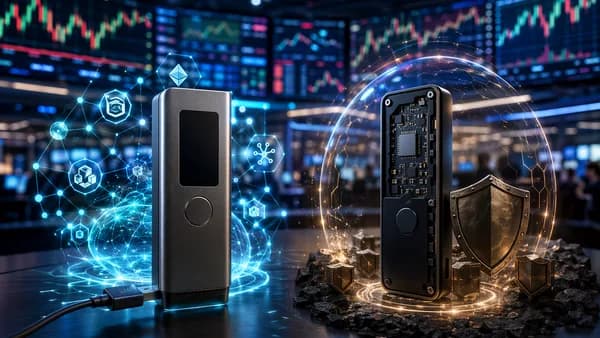
Choosing between a hardware wallet vs MPC wallet is not just a storage decision—it shapes how safely and efficiently crypto traders can move assets between exchanges, DeFi platforms, and long-term custody. Hardware wallets emphasize offline private-key protection, while MPC wallets use distributed cryptography to remove the need for a single complete private key or seed phrase.
For active traders, the safer option depends on the threat model: phishing, malware, physical theft, recovery failure, team approvals, DeFi access, or frequent signing. The research shows that neither wallet type is universally “safer” in every scenario; each protects against different risks and introduces different operational trade-offs.
1. How Hardware Wallets and MPC Wallets Work
At a high level, both wallet types are designed to protect crypto assets by controlling how transactions are signed. The difference is where the signing authority lives.
A hardware wallet stores private keys inside a dedicated physical device. An MPC wallet splits signing authority into multiple cryptographic key shares distributed across devices, servers, or parties.
| Category | Hardware Wallet | MPC Wallet |
|---|---|---|
| Core model | Offline private-key storage | Distributed key-share signing |
| Signing method | User approves on physical device | Threshold of key shares collaborate |
| Private key location | Complete key derived from seed and stored in device | Full private key is not stored in one place |
| Typical users | Long-term holders, individual self-custody users | Active traders, teams, institutions, mobile-first users |
| Main security idea | Keep private keys offline | Eliminate single points of failure |
How hardware wallets work
Hardware wallets are often described as “cold storage” because private keys are kept offline inside a physical device. According to the source data, when a user sets up a hardware wallet, the device typically generates a recovery seed phrase—often 24 words—which can derive the wallet’s private keys.
When signing a transaction:
- The user connects or activates the hardware wallet.
- The transaction details are sent to the device.
- The user verifies and approves the transaction on-device.
- The signed transaction is broadcast to the blockchain.
- The private key never leaves the device.
This design is why hardware wallets are commonly favored for long-term holdings. Sources describe them as strong protection against malware and online hacks because the private keys are isolated from internet-connected devices.
Examples mentioned in the source data include Ledger Nano X, Ledger Nano S Plus, Trezor Model T, Trezor Model One, SafePal, Keystone, GridPlus Lattice1, BitBox02, and Coldcard.
How MPC wallets work
MPC wallets, short for Multi-Party Computation wallets, use cryptography to split signing authority into multiple key shares. The full private key is not stored in one location and, in many implementations, is never reconstructed even during signing.
A typical MPC process includes:
- Key generation: Key shares are created across multiple parties or devices.
- Distributed storage: Each party holds only a fragment of the signing authority.
- Threshold signing: A required number of shares must participate, such as a 2-of-3 arrangement.
- Collaborative signing: The shares jointly produce a valid blockchain signature without exposing the complete key.
The central security difference is simple: hardware wallets protect a complete private key inside a device; MPC wallets try to avoid having a complete private key in one place at all.
Examples mentioned in the research include Zengo, Fireblocks, Coinbase Wallet MPC, Safeheron, Web3Auth, Lit Protocol, and Qredo.
2. Private Keys, Seed Phrases, and Recovery Differences
The biggest practical difference in a hardware wallet vs MPC wallet comparison is recovery. Hardware wallets usually rely on seed phrases. MPC wallets usually rely on key shares, biometric recovery, social recovery, encrypted backups, or other multi-factor recovery designs depending on implementation.
| Recovery Factor | Hardware Wallet | MPC Wallet |
|---|---|---|
| Seed phrase | Yes, commonly 24 words | No seed phrase in many implementations |
| Recovery method | Restore wallet using seed phrase | Recover using remaining shares, biometric methods, encrypted backups, or multi-party recovery |
| Main risk | Seed phrase theft or loss | Weak share distribution, infrastructure dependence, or account recovery failure |
| Inheritance complexity | Requires safe seed access planning | Can support more flexible recovery, depending on provider |
Hardware wallets and the seed phrase problem
Hardware wallets are secure partly because the signing key remains offline. But the source data highlights a critical issue: the recovery phrase is effectively the wallet.
If someone obtains the recovery phrase, they may be able to:
- Recreate the wallet on another device.
- Access assets across supported blockchains.
- Drain funds without possessing the original hardware wallet.
This creates several operational problems:
- Storage Risk: Paper can burn, and metal backups can be discovered.
- Phishing Risk: Users may be tricked into entering seed phrases into fake websites or support chats.
- Inheritance Risk: Loved ones may need access later, but exposing the phrase too early creates theft risk.
- Loss Risk: If the device is lost or damaged and the seed phrase is unavailable, funds may become inaccessible.
MPC wallets and seedless recovery
MPC wallets often remove the traditional seed phrase from the user experience. For example, the research describes Zengo as using a 3-factor authentication model involving the user’s device, Zengo’s servers, and an encrypted backup. It also notes biometric recovery as a usability advantage.
This is not the same as saying every MPC wallet is risk-free. Sources also state that MPC wallets rely on complex infrastructure. If key shares are poorly distributed or recovery processes are misconfigured, vulnerabilities may be introduced.
Seedless does not automatically mean riskless. It means the risk moves away from one recovery phrase and toward the design, distribution, and governance of key shares.
3. Security Strengths and Weaknesses of Each Wallet Type
The safest wallet depends on what kind of attack you are trying to prevent. Hardware wallets are strongest when the priority is offline private-key isolation. MPC wallets are strongest when the priority is eliminating single points of failure and enabling distributed approval.
| Security Aspect | Hardware Wallet | MPC Wallet |
|---|---|---|
| Malware resistance | Excellent because keys remain offline | Good, depending on implementation |
| Phishing resistance | Moderate; seed phrase can still be phished | Strong where no seed phrase exists |
| Physical theft risk | Device protected by PIN/passphrase, but physical theft remains relevant | No single device contains the full key |
| Supply chain risk | Moderate; sources mention fake or tampered devices | Lower physical-device risk, but software/provider trust matters |
| Smart contract risk | Not eliminated | Not eliminated |
| Single point of failure | Seed phrase can be a single point of failure | Designed to avoid single point of failure |
| Trust model | Trust device manufacturer and secure setup | Trust threshold design, share holders, and infrastructure |
Hardware wallet strengths
Hardware wallets offer strong protection against online attacks because private keys are not directly exposed to an internet-connected computer or phone. Sources list key security features such as:
- Cold Storage: Private keys are kept offline.
- PIN and Passphrase Protection: Physical access alone may not be enough.
- On-Device Verification: Users can confirm transaction details on the device.
- Host Malware Resistance: A compromised computer should not be able to extract the private key from the device.
- Secure Chips or Transparent Designs: Ledger uses a secure element approach, while Trezor is described as emphasizing open-source transparency.
For traders who hold a core long-term position and only occasionally move assets, this model remains highly relevant.
Hardware wallet weaknesses
The research identifies several hardware-wallet risks:
- Seed Phrase Exposure: If the recovery phrase is stolen, the device is no longer needed.
- Physical Attacks: Sophisticated attackers with specialized equipment have demonstrated extraction attacks against some devices.
- Supply Chain Tampering: Fake or tampered devices can enter the market.
- User Friction: Frequent signing requires connecting or using the device repeatedly.
- Closed vs Open Design Trade-Offs: Ledger is described as having a strong secure element and broad asset support but closed-source firmware. Trezor is described as open-source and community-auditable but without a dedicated secure element.
The source data also notes that Ledger devices support over 5,500 cryptocurrencies and integrate with Ledger Live, while also flagging concerns including closed-source firmware and a past customer-information breach.
MPC wallet strengths
MPC wallets are designed to avoid the single complete-key problem. Since key shares are distributed, an attacker generally needs to compromise enough shares to meet the signing threshold.
Sources describe MPC wallet strengths as:
- No Single Point of Failure: One stolen share is not enough.
- No Seed Phrase in Many Designs: Reduces seed-phrase phishing risk.
- Threshold-Based Signing: Examples include 2-of-3 setups.
- Flexible Recovery: Recovery can involve backup shares, biometrics, or social/multi-party methods.
- Programmability: Institutional platforms can support policy-driven approvals.
- Operational Scalability: Chainscore Labs states that platforms such as Fireblocks and Qredo use MPC for automated, policy-driven signing with sub-second latency, supporting thousands of transactions per second across hundreds of assets.
Fireblocks is also described in the source data as an institutional MPC provider with an MPC-CMP protocol and over $4 trillion in transactions.
MPC wallet weaknesses
MPC wallets are not automatically safer in every context. The source data highlights important considerations:
- Infrastructure Dependence: Some designs depend on provider servers or cloud/mobile infrastructure.
- Implementation Risk: Weak share distribution or improper setup can introduce vulnerabilities.
- Potential Delays: Reliance on multiple parties or devices can introduce delays, especially in high-latency networks.
- Trust Shift: Users may no longer trust a seed phrase, but they may need to trust threshold participants, servers, apps, or recovery systems.
- Provider Role: Coinbase Wallet MPC is described as using a 2-of-2 setup where one share lives on the user’s device and one on Coinbase’s servers, which changes the trust model.
In other words, MPC improves resilience against seed-phrase theft and single-device compromise, but the quality of the specific implementation matters.
4. Ease of Use for Active Crypto Traders
For active traders, convenience is not a minor feature. If a wallet is too cumbersome, traders may leave more assets on exchanges or in hot wallets, increasing other risks.
| Trader Need | Hardware Wallet Fit | MPC Wallet Fit |
|---|---|---|
| Frequent transactions | Less convenient; requires device interaction | Better suited to mobile/cloud workflows |
| Fast approvals | Manual and physical | Can support automated or policy-driven signing |
| Long-term storage | Strong fit | Possible, but depends on setup |
| Team approvals | Limited compared with MPC | Strong fit for multi-party workflows |
| DeFi operations | Supported by some devices, but less convenient | Often designed for DeFi/mobile integration |
Hardware wallet usability for traders
Hardware wallets require physical interaction. That is a security benefit, but it can slow down frequent trading.
For example, a trader may need to:
- Connect the device.
- Enter a PIN.
- Verify transaction details.
- Approve the transaction on-device.
- Repeat the process across multiple transactions.
Sources describe hardware wallets as less ideal for frequent transactions, even though modern devices have improved interfaces. Ledger and Trezor are described as offering user-friendly interfaces, and some high-end hardware wallets support smart contract and DeFi interactions.
Still, for rapid market activity, the physical approval process can become operational friction.
MPC wallet usability for traders
MPC wallets are generally better aligned with active trading workflows. The research describes them as suitable for cloud/mobile integration, multi-device security, and frequent operations.
For institutions and advanced users, MPC wallets can also support customizable approval processes. Safeheron, for example, is described as allowing users to customize complex approval workflows based on risk management strategies. It also combines MPC with TEE, or Trusted Execution Environment, to add hardware-level protection for key shards.
For traders, that means MPC can be more practical when assets need to move between DeFi platforms, exchanges, and operational wallets—provided the trader is comfortable with the provider’s recovery and trust model.
5. Exchange, DeFi, and Mobile App Compatibility
Compatibility matters because security that blocks necessary trading activity often gets bypassed. The research shows that hardware wallets and MPC wallets both support crypto operations, but they do so in different ways.
Hardware wallet compatibility
Hardware wallets are widely used for asset storage and can support broad crypto portfolios. The source data states that Ledger supports over 5,500 cryptocurrencies and integrates with Ledger Live.
Sources also note that some hardware wallets support smart contract operations, lending, token swapping, and DeFi platform interaction. However, the same sources consistently describe hardware wallets as relatively inconvenient for frequent trading.
Best compatibility profile for hardware wallets:
- Long-Term Holdings: Strong fit for assets that do not move often.
- Broad Asset Storage: Ledger is specifically cited for broad asset support.
- DeFi Access: Possible on some devices, but less streamlined.
- Mobile Integration: Ledger is described as offering mobile app integration, but physical approval remains part of the model.
MPC wallet compatibility
MPC wallets are often software-based, mobile-first, or infrastructure-driven. This makes them attractive for traders who need practical access.
The sources describe MPC wallets as supporting:
- Cloud/Mobile Integration: Easier setup and mobile workflows.
- DeFi Integration: Useful for active DeFi operations.
- Policy-Driven Transactions: Important for teams and institutions.
- APIs: Chainscore Labs notes that MPC custody can be integrated directly into application logic via APIs.
- High-Frequency Operations: Fireblocks and Qredo are described as supporting sub-second signing latency and thousands of TPS across hundreds of assets.
Safeheron is described as supporting Bitcoin, Ethereum, and ERC-20 tokens, with flexible transaction policies and full-chain risk management for institutional users and high-net-worth individuals.
For traders, compatibility is not just “which chains are supported?” It is also “how quickly and safely can I sign the transactions my strategy requires?”
6. Recovery, Inheritance, and Account Lockout Risks
Recovery is where wallet security becomes personal. A wallet can be technically secure and still fail if the owner loses access.
| Risk Scenario | Hardware Wallet | MPC Wallet |
|---|---|---|
| Lost device | Recover with seed phrase | Recover using remaining shares or provider-supported recovery |
| Lost seed phrase | Serious risk if device is also lost/damaged | No traditional seed phrase in many implementations |
| Inheritance planning | Requires careful seed access planning | Potentially more flexible, depending on recovery design |
| Account lockout | Can happen if device and seed are unavailable | Can happen if recovery factors or key shares are unavailable |
| Social engineering | Seed phrase scams are a major risk | Recovery workflows can still be targeted |
Hardware wallet recovery risks
Hardware wallets usually recover through the seed phrase. This is simple in theory but difficult in practice.
The user must keep the recovery phrase:
- Hidden from attackers.
- Protected from fire, water, and accidental destruction.
- Accessible enough for emergencies.
- Structured enough for inheritance without exposing funds prematurely.
This makes inheritance planning challenging. If heirs cannot find or use the seed phrase, assets may be permanently inaccessible. If too many people know where it is, theft risk increases.
MPC wallet recovery risks
MPC wallets can offer more flexible recovery. The source data mentions biometric recovery, backup shares, social recovery-style models, and multi-party recovery options.
However, flexibility introduces design questions:
- Who holds the key shares?
- What happens if a provider server is unavailable?
- Can a lost phone be replaced safely?
- What authentication factors are required?
- Can a malicious party trick the user during recovery?
For example, Zengo is described as using a 3-factor authentication model with the user device, Zengo servers, and an encrypted backup. That removes the burden of storing a seed phrase, but it also means the recovery model depends on those factors working as intended.
7. Cost Comparison: Devices, Subscriptions, and Fees
The cost side of a hardware wallet vs MPC wallet decision is relatively clear in the sources: hardware wallets usually involve a one-time device purchase, while many MPC options—especially institutional ones—use subscription or service-based models.
| Cost Factor | Hardware Wallet | MPC Wallet |
|---|---|---|
| Upfront cost | $50 to $200 typical device purchase | Consumer apps may be free; institutional tools often subscription-based |
| Ongoing subscription | Not emphasized in sources for basic use | Common for institutional solutions |
| Setup access | Requires physical delivery | Can often be set up through apps |
| Enterprise cost | Device model may not fit complex operations | Institutional pricing can be higher |
| Scalability | Individual-device model | Can scale better for teams and institutions |
Hardware wallet costs
The source data states that hardware wallets typically cost $50 to $200 as a one-time purchase. This makes them accessible for many individual traders and long-term holders.
The main non-price costs are operational:
- Device Management: Users must store and protect the device.
- Backup Storage: Seed phrase storage may require additional planning.
- Transaction Friction: Frequent trading takes more time.
- Replacement Risk: Lost or damaged devices require recovery via seed phrase.
MPC wallet costs
MPC wallet pricing varies by market segment. Sources state that consumer-grade wallets such as Zengo can be free to use with optional premium features, while institutional platforms such as Fireblocks often use subscription models.
The research does not provide specific subscription pricing for Fireblocks, Safeheron, Qredo, or other institutional MPC platforms, so traders should evaluate current vendor terms at the time of writing.
MPC can become more cost-effective for high-net-worth individuals or institutions when operational scalability matters. For example, policy-driven signing, multi-user approvals, and API integrations may reduce manual overhead for teams.
8. Best Use Cases for Hardware Wallets vs MPC Wallets
The best choice depends on whether the priority is cold storage, active trading, team operations, recovery flexibility, or DeFi access.
Best use cases for hardware wallets
A hardware wallet is often the better fit when offline self-custody is the main priority.
Long-Term Holding
- Why It Fits: Private keys stay offline.
- Source-Based Rationale: Hardware wallets are repeatedly described as ideal for cold storage and long-term holdings.
Individual Self-Custody
- Why It Fits: Users do not need a provider to participate in signing.
- Trade-Off: The user must manage the seed phrase securely.
Large Personal Holdings
- Why It Fits: Hardware wallets reduce internet-based attack exposure.
- Trade-Off: Inheritance and recovery planning become critical.
Security-Conscious Retail Investors
- Why It Fits: Devices such as Ledger and Trezor are described as established options with strong security models.
- Trade-Off: Device authenticity, firmware trust, and physical handling matter.
Best use cases for MPC wallets
An MPC wallet is often the better fit when flexibility, recovery, and operational access matter.
Active Crypto Trading
- Why It Fits: MPC wallets can support smoother mobile/cloud workflows.
- Source-Based Rationale: Sources describe hardware wallets as cumbersome for frequent transactions and MPC wallets as better for seamless operations.
DeFi Operations
- Why It Fits: MPC wallets can integrate with DeFi platforms and application logic.
- Trade-Off: Smart contract risks are not eliminated by MPC.
Team Treasury Management
- Why It Fits: Threshold signing and approval policies support multi-party control.
- Source-Based Rationale: Safeheron is described as suitable for enterprise-level users, financial institutions, and complex approval workflows.
Institutional Custody
- Why It Fits: MPC supports policy-driven signing, scalability, and API-based integration.
- Source-Based Rationale: Fireblocks and Qredo are cited for sub-second latency, thousands of TPS, and support across hundreds of assets.
Seedless Mobile Recovery
- Why It Fits: Some MPC wallets remove traditional seed phrases.
- Trade-Off: Users must understand the provider’s recovery architecture.
When using both makes sense
Several sources suggest that combining approaches may offer the best balance. A trader might use a hardware wallet for long-term holdings and an MPC wallet for active trading or team-based treasury operations.
| Portfolio Need | Suggested Wallet Type |
|---|---|
| Long-term cold storage | Hardware wallet |
| Daily trading | MPC wallet |
| Team approvals | MPC wallet |
| Personal offline custody | Hardware wallet |
| Mobile-first recovery | MPC wallet |
| DeFi-heavy workflow | MPC wallet, depending on platform support |
| High-value holdings with infrequent movement | Hardware wallet or hybrid approach |
The practical answer is not always “hardware or MPC.” For many traders, it is “hardware for reserves, MPC for operations.”
Bottom Line
The hardware wallet vs MPC wallet decision comes down to trade-offs. Hardware wallets offer strong offline protection and are well suited to long-term self-custody, but they rely heavily on seed phrase security and can be inconvenient for frequent trading.
MPC wallets remove the single seed-phrase failure point in many implementations and are often better suited to active traders, DeFi users, teams, and institutions. But they shift trust toward software infrastructure, threshold design, provider availability, and recovery workflows.
For most crypto traders, the safest setup may be a layered one: keep long-term reserves in a hardware wallet and use an MPC wallet for active trading, DeFi access, or team-based operations. The right answer depends on how often assets move, who needs approval authority, and which failure risk is more dangerous for your situation.
FAQ: Hardware Wallet vs MPC Wallet
Is an MPC wallet safer than a hardware wallet?
An MPC wallet can be safer against seed phrase theft and single-device compromise because no complete private key is stored in one place in many implementations. However, hardware wallets can be safer for offline long-term storage because private keys remain isolated from internet-connected systems.
The safer choice depends on the threat model: MPC is stronger for distributed control and recovery flexibility, while hardware wallets are stronger for cold storage and personal offline custody.
Do hardware wallets always use seed phrases?
The source data describes hardware wallets as typically generating a recovery seed phrase, often 24 words. That phrase can restore the wallet if the device is lost or damaged.
This recovery phrase is also a major risk. If someone steals it, they may be able to access the wallet without the physical device.
Do MPC wallets have seed phrases?
Many MPC wallets do not use a traditional seed phrase. Instead, they split signing authority into key shares and use recovery methods such as encrypted backups, biometrics, or multi-party recovery depending on the provider.
That said, users still need to understand the recovery model. Seedless recovery shifts risk away from seed storage and toward share management and infrastructure design.
Which wallet is better for active crypto traders?
Based on the source data, MPC wallets are generally better suited to active traders because they support smoother mobile/cloud workflows, multi-device signing, DeFi integration, and policy-driven approvals. Hardware wallets can still be used for trading, but they are less convenient because users must physically approve transactions.
A common strategy is to use an MPC wallet for active trading and a hardware wallet for long-term storage.
How much do hardware wallets and MPC wallets cost?
The source data states that hardware wallets typically cost $50 to $200 as a one-time purchase. MPC wallet costs vary: consumer-grade wallets such as Zengo may be free with optional premium features, while institutional MPC platforms such as Fireblocks often use subscription models.
Specific institutional pricing was not provided in the research data.
Can hardware wallets and MPC wallets both be used with DeFi?
Yes, but with different levels of convenience. Some hardware wallets support smart contract interaction, lending, token swapping, and DeFi access, though frequent transactions can be cumbersome.
MPC wallets are often more convenient for DeFi and active workflows, especially where mobile access, API integration, or policy-based approvals are required. Neither wallet type eliminates smart contract risk.