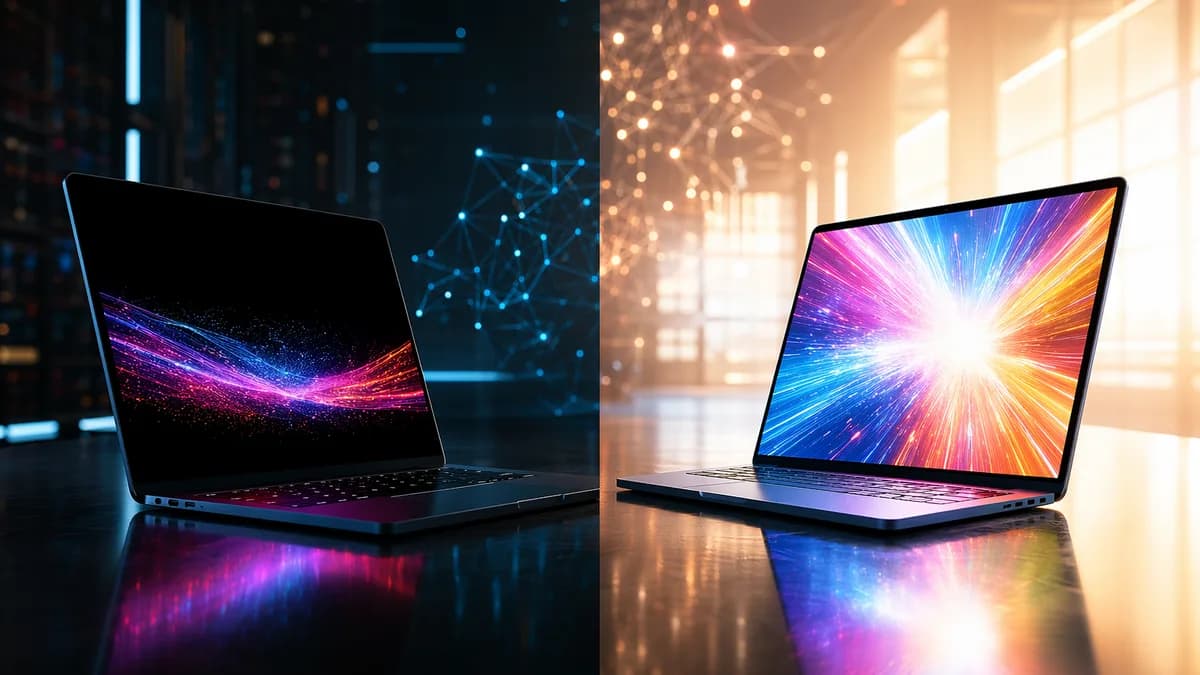
If you’re comparing OLED vs Mini LED laptops, the real choice is not “which display is newer?” but “which display fits how you actually use a laptop?” OLED excels at perfect blacks, precise contrast, and fast motion. Mini-LED excels at high brightness, HDR headroom, static desktop work, and lower burn-in stress.
At the time of writing, both technologies are premium options found in high-end ultrabooks, creator laptops, gaming laptops, and the MacBook Pro line. The best pick depends on whether your daily use is mostly documents and dashboards, games, creative work, movies, travel, or bright-room productivity.
1. OLED and Mini-LED Laptop Displays Explained
OLED and Mini-LED are both premium laptop display technologies, but they create images in very different ways.
An OLED laptop display is self-emissive. Each pixel produces its own light and can turn off completely when displaying black. That is why OLED can show true black rather than dark gray, with extremely precise contrast around small highlights.
A Mini-LED laptop display is still an LCD panel, but with a more advanced backlight. Instead of one large backlight, it uses many tiny LEDs grouped into local-dimming zones. Those zones can brighten or dim independently, which gives Mini-LED much better contrast and HDR brightness than a traditional LCD.
| Buying Question | OLED Laptop Display | Mini-LED Laptop Display |
|---|---|---|
| Core technology | Self-emissive pixels; each pixel can turn off | LCD panel with many small LED backlight zones |
| Best visual trait | Perfect blacks and very precise contrast | Higher sustained brightness and punchy HDR |
| Common weakness | Burn-in risk and bright full-screen power draw | Blooming or haloing around bright objects |
| Text and desktop use | Can be excellent, but subpixel layout and PWM vary by panel | Familiar LCD text rendering; less burn-in concern |
| Bright-room work | Good on modern bright panels, but reflections matter | Usually stronger when brightness is the priority |
| Dark-room movies | Excellent black level and no backlight glow | Very good on high-zone panels, but not pixel-perfect |
| Gaming feel | Very fast pixel response | Depends on LCD response and dimming algorithm |
| Safer all-day office pick | Best if you manage brightness and static UI | Usually yes |
Key takeaway: OLED controls light per pixel. Mini-LED controls light by zones. That single difference explains most of the real-world trade-offs.
Two current product examples show the split clearly.
The ASUS Zenbook S14 UX5406 is a modern OLED ultraportable example. ASUS lists it as a 0.47-inch, 2.65-pound Copilot+ PC with a 3K 120Hz ASUS Lumina OLED display, 77Wh battery, and Intel Core Ultra Series 3 options. ASUS also describes up to 1100 nits peak brightness, while store listings for UX5406 configurations show a 14-inch 2880 x 1800 OLED touchscreen, 120Hz refresh rate, 500-nit display spec, and 1TB SSD. At the time of writing, official-store pricing is around $1,499.99 for well-equipped 1TB configurations when available.
The Apple 14-inch MacBook Pro with M5 is a mainstream Mini-LED-class comparison point. Apple describes its Liquid Retina XDR display as delivering 1600 nits peak HDR brightness and a 1,000,000:1 contrast ratio. The 14-inch buying page confirms M5 configurations, and Apple notes the display measures 14.2 inches diagonally as a standard rectangle. The 14-inch line has historically started at $1,599 in the U.S.
2. Brightness, Contrast, and HDR Performance
Brightness and contrast are where the OLED vs Mini LED laptops decision becomes most obvious.
OLED: Best for black level and contrast precision
OLED’s biggest advantage is black level. Because each pixel can turn off, black areas are genuinely black. There is no backlight glow, no gray haze, and no halo around tiny bright details.
That matters for:
- Movies: Dark scenes look cleaner and more cinematic.
- Games: Night scenes, space scenes, and horror games show true darkness.
- Photo editing: Deep shadows are easier to judge in controlled lighting.
- Dark creative apps: Black UI themes look especially clean.
OLED also keeps contrast consistent from off-axis angles, which can help when sharing the screen or working with visual content.
Mini-LED: Best for brightness and HDR headroom
Mini-LED’s advantage is brightness. Source data consistently describes Mini-LED laptops as better for bright rooms and HDR highlights. Mini-LED laptops can exceed 1000 nits under HDR conditions, while one source describes typical OLED laptop brightness around 400–600 nits.
The ASUS gaming data gives concrete Mini-LED examples:
| Laptop | Display Type | Display Specs Mentioned |
|---|---|---|
| ROG Strix SCAR 16 G635 | Mini-LED | 16-inch Mini-LED, 240Hz, 2.5K, over 2000 dimming zones, 1200 nits brightness |
| ROG Strix SCAR 18 G835 | Mini-LED | 18-inch Mini-LED, 240Hz, 2.5K, over 2000 dimming zones, 100% DCI-P3, reflection-reducing coating described as reducing reflections by 55% |
| Apple 14-inch MacBook Pro with M5 | Mini-LED-class Liquid Retina XDR | 1600 nits peak HDR brightness, 1,000,000:1 contrast ratio |
Mini-LED is especially useful if you work near windows, in bright offices, in lecture halls, or in shared spaces where you cannot control lighting.
The catch: blooming vs brightness limiting
Neither technology is perfect.
OLED can advertise high peak brightness for small highlights, but it may reduce brightness when a large portion of the screen is white. That behavior matters if your workday is mostly spreadsheets, documents, web apps, and white backgrounds.
Mini-LED can get brighter, but it can show blooming. Blooming is a faint halo around bright objects on dark backgrounds, such as subtitles, cursors, stars, or white text on black.
Practical rule: Buy OLED if black-level precision is the priority. Buy Mini-LED if high brightness and HDR impact in real-world lighting matter more.
3. Color Accuracy for Creators
For creative work, both OLED and Mini-LED can be excellent, but the better choice depends on your output.
OLED’s per-pixel lighting gives it an advantage in shadow detail, contrast evaluation, and viewing-angle consistency. If you edit photos with deep shadows, grade video in a dark room, or review cinematic content, OLED can feel more trustworthy because it is not fighting a backlight.
Mini-LED can be more practical for HDR video work because sustained brightness matters when evaluating highlights, outdoor footage, and large bright scenes. A strong Mini-LED panel can also deliver wide color coverage and intense HDR luminance.
| Creative Task | Better Fit | Why |
|---|---|---|
| Photo editing in controlled lighting | OLED | Perfect blacks, precise contrast, strong viewing angles |
| Dark video review | OLED | No blooming around small highlights |
| HDR video editing | Mini-LED | Higher brightness and stronger HDR headroom |
| Bright studio or office work | Mini-LED | Better visibility in high ambient light |
| Color-critical print work | Depends on specs | Look for color-gamut coverage and calibration, not just panel type |
The source data also emphasizes that creators should not rely on the OLED or Mini-LED badge alone. Important specs include:
- sRGB coverage: For web and general content, 100% sRGB is the everyday accuracy target.
- DCI-P3 coverage: For cinema, HDR, and video work, sources recommend at least 90% DCI-P3.
- Adobe RGB: Used for professional print work, though most laptop screens do not fully cover it.
- Factory calibration: Important for professional accuracy.
- Panel uniformity: Relevant for editing large flat tones and gradients.
- HDR behavior: Peak brightness is not the same as sustained brightness or accurate tone mapping.
Specific examples from the source data include the ROG Strix SCAR 18 G835, which is listed with 100% DCI-P3, and the ROG Zephyrus G16 GU605CW-QR133WS, which uses a 16-inch 2.5K OLED, 240Hz display.
4. Battery Life Differences
Battery life is not determined by display technology alone. The processor, battery size, panel controller, refresh rate, brightness setting, and power profile can matter as much as the panel label.
Still, OLED and Mini-LED draw power differently.
OLED battery behavior
OLED power use changes with the image. Dark content can be efficient because black pixels are off. That makes OLED attractive for dark-mode apps, movie watching, and games with darker scenes.
But bright white content is harder on OLED. Full-screen documents, spreadsheets, websites, and white backgrounds can increase power draw. OLED laptops may also reduce brightness when large bright areas fill the display.
Mini-LED battery behavior
Mini-LED uses a backlight, so it still consumes power to illuminate the display. Local dimming can reduce power in darker areas, but Mini-LED is often more consistent across mixed productivity workloads.
This makes Mini-LED attractive for people who spend hours in:
- Documents
- Spreadsheets
- Browsers
- Code editors
- Dashboards
- Presentation tools
The source data gives two useful product anchors. The ASUS Zenbook S14 UX5406 pairs an OLED display with a 77Wh battery in a very thin chassis. The Apple 14-inch MacBook Pro with M5 pairs a bright Liquid Retina XDR display with Apple silicon and an official claim of up to 24 hours of battery life.
| Usage Pattern | OLED Battery Tendency | Mini-LED Battery Tendency |
|---|---|---|
| Dark-mode writing or coding | Can be efficient | Still uses backlight, but local dimming helps |
| Movies with dark scenes | Often favorable | Good, but backlight remains active |
| White documents and web apps | Can draw more power | Often more consistent |
| High brightness outdoors | May be less ideal | Usually stronger |
| Gaming | Depends heavily on GPU, refresh rate, and brightness | Depends heavily on GPU, refresh rate, and brightness |
Battery advice: Do not buy only by panel type. Check battery capacity, processor class, refresh-rate controls, and your typical brightness setting.
5. Burn-In Risk and Long-Term Durability
Burn-in is one of the most important differences in OLED vs Mini LED laptops.
OLED burn-in risk
OLED uses organic pixels that can degrade unevenly over time. If static elements stay on screen for long periods, they can leave faint permanent image retention. Common examples include:
- Taskbars and docks
- Browser headers
- Spreadsheet grids
- Code editor sidebars
- Game HUDs
- Static dashboard widgets
Modern OLED laptops use protection systems such as pixel shifting, compensation cycles, screen savers, automatic brightness behavior, and other mitigation tools. These reduce risk, but they do not eliminate it.
Source guidance for OLED burn-in prevention includes:
- Screensaver: Use a screensaver or automatic sleep mode.
- Brightness: Avoid keeping brightness at maximum constantly.
- Pixel tools: Enable built-in pixel refresh or pixel-shift features where available.
- UI variation: Avoid leaving the same static layout on screen for hours every day.
Mini-LED durability advantage
Mini-LED avoids the classic OLED burn-in issue because it is LCD-based. Static UI does not wear organic subpixels unevenly in the same way.
That makes Mini-LED a safer fit for users who keep the same windows open all day, including:
- Programmers
- Finance users
- Students
- Spreadsheet-heavy workers
- Dashboard and analytics users
- Architects or professional users with static toolbars
Mini-LED is not flawless. It can show blooming, backlight variation, or other LCD-related issues. But those are different from permanent OLED image retention.
One ASUS source states that Mini-LED screens work for about 100,000 hours, while OLED lasts around 30,000–50,000 hours. Treat those as general technology-lifespan figures rather than a guarantee for every laptop model, because real-world longevity depends on brightness, usage, thermal design, and manufacturer implementation.
6. Gaming Performance and Response Times
For gaming, both OLED and Mini-LED can be excellent. The difference is what kind of gaming experience you value most.
OLED gaming strengths
OLED has the response-time advantage. OLED pixels change state extremely quickly, which helps motion look clearer in fast games, animation timelines, and rapid scrolling.
Gaming-focused source data describes OLED pixel response as almost instantaneous, with typical response times around 0.1–0.2 ms. This helps reduce ghosting and motion blur, especially in fast-paced games.
OLED is especially strong for:
- Competitive shooters
- Fast action games
- Dark atmospheric games
- Horror games
- Cinematic single-player games
- Games with deep black scenes
The ASUS gaming examples include:
| Laptop | Display Type | Display Specs Mentioned |
|---|---|---|
| ROG Zephyrus G16 GU605CW-QR133WS | OLED | 16-inch 2.5K OLED, 240Hz, Intel Core Ultra 9 285H, NVIDIA GeForce RTX 5080, 32GB LPDDR5X, 2TB PCIe 4.0 SSD |
| ROG Zephyrus G14 GA403UM-QS007WS | OLED | 14-inch 3K OLED, 120Hz, AMD Ryzen 9 270 Processor, NVIDIA GeForce RTX 5060, 16GB LPDDR5X, 1TB PCIe 4.0 NVMe M.2 |
Mini-LED gaming strengths
Mini-LED gaming laptops can deliver high brightness, strong HDR highlights, and high refresh rates. The ROG Strix SCAR Mini-LED examples list 240Hz displays, 2.5K resolution, and over 2000 dimming zones.
Mini-LED is especially strong for:
- HDR gaming
- Bright-room gaming
- Games with bright outdoor scenes
- Long gaming sessions with static HUDs
- Users concerned about OLED burn-in
The trade-off is motion. Mini-LED panels are still LCD-based, so pixel response depends on the panel. Source data describes high-end Mini-LED LCD response as often in the 3 ms to 8 ms range, while noting that modern high-refresh Mini-LED panels can still feel very smooth.
| Gaming Priority | Better Fit | Reason |
|---|---|---|
| Fastest pixel response | OLED | Near-instant pixel transitions |
| Lowest motion blur | OLED | Strong advantage in fast movement |
| Bright HDR impact | Mini-LED | Higher peak brightness and HDR highlights |
| Static HUD durability | Mini-LED | No OLED burn-in concern |
| Dark-room immersion | OLED | Perfect blacks and no blooming |
| Gaming near windows | Mini-LED | Better high-brightness visibility |
Gaming verdict: OLED is the motion-clarity winner. Mini-LED is the HDR-brightness and long-session durability winner.
7. Eye Comfort and PWM Flicker Considerations
Eye comfort is more personal than brightness or contrast. Two people can react differently to the same panel.
The source data highlights three important variables: text rendering, PWM flicker, and ambient lighting.
Text clarity
OLED laptop displays can look very sharp, especially at high pixel density. However, text rendering can depend on subpixel layout, operating-system font rendering, resolution, scaling, and panel coating. Some users notice color fringing around fine text on certain OLED panels; others never notice it.
Mini-LED often feels more familiar for office text because it is LCD-based. For all-day reading, spreadsheets, coding, and browser work, Mini-LED may be the safer blind buy, especially with a matte or low-reflection finish.
PWM flicker
Some OLED and Mini-LED laptops use PWM, or pulse-width modulation, at certain brightness levels. PWM controls brightness by rapidly flickering the display. Some users do not notice it, while flicker-sensitive users may experience eye strain or headaches.
Because PWM behavior varies by specific laptop panel, the safest advice is to look for measured flicker behavior before buying if you know you are sensitive.
Brightness and room conditions
Mini-LED’s higher brightness can improve visibility in bright environments, which may reduce squinting or the need to lean toward the screen. OLED can be very comfortable in dark or controlled lighting, especially when using dark interfaces, but it may not be the best fit if reflections and bright backgrounds dominate your workday.
| Comfort Factor | OLED | Mini-LED |
|---|---|---|
| Dark-room comfort | Excellent black level; dark UIs look clean | Good, but blooming may appear in high-contrast scenes |
| Bright-room visibility | Depends on brightness and reflections | Usually stronger |
| Text rendering | Panel-dependent; subpixel layout matters | Familiar LCD-style rendering |
| PWM flicker | Can occur on some panels | Can also occur on some panels |
| All-day static work | Requires more care | Usually safer |
8. Which Display Is Better for Work, Gaming, and Media
For most buyers, the best answer is use-case based.
Best for productivity and office work: Mini-LED
Mini-LED is usually the better pick for productivity-heavy users. It avoids OLED burn-in concerns and handles static desktop elements better.
Choose Mini-LED if your day includes:
- Spreadsheets: Long sessions with static grids.
- Coding: Persistent sidebars, terminals, and fixed UI panes.
- Finance tools: Dashboards and tickers.
- Research: Many browser tabs and white pages.
- Office work: Documents, slides, email, and web apps.
- Bright locations: Offices, classrooms, hotels, or desks near windows.
OLED can still work well for productivity if you manage brightness and use screen protection features. But Mini-LED is the lower-stress option for all-day static interfaces.
Best for gaming: OLED for speed, Mini-LED for HDR brightness
OLED is better for fast motion and dark-room immersion. Mini-LED is better for high-brightness HDR and long gaming sessions with static HUDs.
If you play competitive games and value crisp motion, OLED has the edge. If you play HDR-rich games in bright rooms or worry about static health bars, maps, and HUDs, Mini-LED is easier to live with.
Best for movies and media: OLED in dark rooms, Mini-LED in bright rooms
OLED is the stronger cinematic display in controlled lighting. Perfect blacks, no blooming, and pixel-level contrast make dark scenes look cleaner.
Mini-LED is excellent for HDR movies in bright rooms because it can deliver intense highlights and higher brightness. However, subtitles or small highlights on black backgrounds can reveal blooming depending on the panel and dimming algorithm.
Best for creators: depends on output
OLED is compelling for photo editing, shadow work, and dark-room content review. Mini-LED is practical for HDR video workflows, bright studios, and users who need high luminance.
The key is to check actual color specs, calibration, brightness behavior, and HDR support rather than assuming every OLED or Mini-LED panel performs the same.
9. Final Recommendation by Buyer Type
Here is the clearest way to choose between OLED vs Mini LED laptops.
| Buyer Type | Recommended Display | Why |
|---|---|---|
| Movie lover | OLED | Perfect blacks, no blooming, cinematic contrast |
| Frequent traveler | Depends on workload | OLED can be efficient with dark content; Mini-LED is stronger in bright spaces |
| Office worker | Mini-LED | Better for static UI and bright-room visibility |
| Developer | Mini-LED | Less burn-in worry with fixed code editor layouts |
| Spreadsheet-heavy user | Mini-LED | Static grids and white backgrounds are less stressful |
| Photo editor | OLED | Strong shadow detail and contrast precision |
| HDR video editor | Mini-LED | Higher brightness and better HDR headroom |
| Competitive gamer | OLED | Faster response and clearer motion |
| HDR gaming fan | Mini-LED | Brighter highlights and less concern about HUD burn-in |
| Student | Mini-LED or IPS-level alternative | Long reading sessions and static documents favor LCD-based panels |
| Dark-mode enthusiast | OLED | Deep blacks and excellent contrast |
| Burn-in-anxious buyer | Mini-LED | No OLED-style permanent image retention concern |
Short recommendation: Buy OLED for black level, contrast precision, response time, and cinematic viewing. Buy Mini-LED for brightness, HDR headroom, static desktop work, and lower burn-in stress.
Bottom Line
The OLED vs Mini LED laptops decision comes down to lighting, workload, and risk tolerance.
OLED is the better choice if you want the cleanest blacks, the most precise contrast, very fast pixel response, and a premium movie or gaming experience in controlled lighting. It is especially compelling for media, dark-room creative work, and fast games.
Mini-LED is the better choice if you need high brightness, strong HDR impact, all-day productivity comfort, and less concern about static UI elements. It is often the safer choice for office work, coding, spreadsheets, HDR editing, and bright-room use.
Neither display type is automatically better for everyone. The smartest purchase is the one that matches your real daily screen time.
FAQ
Is OLED better than Mini-LED for laptops?
OLED is better for perfect blacks, contrast precision, viewing angles, and fast response times. Mini-LED is better for high brightness, HDR headroom, static desktop work, and lower burn-in concern. The better choice depends on whether your use is more cinematic and gaming-focused or productivity and brightness-focused.
Is Mini-LED safer than OLED for long work sessions?
Yes, for static desktop work, Mini-LED is generally safer. It is LCD-based and does not have OLED’s organic-pixel burn-in risk. That makes it a better fit for spreadsheets, coding, dashboards, and apps with persistent toolbars.
Do OLED laptops still have burn-in risk?
Yes. Modern OLED laptops use mitigation features such as pixel shifting, compensation cycles, screen savers, and brightness controls, but the risk is reduced rather than eliminated. If you leave the same taskbar, game HUD, or application layout on screen for hours every day, Mini-LED is the lower-risk option.
Which is better for gaming, OLED or Mini-LED?
OLED is better for motion clarity because its pixels switch extremely quickly. Mini-LED is better for bright HDR gaming and long sessions with static HUD elements. Competitive gamers may prefer OLED, while HDR-focused or burn-in-conscious gamers may prefer Mini-LED.
Which display is better for battery life?
It depends on content. OLED can be efficient with dark content because black pixels turn off, but it can use more power with bright white screens. Mini-LED can be more consistent for office work and web browsing, though it still powers a backlight. Processor, battery size, refresh rate, and brightness setting also matter.
Is OLED or Mini-LED better for eye comfort?
Neither is automatically better for every person. OLED can look excellent in dark environments, while Mini-LED can be easier to see in bright rooms. Some OLED and Mini-LED laptops use PWM flicker at certain brightness levels, so flicker-sensitive buyers should look for measured panel behavior before buying.