Choosing between a smartwatch vs fitness tracker is harder than it used to be because the categories now overlap. Many smartwatches track workouts, heart rate, sleep, and blood oxygen, while many fitness trackers can show phone notifications, support payments, and even run limited apps.
For most buyers, the right choice comes down to priorities: do you want a wrist-based extension of your phone, or a lighter, cheaper device focused on health and activity tracking? This guide compares both wearable types using the real features, pricing, battery-life examples, and trade-offs documented in the source research.
1. Smartwatch vs Fitness Tracker: Main Differences
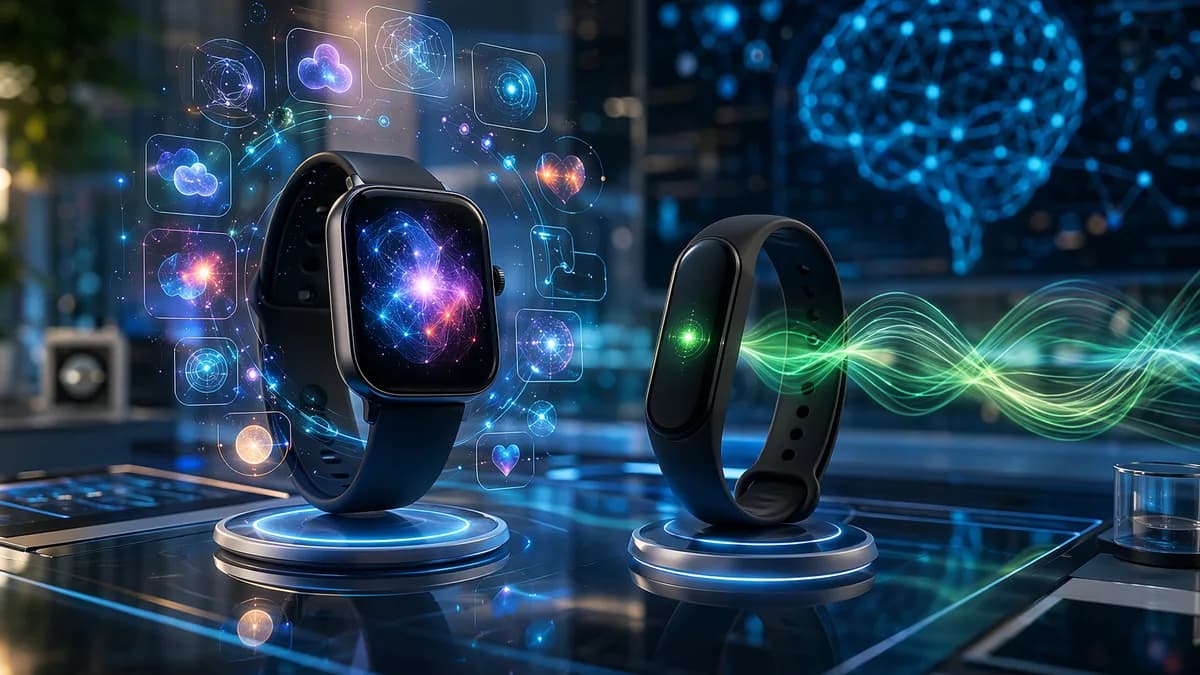
The clearest difference is purpose. A smartwatch is closer to a mini smartphone on your wrist, while a fitness tracker is more focused on activity, health, and wellness data.
Tom’s Guide describes smartwatches as more technology-packed, with communication apps and smart features. Examples mentioned include the Apple Watch 10 and Samsung Galaxy Watch 7, which can handle many tasks associated with a smartphone.
Fitness trackers, by contrast, are more dedicated to tracking workouts and well-being. They are usually smaller, lighter, and more affordable, although the line has become increasingly blurred.
| Category | Smartwatch | Fitness Tracker |
|---|---|---|
| Main purpose | Phone-like features plus health tracking | Fitness, health, sleep, and activity tracking |
| Typical strengths | Apps, calls, texts, LTE, music, NFC, safety features | Battery life, comfort, price, simple tracking |
| Typical design | Larger watch-style screen | Slimmer band-style body |
| Price pattern from sources | Often higher; Apple/Samsung commonly cited around $200-$400, Garmin models can exceed $600 | Often available under $100, with models like Fitbit Inspire 3 around that range |
| Best fit | People who want notifications, apps, calls, and autonomy from a phone | People who mainly want steps, workouts, sleep, heart rate, and lower cost |
The practical shortcut: buy a smartwatch if you want your wearable to reduce how often you pick up your phone. Buy a fitness tracker if you mainly want health data, workout tracking, and longer battery life.
How-To Geek summarizes the distinction well: almost every smartwatch is also a fitness tracker, but not every fitness tracker is a smartwatch. That is the core of the smartwatch vs fitness tracker decision.
2. Health and Fitness Tracking Features Compared
Both categories can track health and exercise, but they often approach the job differently.
Core tracking features are common on both
According to the source data, most modern wrist wearables include sensors for common health and activity metrics. Tom’s Guide notes that pulse, blood oxygen saturation, active minutes, distance, and related fitness tracking tools are standard in many current devices.
TechRadar says any worthwhile fitness tracker should track:
- Heart Rate: Continuous or periodic heart-rate monitoring, depending on the brand and model.
- Steps: Daily step counting is standard across smartwatches and fitness trackers.
- Calories Burned: Estimated calorie tracking is common, though accuracy depends on sensors and algorithms.
- Sleep: Many trackers and watches offer sleep tracking, but comfort and battery life affect how practical it is.
- Blood Oxygen / Skin Temperature: TechRadar notes that even cheaper trackers have started adding features such as blood oxygen monitoring and skin temperature readings that were once found mainly on more expensive devices.
Fitness trackers are more focused
Fitness trackers are designed specifically around health and activity. How-To Geek describes them as focused devices whose main purpose is fitness tracking, from basic step counts to more advanced heart measurements and blood oxygen levels.
That focus can make them easier to use if you do not care about apps, LTE, or watch-based calling. For example, someone recovering from a sedentary lifestyle or injury may only need step counting, move reminders, calories, heart rate, stress estimates, and optional sleep tracking—the exact type of use case discussed in the Reddit source.
Smartwatches can match many tracking features, but add more
Smartwatches often include many of the same fitness features. The difference is that health tracking is part of a broader package that also includes apps, calls, messages, music, and safety tools.
Tom’s Guide notes that the workout-tracking comparison can be a tie, especially because fitness-focused brands such as Fitbit and Garmin now make smartwatch-like devices, while smartwatch brands have improved health tracking.
| Health/Fitness Need | Better Fit Based on Sources | Why |
|---|---|---|
| Basic steps, calories, heart rate | Fitness tracker or smartwatch | Both categories commonly support these |
| Simple activity nudges | Fitness tracker | Often cheaper and more focused |
| Advanced training plus some smart features | Hybrid or fitness-focused smartwatch | Examples include Garmin Forerunner 265 and Fitbit Charge 6 |
| Sleep and recovery | Fitness tracker | Smaller, lighter, and easier to wear in bed |
| Safety features like fall detection | Smartwatch | Flagship models are more likely to include emergency tools |
3. Battery Life and Charging Convenience
Battery life is one of the strongest reasons to choose a fitness tracker.
TechRadar gives a concrete example: the Apple Watch Series 7 may struggle to last two days without needing a charge, while the Huawei Band 7 can last an “incredible two weeks” and costs far less. Canyon’s comparison makes the same general point: fitness trackers can go for days without recharging, while smartwatches often need charging much more frequently because they do more.
| Battery Factor | Smartwatch | Fitness Tracker |
|---|---|---|
| Typical charging pattern in sources | Often daily or every couple of days | Often several days; one cited example reaches two weeks |
| Why battery drains faster | Larger screens, apps, calls, LTE, music, more processing | Simpler features and smaller displays |
| Sleep tracking convenience | Can be limited by charging needs | Easier to leave on overnight |
| Travel convenience | Less ideal if charging access is limited | Better for remote trips or low-maintenance use |
If sleep tracking matters, battery life is not just a convenience feature. A device that needs charging every night may be less useful for overnight recovery data.
TechRadar specifically recommends a fitness tracker for sleep tracking until smartwatch batteries last longer, unless the user is willing to manage charging carefully. Tom’s Guide also points to trackers and recovery-focused wearables as strong choices for sleep and recovery because they are smaller, lighter, and more comfortable in bed.
4. Notifications, Apps, and Smart Features
This is where smartwatches pull ahead.
A smartwatch is the better choice if you want calls, texts, apps, music, or cellular independence. Tom’s Guide says that while many fitness trackers can receive messages and call notifications, the best wrist-based calling and texting experience usually comes from a smartwatch.
Smartwatch features highlighted in the sources
Smartwatches may include:
- Calls and Texts: Receive and sometimes send messages, and accept or initiate calls.
- Third-Party Apps: How-To Geek lists apps as a defining smartwatch feature.
- Music Control and Streaming: TechRadar notes that smartwatch platforms can stream music, reducing the need to carry a phone on a run.
- NFC Payments: How-To Geek and Canyon both identify NFC/contactless payments as available smartwatch-style functionality.
- Cellular Connectivity: Tom’s Guide says cellular-capable smartwatches can offer more independence from a phone.
- GPS: Common in smartwatches and some advanced trackers.
- Safety Features: Tom’s Guide cites fall detection, emergency calling, a built-in siren on the Apple Watch Ultra line, and Loss of Pulse detection on the Google Pixel Watch 3.
Tom’s Guide also notes that most smartwatch data plans cost between $10 and $20 per month, depending on carrier and location. That is important for buyers considering LTE models because the purchase price is not the only cost.
Fitness trackers can still handle some smart features
Fitness trackers are not limited to step counts anymore. Tom’s Guide mentions the Fitbit Charge 6 as a crossover device with a decent-sized screen, onboard GPS, support for Google apps, and mobile payments.
Canyon also notes that modern fitness trackers may include:
- Notifications: Incoming calls and messages.
- NFC Payments: Contactless payments on some models.
- GPS Tracking: Available on more advanced trackers.
- Touchscreen Displays: Larger color screens compared with older bands.
Still, the source data consistently frames fitness trackers as less suitable for users who want a wide range of apps, web access, calling, texting, or cellular independence.
| Smart Feature | Smartwatch | Fitness Tracker |
|---|---|---|
| Rich notifications | Stronger | Basic to moderate, depending on model |
| Calls from wrist | Stronger | Usually limited or unavailable |
| Third-party apps | Stronger | Limited |
| Cellular/LTE | Common on many premium models | Not a typical strength |
| NFC payments | Common on many models | Available on some trackers |
| Music storage/streaming | Stronger | Available on some hybrid-style devices |
5. Comfort, Design, and Everyday Wearability
Comfort matters because a wearable only works if you actually wear it.
Fitness trackers are usually smaller and lighter. Tom’s Guide says they tend to be more discreet, and models like the Fitbit Inspire series can look more like bracelets than tech gadgets. TechRadar similarly describes classic trackers like the Fitbit Inspire 2 as thin, with slimline screens and minimal controls.
Smartwatches, meanwhile, often look more like traditional watches. TechRadar notes that they commonly come in rounded-square designs like the Apple Watch or circular designs from brands such as Samsung, Garmin, and Amazfit.
Everyday design trade-offs
| Design Priority | Better Fit | Source-Grounded Reason |
|---|---|---|
| Discreet look | Fitness tracker | Slimmer, bracelet-like designs |
| Larger screen | Smartwatch | Better for apps, messages, maps, and controls |
| Sleep comfort | Fitness tracker | Smaller and lighter for overnight wear |
| Fashion/watch styling | Smartwatch | More like analog watches; often treated as style accessories |
| Minimal distraction | Fitness tracker | Fewer apps and alerts |
| Phone-like convenience | Smartwatch | More screen space and interaction options |
Both categories often support swappable straps and customizable watch faces, according to TechRadar. So design is not only about the device category; it also depends on the model, strap, and display size.
A larger display is better for reading texts and using apps, but a smaller band is usually easier to forget about during sleep, workouts, and daily movement.
6. Accuracy for Steps, Heart Rate, Sleep, and Workouts
Accuracy is not just about the category; it also depends on the brand, sensor quality, algorithm, and how you wear the device.
The Reddit discussion provides useful practical detail: step counting algorithms can behave differently. According to one experienced commenter, Fitbit and Pixel devices may be better at not adding false steps during toothbrushing, but can have issues counting steps in a car. Garmin devices may barely count steps in the car, but brushing teeth with the watch-wearing wrist can cause false steps, and pushing strollers or lawnmowers can lead to lower counts because of fixed arm positioning.
The key advice from that discussion is to understand algorithm limitations and work from trends rather than treating every single number as perfect.
Step tracking
All major wearable categories can count steps. But source data warns that false positives and missed steps happen depending on motion patterns.
- Toothbrushing: Some devices may count wrist movement as steps.
- Driving: Some devices may add steps in a car.
- Pushing Objects: Strollers or lawnmowers can reduce counts on some devices because the wrist stays in a fixed position.
Heart-rate tracking
The Reddit source also distinguishes heart-rate sampling styles:
- Continuous HR: Brands mentioned as continuous include Garmin, Fitbit, and Pixel.
- Dynamic HR: Apple Watch and Huawei are described as dynamic, becoming periodic when inactive.
- Periodic HR: Amazfit is described as offering choices such as 1-minute or 10-minute frequency.
Increasing heart-rate frequency can affect battery life on brands that allow those settings, according to the same discussion.
Stress tracking
Stress tracking needs caution. The Reddit source explains that wearable stress estimates are usually based on the autonomic nervous system—the physical stress your body is under. Mental anxiety may affect those signals, but not always.
That means stress tracking can be “hit and miss” across watches and trackers. Baseline trends and deviations matter more than treating a single stress score as a diagnosis.
Sleep tracking
Tom’s Guide and TechRadar both favor fitness trackers for sleep because they are smaller, lighter, and have longer battery life. Smartwatches can track sleep, but shorter battery life may require charging before bed.
| Metric | What Sources Suggest |
|---|---|
| Steps | Common across both; algorithms vary by brand and activity |
| Heart rate | Common, but sampling frequency differs |
| Calories | Better brands may do better due to sensors and algorithms, but still estimates |
| Stress | Estimate only; may not reliably capture mental anxiety |
| Sleep | Trackers often more practical because of comfort and battery life |
| Workouts | Strong options exist in both categories |
7. Best Option for iPhone and Android Users
Phone compatibility can narrow your choice quickly.
The Reddit source makes one point very clearly: if you use Android, Apple Watch is not an option. For Android users, the discussion suggests considering other smartwatch and tracker ecosystems, including Wear OS, Fitbit, Huawei, Amazfit, Garmin, Coros, Polar, and Suunto.
Tom’s Guide also notes that some devices play well with both Android phones and iPhones. The Amazfit Active 2 and Fitbit options are described as working with both Android and iPhone.
For iPhone users
The source data mentions several Apple Watch models and features, including the Apple Watch 10, Apple Watch Ultra 2, and Apple Watch SE. Tom’s Guide says all of the best Apple Watch models support LTE connectivity, making them relevant for users who want calls, texting, and more independence from a phone.
However, if your priority is sleep, recovery, or budget, a tracker may still be the better fit. Tom’s Guide points to Fitbit, Whoop 4.0, and Oura Ring 4 as strong sleep/recovery-oriented options, though Oura is a smart ring rather than a wrist tracker.
For Android users
Android users have broader non-Apple options. Tom’s Guide specifically mentions the Samsung Galaxy Watch 7, Samsung Galaxy Watch 6, Samsung Galaxy Watch FE, and Google Pixel Watch 3 in smartwatch contexts.
The Google Pixel Watch 3 is also cited for Loss of Pulse detection, while Samsung and Google flagship watches are named among devices with safety features such as fall detection and emergency calling.
Cross-platform buyers
If you may switch phones later, consider a device that the sources say works with both ecosystems. Tom’s Guide identifies Amazfit Active 2 and Fitbit trackers as options that play nicely with both Android and iPhones.
| Phone Type | Source-Grounded Options to Consider |
|---|---|
| iPhone | Apple Watch models for strongest smartwatch integration; Fitbit or Amazfit if prioritizing tracker-style use |
| Android | Samsung Galaxy Watch, Google Pixel Watch, Garmin, Fitbit, Amazfit, and other non-Apple wearables |
| Unsure / may switch phones | Fitbit or Amazfit options mentioned as working with both Android and iPhone |
8. Which Wearable Offers Better Value?
Value depends on whether you will use the smart features enough to justify the price and charging trade-offs.
Fitness trackers usually win on upfront cost. TechRadar says they can be picked up for under $100 in the U.S., £80 in the UK, or AU$150 in Australia. Tom’s Guide recommends choosing a quality fitness tracker over a subpar smartwatch when your budget is around $100, citing the Fitbit Inspire 3 as strong value at about that price.
How-To Geek gives another example: the Fitbit Inspire 2 handles many basic fitness tracking tasks for $100, while the Fitbit Charge 5 adds GPS, blood oxygen, ECG, a color touchscreen, and more for an extra $30.
Smartwatches cost more but do more. Tom’s Guide says the Apple Watch SE starts at $249 and is often discounted by $50 to $100. It also cites the Samsung Galaxy Watch FE starting at $199. TechRadar lists the Samsung Galaxy Watch 5 around $279 in the U.S., £269 in the UK, and AU$499 in Australia.
How-To Geek frames Apple Watch and Samsung Galaxy Watch pricing as generally around $200 to $400, while some Garmin smartwatches can cost over $600.
| Budget / Value Scenario | Better Choice | Why |
|---|---|---|
| Around $100 | Fitness tracker | Sources recommend quality trackers over cheap smartwatches |
| Around $200-$400 | Smartwatch or advanced tracker | Many Apple/Samsung watches fall in this range; advanced trackers may also compete |
| Need LTE | Smartwatch | LTE support is common on many major smartwatch models |
| Want lowest maintenance | Fitness tracker | Longer battery and simpler use |
| Want best phone replacement features | Smartwatch | Apps, calls, texts, music, and cellular options |
The biggest value mistake is paying smartwatch prices for features you will not use—or buying a basic tracker when you actually need calls, apps, and safety features.
9. How to Choose Based on Your Lifestyle
The best wearable is the one that matches your daily routine, not the one with the longest feature list.
Choose a fitness tracker if you want simple health guidance
A fitness tracker is likely the better buy if your main goals are steps, movement reminders, calories, heart rate, sleep, and basic workout tracking.
This matches the Reddit user’s scenario: recovering from a sedentary lifestyle, needing step counts, sedentary reminders every 30-60 minutes, calories, heart rate, stress context, and optional sleep tracking. The discussion response said a fitness tracker would cover most of those needs.
Good source-mentioned examples in this lane include:
- Fitbit Inspire 3: Cited by Tom’s Guide as strong value at about $100.
- Fitbit Charge 6: A crossover tracker with onboard GPS, Google apps, and mobile payments.
- Xiaomi Smart Band 8/9: Mentioned in the Reddit discussion as budget-friendly picks.
- Garmin Vivosmart: Also recommended in the Reddit discussion for the stated basic tracking needs.
- Huawei Band 7: Cited by TechRadar as a lower-cost tracker with up to two weeks of battery life.
Choose a smartwatch if you want phone features on your wrist
A smartwatch makes more sense if you want calls, texts, apps, music, safety features, and possibly LTE. It is also better if you want a larger screen for interacting with notifications.
Source-mentioned smartwatch examples include:
- Apple Watch 10: Cited by Tom’s Guide as a technology-packed smartwatch.
- Samsung Galaxy Watch 7: Cited as a major Android smartwatch option.
- Google Pixel Watch 3: Noted for Loss of Pulse detection and safety-related features.
- Apple Watch Ultra 2: Mentioned for fall detection and a built-in siren.
- Garmin Forerunner 265: A crossover option with training, wellness, payments, offline music storage, notifications, and Android text replies.
Choose a hybrid-style device if you are stuck in the middle
Tom’s Guide highlights crossover devices for buyers who do not fit neatly into either category. The Fitbit Charge 6 is one example because it has tracker-style health features plus smartwatch-like tools. The Garmin Forerunner 265 is another example because it combines training and wellness features with payments, offline music storage, notifications, and Android text replies.
| Lifestyle | Best Fit |
|---|---|
| New to fitness | Fitness tracker |
| Training seriously | Fitness tracker, Garmin-style sports watch, or fitness-focused smartwatch |
| Wants fewer phone pickups | Smartwatch |
| Needs long sleep tracking | Fitness tracker |
| Wants emergency features | Smartwatch |
| Budget under $100 | Fitness tracker |
| Wants LTE/calls | Smartwatch |
| Wants discreet design | Fitness tracker |
Bottom Line
In the smartwatch vs fitness tracker comparison, fitness trackers generally offer better value, longer battery life, lighter designs, and simpler health tracking. They are especially strong for steps, sleep, basic workouts, movement reminders, and buyers around the $100 budget.
Smartwatches are better if you want a wearable that behaves more like a phone: calls, texts, apps, music, LTE, richer notifications, and safety features such as fall detection or emergency calling. They cost more and usually need more frequent charging, but they also do more.
If you are still unsure, look at crossover devices. Source-mentioned options like the Fitbit Charge 6 and Garmin Forerunner 265 show how blurred the categories have become, combining fitness-first tracking with selected smart features.
FAQ
Is a smartwatch better than a fitness tracker?
Not always. A smartwatch is better for calls, texts, apps, LTE, music, and safety features. A fitness tracker is often better for price, comfort, battery life, and straightforward health tracking.
Can a fitness tracker receive texts and notifications?
Yes, many fitness trackers can receive call and message notifications. However, Tom’s Guide says the best wrist-based calling and texting experience usually comes from a smartwatch.
Which is better for sleep tracking?
A fitness tracker is usually more practical for sleep tracking because it is smaller, lighter, and often lasts several days between charges. TechRadar specifically favors trackers for sleep until smartwatch battery life improves.
Are fitness trackers cheaper than smartwatches?
Yes, based on the source data. Fitness trackers are often available under $100, while smartwatches commonly fall into higher ranges, with Apple and Samsung models cited around $200-$400 and some Garmin smartwatches over $600.
Can Android users buy an Apple Watch?
The Reddit source states that Apple Watch is not an option for Android users. Android buyers should look at non-Apple options such as Samsung Galaxy Watch, Google Pixel Watch, Garmin, Fitbit, Amazfit, and other compatible devices.
Which wearable should I buy if I only care about steps, heart rate, and reminders?
A fitness tracker is likely the better fit. The Reddit discussion specifically says a fitness tracker would cover most needs such as step counting, sedentary reminders, calories, heart rate, stress estimates, and optional sleep tracking.