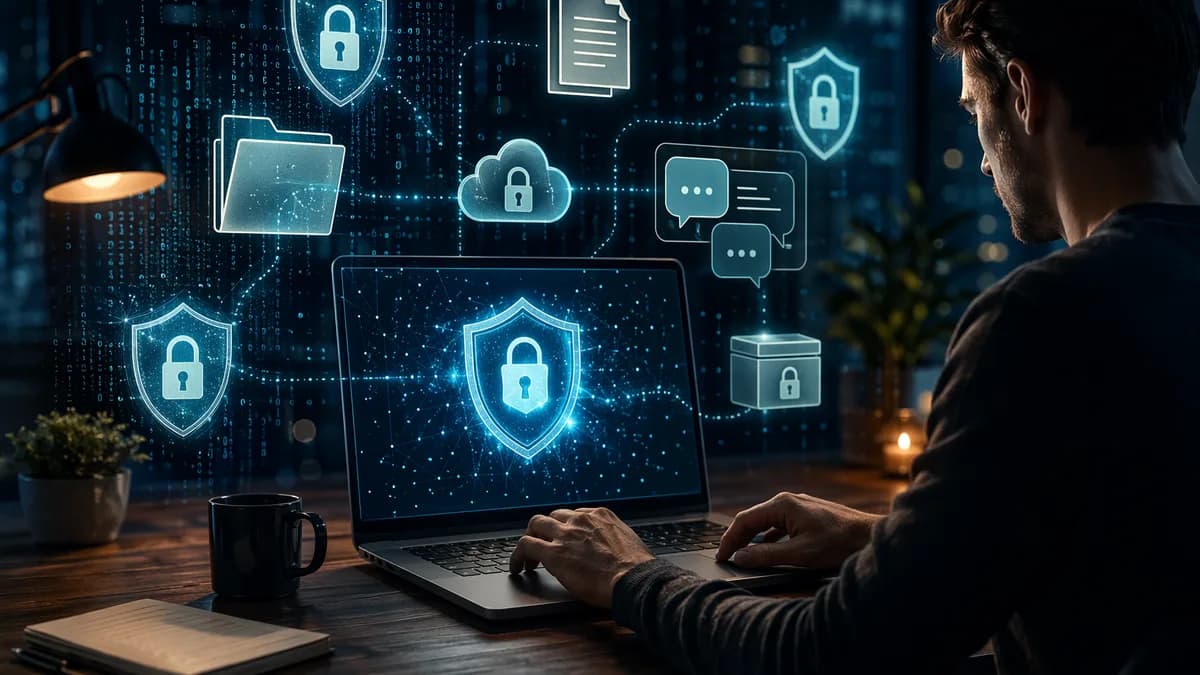
If you work with client logins, invoices, contracts, cloud folders, or public Wi-Fi, privacy tools for freelancers are no longer “nice to have.” Freelancers often handle sensitive business data without a company IT department, which means a single weak password, exposed invoice, or unsafe file transfer can create real professional risk.
XOOMAR Intelligence
Analyst Take
This practical listicle focuses on tools and habits supported by the source research: VPNs, password managers, encrypted storage, secure messaging, two-factor authentication, private browsing, and privacy practices for invoices and tax documents. The goal is not to buy every tool available—it is to build a lean, realistic privacy toolkit that protects client files, accounts, and communications without slowing down your work.
1. Why Freelancers Need a Privacy Toolkit
Freelancers face a privacy problem that traditional employees often do not: you need to be visible online to win work, but every profile, invoice, account, and client portal adds exposure.
PrivacyOn describes this as a “privacy paradox” for freelancers and gig workers. You may need public profiles on freelance platforms, a portfolio website, social media, and business contact details—but those same assets can expose your name, location, email, phone number, and sometimes your home address.
Freelancers are often their own IT department, HR department, and security team. That makes basic privacy tooling a business continuity issue, not just a technical preference.
The source research identifies several recurring freelancer risk areas:
| Freelancer Risk | Why It Matters |
|---|---|
| Multiple accounts | Every client portal, CMS, freelance platform, and business tool becomes a possible entry point. |
| Shared credentials | Clients may share passwords through email or chat, which is insecure. |
| Public Wi-Fi | Coffee shops, coworking spaces, hotels, and airports are common work environments. |
| Financial data | Invoices may include bank details, addresses, tax information, and payment records. |
| Personal devices | The same laptop or phone may hold both personal and client files. |
| No corporate IT team | Freelancers usually lack enterprise firewalls, monitored endpoints, and internal security support. |
| Public profiles | Freelance platforms and websites can expose personal information to clients, competitors, and data brokers. |
A practical freelancer privacy toolkit should cover four core outcomes:
- Account protection: Unique passwords, password managers, and two-factor authentication.
- Connection privacy: VPNs for public or shared networks.
- File protection: Encrypted cloud storage, secure sharing, backups, hashes, and PDF flattening.
- Identity separation: Separate business email, phone number, address, and limited personal details online.
The best approach is layered. No single app protects everything, but a small stack of well-chosen privacy tools for freelancers can sharply reduce common risks.
2. VPNs for Public Wi-Fi and Client Work
A VPN, or virtual private network, encrypts your connection and routes it through its servers, hiding your real IP address and location, according to Cloudwards. For freelancers, the most obvious use case is public Wi-Fi: coworking spaces, coffee shops, hotels, and airports.
PrivacyOn specifically recommends using a VPN whenever working from public networks, especially when accessing client systems, sending invoices, or logging into financial accounts.
A VPN is most useful for freelancers when the network is not under your control. It helps prevent others on the same public network from intercepting your traffic.
Free VPN options mentioned in the research
Cloudwards lists multiple free VPN options with different limits. These are not all equivalent, and several come with restrictions that matter for client work.
| VPN | Free Plan Data | Locations / Device Limits | Notable Details From Source |
|---|---|---|---|
| PrivadoVPN | 10GB monthly | Mobile and desktop support mentioned | Includes a kill switch and a strict no-logs policy. |
| Hide.me | 10GB per month | Five server locations, single device | Free plan limited to one device. |
| Proton VPN | Unlimited data | Three locations, preferred location cannot be selected | Useful if you use lots of data while browsing. |
| Windscribe | 10GB of data | 10 locations | Gives users more location choice than some free plans. |
| TunnelBear | 500MB per month | Not specified in source | Source notes this is “hardly enough for anyone.” |
| Speedify | 2GB per month | No account required | Source says it is not the fastest nor the safest, but “does the job.” |
| Hotspot Shield | 500MB per day | Not specified in source | Source flags privacy policy concerns and says to avoid mobile because the app does not encrypt traffic there. |
| ZoogVPN | 10GB of data | Five locations | Requires email registration and verification. |
| SecurityKISS | 300MB per day | Location list available | No registration, no ads, and no speed throttling noted. |
| TorVPN | 2GB per registration period | One server, changed at period start | Requires re-registration every seven days and is complicated to use. |
How freelancers should choose a VPN
For freelancers, the “best” VPN depends on workflow:
- Heavy browsing: Proton VPN is notable because the source states its free plan offers unlimited data, though you cannot select your preferred location.
- Occasional public Wi-Fi: PrivadoVPN, Hide.me, Windscribe, or ZoogVPN each provide 10GB of data in the source research.
- Low-data emergency use: TunnelBear, Avira Phantom VPN, or SecurityKISS may work for light use, but their free data limits are much smaller.
- Non-technical users: Be careful with tools the source describes as hard to set up, such as VPNBook and TorVPN.
A VPN should not replace secure passwords, 2FA, encrypted storage, or safe file-sharing habits. It is one layer—especially important when the network is not yours.
3. Password Managers for Business Accounts
Password reuse is one of the biggest practical risks for freelancers. Tools Oasis warns freelancers to stop reusing passwords across client platforms and recommends strong, random passwords of at least 16 characters with uppercase letters, lowercase letters, numbers, and symbols.
A password manager generates and stores strong, unique passwords so you only need to remember one master password. PrivacyOn specifically mentions Bitwarden, 1Password, and Proton Pass as popular options for freelancers.
Password manager options from the source data
| Password Manager | Free Plan / Cost Details in Source | Notable Features Mentioned |
|---|---|---|
| Bitwarden | Free plan described as strong for individuals | Secure and easy to use; ranked by source as a top free password manager. |
| Dashlane | Free plan stores up to 50 passwords on a single device | Source describes the free plan as generous. |
| Sticky Password | Free plan available | Autofill, password generator, secure notes, digital wallet, 2FA, biometric authentication. |
| Zoho Vault | Personal plan is free | No limit on stored passwords and notes; includes a password generator. |
| IronVest | Free plan available | Password manager and generator; formerly Blur. |
| RoboForm | Free option mentioned | Saves unlimited logins, has autofill, works on almost any platform. |
| LastPass | Free plan available | Unlimited passwords, autofill, password generator, one-device limit. |
| Norton Password Manager | Free | Browser extension or mobile app; stores passwords, addresses, cards, and notes; mobile unlock with fingerprint or Face ID. |
| RememBear | Free on one device | Stores one-time 2FA codes and supports biometric authentication. |
| LogMeOnce | Free option mentioned | Feature-packed, but source says the interface is difficult. |
| Master Password | Local password generation model | Uses the Spectre algorithm with your name, secret phrase, and domain to generate reproducible passwords. |
| KeePass | Free and open source | Source notes the interface has not been updated in some time. |
| 1Password | Paid-only; no free version in source | Password generation, secure sharing, item storage, and team management tools. |
Practical setup for freelancers
For business accounts, a password manager should be used for:
- Client portals: CMS accounts, ad platforms, analytics dashboards, project management tools.
- Freelance platforms: Accounts such as Upwork, Fiverr, Freelancer.com, LinkedIn, and similar platforms identified by PrivacyOn as expanding the attack surface.
- Financial accounts: Banking, payment processors, accounting tools, and tax portals.
- Cloud storage: Any account containing client files or contracts.
- Email: Your business inbox is often the reset point for every other account.
Tools Oasis also mentions browser-based password generators and password strength checkers that process data locally. The privacy advantage is important: according to the source, those tools run entirely in the browser, and generated or checked passwords are not transmitted or stored.
If one reused password is compromised, every account using it becomes vulnerable. Unique passwords limit the damage to one service.
4. Encrypted Cloud Storage and File Sharing Tools
Freelancers often exchange client files, contracts, creative assets, tax forms, source files, and invoices. Regular email attachments may be convenient, but PrivacyOn recommends avoiding them for sensitive files.
Instead, the source recommends secure file sharing through:
- Encrypted cloud storage: Specifically Tresorit and Proton Drive.
- Password-protected ZIP files: Useful for one-off transfers.
- Client-provided secure portals: Prefer these when available.
File sharing options mentioned in the research
| File Sharing Method | Best Use Case | Source-Based Privacy Notes |
|---|---|---|
| Tresorit | Encrypted cloud storage for client files | Mentioned by PrivacyOn as an encrypted file-sharing option. |
| Proton Drive | Encrypted cloud storage and sharing | Mentioned by PrivacyOn as an encrypted cloud storage option. |
| Password-protected ZIP files | One-off transfers | Recommended for occasional sensitive file transfers. |
| Client secure portals | Enterprise or regulated clients | Use when clients provide them. |
| Regular email attachments | Non-sensitive files only | PrivacyOn advises not sending sensitive files this way. |
Use hashes to verify deliverables
Tools Oasis mentions a Hash Generator for creating MD5, SHA-256, and other cryptographic hashes. For freelancers, this can help verify file integrity.
For example, if you deliver a large file, software package, archive, or design asset, a hash lets the recipient check that the file has not changed during transfer.
# Example concept only: generate a SHA-256 hash for a deliverable
sha256sum client-deliverable.zip
The key idea is simple: if the hash value changes, the file changed.
Flatten PDFs before sending contracts and invoices
Tools Oasis also recommends a PDF Flattener before sending contracts, proposals, or invoices. Flattening merges layers, form fields, and annotations into a single layer.
That matters because it:
- Prevents editing: Recipients cannot easily modify form fields or annotations.
- Preserves appearance: The document should appear as intended across devices.
- Reduces accidental exposure: Hidden layers or editable fields are less likely to remain in the file.
Back up client work with the 3-2-1 rule
PrivacyOn recommends the 3-2-1 backup rule:
- 3 copies of important data.
- 2 different types of storage.
- 1 copy off-site, such as cloud storage.
This protects against ransomware, device failure, and accidental deletion. For freelancers, backups are not only about convenience—they can determine whether you can finish a project after a laptop failure.
5. Secure Email and Messaging Options
Client communication often includes contracts, requirements, credentials, financial details, legal questions, and business plans. That makes secure communication one of the most important categories of privacy tools for freelancers.
Encrypted email: ProtonMail
ProtonMail is described in the source research as an encrypted email service with end-to-end encryption and zero-access architecture, meaning Proton cannot read message content. The source also notes that it is based in Switzerland and has a free plan for personal use.
| Tool | Best For | Pros From Source | Cons From Source |
|---|---|---|---|
| ProtonMail | Client communications with sensitive data | End-to-end encryption, zero-access architecture, Switzerland-based, free plan, mobile and desktop-friendly | Free tier has storage limits; not ideal for mass emailing or newsletters. |
For freelancers, ProtonMail may be most useful for:
- Sensitive client conversations
- Contract discussions
- Private project details
- Business correspondence separated from personal email
PrivacyOn also recommends using a separate email address for all freelance work. This keeps client communications and platform notifications away from your personal inbox. If your work email is compromised, your personal accounts remain separated.
Secure messaging: Signal
Signal is described as a privacy-first messaging app backed by a nonprofit foundation. It uses open-source end-to-end encryption and collects virtually no metadata, according to the source research.
| Tool | Best For | Pros From Source | Cons From Source |
|---|---|---|---|
| Signal | Private direct messaging with clients and collaborators | Strong encryption, no ads or data harvesting, works on desktop and mobile | Smaller user base than WhatsApp or Telegram; requires a phone number to register. |
Signal is useful when you and a client need a private communication channel outside normal work platforms. However, because it requires a phone number, freelancers may want to pair it with a business number rather than a personal cell number.
Temporary numbers for signups: Quackr
Quackr is a temporary phone number service for receiving SMS one-time passwords on platforms such as Gmail, Telegram, and WhatsApp without using your personal SIM.
| Tool | Best For | Pros From Source | Cons From Source |
|---|---|---|---|
| Quackr | Secure signups and OTP verification | Works across platforms like Google, WhatsApp, and Telegram; instant access to numbers from multiple countries; no personal phone number exposure | SMS only; no voice or call features. |
This can help freelancers who test app workflows, manage multiple social profiles, or onboard accounts without exposing a personal number.
6. Two-Factor Authentication Apps and Security Keys
Two-factor authentication, or 2FA, adds a second step beyond your password. PrivacyOn recommends enabling 2FA everywhere possible, especially on email, freelance platforms, banking, and cloud storage.
Tools Oasis also lists enabling two-factor authentication everywhere possible as a basic freelancer security habit.
Authenticator apps vs SMS
PrivacyOn recommends using an authenticator app, such as Authy or Google Authenticator, rather than SMS when possible. The reason given is that SMS codes can be intercepted through SIM swap attacks.
| 2FA Method | Source-Based Notes | Freelancer Use Case |
|---|---|---|
| Authy | Recommended as an authenticator app option | Business accounts, freelance platforms, cloud storage. |
| Google Authenticator | Recommended as an authenticator app option | Email, banking, client portals, project tools. |
| SMS codes | Less preferred because of SIM swap risk | Use only when app-based 2FA is unavailable. |
| Security keys | Mentioned in the outline, but the provided sources do not name specific products or specs | Consider where supported, but at the time of writing, the source data does not provide product-level comparisons. |
Priority accounts for 2FA
Start with accounts that can unlock other accounts or expose client data:
- Business email
- Freelance platforms
- Banking and payment accounts
- Cloud storage
- Password manager
- Client portals
- Domain registrar and website hosting
- Accounting or invoicing tools
If you only enable 2FA in a few places, start with your business email and financial accounts. Those are often the highest-impact accounts in a freelancer workflow.
7. Private Browsers and Tracker Blocking Extensions
Most apps and websites are not optimized for privacy by default, according to Cloudwards. That creates a need for privacy-oriented tools and browser extensions, especially for freelancers who live in web apps all day.
Brave browser
Brave is a Chromium-based privacy browser. The source research says it blocks trackers and ads by default, upgrades site security with HTTPS Everywhere, and includes features such as built-in Tor, private search, and secure mobile sync.
| Browser | Best For | Pros From Source | Cons From Source |
|---|---|---|---|
| Brave | Browser-heavy freelance work | Built-in ad and tracker blocking, private search, Tor tab options, secure device sync | Smaller extension library than Chrome; some sites may break with aggressive blocking. |
Brave is especially relevant for:
- Freelancers using cloud tools
- Marketers and creators avoiding surveillance-based ads
- Remote teams accessing accounts through the browser
- People who want privacy defaults without extensive setup
Tracker blocking trade-offs
Tracker blocking can improve privacy, but aggressive blocking can break some websites. The source research explicitly notes that some websites may break when Brave’s blocking is aggressive.
A practical workflow is:
- Default to privacy blocking for general browsing.
- Use site-specific exceptions when a trusted client platform breaks.
- Avoid installing unnecessary extensions, since every extension can add complexity and potential exposure.
- Keep browser and extensions updated, consistent with Tools Oasis’s recommendation to keep software updated.
8. Invoice, Payment, and Tax Document Privacy
Invoices, payment records, contracts, and tax documents are some of the most sensitive files freelancers handle. Tools Oasis notes that invoices can contain bank details, addresses, and tax information. PrivacyOn recommends separating personal and professional identity wherever possible.
Separate your business identity
PrivacyOn says the most impactful privacy step for freelancers is creating a clear boundary between personal and professional information.
| Privacy Step | Source-Based Recommendation | Why It Helps |
|---|---|---|
| Separate email address | Use a dedicated email for freelance work | Keeps client communications and platform notifications separate from personal accounts. |
| Business phone number | Use Google Voice or a dedicated business line | Avoids giving clients your personal cell number. |
| Business address | Use a P.O. Box, virtual mailbox, coworking address, or registered agent | Avoids putting your home address on invoices, contracts, and profiles. |
| Business entity | Consider LLC or sole proprietorship where appropriate | May allow use of a business name instead of a legal name; consult a tax professional. |
PrivacyOn specifically mentions iPostal1 and Anytime Mailbox as virtual mailbox services. It also suggests a registered agent service if you have an LLC.
Never use your home address on invoices, contracts, or public business profiles if you can use a legitimate business address alternative.
Protect invoice and tax files
For invoice, payment, and tax privacy, use the same layered approach:
- Flatten PDFs: Tools Oasis recommends flattening contracts, proposals, and invoices before sending.
- Use secure file sharing: PrivacyOn recommends encrypted storage, password-protected ZIP files, or client portals for sensitive files.
- Avoid regular email attachments: Especially for files with tax IDs, bank details, addresses, or client-confidential information.
- Delete old client data: PrivacyOn recommends securely deleting client files you no longer need after the project is complete and deliverables are accepted.
- Back up important records: Use the 3-2-1 backup rule for critical tax, invoice, and contract records.
Reduce data broker exposure
Freelancers are more exposed online because of platform profiles, business registrations, public websites, and domain records. PrivacyOn recommends regularly searching your name to see what information is public.
It also recommends enabling WHOIS privacy protection on domain registrations. Without it, your name, address, phone number, and email can be publicly listed in the domain registry and scraped by data brokers.
PrivacyOn’s own service is described as monitoring and removing personal information from over 100 data broker sites, with plans starting at $8.33 per month and family coverage for up to 5 people. The source also mentions dark web monitoring and 24/7 automated scanning.
9. How to Build a Low-Cost Freelancer Security Stack
You do not need to buy every product in this article. A low-cost security stack should address your highest-risk areas first: passwords, 2FA, public Wi-Fi, file sharing, business identity separation, and safer browsing.
A practical low-cost stack
| Layer | Low-Cost Option From Source Data | What It Protects |
|---|---|---|
| Passwords | Bitwarden, Zoho Vault, KeePass, or other free password managers listed | Client accounts, freelance platforms, cloud tools. |
| Password creation | Browser-based password generator from Tools Oasis | Creates unique passwords of at least 16 characters. |
| 2FA | Authy or Google Authenticator | Email, banking, cloud storage, freelance accounts. |
| VPN | Proton VPN, PrivadoVPN, Windscribe, Hide.me, or another free VPN listed | Public Wi-Fi and shared-network browsing. |
| Secure email | ProtonMail free plan | Sensitive client communications, with storage limits. |
| Messaging | Signal | Encrypted client or collaborator chats. |
| Browser privacy | Brave | Tracker blocking, ad blocking, private search, Tor tab options. |
| File sharing | Proton Drive, Tresorit, password-protected ZIPs, or client portals | Sensitive deliverables and documents. |
| Document handling | PDF flattener and hash generator from Tools Oasis | Harder-to-edit PDFs and file integrity checks. |
| Business identity | Separate email, business phone number, virtual mailbox or P.O. Box | Reduces exposure of personal contact details. |
Suggested setup order
Start with a password manager
Move every business account into a password manager and replace reused passwords with unique ones.Enable 2FA on high-value accounts
Prioritize email, freelance platforms, banking, cloud storage, and password manager access.Separate personal and business identity
Create a dedicated freelance email, use a business phone number, and avoid putting your home address on invoices.Add a VPN for public Wi-Fi
Pick a plan that matches your data needs. If you work often from shared networks, pay attention to data caps.Switch sensitive files to secure sharing
Use encrypted storage, client portals, or password-protected ZIP files instead of ordinary email attachments.Harden browser privacy
Use Brave or privacy-focused extensions, but test important client websites in case blocking breaks functionality.Create a data retention habit
Delete client files you no longer need after a project ends and accepted deliverables are complete.Back up critical files
Follow the 3-2-1 rule for client work, invoices, contracts, and tax records.
What to avoid
- Reused passwords across client portals.
- Client passwords sent by email without moving them into a secure manager.
- Home address on invoices when a business address option is available.
- Personal phone number everywhere, especially in public profiles.
- Sensitive attachments by regular email when encrypted sharing is available.
- Keeping client data forever after projects end.
- Ignoring public search results for your own name and business details.
Bottom Line
The most useful privacy tools for freelancers are the ones that protect the way freelancers actually work: public Wi-Fi, many client accounts, file transfers, invoices, contracts, and constant online visibility.
Start with a password manager, 2FA, a VPN for public networks, encrypted file sharing, a private browser, and better business identity separation. Then add secure email, encrypted messaging, PDF flattening, hashes, backups, and data broker monitoring where your risk level justifies it.
A freelancer does not need an enterprise security department to reduce risk. A small, consistent privacy stack—used every day—is far better than a large collection of tools you never configure properly.
FAQ
What are the most important privacy tools for freelancers?
The most important categories are password managers, two-factor authentication apps, VPNs, encrypted file-sharing tools, secure email, private messaging, and private browsers. Source data also recommends PDF flatteners, hash generators, backups, and business identity separation for invoices and client files.
Should freelancers use a VPN on public Wi-Fi?
Yes. PrivacyOn recommends always using a VPN when working from coffee shops, coworking spaces, hotels, or other public Wi-Fi networks. A VPN encrypts your internet traffic and helps prevent others on the same network from intercepting your data.
Which password managers have free options?
The source research lists several password managers with free plans or free personal options, including Bitwarden, Dashlane, Sticky Password, Zoho Vault, IronVest, RoboForm, LastPass, Norton Password Manager, RememBear, LogMeOnce, Master Password, and KeePass. 1Password is described in the source as paid-only with no free version.
Is SMS two-factor authentication safe enough?
PrivacyOn recommends using an authenticator app such as Authy or Google Authenticator instead of SMS when possible. The source notes that SMS codes can be intercepted through SIM swap attacks.
How can freelancers protect invoices and tax documents?
Use a business email, business phone number, and business address rather than personal details where possible. Flatten invoice PDFs before sending, avoid regular email attachments for sensitive files, use encrypted storage or client portals, and securely delete client files you no longer need after projects end.
Should freelancers delete client files after a project?
Yes, when the project is complete and deliverables have been accepted, PrivacyOn recommends securely deleting client files you no longer need. Keeping sensitive client data indefinitely increases liability and risk.
Sources & References
Content sourced and verified on June 17, 2026
- 1Essential Privacy Tools for Freelancers: Protect Your Business | Tools Oasis
https://toolsoasis.dev/blog/privacy-tools-for-freelancers/
- 2Best Privacy Tools & Software Guide in in 2026
https://www.privacytools.io/
- 399 Free Privacy Tools for 2026 [Online Security for Nothing]
https://www.cloudwards.net/99-tools-to-protect-your-privacy/
- 4Top 5 Online Privacy Tools for Freelancers and Creators
https://coruzant.com/security/top-5-tools-for-online-privacy-in-2025-stay-secure-without-sacrifice/
- 5Privacy Guide for Gig Workers and Freelancers | PrivacyOn
https://www.privacyon.com/blog/privacy-guide-for-gig-workers-and-freelancers
- 6A Freelancer's Toolkit: 26 Tools Everyone Can Use - Upwork
https://www.upwork.com/resources/freelancers-toolkit-tools-everyone-should-use

Written by
XOOMAR Insights Team
Research and Editorial Desk
The XOOMAR Insights Team pairs automated research with human editorial judgment. We track hundreds of sources across technology, fintech, trading, SaaS, and cybersecurity, cross-check the facts, and explain what happened, why it matters, and what to watch next. We do not just rewrite headlines. Every article is fact-checked and scored for reliability before it goes live, and we link back to the original sources so you can verify anything yourself.