
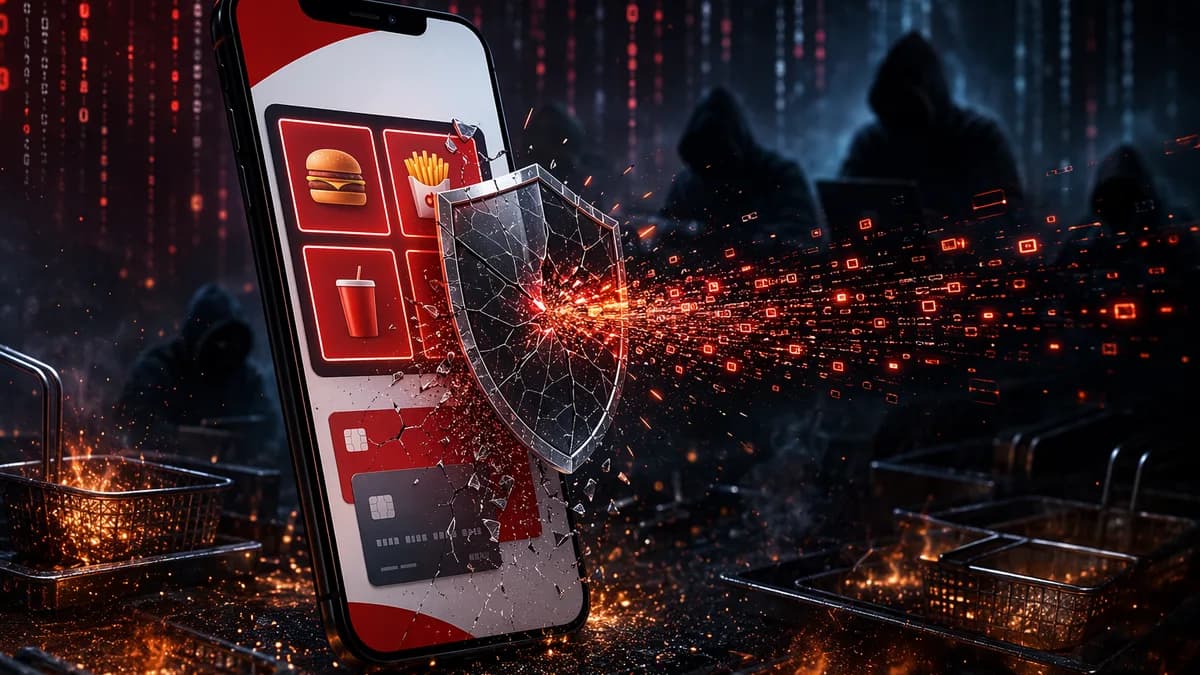
Chick-fil-A credential stuffing attackers broke into customer loyalty accounts by using passwords taken from outside sources, putting stored rewards, partial payment details, and personal profile data at risk for Chick-fil-A One users.
CybersecurityJuly 26, 2026· 5 min read· By XOOMAR Insights Team
Credential Stuffing Cracks Chick-fil-A One Accounts
Updated on July 26, 2026
XOOMAR Intelligence
Analyst Take
65/ 100
4 sources analyzedLow confidenceTrend10Freshness98Source Trust85Factual Grounding91Signal Cluster20
The fast-food chain disclosed the breach after automated login attempts hit its mobile app and website between June 17 and June 19, 2026, according to SecurityWeek. The reported activity targeted customer accounts, not a confirmed compromise of Chick-fil-A’s internal systems.
Chick-fil-A One customers face the immediate account takeover risk
The attackers used credentials obtained from third-party sources, including reused or stolen credentials from prior breaches. That detail matters. In a credential stuffing attack, criminals don’t need to crack a company’s systems if customers reused passwords that already leaked elsewhere.
The company determined on July 13, 2026 that unauthorized parties may have accessed data stored in affected Chick-fil-A One accounts.
“We recently identified suspicious login activity to certain Chick-fil-A One accounts,” the company notice said, according to reporting on the breach notice.
What could have been exposed? The account data varies by customer, but the listed categories are sensitive enough to make this more than a nuisance.
| Data category | Information attackers may have accessed |
|---|---|
| Identity | Names, email addresses, phone numbers, addresses, dates of birth |
| Loyalty account | Chick-fil-A membership numbers, rewards balances, Chick-fil-A credit |
| Payment-linked data | Mobile pay numbers, partial payment card numbers, last four digits of linked cards |
| Account access tools | QR codes associated with the account |
One immediate question for customers: did someone access stored value or rewards before Chick-fil-A intervened?
The available reporting does not detail every account-level remediation step taken after the incident. Customers should still assume that any exposed loyalty balance, saved account data, or linked payment setting deserves a close review.
Loyalty app teams get a blunt reminder about reused passwords
For app operators, the Chick-fil-A credential stuffing incident shows why loyalty programs can become soft targets even when the initial password theft happened somewhere else.
These accounts can hold balances, membership identifiers, QR codes, partial card details, and personal information. That gives attackers multiple possible payoffs: access to rewards, account data, or a profile that can make later phishing attempts more convincing. XOOMAR analysis: the account itself becomes the prize because it connects identity, payment-adjacent data, and stored value in one place.
SecurityWeek reported that the number of affected people remains unclear. Separate reporting cited 2,182 Texas residents affected, and breach notices were also sent in several other states, including Massachusetts.
What should consumer app teams be asking now? Whether their login defenses can distinguish a real customer from an automated credential-testing tool before the attacker gets in.
In this type of attack, the defensive checklist usually centers on:
- Forced resets: Change passwords for accounts with suspicious access.
- Session control: Log users out across devices after suspected takeover.
- Bot friction: Detect automated login patterns and slow them down.
- Rate limits: Cut repeated login attempts from suspicious sources.
- Behavior flags: Watch for abnormal account access or balance activity.
Chick-fil-A has not disclosed the full victim count, and available reporting does not spell out every post-incident remediation step. That leaves the focus on customer account hygiene and stronger login defenses.
For broader account-security context, XOOMAR has covered other access-abuse cases, including Robinhood CEO Hack Pushed Fake $VLAD Listing to Traders and AI Phishing Threat Sends $36M Into AegisAI's Agents. Those are separate incidents, but they point to the same pressure point: attackers keep looking for trusted accounts they can turn against users.
Chick-fil-A One users should reset passwords and inspect rewards activity
Customers with a Chick-fil-A One account should treat this as an account takeover incident, especially if they reused the same password on any other service.
Start with the obvious step: set a new, unique Chick-fil-A One password. Don’t recycle a password from email, banking, retail, delivery, streaming, or social accounts. If the same password was used elsewhere, change it there too.
The practical customer checklist is short:
- Password: Reset it to something unique.
- Rewards: Check balances, Chick-fil-A credit, and recent rewards activity.
- Payment methods: Review linked cards or saved payment settings.
- Profile data: Look for unfamiliar changes to phone number, address, or other account details.
- Messages: Be wary of emails or texts that reference real Chick-fil-A account details.
Can customers turn on stronger login protection? Malwarebytes reported that Chick-fil-A supports MFA for Chick-fil-A One accounts using a verified mobile phone number. Customers should enable it if available on their account.
Monitor payment cards linked to the account. The reported exposed card data includes partial card numbers or last four digits, not full card numbers, but suspicious activity still belongs with the card issuer and Chick-fil-A support.
The next pressure point is Chick-fil-A’s login defenses
Chick-fil-A has not said how many customers were affected overall. SecurityWeek said it contacted the company for more information and would update its report if Chick-fil-A responded.
The open issues are narrow but important: the final number of affected accounts, whether any payment-linked information was misused beyond stored balances, how many customers received notices, and whether Chick-fil-A will add new protections against automated login attacks.
Credential stuffing keeps working because one leaked password can unlock unrelated accounts when users reuse credentials. Companies can’t control every third-party breach, but they can make automated testing harder to scale.
The next signal to watch is whether Chick-fil-A limits this to cleanup for affected users or follows with tougher login controls for the entire Chick-fil-A One program. If the same stolen credential lists keep circulating, password resets alone won’t be the last round.
What This Means For You
- Chick-fil-A One users may have had personal profile data, rewards balances, Chick-fil-A credit, and partial payment details exposed.
- The attack shows how reused passwords from other breaches can lead to account takeovers even without a confirmed compromise of Chick-fil-A systems.
- Customers should change reused passwords and review loyalty accounts for missing rewards, credit, or suspicious activity.
Sources

Written by
XOOMAR Insights Team
Research and Editorial Desk
The XOOMAR Insights Team pairs automated research with human editorial judgment. We track hundreds of sources across technology, fintech, trading, SaaS, and cybersecurity, cross-check the facts, and explain what happened, why it matters, and what to watch next. We do not just rewrite headlines. Every article is fact-checked and scored for reliability before it goes live, and we link back to the original sources so you can verify anything yourself.
Explore More Topics
Related Articles
 Cybersecurity
$600K DraftKings Hacker Snoopy Draws 18 Months in Prison
Nathan Austad, alias Snoopy, got 18 months for a DraftKings credential-stuffing scheme that stole $600K from 1,600 accounts.
Jun 24, 20266 min
 Cybersecurity
Russian Signal Phishing Hijacks VIP Accounts in Support Scam
Russian actors are phishing Signal users for recovery keys, targeting officials, military figures and journalists without breaking encryption.
Jun 30, 20269 min
 Cybersecurity
42 US Attacks Pull Russian Cybercrime Hosts Into Court
DOJ says Russian bulletproof hosts enabled attacks on 42 US entities, shifting pressure from hackers to infrastructure sellers.
Jul 19, 20267 min
 Cybersecurity
14 Million Email Logins Leak as KDDI Cyberattack Hits ISPs
Up to 14.22 million email logins may have leaked after third-party software in KDDI's managed ISP email platform was exploited.
Jul 9, 20268 min
 Cybersecurity
Fake OpenAI Invites Lure Security Staff into ChatGPT Trap
Attackers are using real OpenAI invite emails to lure security staff into fake ChatGPT workspaces built for data theft.
Jun 27, 20268 min
 Global Trends
1 Dead as Berlin Pride Ramming Attack Triggers Manhunt
One woman is dead, 16 are injured, and Berlin police are searching for a 21-year-old suspect after the Pride ramming.
Jul 26, 20268 min
 Future Fiction
The Night the Grid Became Weather
In 2047, orbital microwave relays and compact fusion plants make clean energy abundant enough to beam across continents like a public forecast. Laleh Nouri, once a negotiator for a petrostate, is sent to a coastal city in Kenya where free power has transformed daily life—but also upended old alliances, cultural rhythms, and the meaning of sovereignty.
Jul 26, 202613 min
 Technology
Console-Free Amazon Luna Hits Prime Video on Fire TV
Amazon is folding Luna into Prime Video, betting Fire TV users will try console-free games beside shows, movies, and sports.
Jul 26, 20268 min
 SaaS & Tools
Tiny Missions Attack Doomscrolling Inside MeBeMe App
MeBeMe tries to beat doomscrolling with identity-based missions, not lockouts. Timing will decide if the idea sticks.
Jul 26, 20266 min
 Technology
AI Collaboration Quietly Rewrites Work Before Layoffs
AI is reshaping tasks before it replaces workers. The first shock is workflow, not mass layoffs.
Jul 26, 20269 min
Don't miss the signal
Get our weekly roundup of the stories that matter across tech, fintech, and trading. No noise, just signal.
Free forever. No spam. Unsubscribe anytime.