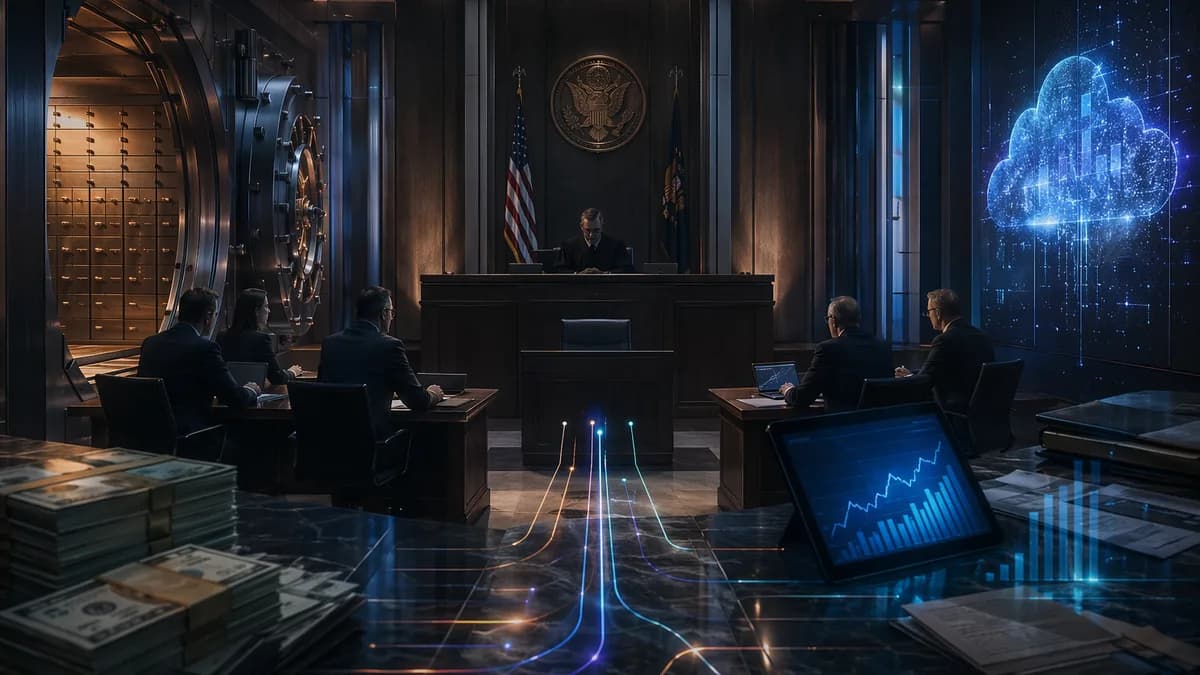
Can SVB Financial Trust recover $1.7 billion left inside Silicon Valley Bank after regulators seized it, or did executives weaken that claim by taking risks the FDIC now says crossed the line?
XOOMAR Intelligence
Analyst Take
Can SVB’s former parent claw back $1.7 billion from the FDIC?
The SVB FDIC trial opened Monday in federal court, putting the failed bank’s former parent against the Federal Deposit Insurance Corp. in a fight over roughly $1.7 billion in deposits left at Silicon Valley Bank when regulators took control in March 2023, according to American Banker.
The case centers on a blunt question: were those funds still the property of the holding company, or can the FDIC keep control as it liquidates assets and tries to recover receivership costs?
Silicon Valley Financial Trust, the entity created to collect and distribute remaining assets tied to the failed bank, sued the FDIC in the U.S. District Court for the Northern District of California. The Trust argues the disputed deposits belong to the former holding company. The FDIC says SVB executives’ conduct before the collapse should block that recovery.
The trial started with opening statements Monday. The FDIC then called former SVB chief financial officer Daniel Beck as its first witness. Beck occupied nearly the entire first day, with FDIC attorneys examining him through much of the afternoon. His cross-examination by SVB’s lawyers was expected to continue Tuesday.
This is one of the more concrete legal aftershocks of the 2023 banking crisis. SVB was not just a failed lender. It became a test of how fast depositor panic can overwhelm a concentrated bank balance sheet, and how aggressively regulators can act afterward.
The disputed funds were not part of First Citizens’ acquisition of most of the failed bank’s assets. That leaves the FDIC in control of the money while the Trust tries to prove the assets should flow back to the holding company and, ultimately, creditors.
Did SVB executives “gamble” with depositor funds?
The FDIC’s case is that SVB leadership took excessive interest-rate risk with depositor money, chased short-term gains, and left the bank exposed when conditions turned.
“It is fundamental that officers of a federally insured bank and bank holding company cannot gamble with depositor funds by taking excessive interest-rate risk,” the FDIC side states in its trial brief.
The agency alleges officers put more than $115 billion into long-term, fixed-rate securities during a period of historically low interest rates. It also says executives unwound interest-rate hedges while holding onto the underlying securities, bypassed internal risk limits, and approved a $294 million dividend from the bank to the holding company while unrealized losses were mounting.
The FDIC says those actions breached fiduciary duties, caused more than $5.4 billion in damages, and should prevent the Trust from recovering the $1.7 billion now at issue.
The number matters because this is not a symbolic dispute. If the FDIC prevails, it strengthens its ability to hold onto assets tied to a failed bank when it argues management decisions damaged the receivership. If the Trust wins, creditors gain a clearer path to money that has been trapped since the seizure.
SVB’s collapse was driven in large part by paper losses on long-term securities and rapid depositor withdrawals that became unsustainable. The bank’s customer base was unusually concentrated: by the end of 2022, SVB reported $209 billion in assets and $191.4 billion in deposits, 94% of which were uninsured.
That concentration turned liquidity into the core problem. XOOMAR analysis: the trial is not just relitigating investment choices. It is testing whether a bank’s funding model can make otherwise common balance-sheet decisions look reckless once withdrawals accelerate.
That liquidity pressure also tracks with broader bank plumbing risks we’ve covered, including how payment speed can expose funding gaps in Real-Time Payment Liquidity Traps Banks at the Send Button and why bankers are focused on settlement certainty in 53% of Bankers Crown Certainty in Real-Time Payments.
Was the $294 million dividend lawful or reckless?
SVB’s former parent frames the FDIC case as hindsight dressed up as accountability.
The Trust says executives were dealing with an unprecedented pandemic-era surge in deposits and had to “balance many competing risks.” Its position is that management invested excess deposits in government-backed securities, and that those choices were reviewed by the board and regulators at the time.
“FDIC's claims stem from its disagreement with business decisions, but that does not amount to a breach of fiduciary duty. FDIC's criticisms are based on hindsight,” the Trust wrote in its June trial brief.
The Trust also defended the $294 million payment made in late 2022, saying it was lawful because the bank remained solvent and highly liquid. It said the dividend “represented only 2% of the bank's cash on hand,” and that SVB still had nearly $79.6 billion in borrowing capacity.
That is the legal and factual split at the center of the SVB FDIC trial.
| Issue | FDIC argument | SVB Financial Trust argument |
|---|---|---|
| $1.7 billion deposits | FDIC can retain control because management’s conduct damaged the receivership | Funds belong to the former holding company |
| $294 million dividend | “Grossly imprudent” while unrealized losses were piling up | Lawful because the bank was solvent, liquid, and had borrowing capacity |
| Securities strategy | Excessive interest-rate risk and abandoned hedges | Reasonable decisions based on conditions at the time |
| Cause of failure | Management decisions caused damages | Collapse followed an unprecedented depositor panic |
The courtroom record already includes a sharp exchange over a March 2021 email from Beck. FDIC attorneys highlighted alleged language in which Beck wrote that he did not believe the bank was “thinking big enough” about the “potential ramifications” of rapid growth, and that he did not think it had “the right risk metrics and indicators to shape our view of an unprecedented situation.”
Beck agreed those statements reflected his thinking at the time. Asked whether he believed the bank had the right risk metrics to manage the possibility of sudden and massive deposit outflows, he testified that he was “questioning it.”
That testimony gives the FDIC a clean narrative: executives saw risk building before the collapse. The Trust’s harder task is to show that recognizing risk is not the same as breaching duty.
How far can the FDIC go after a failed bank’s parent?
The next phase of the trial will turn on witness testimony, internal documents, and how the court weighs the FDIC’s authority after a seizure against the holding company’s claim to its own deposits.
There is a separate legal fight in the background. Last year, the FDIC sued 17 former SVB executives, including former CEO Gregory Becker and CFO Daniel Beck, seeking to recoup receivership costs. That case reinforces the agency’s broader posture: SVB was not merely unlucky, in the FDIC’s view. It was mismanaged.
Federal regulators also took extraordinary action after the collapse. The Treasury, Federal Reserve and FDIC said in March 2023 that SVB depositors would have access to all their money, including funds above the $250,000 insured ceiling, NBC News reported at the time.
For banks, corporate parents, creditors, and uninsured depositors, the practical question is narrower than the public debate over SVB’s collapse: when a bank fails, what money is actually recoverable, and what can regulators hold back as part of the cleanup?
XOOMAR analysis: a ruling for the FDIC would give regulators a stronger hand in future fights over assets tied to failed banks, especially where they can connect pre-collapse decisions to receivership losses. A ruling for the Trust would limit that reach and put more pressure on the FDIC to separate bad management claims from ownership claims over specific funds.
The SVB FDIC trial will continue in coming weeks, with testimony from SVB executives still unfolding. The watch item now is whether the court treats the disputed $1.7 billion as trapped property from a chaotic failure, or as money the FDIC can withhold while it presses its larger case over risk, accountability, and the cost of SVB’s collapse.
Disclaimer: This XOOMAR analysis is for informational and educational purposes only. It is not financial, investment, legal, tax, or professional advice. It does not provide buy, sell, hold, price-target, portfolio, or personalized recommendations. Verify information independently and consult qualified professionals before making decisions.
Impact Analysis
- The case could determine whether SVB’s former parent can reclaim $1.7 billion from the failed bank’s receivership.
- The outcome may influence how regulators handle assets left behind after major bank failures.
- The trial is a key legal aftershock of the 2023 banking crisis and SVB’s collapse.
SVB Financial Trust vs. FDIC
| Party | Position | Key Argument |
|---|---|---|
| SVB Financial Trust | Seeks recovery of roughly $1.7 billion in deposits | Argues the funds belong to the former holding company |
| FDIC | Wants to retain control of the deposits during receivership | Argues SVB executives’ pre-collapse conduct should block recovery |
Deposits Disputed in SVB-FDIC Trial
Primary Sources & Disclosures
Disclaimer: Content on XOOMAR is produced using AI-assisted research, drafting, and verification workflows and is intended for informational and educational purposes only. It does not constitute financial, investment, legal, tax, medical, or professional advice of any kind. All analysis reflects available information at the time of publication and may not be current. Verify information independently and consult qualified professionals before making decisions. Editorial policy

Written by
XOOMAR Insights Team
Research and Editorial Desk
The XOOMAR Insights Team pairs automated research with human editorial judgment. We track hundreds of sources across technology, fintech, trading, SaaS, and cybersecurity, cross-check the facts, and explain what happened, why it matters, and what to watch next. We do not just rewrite headlines. Every article is fact-checked and scored for reliability before it goes live, and we link back to the original sources so you can verify anything yourself.