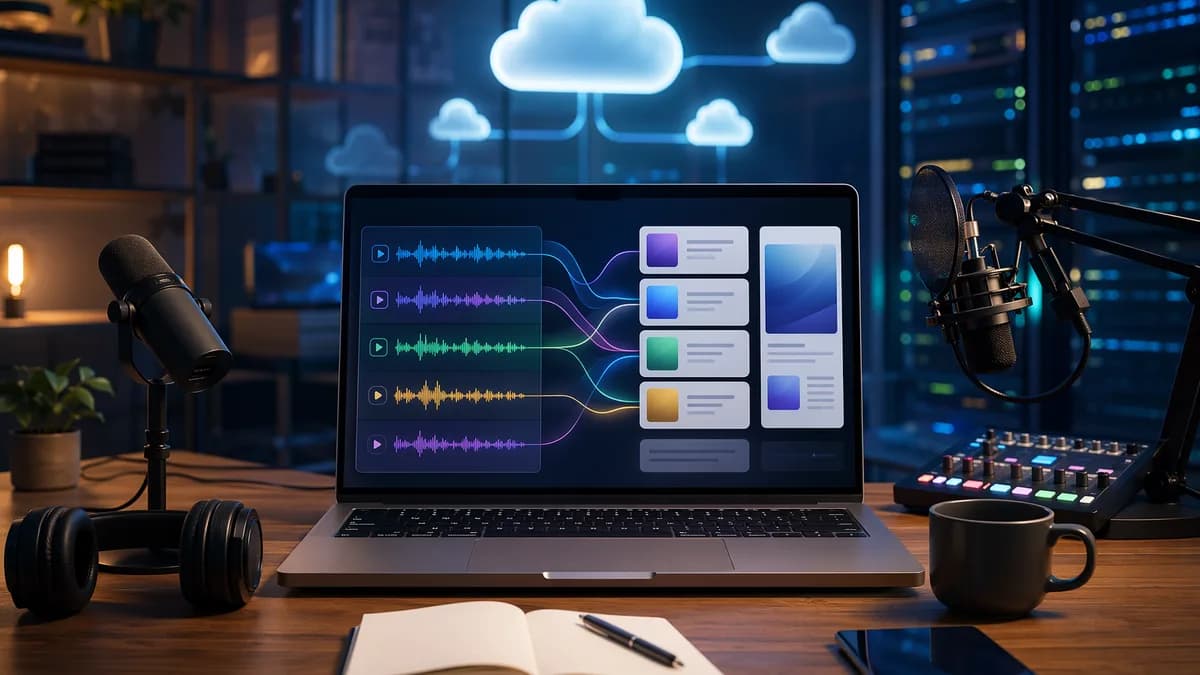
On Tuesday, Riverside moved beyond recording and editing into Riverside AI newsletters, a feature that signals a wider push to own what happens after a podcast or video session ends.
XOOMAR Intelligence
Analyst Take
The new tool lets users turn existing videos and podcasts into newsletters, then send them from inside Riverside, according to TechCrunch. Users can also create newsletters from scratch without using the AI conversion feature.
That timing matters because creator software is collapsing into fewer, broader tools. Substack launched a built-in recording studio in March. Beehiiv moved into podcasting in April. Mastodon said in June that users would be able to publish posts as newsletters. Riverside is moving in the opposite direction: from recording into publishing.
June 30: Riverside AI Newsletters Turn Recordings Into a Publishing Layer
Riverside is not presenting newsletters as a direct assault on Mailchimp, Substack, Beehiiv, or Ghost. The sharper move is workflow capture. Riverside already sits at the point where creators produce long-form spoken material. Now it wants to convert that material into written distribution before users leave the app.
That gives the product a clear logic. A creator records an interview or solo episode. The conversation already contains arguments, stories, product updates, links, and calls to action. Riverside’s pitch is that AI can extract that raw material and turn it into newsletter-ready copy with less manual writing.
Riverside co-founder and CEO Nadav Keyson framed the difference directly:
“Substack and Beehiiv start you at a blank page. But our creators and business customers are already producing rich, information-dense spoken content on Riverside. For most people, speaking is easier and more natural than writing from scratch, and the ideas are already there, in the conversation. So instead of asking them to start over in a separate tool, we help them turn a recording they’ve already made into newsletter-ready content with far less effort,” Riverside’s co-founder and CEO Nadav Keyson told TechCrunch.
XOOMAR analysis: The important phrase is “instead of asking them to start over in a separate tool.” Riverside’s bet is not just that AI can summarize audio. It’s that creators will prefer a production flow where recording, first draft, social hooks, video cleanup, and now newsletters all happen in one place.
After the Recording Ends, the Real Workflow Starts
The likely habit shift is straightforward: record first, write second. Or, more accurately, let AI create the first written pass and then edit.
Riverside’s update includes more than newsletters. The company is adding AI features that can draft a first cut of a recording once it is finished. Its assistant can also create hooks and content for social media platforms. On the video side, Riverside is adding an AI enhancement feature trained on conversational video podcasts, which the company says can improve lighting, depth, and sharpness.
For podcasters, that matters because the hardest part of repurposing is not knowing that clips, posts, and emails are useful. It’s doing them every week without building a separate editorial operation. Long-form audio is dense, but it’s messy. The strongest point may appear 37 minutes in. The best quote may need context. The episode title may not translate into a newsletter subject line.
Riverside AI newsletters lower that first-draft burden. But they don’t remove the editorial burden.
The risk is obvious: if every recording becomes an automated email, inboxes fill with polite summaries nobody asked for. A useful newsletter needs judgment. It needs a reason to exist beyond “we published an episode.” AI can surface structure, but the creator still has to decide what matters.
The Numbers Riverside Can Point To Are Funding and Timing, Not Newsletter Adoption
The available numbers here are limited, but they still say something about the strategy.
| Milestone | Date or figure | What it shows |
|---|---|---|
| Riverside funding | over $60 million | The company has capital behind a broader product push |
| Substack recording studio | March | Newsletter platforms are moving into audio production |
| Beehiiv podcasting move | April | Email-native tools are adding creator media formats |
| Mastodon newsletter plan | June | Social publishing tools are testing email as a distribution channel |
| Riverside newsletter launch | June 30 | Recording tools are now moving into newsletters |
Riverside’s move fits that sequence. The direction is not one-way. Newsletter companies are adding audio. Recording companies are adding newsletters. Social platforms are trying to turn posts into email products.
XOOMAR analysis: This is a fight over the creator workflow more than a fight over any single format. The value sits in the handoff points: recording to edit, edit to clip, clip to social post, episode to email. Each handoff used to push creators into another tool. Riverside is trying to make fewer handoffs necessary.
Still, TechCrunch does not report pricing, adoption targets, paid subscription tools, email analytics, segmentation, or monetization features for Riverside newsletters. Those omissions matter. Without them, this is best understood as a publishing workflow expansion, not yet a full newsletter business platform.
Creators Get Speed, Newsletter Platforms Get a Quiet Warning
For creators and business customers already recording on Riverside, the immediate appeal is practical. Newsletters take time. Many audio-first teams can talk fluently for an hour but stall when staring at a blank document. Riverside’s feature attacks that friction directly.
Newsletter platforms will read the move differently. Riverside says it is not trying to directly take on Mailchimp, Substack, Beehiiv, or Ghost. But software competition often starts with one convenient feature, then deepens as users stop opening the old tool. If Riverside handles the draft and the send, some users may have less reason to maintain a separate lightweight email workflow.
The same logic cuts both ways.
For creators:
- Speed: A recording can become written copy faster.
- Consistency: Teams may publish newsletters more regularly if the first draft is automatic.
- Editing load: Bad AI copy still needs human rewriting, so the time savings depend on output quality.
For subscribers:
- Better recaps: A strong email can pull out the useful parts of a long episode.
- More noise: A weak one becomes another generic content blast.
XOOMAR analysis: The winner here is not the tool that produces the most text. It’s the tool that helps creators preserve voice. Spoken content has rhythm, hesitation, surprise, and personality. A newsletter that sands all of that down into corporate summary language will not build loyalty.
From Show Notes to AI Newsletters, Podcast Audio Keeps Getting Repackaged
Podcast repurposing has moved in stages. First came basic show notes and RSS feeds. Then transcripts became more common. Then audiograms and short-form clips turned episodes into social assets. Now AI tools are pushing toward full content packages: drafts, hooks, clips, posts, and newsletters.
Riverside’s update sits squarely in that progression. The company is also updating its recording suite to support multi-camera recording setups and remote guests. That means Riverside is improving the capture layer while expanding the publishing layer.
That combination matters. A multi-camera video podcast produces more raw material than a simple audio call. More angles. More clips. More visual polish. If Riverside can also generate the first edit, social hooks, and newsletters, it becomes less of a recorder and more of a production console.
But there’s a ceiling to automation. The best newsletters are not transcripts with cleaner grammar. They make choices. They tell readers why an episode matters, what idea to remember, and what to do next. Riverside AI newsletters will be judged less by whether they can produce copy and more by whether that copy is worth sending.
The Next Decision Point Is Whether Creators Trust Riverside With the Inbox
Riverside’s next battle is not the recording studio. It’s the inbox.
If creators use Riverside AI newsletters as a draft engine, the feature could become a useful bridge between spoken content and written audience contact. If they use it as a one-click content cannon, subscribers will tune out fast.
For solo creators and small teams, the practical test is simple: does the AI draft save real editing time? For professional teams, the test is stricter: brand voice, approvals, templates, analytics, integrations, and control over what gets sent.
The next evidence to watch is not just whether Riverside adds more AI publishing features. It’s whether the company adds the newsletter controls serious publishers expect. Strong analytics, audience management, and cleaner editorial review would strengthen the case that Riverside is building a real publishing layer. If the feature stays at generic draft-and-send, it will look more like a convenience add-on.
Riverside’s move will matter if it turns recordings into stronger audience relationships. If it only creates more automated email, creators will test it once, then go back to the tools that already own their lists.
The Bottom Line
- Riverside is trying to keep creators inside its platform after recording ends.
- The move reflects a broader trend of creator tools merging recording, writing, and distribution.
- AI newsletters could reduce the effort needed to turn podcasts and videos into written audience updates.
Creator Platforms Expanding Across Formats
| Platform | Starting Point | New Move |
|---|---|---|
| Riverside | Podcast and video recording/editing | Added AI newsletters and in-app sending |
| Substack | Newsletter publishing | Launched a built-in recording studio in March |
| Beehiiv | Newsletter publishing | Moved into podcasting in April |
| Mastodon | Social publishing | Said in June users would be able to publish posts as newsletters |
Primary Sources & Disclosures

Written by
XOOMAR Insights Team
Research and Editorial Desk
The XOOMAR Insights Team pairs automated research with human editorial judgment. We track hundreds of sources across technology, fintech, trading, SaaS, and cybersecurity, cross-check the facts, and explain what happened, why it matters, and what to watch next. We do not just rewrite headlines. Every article is fact-checked and scored for reliability before it goes live, and we link back to the original sources so you can verify anything yourself.