The question around World Cup payment tech isn't whether fans will tap, scan, or authenticate their way through a match. It's whether those habits will follow them home.
XOOMAR Intelligence
Analyst Take
At this year's tournament, Visa is treating the World Cup as a live payments trial, not just a sponsorship asset, according to American Banker. The event is expected to draw 6.5 million spectators, generate $30 billion in overall economic activity, and create between $160 million and $600 million in revenue for each host city.
That scale gives payment companies something ordinary product launches rarely can: millions of people making rushed, emotional purchases in stadiums, cities, and digital channels at the same time.
Can World Cup payment tech turn a crowded stadium into a checkout lab?
Yes, and that is the real point beneath the marketing.
Sports venues compress demand. Fans buy food, merchandise, rides, tickets, and hotel stays under time pressure. A slow checkout doesn't just irritate them. It risks making them miss part of the event they came to see.
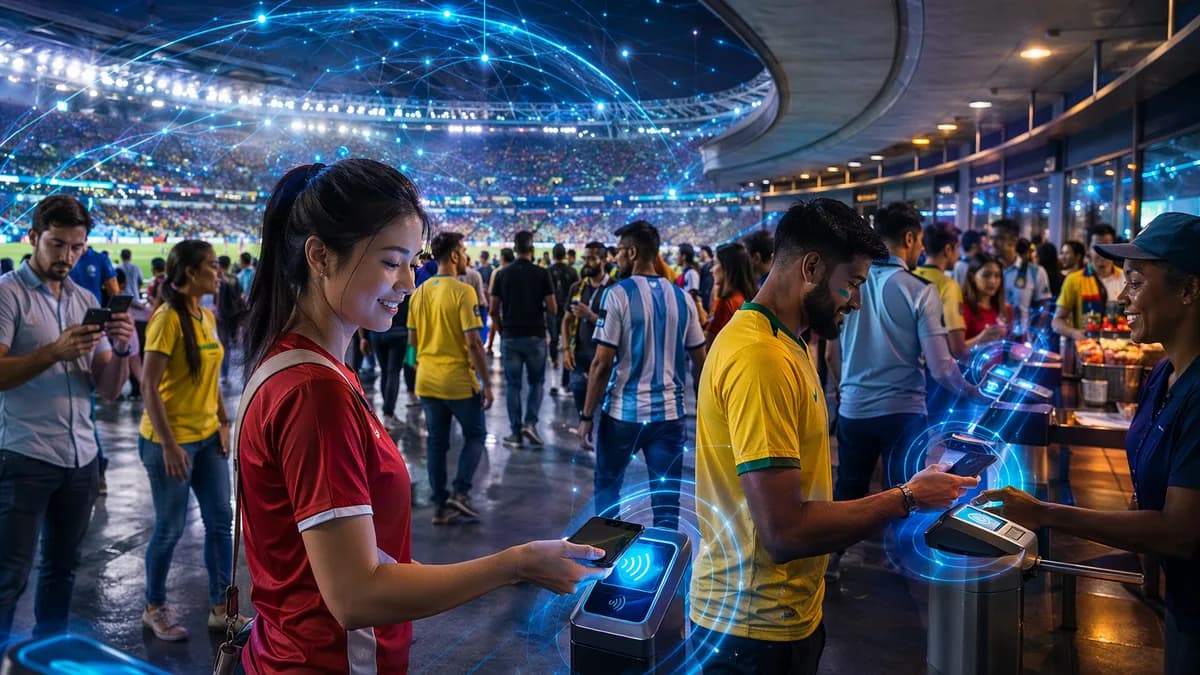
Visa's "Tap In" campaign ties digital payments to event content about teams and players through the same app. The company is showcasing contactless payments, including tap-to-pay in stadiums and its Tap to Score promotion.
"It's one of the few environments where scale and intensity come together in real time. You've got millions of fans moving through stadiums, cities and digital platforms all at once, which creates a really dynamic setting for consumers to interact with our technology, and our brand," Andrea Fairchild, senior vice president and global head of sponsorship strategy at Visa, told American Banker.
XOOMAR analysis: that sentence explains the whole strategy. The World Cup lets Visa test whether payment behavior changes when convenience is not abstract. Fans don't want a tutorial. They want the line to move.
This is also where adjacent commerce problems matter. Ticketing, checkout, and payments all sit in the same fan journey, which is why XOOMAR's coverage of 4 States Drag FIFA World Cup Ticketing Into Legal Fire belongs in the same conversation. If one layer creates friction, the rest of the experience absorbs the blame.
Which checkout tools get exposed when match-day demand spikes?
The current World Cup push centers on contactless cards, tap-to-pay, and app-linked payment experiences. Earlier tournaments show how far sponsors are willing to stretch the event format.
At the 2022 FIFA World Cup Qatar, Visa deployed 5,300 contactless-enabled payment terminals at official venues, including stadiums and the FIFA Fan Festival, according to Digital Transactions. Visa also piloted digital prepaid card issuance through QR codes and demonstrated facial-recognition payments at three Flat White Specialty Coffee branches in Qatar.
The lesson is not that every pilot becomes mainstream. Most won't. The lesson is that mega-events give payment companies a public stress test.
| Payment layer | What the sources support | What it tests |
|---|---|---|
| Contactless terminals | Visa used them at prior World Cup venues and is showcasing tap-to-pay this year | Speed, acceptance, line movement |
| Mobile wallet and app-linked payments | Visa's Tap In campaign ties payments to digital content | Repeat use, fan engagement |
| QR-issued prepaid cards | Visa piloted digital prepaid cards in Qatar in 2022 | Fast onboarding |
| Biometric checkout pilots | Facial-recognition payments were demonstrated in Qatar in 2022 | User trust and authentication |
| Transportation payments | NMI says difficult transportation payments would hurt visitor experience | First-touch payment friction |
XOOMAR analysis: the commercial prize is portability. If a checkout method feels natural in a packed stadium, it earns a stronger argument for airports, concerts, retail chains, hotels, and quick-service restaurants. If it fails there, the weakness is hard to hide.
Why are the numbers so attractive to Visa, SumUp, and NMI?
Because the tournament doesn't produce normal retail data.
SumUp found that 62% of U.S. adults plan to watch the event, and 33% of World Cup watchers say they will spend more at local businesses on match days than during a typical weekend day. SumUp also reports that 60% of adults pay with cards at local businesses during sporting events, while 14% use a mobile wallet.
That gives payment companies a rare behavioral sample: consumers under time pressure, merchants facing bursts of demand, and visitors testing unfamiliar checkout systems.
The downside is just as measurable. Forty-nine percent of U.S. adults say they would switch to a chain retailer if a local business' checkout is slow, according to SumUp. That should make small merchants nervous. A tournament can lift foot traffic, but weak checkout technology can hand the sale to someone else.
NMI adds a travel angle. Its research found that nearly half of U.S. consumers who traveled internationally in the past year say payments are faster or easier abroad. It also found that 77% of consumers say difficulty paying for transportation would negatively affect international visitors' overall experience of the U.S.
XOOMAR analysis: this turns payment acceptance into city infrastructure. The first transaction may not be in a stadium. It may be parking, transit, food, or a taxi. If that fails, the host city has already made a bad first impression.
How did mega-events become payment adoption engines?
Visa has been using global sporting events to test payment behavior for years. American Banker reports that the network piloted wearables and new forms of contactless payments as early as 2012.
The 2024 Paris Olympics offered a more recent data point. Visa reported that 78% of payments from international travelers in Paris and surrounding areas were contactless, which was 9% higher than the same weekend the prior year. Visa also saw a 26% increase in sales at local businesses from Visa consumers.
That history shows a shift. Earlier campaigns pushed card acceptance and terminal coverage. Today's World Cup payment tech is more about tying payment to identity, content, loyalty, and authentication.
Fairchild put Visa's goal plainly:
"When it works well, fans don't think about the tech, they just feel like everything is easier."
That is the standard every payment company wants to hit. Not novelty. Default behavior.
For fintechs outside the card network model, the same checkout-pressure lesson applies. XOOMAR has covered that tension in GoBTC Pay Targets Square With Bitcoin-First Checkout, where the question is not whether alternative payment rails can exist, but whether merchants and consumers will use them when speed matters.
Who judges the same payment experience most harshly?
Fans, merchants, sponsors, and regulators are not grading the same exam.
For fans, the winning system is the one that works quickly with the card, phone, or wallet they already trust. American Banker quotes Peter Galvin, chief marketing officer at NMI, saying visitors will judge host cities by how easy it is to get around, buy food and merchandise, pay for parking, and move without unnecessary friction.
For merchants, the stakes are more operational. Faster checkout can capture match-day spending. Slow checkout can push customers to chains, based on SumUp's findings. That puts pressure on local businesses near venues to modernize quickly, even if the tournament spike is temporary.
For sponsors, the prize is habit formation. Visa says it measures whether the technology improves the fan experience, whether more people choose it when available, and whether repeat usage continues beyond the event.
Zil Bareisis, banking and payments director at Celent, told American Banker that networks like Visa and Mastercard rest on three pillars: technology, rules of participation, and brand. Sponsoring events like the Olympics or World Cup can boost brand awareness, increase event spending, and sometimes showcase new technology that sparks adoption afterward.
XOOMAR analysis: this is the hard part. A payment system can be successful for a sponsor and still feel too controlled for consumers if it pushes them into a narrow app, wallet, or identity layer. The winning systems will reduce friction without making fans feel captured.
Which World Cup payment habits survive after the final whistle?
The strongest candidates are already familiar: contactless cards and mobile wallets. They have clear behavioral support in the sources, including Visa's Paris Olympics data and SumUp's sporting-event payment research.
More experimental tools, including biometric checkout and QR-issued prepaid cards, still need proof beyond a controlled pilot. The World Cup can make them visible. It cannot guarantee trust.
Retailers and fintechs should watch three signals after the event:
- Repeat usage: Do fans keep using the same payment method after the tournament?
- Merchant retention: Do local businesses keep upgraded checkout tools once traffic normalizes?
- Failure points: Do transportation, parking, food, and merchandise payments hold up during the busiest moments?
The World Cup won't invent the future of payments. It will reveal which checkout habits ordinary people accept when the line is long, the match is starting, and the easiest option wins.
Disclaimer: This XOOMAR analysis is for informational and educational purposes only. It is not financial, investment, legal, tax, or professional advice. It does not provide buy, sell, hold, price-target, portfolio, or personalized recommendations. Verify information independently and consult qualified professionals before making decisions.
The Bottom Line
- The World Cup gives Visa a massive real-world test of contactless and app-based payment behavior.
- High-pressure stadium purchases can reveal whether faster checkout meaningfully changes consumer habits.
- If fans adopt these payment tools during the tournament, those habits may carry into everyday spending.
World Cup Economic Scale
Primary Sources & Disclosures
Disclaimer: Content on XOOMAR is produced using AI-assisted research, drafting, and verification workflows and is intended for informational and educational purposes only. It does not constitute financial, investment, legal, tax, medical, or professional advice of any kind. All analysis reflects available information at the time of publication and may not be current. Verify information independently and consult qualified professionals before making decisions. Editorial policy

Written by
XOOMAR
Data desk
XOOMAR is a capital markets software and data company. Every brief on this site starts from a dataset the company collects itself from primary sources (CFTC, SEC EDGAR, FINRA, the Federal Reserve, exchange APIs) and names the numbers it is built on, with a link to the data page so you can check them. Briefs are reviewed before they go out and corrected in place when the data is revised.