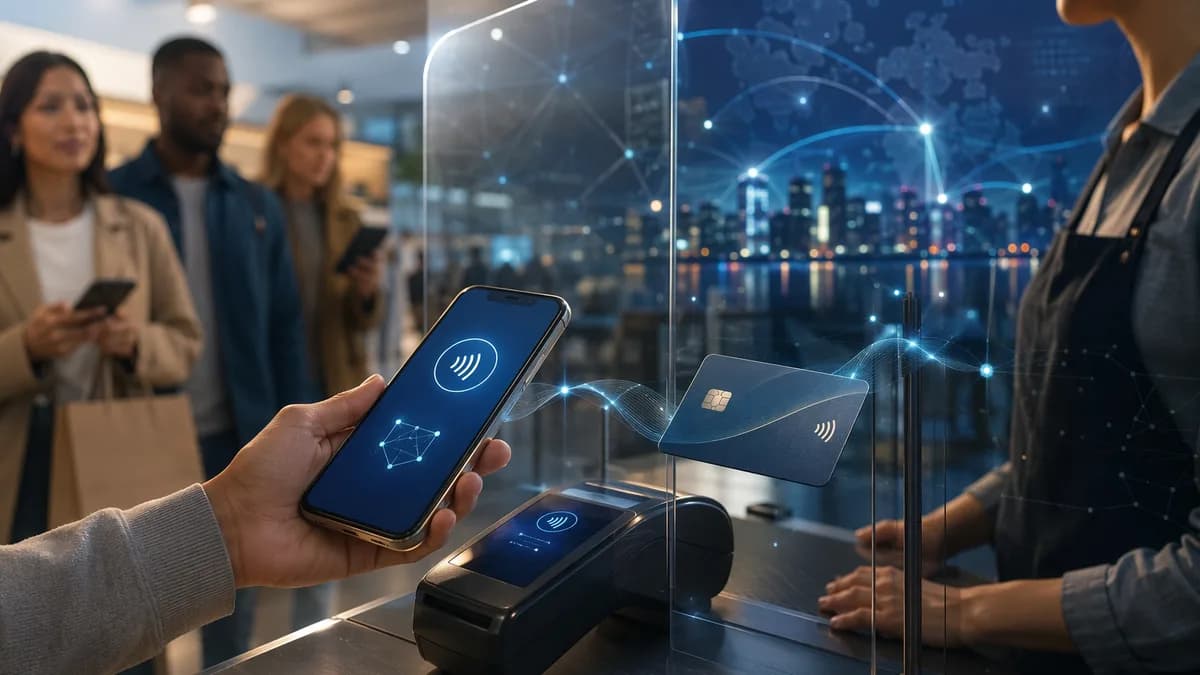
Click to Pay is gaining more visible traction outside the U.S. just as American banks risk letting another online checkout habit form without them.
XOOMAR Intelligence
Analyst Take
The card networks’ universal buy button has expanded in Europe and other markets, but U.S. adoption remains slower, according to American Banker. That gap matters because Visa, Mastercard, American Express, and Discover are trying to make cards feel native to e-commerce, not like 16-digit plastic credentials awkwardly dragged onto a website.
The deeper signal: this isn’t mainly a technology problem. It’s a behavior problem. A standardized checkout button can reduce friction, support tokenized payments, and limit manual card entry. But shoppers need to recognize it. Merchants need to see conversion upside. Banks need to explain why it’s worth using.
Click to Pay is gaining ground abroad while the U.S. checkout problem stays stubborn
Click to Pay launched in 2019 as a universal online checkout experience backed by the card networks. Its job is simple: make card checkout faster and more secure without forcing consumers to type card details into every merchant site.
The timing is not accidental. Card brands are moving toward much broader use of tokenization, with Mastercard saying it has committed to fully tokenizing every online transaction on its network by 2030. In this context, tokenization means replacing card numbers with temporary identifiers for security. It is unrelated to crypto tokens.
"It's very important that banks ensure cards stay robust," Nick Maynard, vice president of research at Juniper Research, told American Banker.
That line captures the strategic tension. Cards remain a major revenue stream for banks, but checkout is where consumer payment preferences harden. If a shopper defaults to PayPal, Apple Pay, Google Pay, a local wallet, or a pay-by-bank option, the bank-issued card can become less visible even when it still funds a transaction.
XOOMAR analysis: Click to Pay is the card industry’s attempt to keep the card credential central in digital commerce. The problem is that “central” at checkout now means fast, familiar, and almost invisible.
The adoption numbers show why global growth matters
The strongest reported momentum is outside the U.S. In Europe, Click to Pay is live in 32 markets, enrollments have more than doubled, and more than 70% of users return to use it again, according to a Mastercard spokesperson cited by American Banker.
In the U.S., the foundation exists but behavior has lagged. 90% of Mastercard consumer cards are enabled for Click to Pay, according to the same spokesperson. That is a large base, but enablement is not the same as habitual use.
The checkout pain is real:
- Manual entry: A 2024 Mastercard report, with data fielded in November 2023, found that 72% of consumers always or often manually enter payment information at checkout.
- Recent purchase behavior: A Visa report using data from late 2024 showed that around 21% of consumers manually entered information for their most recent online purchase.
- Merchant friction: Avin Arumugam, chief product and technology officer at payments platform Flute, told American Banker manual entry is “a huge problem” because it often leads to cart abandonment.
The source does not provide transaction growth, authorization rates, fraud-rate comparisons, or merchant acceptance totals for Click to Pay. That absence matters. Without those numbers, the case for merchants remains partly inferential: fewer fields and fewer failed moments should help conversion, but merchants will still want proof in their own checkout data.
Why Click to Pay travels better in some overseas markets than it does at home
Recent launches show where the push is happening. In May, Network International Jordan launched Click to Pay for e-commerce merchants through Mastercard Merchant Cloud. Last month, Visa launched Click to Pay for eligible Revolut Visa cardholders. Also last month, Worldline enabled Click to Pay for recurring payments.
Several banks outside the U.S., including Commonwealth Bank of Australia, Revolut Bank in the U.K., and ING in Spain, are actively promoting Click to Pay, Dan Coates, director of product management for the merchant segment at ACI Worldwide, told American Banker.
The U.S. has a different obstacle: shoppers already have plenty of familiar checkout shortcuts. Coates pointed to the prevalence of Google Pay and Apple Pay, saying, “People have a hard time seeing beyond that.”
Banks also have their own domestic focus. American Banker notes that many U.S. banks have put more attention on Paze, the bank wallet launched by Early Warning Services in 2023. That creates a strategic split: banks may support cards through Click to Pay, but they’re also backing a separate bank-led wallet effort.
XOOMAR analysis: international growth suggests Click to Pay can work when banks, networks, and processors make it visible. The U.S. problem is not lack of enabled cards. It is crowded checkout real estate.
Banks can turn enabled cards into actual Click to Pay behavior
The reported bank role is clear but narrower than many wish lists: education and promotion.
Consumers can enroll in Click to Pay through a participating bank, at checkout with a participating merchant, or through the Visa and Mastercard Click to Pay consumer portals. American Express and Discover advertise the service on their websites, but direct users to sign up at checkout.
That fragmented enrollment path explains part of the adoption drag. A consumer who sees a new button during checkout may not understand whether it is a wallet, a card feature, a security layer, or a merchant-specific option.
Banks can help by describing the product in plain terms: faster checkout, fewer passwords, and card security that travels across merchants. That is supported by the source’s core point that banks have an educational role and risk missing an opportunity if they do not push the service.
The same bank-relevance pressure appears in other payment rails. XOOMAR has covered how Blockchain Banking Exposes Slow Banks' Relevance Trap, and how Samsung Wallet Stablecoin Push Puts Banks on Notice. Those are different products, but the strategic issue rhymes: if banks don’t shape the payment interface, someone else will.
Merchants, issuers, networks, and shoppers each want a different win
Click to Pay sits at the intersection of four agendas.
| Stakeholder | What they want from Click to Pay | Reported hurdle |
|---|---|---|
| Merchants | Less checkout friction and fewer abandoned carts | They must opt in, and shoppers must recognize the button |
| Banks | Continued card usage in e-commerce | U.S. banks have also focused on Paze |
| Card networks | More tokenized online card transactions | Adoption is uneven by region |
| Consumers | A fast, familiar, safe checkout | Many already use Apple Pay, Google Pay, PayPal, or stored cards |
Gary Stein, managing director in Accenture’s North American payments practice, told American Banker that Click to Pay can be more economical for merchants because it removes Google and Apple as middlemen.
Rob Garf, chief strategy officer at Cordial, framed the merchant risk more bluntly:
"One of the holy grails for retail executives in this digital age is breaking down the friction between inspiration and purchase."
He added that if the payment process is “clunky,” consumers may leave the site, and Cordial’s research shows that after three bad experiences, a consumer will leave the brand entirely.
That is the merchant case for Click to Pay. But the consumer case is harsher. Shoppers do not care about network strategy. They care whether the button works, whether it is accepted often enough to remember, and whether it feels safer than typing card numbers again.
Click to Pay is part of a bigger network product push
Card networks are no longer just rails. They are selling security, identity, fraud, data, and checkout infrastructure around the transaction.
A related analysis from The Paypers notes that Mastercard’s developer APIs show around 90 products, while Visa offers API-based products for underwriting, fraud prevention, card benefits, foreign exchange rates, and more. It also cited VisaNet operating at 99.9999% availability in 2025.
That context makes Click to Pay easier to understand. It is not a standalone button. It is part of the networks’ broader move to own more of the checkout stack, especially as tokenization becomes the default security model for online card payments.
Eric Nelson, senior associate at TSG, compared the slower U.S. rollout to EMV acceptance trends. “At the 1996 Olympics, we were talking about EMV, and it took a good 10-plus years to really take hold in the U.S.,” he told American Banker.
That comparison is useful because standards often look slow until they don’t. But EMV also shows the catch: adoption takes coordination, incentives, and enough pressure to make delay expensive.
Click to Pay’s next phase depends on visibility, not just enablement
Mastercard’s 2030 tokenization target gives Click to Pay a long runway. The near-term question is whether consumers learn to trust the button before wallets and pay-by-bank options take more checkout mindshare.
Dave Scola, chief product officer at Form3, told American Banker that many customers are moving toward pay-by-bank, with younger consumers liking methods that let them pay directly from a bank account and avoid credit. He also said many merchants prefer to avoid interchange fees where possible.
That is the competitive squeeze. Click to Pay must prove it can make cards easier online while merchants weigh alternatives that may offer different cost structures.
XOOMAR’s read: Click to Pay won’t win by appearing as one more logo at checkout. It has to become part of the card industry’s trusted plumbing, visible enough for consumers to choose it, but simple enough that they don’t need to think about the network machinery underneath.
The evidence to watch is specific: more issuer promotion, broader merchant opt-in, repeat usage outside Europe, and harder data on conversion or abandonment. If those appear, Click to Pay’s international momentum can become a durable card-network advantage. If not, U.S. adoption may remain stuck at the gap between enabled cards and actual checkout behavior.
Disclaimer: This XOOMAR analysis is for informational and educational purposes only. It is not financial, investment, legal, tax, or professional advice. It does not provide buy, sell, hold, price-target, portfolio, or personalized recommendations. Verify information independently and consult qualified professionals before making decisions.
The Bottom Line
- Click to Pay could help card networks keep cards central in online commerce.
- Slow U.S. adoption gives wallets like PayPal, Apple Pay and Google Pay more room to shape consumer habits.
- Tokenized checkout may improve security, but banks and merchants still need to convince shoppers to use it.
Click to Pay Adoption by Market
| Market | Status | Implication |
|---|---|---|
| Europe and other markets | More visible traction and expansion | Card networks are making progress embedding cards into e-commerce checkout. |
| United States | Slower adoption | Banks risk letting rival checkout habits become default for online shoppers. |
Primary Sources & Disclosures
Disclaimer: Content on XOOMAR is produced using AI-assisted research, drafting, and verification workflows and is intended for informational and educational purposes only. It does not constitute financial, investment, legal, tax, medical, or professional advice of any kind. All analysis reflects available information at the time of publication and may not be current. Verify information independently and consult qualified professionals before making decisions. Editorial policy

Written by
XOOMAR Insights Team
Research and Editorial Desk
The XOOMAR Insights Team pairs automated research with human editorial judgment. We track hundreds of sources across technology, fintech, trading, SaaS, and cybersecurity, cross-check the facts, and explain what happened, why it matters, and what to watch next. We do not just rewrite headlines. Every article is fact-checked and scored for reliability before it goes live, and we link back to the original sources so you can verify anything yourself.