The Aqualung Peace
Two generations divided by the sky, united by a garden in the deep.
The Aqualung Gardens
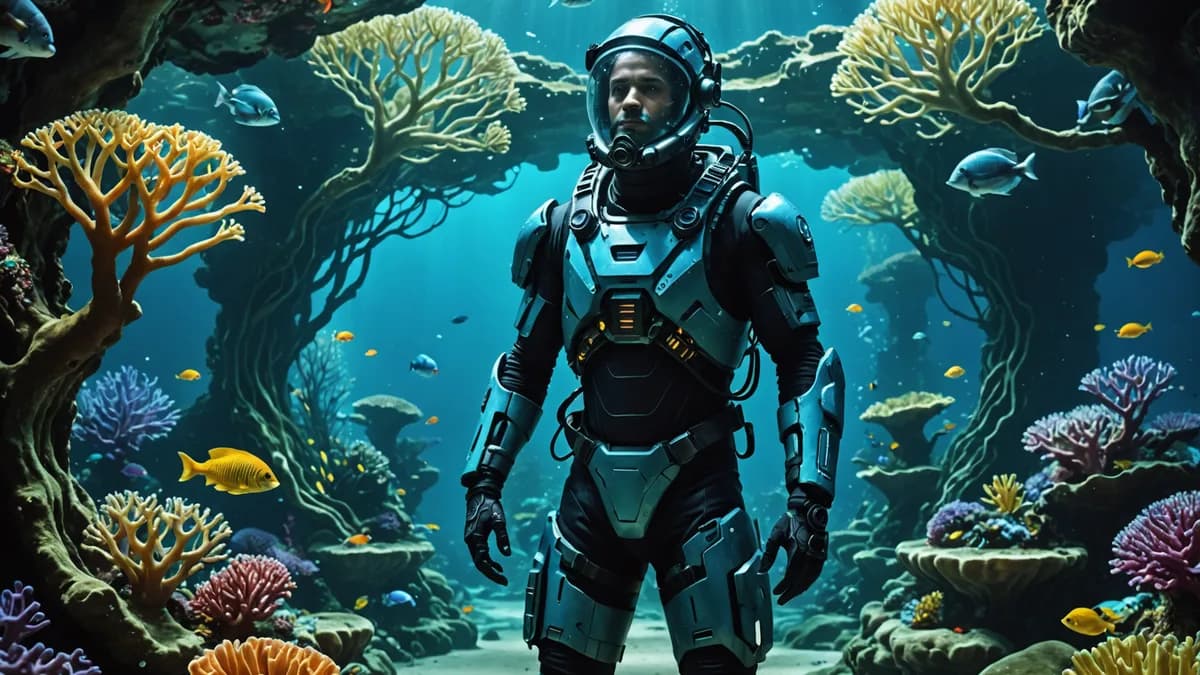
The water in the grotto is a living, breathing night. Tarik drifts within it, his movements slow and deliberate to conserve air. Before him, his garden glows. Strands of genetically adapted Pacific Gale kelp sway in the gentle current, their fronds emitting a soft, persistent blue light. Between them, colonies of starburst coral pulse with gentle amber and green, their symbiotic algae engineered to thrive in the cold, nutrient-rich depths. This is Tarik's revolution; a symbiotic deep-sea garden that fixes nitrogen, sequesters carbon, and produces edible, protein-rich fronds and fruits.
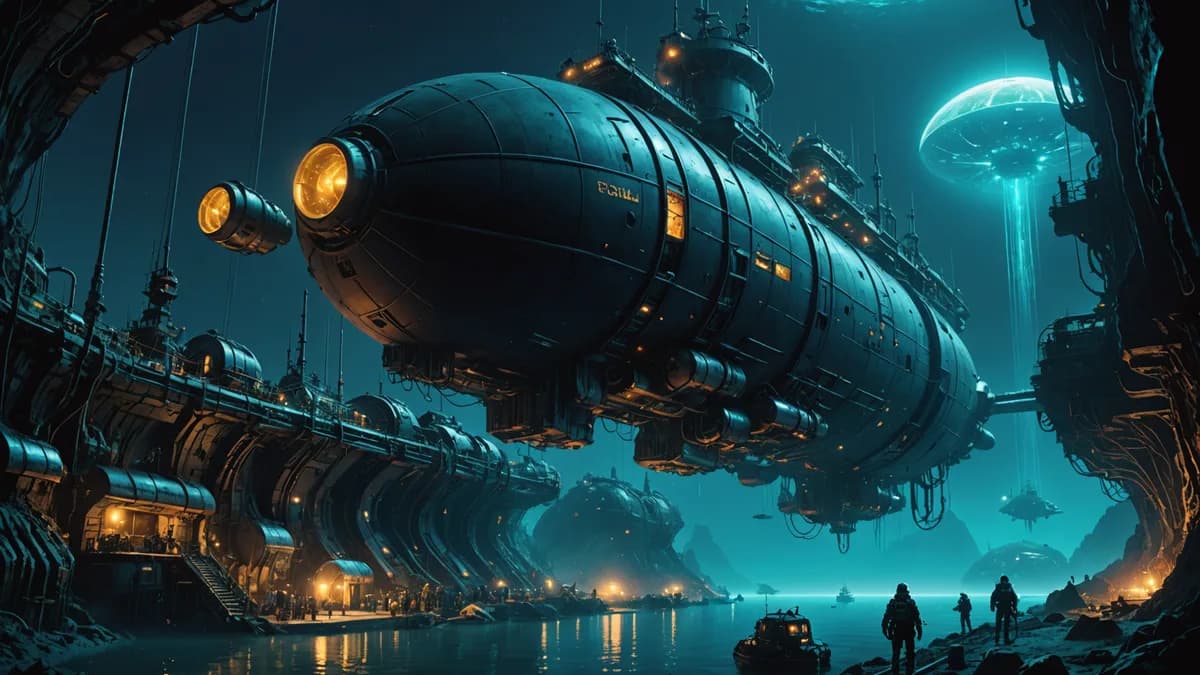
He feels the subtle, familiar vibrations of Aqualung-Epsilon through his suit’s tactile padding; the deep hum of the city’s pressure sphere two kilometers away, the low thrum of distant methane harvesters tapping the seabed vents. This garden is his answer to all that industrial noise. He pinches off a cluster of translucent "depth-berries" from a kelp stem, placing them in his woven collection basket. The berries glow faintly in his palm, a tiny captured constellation.
His comm-bead crackles in his ear, voice distorted by depth. "Tarik. Return to lockout. Priority."
"Harvest isn't done," he replies, his own voice sounding hollow.
"Now," the voice insists. "Surface delegation is early. Council wants all specialists in the arboretum gallery. You're assigned."
Surface. The word feels alien here, in the cradle of his luminous, silent world. The Sky-Farmers, the Suncursed, are here. Tarik looks at his garden, this fragile, glowing proof that life can be negotiated with, rather than extracted from, the deep. He wonders what they could possibly want from it, or from him. He kicks off gently from the seabed, his garden shrinking below him into a patch of defiant stars in the eternal dark.
Delegates from the Sun
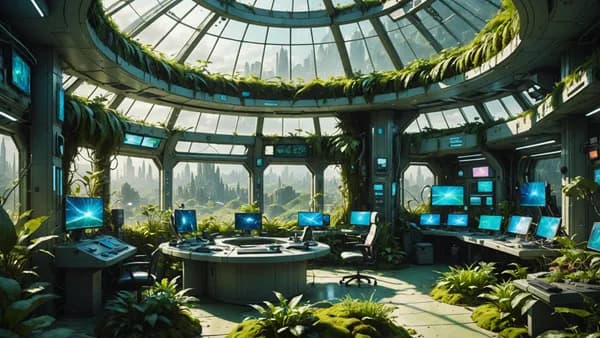
The arboretum gallery is a bubble of pressurized air and false sunlight, a jarring transition from the deep ocean. Here, plants from a lost world, palm fronds, ferns, grow under full-spectrum lamps, a psychological comfort for a people who have never seen the real sun. Tarik’s wetsuit drips onto the polished floor, marking him as an outsider even among his own.
The Sky-Farm delegation moves through the room like sharp, bright ghosts. Their clothes are loose, linen-white, designed to reflect heat. Their skin carries the even tan of controlled, orbital-mirror sunlight. Kalina, their lead atmospheric scientist, is all angles and focused intensity. Her eyes, a pale grey, scan the room, missing nothing.
The negotiation table is a slab of polished basalt. Tarik is seated at the far end, next to the city’s chief hydrologist.
"The issue is simple," Kalina states, her voice cool and precise. No pleasantries. "Your methane-harvesting operations at the Trench-7 vents are releasing unprecedented levels of methyl radicals into the lower stratosphere. It’s degrading our sunshade’s polymer lattice. You must curtail by seventy percent."
"Our city’s thermal regulation, our industry, relies on those vents," the Aqualung mayor counters, her voice tight. "You ask us to freeze in the dark."
"You live in the dark," Kalina says, and the word isn’t an insult, just a stark fact from her worldview. "We live by a precise balance of light. Your waste is crippling our mirror array. The Kessler Shield is all that keeps the surface from burning. We will not let it fail."
Tarik watches the divide solidify. It is not just about gas and polymers. It is about the Suncursed, who fear an untamed sky, and the Depthbound, who fear a choking, static dependence. He sees no bridge, only a widening abyss filled with mutual, generations-deep apprehension.
The Kessler Gambit
The talks spiral into a tense, silent stalemate for two days. Data is exchanged like artillery fire. Projections of atmospheric decay from the Sky-Farms clash with models of Aqualung economic collapse. Tarik spends the time in the lab, running absorption rates on his coral samples, feeling increasingly like a curiosity no one thinks to consult.
On the third day, Kalina stands. She doesn’t raise her voice. Its quiet clarity cuts through the room’s humid air. "You leave us no alternative. Our governing syndicate has authorized a demonstration of resolve. A contingency known as the Kessler Gambit."
She taps a panel, and a schematic floats above the table. It shows the vast, intricate network of the orbital sunshade. "We will temporarily pulse a sector of the shield. A coordinated tilt, for twelve hours, focusing raw solar flux on the North Atlantic gyre."
The Aqualung hydrologist goes pale. "You would boil the surface layers."
"Warm them, catastrophically," Kalina corrects, her gaze unflinching. "It would trigger a thermal barrier, disrupting the Atlantic meridional overturning current. Your deep-water thermal siphons would fail. Your city would lose its primary heat exchange. You would not freeze. You would slowly suffocate as your circulators stalled."
The silence is absolute, broken only by the hum of the air recyclers. It is geoengineering as a scalpel, aimed at the heart of their civilization. A weapon that uses the planet’s own systems against them. Tarik feels a cold anger, deeper than the ocean outside. They are playing with the very lifeblood of the world, a system both sides depend on but neither truly understands as a whole. He thinks of his garden, its delicate balance, and sees it snuffed out by this blunt, brutal calculus.
A Proof in the Deep
That night, Tarik makes a decision that could end his career. He bypasses three levels of security protocol, using his horticultural clearance to request a private, unscheduled dive. His guest: Kalina.
She is silent as they descend in the personnel lockout sphere, her face illuminated by the console lights, a mask of professional skepticism. When the outer hatch opens and they are engulfed by the ocean’s embrace, her breath hitches, just once, in his audio feed.
He leads her to the grotto. His garden unfolds below them, a silent, breathtaking galaxy on the seabed. He doesn’t speak at first. He lets the sight do its work. He sees the rigid line of her shoulders, visible through her borrowed Aqualung suit, slowly soften.
"This," he says finally, switching to a private channel, "is the data-pad can’t show you." He swims to a dense cluster of the pulsed coral. "These symbionts don’t just grow food. They are carbon pumps. And methane sinks." He gestures to a nearby vent, a tiny cousin to the industrial ones causing the crisis. A faint shimmer of gas rises from it, only to be captured and woven into the growing lattice of a coral colony. "We’ve been harvesting methane as a fuel. A waste product. But here, it’s a feedstock."
Kalina drifts closer, her gloved hand extended but not touching the glowing organisms. "The sequestration rate?"
"Twenty times better than our open-sea kelp forests," Tarik replies. "My project was approved for food security. But its real value is here. We don’t need to stop harvesting. We need to redirect it. Pipe it here, to garden hubs like this. Your atmospheric methyl radicals come from vent leakage and processing byproducts. We can eliminate the leakage and convert the byproduct into limestone and biomass."
She turns to look at him, her grey eyes wide behind her visor. In the bioluminescent glow, her face is no longer that of a stern delegate, but of a scientist witnessing a fundamental truth. The proof is not in a threat, but in this thriving, silent, beautiful solution. "You’ve quantified this?" she asks, her voice barely a whisper.
"On a small scale," he says. "The question is whether you see a weapon, or a tool. Whether we see each other as a problem, or a partner."
The Atmospheric Handshake
The atmosphere in the arboretum gallery the next morning is different. The basalt table is still there, but the lines drawn across it seem less permanent. Tarik presents his findings, his models now bolstered by the raw, undeniable witness of Kalina.
The new framework is built not from demands, but from symbiosis, much like his garden. The Aqualung cities will not cease methane harvesting, but will deploy a network of sealed pipelines to direct a majority of the resource to new, expanded Garden Hubs for sequestration. Sky-Farm atmospheric auditors will have real-time access to the process, a guarantee of transparency.
In return, the Sky-Farms will share their most precious commodity: light. Not raw sunlight, but centuries of proprietary data on optimal photosynthetic spectra. This knowledge will be fed into the Aqualung agricultural grids, boosting the efficiency of all subsea food production, not just Tarik’s gardens.
The agreement is ratified with digital signatures that flicker above the table. But the true seal comes after. As the delegates mill, talking in hushed, hopeful tones, Kalina approaches Tarik. She holds out a small, sterile cultivation cylinder.
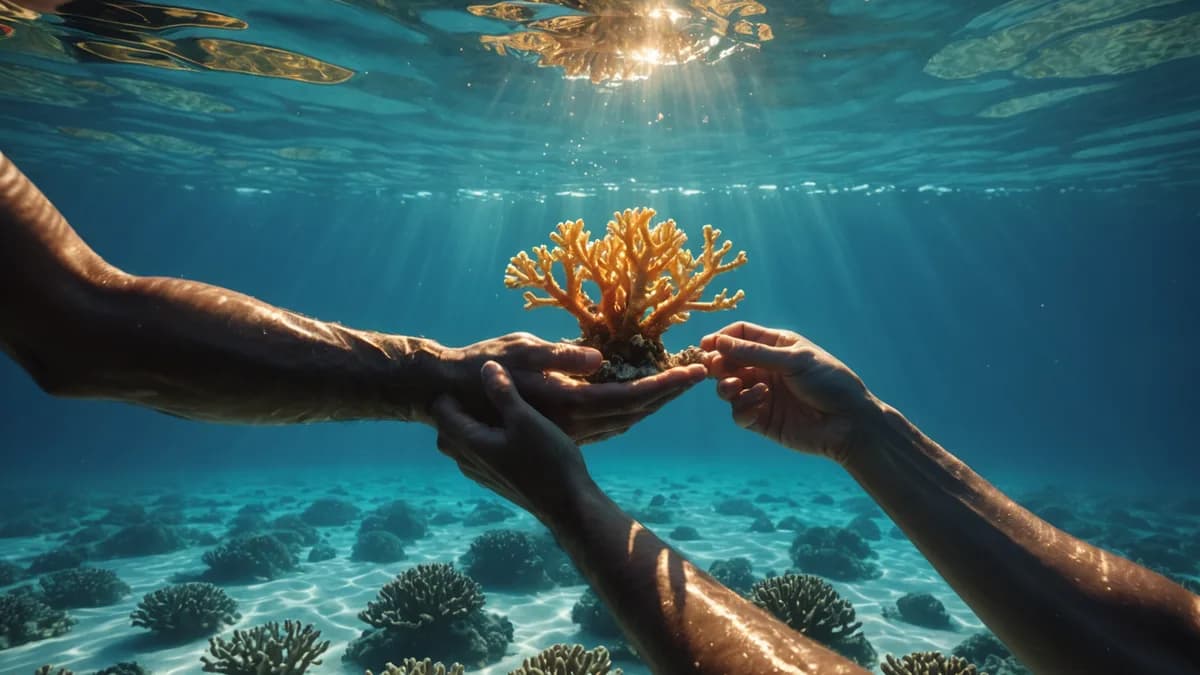
"For your archives," she says. Then she produces a second, empty one. "And for mine. If you would share a cutting. I have an experimental water tank on my station. I want to see if a piece of this peace can grow with us, in the sky."
Tarik, moved beyond words, selects a small, robust fragment from his prime coral colony. It pulses gently as he seals it in the cylinder. It is not a document, but a living contract, a piece of the deep destined for the sun.
First Harvest, Shared Light
Months later, the ocean above Aqualung-Epsilon is a sheet of hammered silver under the diffused, gentle light of the stabilized sunshade. The first joint harvest is ready.
Tarik rides a buoyant cargo pod to the surface. Breaking into the air is always a shock; the sudden lightness, the vastness of the sky. Today, it is not threatening. A Sky-Farm agri-dirigible hangs above him, a silent, elegant whale of doped fabric and light alloy. A boarding ramp extends down, kissing the water.
Kalina walks down to meet him. She wears a practical sky-blue jumpsuit, her face no longer bearing the stern mask of the delegate, but the focused calm of a collaborator. Between them lies the interface, the shimmering, fragile membrane where their two worlds meet.
"Your grain," Tarik says, his voice sounding strange in the open air. He passes her a sealed crate. Inside are sacks of "Abyssal Pearl," a protein-rich grain milled from the seeds of his deepest kelp strains.
"And your fruit," Kalina replies, handing him a crate of her own. It holds cloud-grown quinoa and strawberries cultivated under precise spectral arrays, fruits that have never known soil, only mist and optimized light.
They stand for a moment, the crates between them on the floating platform. The dirigible’s shadow dapples the water. Tarik looks up at the sky, a serene, managed blue, and then down into the dark water from which he came. Kalina follows his gaze.
"The coral cutting," Tarik asks. "Did it take?"
"It’s growing," she says, a hint of wonder in her voice. "It pulses at night. The crew gathers to watch. They call it the Depth-Star."
He smiles. There is no grand ceremony, no sweeping speech. There is only this exchange, this tangible result of a choice made over threat. The sun, filtered and kind, glints off the water between them, catching the wake of a passing pod of real whales. The thread connecting their worlds is fragile, biological, fraught with future challenges. But for now, it is alive, and it is growing in both directions, towards the light and into the deep.