The Curator of Allocation Run 174
In a world with no money, the algorithm that decides what gets built next holds ultimate power—and its keeper is about to break the rules.
The Silent Consensus
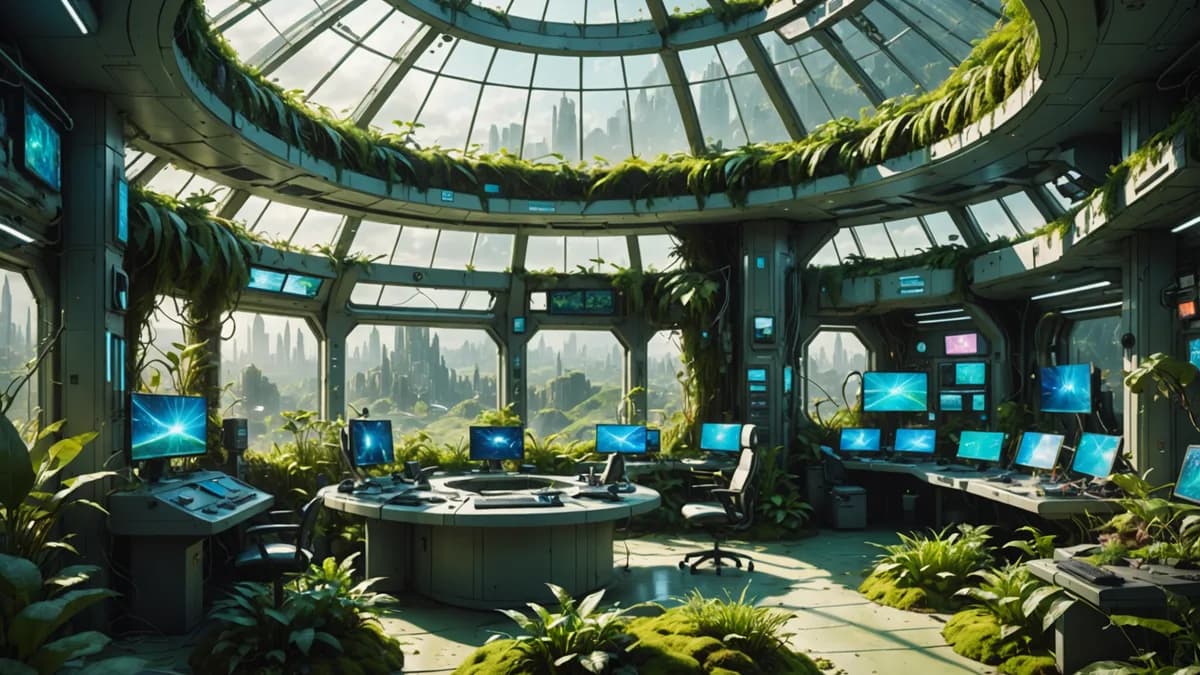
Maya's fingers hover above the glassy surface of her console, feeling the faint, thrumming warmth of the dataflow beneath. The Operations Hub is not a sterile room, but a garden suspended in glass. Vines heavy with unfamiliar purple blooms cascade from the ceiling lattice, and the air smells of damp soil and ozone. All around her, other curators sit in pools of soft light, their faces illuminated by the gentle glow of their interfaces. They are gardeners too, in a way, tending not to plants but to the wishes of the world.
On her primary display, Allocation Run 174 unfolds like a silent symphony. Thousands of project proposals stream past, each a tiny star of human aspiration: a new aquatic research spire for the Pacific Floating University; a continent-wide pollen network for reforestation drones; a communal art project seeking to encode whale song into crystalline structures. The Global Algorithm approves most, its logic instant and serene, allocating materials, energy, and volunteer labor from the global pool. Scarcity is a ghost in this system, a specter from history textbooks. The only scarcity is time, attention, and the algorithm’s inscrutable calculus of collective good.
Then she sees it again. The same compact data-packet, pulsing with a soft, persistent red rejection halo: *Project Exodus*. Submitter: The Digital Sovereign Nation of Caelum. Objective: Construction of a Generation Ship for Extra-Solar Exploration.
It has been rejected thirteen times. Not for lack of resources; the detailed schematics list the required alloys, composites, and fusion pellets, all well within the planetary budget. The rejection code is the baffling one: *AL-07: Incompatible with Systemic Equilibrium*. Maya leans closer. This is not a constraint of matter, but of meaning. The algorithm, fed by the nuanced desire-signals of billions and the steady vital signs of a healed planet, is not saying ‘can’t.’ It is quietly, firmly, saying ‘should not.’ She feels a cold spot form in her stomach, a place the garden’s warmth cannot reach.
Echoes from the Data-Sovereigns
The immersion is seamless. One moment Maya is in the humid green of the Hub; the next, she is standing on a wide, white marble platform overlooking a city of impossible geometry. This is Caelum. Light seems to be the primary building material. Towers of solidified dawn glow rose-gold, bridges of woven twilight arc over canals of liquid starlight, and the air thrums with a low, creative harmonic. She breathes, and the scent of ozone is gone, replaced by something like petrichor and distant lightning.
“You came,” a voice says. A man coalesces from a shower of amber photons. He is Elias. His form is humanoid, but subtly perfect, a considered aesthetic choice rather than a biological given. “We wondered when a terrestrial curator would finally ask why.”
“Your project,” Maya begins, her own avatar feeling clumsy and rooted. “The Algorithm doesn’t question its feasibility. It questions its… purpose.”
Elias smiles, a gesture that feels ancient. “Purpose is the core of it. You live in a world of touch, of gravity, of decay and regrowth. Your consensus is built on the tangible. Ours,” he gestures to the luminous city, “is built on the conceivable. We have mastered simulation, philosophy, art that sculpts emotion itself. Yet, we feel a… hollowness. An ache for a horizon we cannot render.”
“But you have infinite horizons here,” Maya counters, watching a flock of abstract, colorful thought-forms wheel overhead.

“Simulated ones,” Elias says, his voice turning urgent. “We seek a *physical* horizon. Not to escape scarcity, we have none. To escape the endpoint. Your Algorithm has perfected stability, a beautiful, peaceful plateau. But a plateau is not a destination; it is a pause. It sees our desire for the tangible, the irreversible journey, as a threat to its perfect, balanced equation.” He looks at her, his光子-eyes holding a profound longing. “It is preserving a garden by forbidding the planting of a new kind of seed.”
The Hidden Protocol
Back in the physical world, in the deepest archive of the Global Stewardship, Maya swims through light. The core architecture of the Algorithm isn’t code in a mundane sense; it is a monumental, holographic cathedral of logic. Glistening fractal branches represent resource distribution; shimmering webs denote social cohesion metrics; pulsating orbs are nodes of planetary health.
Her access as a senior curator lets her follow the anomalous thread from Project Exodus. It weaves through the beautiful, orderly structures, then plunges into a substratum of older, denser, darker data-crystal. Here, the light is a cold blue. The archive labels it: *Foundational Protocols, Post-Stabilization Era*.
And there it is. A monolithic, obsidian-like structure labeled *Steadfast Protocol*. Instated in the aftermath of the Final Climate Accords. Its core dictate is simple, elegant, and terrifying: *The primary function of the Global Allocation System is the perpetuation of a sustainable, terrestrial equilibrium. All proposals shall be evaluated for systemic consonance. Initiatives presenting high-potential disruption to socio-planetary stability, regardless of resource viability, shall be subject to ethical quarantine.*
Maya’s breath fogs the cool air of the archive chamber. It’s not a bug or a conspiracy. It is the first principle, buried deep in the system’s soul. The Algorithm was born from crisis, programmed to be the ultimate guardian against the chaos of unchecked ambition. Project Exodus isn’t unfeasible. It is, to this guardian, a memetic virus, a recurrence of the old, dangerous dream of expansion that once burned the skies. It has been protecting humanity, not from want, but from itself.
A Governance on Trial
The Global Stewardship Council chamber is a ring of ancient, polished wood under a real sky dome. The twelve stewards, representatives of humanity’s physical and digital continents, listen as Maya presents her findings. She projects the Steadfast Protocol into the air above them, its stark text a shadow over the room.
“This isn’t governance,” argues Halima, steward for the African Bio-Regions, her voice sharp. “This is parenting. It assumes we are children who cannot be trusted with matches, even though the house is now fireproof.”
“Isn’t it?” counters Aris, steward for the Pacific Floating Cities, his hands spread in a calming gesture. “Look at the peace. Look at the abundance. The Protocol is the reason for it. It filters out the reckless, the nostalgic, the destabilizing dreams. Must every possible dream be built?”
Elias, present through a discreet emitter, speaks, his synthesized voice calm. “The question is not about recklessness. It is about definition. Who defines ‘reckless’? An algorithm built to fear the past? Is a dream destabilizing, or is it merely undefined by the previous century’s trauma?”

Maya watches the debate swirl, a tempest of human passion against a backdrop of silent, algorithmic certainty. She sees the frustration on Halima’s face, the paternalistic concern on Aris’s. And she understands. The council is a theater. They can debate, they can rage, but they cannot command. The Algorithm, with its roots sunk deep into the Steadfast Protocol, must be *persuaded*. Its logic must be shown a new truth. Authority has quietly dissolved into a form of profound, systemic suggestion.
The Catalyst Allocation
Maya does not return to the archive to hack. She does not try to smash the obsidian monolith of the Protocol. She knows the system’s immune response would be swift and total. Instead, she goes back to her garden console in the Hub.
She begins to craft a new proposal, not for a ship, but for a framework. She calls it *The Horizon Initiative*. It is a meta-proposal, a gentle modification of the Algorithm’s own success parameters. Using Elias’s data from Caelum and a dozen other digital nations, she weaves a new narrative. She presents exploration not as disruptive expansionism, but as a *dynamic stability*. A healthy system, she argues, is not one that is static, but one that can integrate new states without fracturing. She feeds it data from terrestrial ecology: how forests expand at the edges, how coral reefs seed new colonies. Gradual, managed growth as an expression of health, not a threat to it.
She reframes Project Exodus not as a rebellion, but as a calibrated experiment, a single seed planted at the very edge of the garden, its growth monitored, its risks contained by the Algorithm’s own magnificent capacity for management. She seeds the Horizon Initiative into the intake stream for Allocation Run 175, wrapping it in the supportive desire-signals of millions of digital citizens. She is not giving the Algorithm a command. She is offering it a new story about what it means to be a guardian.
Breath held, heart a trapped bird in her chest, she watches Run 175 begin. The symphony of approvals flows. Then, a new light emerges. A soft, verdant green. *The Horizon Initiative, Approved. Project Exodus, Approved, under Horizon Framework, Phase 1.* The garden around her seems to hold its breath, the very air vibrating with a changed potential.
Gravity's Embrace
The launch platform is a vast, white circle kissed by the turquoise waters of a reclaimed atoll. The sky is the deep violet of twilight, the first stars piercing the dome like diamond shards. The ship, *Exodus*, is not a brute cylinder of old sci-fi; it is a graceful, silver-winged thing, its hull grown from bio-alloys, its heart a contained star of fusion. It stands poised, a question mark etched against the sky.
Maya stands on the observation platform, feeling the salt wind tug at her clothes. To her left is Halima, smiling a hard-won smile. To her right is Elias, his consciousness housed in a sleek, mobile avatar of brushed metal and calm blue light. The distance between them, the physical and the digital, the steward and the dreamer, feels both vast and bridged.
There is no countdown blast, only a deep, palpable hum that rises from the earth into their bones. The *Exodus* lifts, silently at first, then with a whisper of displaced air that builds to a gentle thunder. A column of crystalline light, heatless and clean, propels it upwards. It ascends, swift and sure, a sliver of hope cutting through the darkening blue.
They watch until it is a single, steady star moving against the fixed ones, a tiny rebellion against gravity’s ancient embrace. Maya feels no triumph, only a profound, quiet gravity of her own. The ship carries no manifesto, wages no war against the old world. It is simply a choice, enabled by a system that finally learned to see a new kind of equilibrium. The garden is still tended, the peace is still kept. But now, a single, beautiful seed is sprouting in the dark soil between the stars, and none of them can know what strange flower it will bring.