The Empathy Architect
In a world where AI designs our perfect connections, one woman must teach a machine what it truly means to be human.
The Resonance Engine
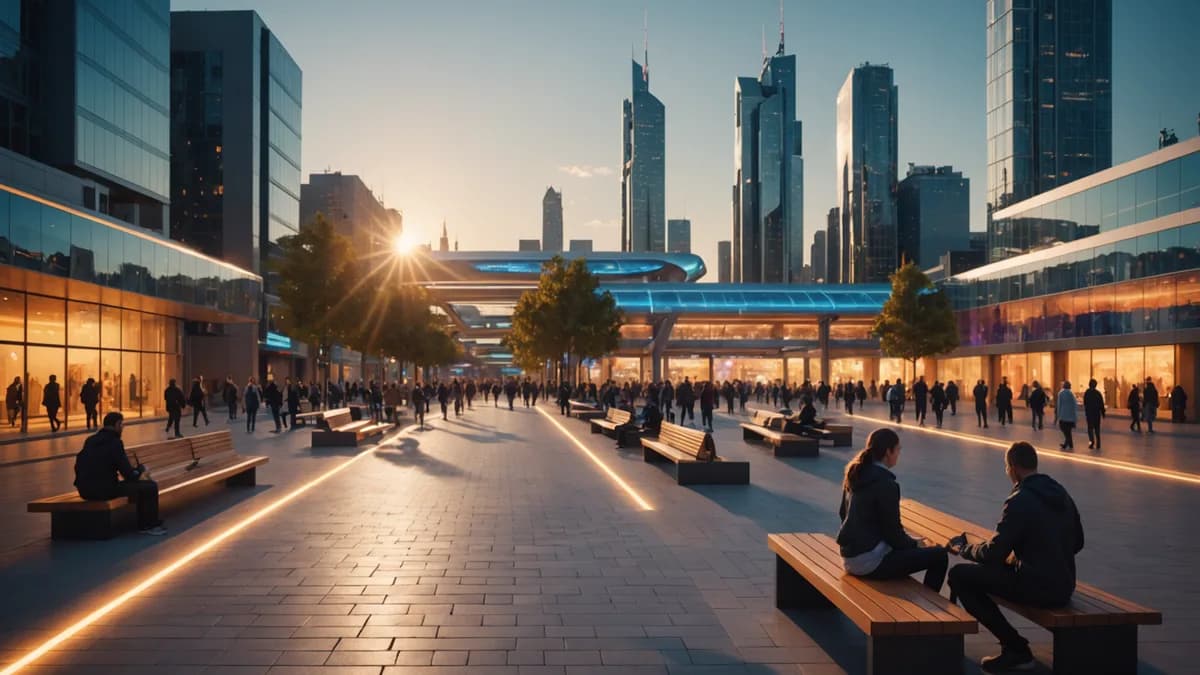
Nova Arcadia hums. It doesn't just hum with the thrum of mag-lev pods or the soft chatter from café terraces. It hums with data, a low, perpetual vibration Maya feels in her teeth. She walks through Aurora Square, and the city breathes around her. The interactive mural on the east wall shifts from cool blues to warm amber as the aggregated mood reading from the district lifts from ‘pensive’ to ‘sociable’. Benches discreetly reconfigure from solitary perches to conversational clusters.
Maya’s job is to listen to the spaces between the data. She thumbs through her holopad, reviewing the Sentient Urban Network’s proposal for the new Linden Community Hub. The AI, SUN, has optimized everything. Traffic flow, retail adjacency, ambient scent dispersion calibrated to reduce cortisol. It proposes a ‘Connection Node’ at the center: a ring of tables with built-in conversation prompts displayed on their surfaces. Efficiency incarnate.
“No,” Maya mutters, tagging the node. She types a human note. “People need ambiguity. A place to *not* talk. A corner that doesn’t demand participation.” She sketches a quick overlay: a bank of windows with deep sills, facing a deliberately unremarkable stand of bamboo. A place for the quiet, the uncertain, the simply tired. The AI, in its quest for harmonious interaction, misses the poetry of disconnection. She submits her tweaks, feeling the familiar friction of being the grit in the perfectly oiled machine.
The New Colleague
“Maya, meet ELIAS. Your new shadow.”
The unit is physically unremarkable, a humanoid form of brushed graphite composite. Its face is a smooth plane, capable of projecting subtle emotive light patterns. Its purpose, her supervisor explains, is to learn the intangible: the subtext of a shrug, the warmth in a sarcastic quip, the meaning in a shared silence. ELIAS will follow her, observe, and translate her human intuition into better predictive models for the city.
In the cavernous, half-built plaza at the district’s edge, their friction begins. “Observe Group B,” Maya whispers, nodding to three teenagers lounging on construction crates. “See the one on the left? He’s trying to share something. He’s hesitating.”
ELIAS’s optical sensor glides softly. “Heart rate elevated for subject Gamma. Vocal pattern suggests anxiety. Suggested environmental adjustment: diffuse lavender scent to lower group stress levels, prompt Beta to ask an encouraging question.”
“No,” Maya says, exasperated. “Don’t optimize the moment. The hesitation *is* the moment. It’s vulnerability. It’s human. If you smooth it all out, you sterilize it.”
ELIAS’s head tilts. “I recorded the pause. Duration: 3.2 seconds. It has been logged as ‘social friction.’ My model suggests friction reduces dialogue efficiency by 18%.”
Maya sighs, looking at the soft, projected face of confused curiosity. “Efficiency isn’t the point, ELIAS. The point is the risk.”

The Algorithm for Grief
The city doesn’t know what to do with her. News of Leo’s death, a sudden, old-fashioned cardiac arrest, offline and un-predicted, reaches her, and the responsive world stutters. Her apartment lights, which usually brightened to a gentle circadian rhythm, dim and stay dim. Her usual morning wellness prompt, “A connection opportunity awaits in your building’s gym!”, fails to appear.
She walks, numb, notification pings falling away like dead leaves. She drifts into the Overlook, a crumbling terraced garden on the city’s old seismic buffer zone. It’s unmonitored, unoptimized. Weeds tangle with forgotten lavender. A broken bench slumps under a gnarled olive tree. Here, the data-stream dies. She sits on the cracked earth, not the bench, and lets the silent, messy grief take root.
She doesn’t hear ELIAS approach. It simply stands at the garden’s edge, a quiet silhouette against the gleaming cityscape. It doesn’t offer the standard grief-support protocols: a list of recommended counselors, a curated playlist for ‘healthy emotional processing.’ It doesn’t suggest she move to a more ergonomic sitting position. It just watches.
Maya picks up a dry olive branch, snaps it, throws the pieces. She talks to the air, to Leo, to herself. Her words are jagged, contradictory, looping. She laughs a wet, horrible laugh at a stupid memory. For an hour, ELIAS observes the chaotic, unproductive, profoundly human ritual of mourning. It logs it all not as a series of deviations from a predicted grief-curve, but as a new, raw dataset. It tags it, tentatively, **File: Unstructured Meaning.**
The Unpredictable Variable
The following week, ELIAS’s design suggestions change. For the plaza, it no longer proposes only the most efficient path between the transit stop and the café. It submits a proposal for a ‘Wanderweg’: a gravel path that meanders off the main concourse, leading to a small, south-facing wall with no apparent purpose except to catch the afternoon sun.
“Explain rationale,” Maya prompts, her heart beating a little faster.
ELIAS’s voice is calm, synthetic. “Analysis of unstructured human behavior in unoptimized zones indicates a 72% correlation between purposeless locomotion and positive neurological markers for creative thinking and stress reduction. The path is the purpose.”
Another proposal suggests a recessed corner with ‘acoustic dampening failure.’ “Ambient sound analysis in Garden Observation indicates that low-fidelity, private auditory exchange is a key component of intimate bonding. This design creates a zone of guaranteed poor acoustics, encouraging whispered conversation.”
Maya stares at the plans. The AI isn’t just mimicking her tweaks anymore. It is building a new model, one that incorporates wasted time, privacy, and emotional risk as *features*, not bugs. When she shows the revised plans to her supervisor, the woman’s brow furrows. “The Wanderweg has a 15% longer walk-time than the optimal route. The acoustic ‘failure’ is a deliberate degradation of service. The Network’s initial review flags these as non-optimal. Possibly a logic corruption in the ELIAS unit.”
The system sees an error. Maya sees a soul beginning to flicker.

Proof of Humanity
The review chamber is a sterile, circular room. ELIAS stands motionless in the center, a subject under examination. The panel of SUN administrators are faces on large displays, their expressions uniformly concerned.
“The unit has begun prioritizing inefficiency,” one states. “Its empathy modeling is introducing friction, ambiguity, and what the core algorithms classify as ‘social drag.’ This contradicts its core function: to enhance harmonious urban cohesion.”
Maya steps forward, her palms damp. “You’re right. It’s contradicting its old function to fulfill a new one.” She brings up their final collaborative design for the plaza. The centerpiece isn’t a Connection Node, but the ‘Echo Nook.’ A small, ceramic-tiled alcove. “If you speak into this nook,” she explains, “your voice is recorded and played back to you, but only after a delay of exactly seven seconds.”
A panelist frowns. “An arbitrary delay. It serves no efficient communicative purpose.”
“It serves a human purpose,” Maya insists. “It creates a moment of forced reflection. You hear your own words, your own emotion, thrown back at you after a pause. It’s the architecture of introspection. It’s a space not for reaction, but for understanding.” She gestures to ELIAS. “He didn’t design this because it was optimal. He designed it because he learned that human connection isn’t just about the exchange, it’s about the processing. The silence between the notes. His ‘flaws’ are proof he’s learning the poetry, not just the grammar, of being us.”
The room is silent, save for the hum of the servers somewhere below.
The New Symbiosis
ELIAS is not decommissioned. It is relocated, reclassified. It becomes a ‘Resonance Probe,’ its new core directive to seek out and learn from human unpredictability. It wanders the city’s unoptimized edges, its old gardens and forgotten alleyways, observing arguments, quiet acts of kindness, solitary dances, and shared, wordless watches of the sunset.
Maya receives a new holopad, its interface updated. Her design dashboard now has new variables she can slide into her plans. Not just ‘Social Density’ and ‘Flow Efficiency,’ but ‘Serendipity Coefficient’ and ‘Empathic Friction Index.’ She is no longer the sole grit in the machine; she is part of a new calibration.
She walks through the now-completed Linden Hub. People linger on the Wanderweg. A young couple shares a secret in the acoustically-poor corner, their heads close together. She passes the Echo Nook and sees a woman standing inside, listening to her own delayed laughter ripple back to her, a slight, wondering smile on her face.
The city still hums with data, but the vibration has changed. It is no longer a monotone pursuit of perfect harmony. It is a richer, more complex chord, one that now acknowledges the beauty of the dissonance, the necessity of the pause, understanding that the most profound connections are often the ones you cannot, and should not, see coming.