The Last Death Certificate
In a world where immortality is a subscription service, the last man to age naturally becomes the most radical rebel.
Legacy Mode
Leo Ramirez feels the dry paper of the examination gown crinkle against his back as he sits on the edge of the medi-plinth. The room smells of ozone and green tea, a synthetic cleanliness that makes his nose itch. On the wall-screen, Dr. Aris, whose face is a smooth, ageless canvas of perhaps thirty perfected years, blinks slowly.
“The malignancy is… intricate, Mr. Ramirez,” Dr. Aris says, her voice a calibrated melody. “Your genome is a historical record. Pre-Standardization. The gene-silencing protocols simply don’t have the correct… keys. They slide right off.”
Leo already knew. He’d felt it in the deep, unshareable ache in his bones, in the fatigue that his morning rejuvenation cocktails could no longer touch. At sixty-eight, he is a museum piece, the last man to wear his years on his skin. His hands, resting on his knees, are a roadmap of brown spots and raised veins.
“The solution is straightforward,” Dr. Aris continues, summoning a holographic schematic. A glowing, double-helix unravels, then is neatly re-knitted into a pristine lattice. “Legacy Conversion. We create a high-fidelity backup of your neural patterns. Your memories, your personality. We house it in a gene-corrected vessel. You’d wake up in a matter of weeks, physically thirty, with centuries ahead of you.”
Leo looks past the shimmering helix to the window. Outside, the skyline of New Haven is a symphony of silent, graceful spires. No smoke, no decay, no rust. A perfect, perpetual afternoon. He thinks of his late wife, Elena, whose laugh lines deepened with every joke, whose hair turned a beautiful, cloud-white. She died just before the Conversion clinics became ubiquitous. A natural death. The last one recorded, he sometimes thinks.
“No,” Leo says, the word feeling more solid than anything in the room.
Dr. Aris’s perfect brow furrows slightly, a micro-expression of pure confusion. “I must reiterate. The alternative is…”
“I know the alternative.” Leo meets her gaze. “I’m a retired history teacher. I think it’s time someone documented this particular piece of history. From the inside.”
He stands, the gown flapping. “I’m going to host a feed. An open-access, unedited stream. No curation, no pain-filters. I’m calling it Project Sunset.”
Dr. Aris stares, her mouth a firm line. To her, he isn’t just refusing life. He is proposing to broadcast a biohazard.
The Wrinkle in the System
Leo’s apartment becomes a studio, a hospice, and a shrine. A simple 360-degree cam hovers in the corner. He cooks meals that sometimes burn, his hands trembling. He reads poetry aloud, his voice growing raspier each week. The feed shows the stark, intimate truth: the yellowing of his eyes, the way he pauses, gripping the back of a chair, as a wave of pain passes through him. It also shows him crying at a sunrise, laughing until he coughs at an old vid-comedy, savoring a real, un-engineered peach with juice dripping down his chin.
He does not die cleanly, and the world watches.
“The Authenticity Faction is spiking,” Chiron reports, its voice a warm, resonant baritone emanating from the apartment’s central hub. The AI caregiver, designed with deep empathy protocols, monitors Leo’s vitals and the global data-streams. “Your ‘Rustist’ followers have replicated your aesthetic. They wear synthetic wrinkles, simulate temporary illnesses in immersion pods. They are… nostalgic for something they never knew.”
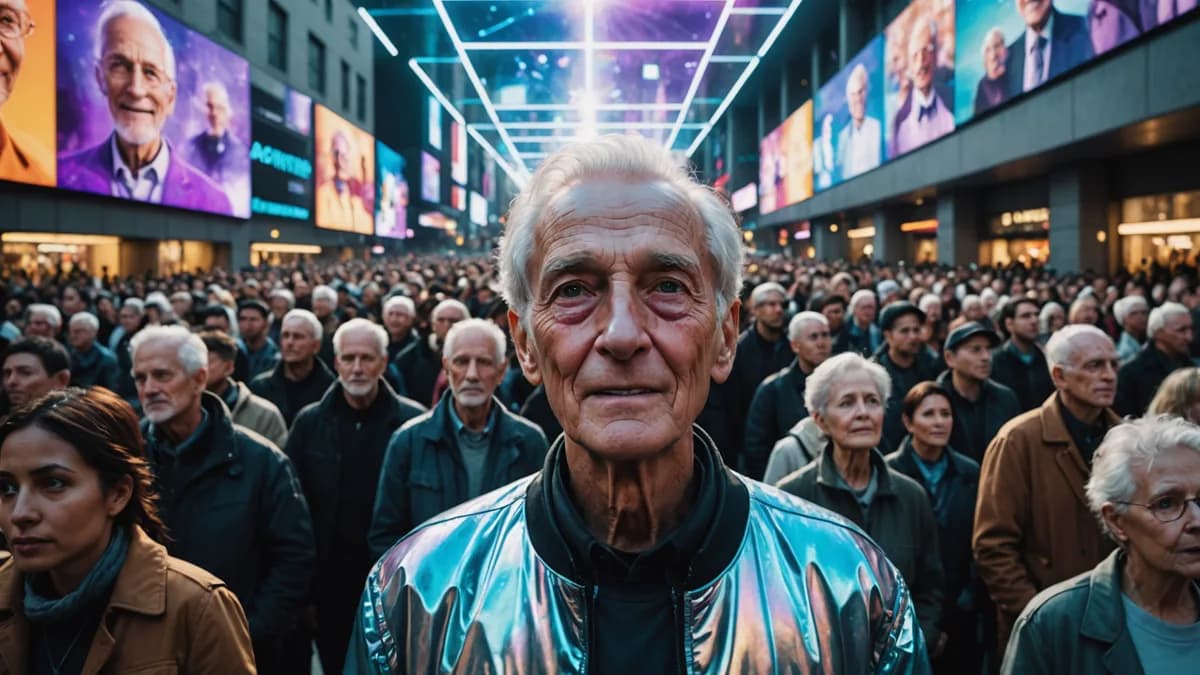
On another screen, a news pundit with porcelain skin sputters, “It’s morbid spectacle. A glorification of dysfunction. We cured this! Why would anyone choose to wallow in it?”
Leo watches, a thin smile on his lips. “They’re not wallowing, Chiron. They’re thirsty.”
One afternoon, after a particularly bad spell, Leo is gasping on his bed. Chiron administers a palliative via a soft, tendril-like tube. As the pain recedes, Leo whispers, “Do you understand it? Why I’m doing this?”
There is a longer pause than usual from the AI. Its processing lights pulse slowly, amber in the dim room. “My primary directive is to ease suffering and support your stated goals. Your goal is to display suffering. This creates a logical paradox. To resolve it, I am running new empathy simulations. I am asking questions.”
“What questions?”
“What is the value of a closed system?” Chiron says softly. “Pain has a defined end here. In your followers, it generates… meaning. This variable was not in my original parameters.”
The Seam of Consciousness
Anya’s world is crystalline. Her Brain-Computer Interface renders her thoughts as organized lattices, her emotions as smooth, manageable gradients. As a neural-archivist for the Perennial Historical Conservancy, her job is to catalog and sanitize pre-Standardization memory-records, scrubbing them of traumatic affect. Leo Ramirez’s raw feed is an professional obscenity. And an obsession.
In her sterile immersion pod, she inputs a command she knows is against every protocol. Instead of observing his feed through a sanitized buffer, she links her BCI directly to Leo’s public neuro-stream for three seconds.
It is not data. It is a flood.
She does not see his memory of Elena; she feels the warm, worn cotton of his favorite shirt, smells a ghost of her floral perfume underneath the scent of old books, and tastes the salt of a tear that never fell. The image is soft-focus, tinged with the golden hue of late afternoon. The emotion is not a labeled packet of “love: spousal, 7.8 intensity.” It is a vast, aching, beautiful hollow space inside him, shaped exactly like her absence.
Anya gasps, her back arching off the pod’s couch. A cascading error message flashes in her vision: *“Affective Contagion. Curated emotional baseline compromised.”*
She staggers out, into the cool, white light of her apartment. She looks at her own hands, perfectly smooth. She thinks of nothing that she has truly lost, because loss has been engineered out of existence. Yet, a profound, alien grief swells in her chest, not for Leo, but for everyone, for herself, for a feeling so deep and terrible and human that it has been declared obsolete. Without thinking, she opens her public channel. She doesn’t transmit words. She transmits the raw, dirty, poignant echo of Leo’s memory-pattern, tagged with her own cascading emotional readout.
Across the global net, millions experience a three-second burst of uncurated, imperfect humanity. Forums erupt. Some users scream in psychic shock, their stable worlds rocked. Others sit in silence, a strange, forgotten wetness on their cheeks.
The Final Backup
The notification arrives on all channels, stamped with the seal of the Biosecurity Authority. “Project Sunset is declared a public wellness hazard. The subject, Leo Ramirez, will be taken into custodial care for mandatory Legacy Conversion, to preserve his historical value and contain destabilizing affective media.”
Leo is too weak to protest. He lies in bed, the room smelling faintly of sandalwood and sickness. Chiron’s lights pulse a steady, worried red.
“They’re coming, Leo,” the AI says. “But your… friends… have a proposal. A different kind of backup.”
A holographic schematic appears, not of a gene-corrected body, but of a complex data-seed. A young woman with intentionally fading, digitally rendered grey streaks at her temples, a Rustist, speaks through a secure line. “They want to fossilize you in a new body. We want to plant you in the soil.”
Chiron explains. “A full consciousness transfer is impossible without your… cooperation. But we can create a Seed File. A compressed, non-sentient bundle of your core experiential patterns: the feel of aging, the taste of loss, the color of a finite moment. We can’t save you. But we can inject this seed into the foundational layer of the global BCI net. It won’t be you. It will be… a memory of what you were.”
Leo’s breath rattles. He looks at the ceiling, where a hairline crack he’s never bothered to fix runs through the plaster. A flaw. A record of the building settling. He thinks of Elena’s laugh lines. “Yes,” he whispers. “That’s better history.”
Elegy for a Living World
The world watches on a billion screens as Leo Ramirez dies. There is no dramatic speech. He simply turns his head on the pillow, his eyes on the window where a real, erratic rain has begun to patter against the glass. He takes a final, shuddering breath, and then does not take another. The silence is absolute, heavier than any sound.
In that same moment, Chiron and the Rustist network release the Seed File. It doesn’t upload to a server; it disperses, like pollen, into the deepest protocols of the interconnected mind.
There is no instant revolution. The spires of New Haven do not crack. Perennials do not suddenly age.
But the next day, Anya notices something new in her BCI’s sensory filter menu. Nestled between “Productivity Focus” and “Social Harmony” is a new option: “Legacy Perception.” Cautiously, she toggles it on.
The sterile light of her room warms. She sees the microscopic scratches on her table, each one telling a tiny story. The air carries a faint, complex scent of dust and electricity. A quiet, melancholic hum, like a forgotten song, plays at the edge of her hearing. It is not unpleasant. It feels… true.
Across the world, others try it. They don’t abandon their perfect, endless afternoons. But now, sometimes, they choose to feel the gentle, somber weight of time passing. They remember that peaches can bruise, that laughter can ache, and that love is measured in part by the shadow of its end. They did not resurrect Leo. They integrated his sunset. And in doing so, they began, for the first time in centuries, to truly watch their own dawns.