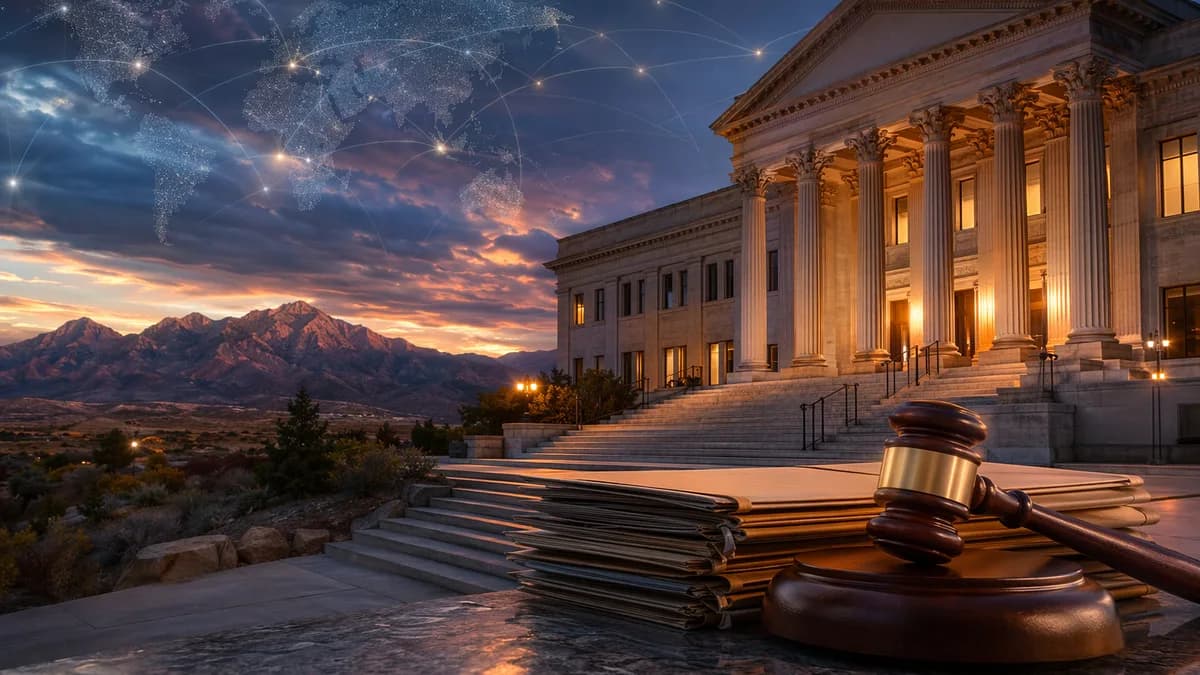
The Charlie Kirk murder trial question now rests on a narrow legal test with enormous public consequences: whether prosecutors have shown enough evidence against Tyler James Robinson to move from accusation to trial.
XOOMAR Intelligence
Analyst Take
That decision sits with Judge Tony Graf after a five-day preliminary hearing in Provo, Utah, closed Friday, according to Guardian World. The ruling will matter first to Robinson, Kirk’s family, prosecutors, and the Utah Valley University community. But because Kirk was a nationally known far-right activist, the hearing is already being read as a test of accountability after political violence.
Charlie Kirk murder trial decision now turns on a low legal bar with high political stakes
Graf does not need to decide whether Robinson is guilty. He needs to decide whether the state has cleared probable cause, the threshold required to send the case forward.
That distinction is everything. A preliminary hearing is not a trial. It is a filter. Prosecutors put enough evidence into the record to show the charge can proceed. Defense lawyers test that evidence, expose weak spots, and preserve arguments for later.
The public will not treat it so narrowly. Kirk was killed at Utah Valley University, and his national political profile has turned a procedural ruling into a national signal. In a case already carrying intense public attention, even a limited legal decision can be read far beyond the courtroom.
The live question is simple: does the record show enough to justify a Charlie Kirk murder trial, even if it does not yet prove guilt?
XOOMAR analysis: The political stakes raise the temperature, but Graf’s comments suggest he is trying to keep the hearing inside the legal lane. That matters because a ruling to proceed would not validate every prosecution claim. A ruling against all or part of the case would not prove Robinson innocent. Either way, the decision will shape public trust, legal strategy, and the next stage of litigation.
Inside the five-day Utah hearing that tested the evidence against Tyler Robinson
The state’s case, as presented during the hearing, centered on three kinds of evidence: forensic testing, surveillance video, and statements tied to Robinson’s roommate and romantic partner.
Prosecutors presented forensic evidence linking Robinson’s DNA to the firearm they say was used to kill Kirk. They also played video footage allegedly showing Robinson entering campus and climbing onto a rooftop perch. Court material also referred to statements connected to Robinson’s roommate and romantic partner, though the supplied material does not support naming that person here or quoting specific alleged remarks.
For the defense, the clearest target was the DNA evidence. Robinson’s lawyers pressed witnesses on the limits of forensic conclusions, especially whether the testing could be treated as certain.
That is why this hearing matters beyond the headline. The defense does not need to win acquittal at this stage. It needs to show where the prosecution’s theory may crack later, especially under the much tougher trial standard of proof beyond a reasonable doubt.
Graf pushed back when the defense appeared to dig too deeply into trial-level detail:
“We don’t need to go 100 miles down a path where one mile is where probable cause may be. I invite you to refocus … I’m not trying to limit your theories or such but I need to hold to probable cause,” Graf said in court on Thursday.
That line captures the tension. How much uncertainty is enough to stop a murder case before trial? At a preliminary hearing, usually not much. But in a case with forensic evidence, video, family pressure, and intense public scrutiny, even early arguments can harden into the case’s public record.
The next step is for the court to decide whether the prosecution has shown enough for the case to proceed toward trial.
The numbers behind the Charlie Kirk shooting case: five hearing days, one judge, and a trial decision pending
The hard numbers in the record are useful because they strip away some of the noise.
- Five-day hearing: The preliminary hearing ran across five days, a sign both sides treated the probable cause fight as serious.
- One judge: Graf must decide whether the legal threshold has been met.
- 1 trillion: ATF forensic biologist Caitlin Oliver testified that DNA samples on some parts of the rifle were at least 1 trillion times more likely to have been contributed by Robinson and one other unrelated person.
- Trial decision pending: The case now turns on whether the evidence presented clears probable cause.
The DNA number is powerful, but the defense focused on what that number does not mean. Defense attorney Michael Burt argued that the evidence could not be described as infallible, could not be tied to “a zero error rate”, and could not be stated as source-connected to one person with absolute certainty.
Oliver explained that her agency uses five categories: “exclusion, limited support for exclusion, uninformative, limited support for inclusion, and support for inclusion.” On cross-examination, Deputy Utah County Attorney Ryan McBride asked whether “at least 1 trillion times more likely” could be higher than 1 trillion. Oliver said it was possible, while also confirming the lab caps reported numbers at 1 trillion.
So what does that number really do at this stage?
XOOMAR analysis: It likely helps the state clear probable cause if Graf views it alongside the video and the other material presented during the hearing. But at trial, the defense can still argue about collection, interpretation, mixture, transfer, lab limits, and the gap between statistical support and juror certainty. Probable cause can tolerate those disputes. A conviction cannot merely glide over them.
Prosecutors, Robinson’s defense, Kirk supporters, and the university community see different cases
The same hearing produced different cases for different audiences.
| Stakeholder | What they are likely focused on | Source-grounded limits |
|---|---|---|
| Prosecutors | Building a coherent path from the Utah Valley University shooting to Robinson | The judge still must decide legal sufficiency |
| Defense | Challenging DNA reliability, interpretation, and the strength of the state’s proof | Robinson did not testify |
| Kirk family | Accountability and public visibility of evidence | The court process remains limited by evidentiary rules |
| Media and public | Access, transparency, and the first durable record of the case | A preliminary hearing is not a full trial record |
| Utah Valley University community | Campus safety and trauma after a public shooting | The supplied sources do not include university or student statements |
The prosecution wants Graf to see the evidence as a chain: Robinson allegedly arrives on campus, moves into position, uses the rifle, flees, and is connected to later material that points toward guilt. That is the state’s core story.
The defense wants the judge to see missing certainty. Its strategy is not hard to read. If the DNA evidence sounds less conclusive, if the video requires interpretation, and if statements from other witnesses need context, then Robinson’s lawyers can argue the state is asking too much from an early record.
For Kirk’s family, the hearing carried a different weight. Erika Kirk and Kirk’s parents were in the courtroom with Robinson for the first time during this week’s proceedings. On Friday, Erika Kirk was permitted to watch the original version of surveillance video that prosecutors said showed Robinson on campus the day Kirk was killed.
The family issued a statement calling the hearing “an important step forward in the pursuit of justice for Charlie”.
“As difficult as these last few days have been, it brings our family comfort to know that the world has witnessed the overwhelming evidence of what occurred to Charlie that day.”
Can a court keep the process credible when every side wants the record to serve a different purpose? That is now one of Graf’s practical challenges.
For readers tracking how high-attention criminal cases strain courts under public pressure, XOOMAR has also covered Death Threats Stalk Judge in India Cow Vigilante Case. The contexts differ, but the shared issue is pressure around adjudication when politics and criminal law collide.
Political violence cases can turn preliminary hearings into public battlegrounds before trial
This Utah hearing already showed how quickly a preliminary proceeding can become a public battleground.
That does not require every dispute to be visible in the public record. In a case involving a nationally known political figure, courtroom procedure itself can become part of the broader fight over meaning. Evidence, access, family presence, defense objections, and the judge’s control of the hearing all take on a public weight they might not carry in a lower-profile case.
This is where the case’s political character meets court mechanics. Kirk’s supporters want the process to demonstrate accountability. Robinson’s defense wants the court to keep the state to the proper standard. Prosecutors want the evidence viewed as a coherent whole. The judge’s task is narrower than all of that: decide whether probable cause exists.
But courts do not exist to satisfy online demand for total visibility. They protect defendants’ rights, victims’ rights, evidentiary rules, and the possibility of seating a fair jury. That is slow work. It is narrower than public debate by design.
XOOMAR has tracked similar public pressure around violence at public gatherings, including Suspect on Run After Toronto Festival Shooting Kills 2. Here, the added element is political identity: Kirk’s supporters, critics, and commentators are all likely to interpret each procedural move through that lens.
The key question now is whether the official record can stay stronger than the unofficial one.
What Graf’s ruling means for campus security, political speech, and criminal justice credibility
If Graf sends the case forward, the next phase will likely intensify scrutiny of Utah Valley University’s security planning and the handling of public political events on campus. That is an inference from the source facts, not a reported university response. The shooting happened during a high-profile political event, and prosecutors say the alleged shooter accessed a rooftop position. Those details alone invite questions that a trial could surface more fully.
If Graf declines to send all or part of the case forward, backlash is easy to imagine, especially from Kirk supporters who see the hearing as a test of justice. But the more legally precise reading would be different: such a ruling would mean Graf found the state had not cleared the required threshold on the record before him. It would not erase the killing, and it would not settle every factual dispute.
The strongest signal from the hearing is that Graf appears focused on legal sufficiency rather than political meaning. His “100 miles” comment was not a throwaway line. It told both sides that probable cause, not narrative control, is the standard in front of him.
The next evidence to watch is practical and specific:
- Briefing: How Robinson’s lawyers frame the legal complexity around the state’s allegations.
- Argument focus: Whether prosecutors rely mainly on DNA, video, witness-linked material, or the combined force of all three.
- Ruling scope: Whether Graf advances the case, narrows it, or demands more precision.
- Case posture: How both sides respond once the court rules.
- Evidence access: Whether disputes over transparency and evidentiary limits continue to shape the public record.
The thesis will be confirmed if Graf’s ruling stays tightly tied to probable cause and avoids broader political language. It will weaken if the decision turns on evidentiary gaps serious enough to limit the prosecution’s theory before trial. Either way, the Charlie Kirk murder trial question is moving from public outrage toward a narrower place: the courtroom record, one exhibit and one ruling at a time.
Impact Analysis
- The ruling will decide whether Tyler James Robinson faces a murder trial in Charlie Kirk’s killing.
- The case carries national attention because Kirk was a prominent far-right activist killed at Utah Valley University.
- The decision may be politically interpreted, even though the judge is applying a limited probable-cause test.
Preliminary Hearing vs. Murder Trial
| Stage | Purpose | Legal Standard |
|---|---|---|
| Preliminary hearing | Determines whether the case can proceed | Probable cause |
| Murder trial | Determines guilt or innocence | Not decided at this stage |
Primary Sources & Disclosures

Written by
XOOMAR Insights Team
Research and Editorial Desk
The XOOMAR Insights Team pairs automated research with human editorial judgment. We track hundreds of sources across technology, fintech, trading, SaaS, and cybersecurity, cross-check the facts, and explain what happened, why it matters, and what to watch next. We do not just rewrite headlines. Every article is fact-checked and scored for reliability before it goes live, and we link back to the original sources so you can verify anything yourself.