Pokémon Go's 10th anniversary signals something rare in mobile gaming: a hit that outlived its launch frenzy by turning play into a public habit. The app has been downloaded more than a billion times across iOS and Android, and millions still log on each day, according to BBC World. That is the real story beneath the birthday celebration.
XOOMAR Intelligence
Analyst Take
Most viral apps burn through attention. Pokémon Go did something stranger. It converted a phone game into a reason to walk, gather, raid, travel, and remember. That doesn't mean the game is untouched by commercial pressure or player fatigue. It means its defensibility comes from behavior, not novelty.
Pokémon Go's tenth year exposes the weakness of most mobile gaming hits
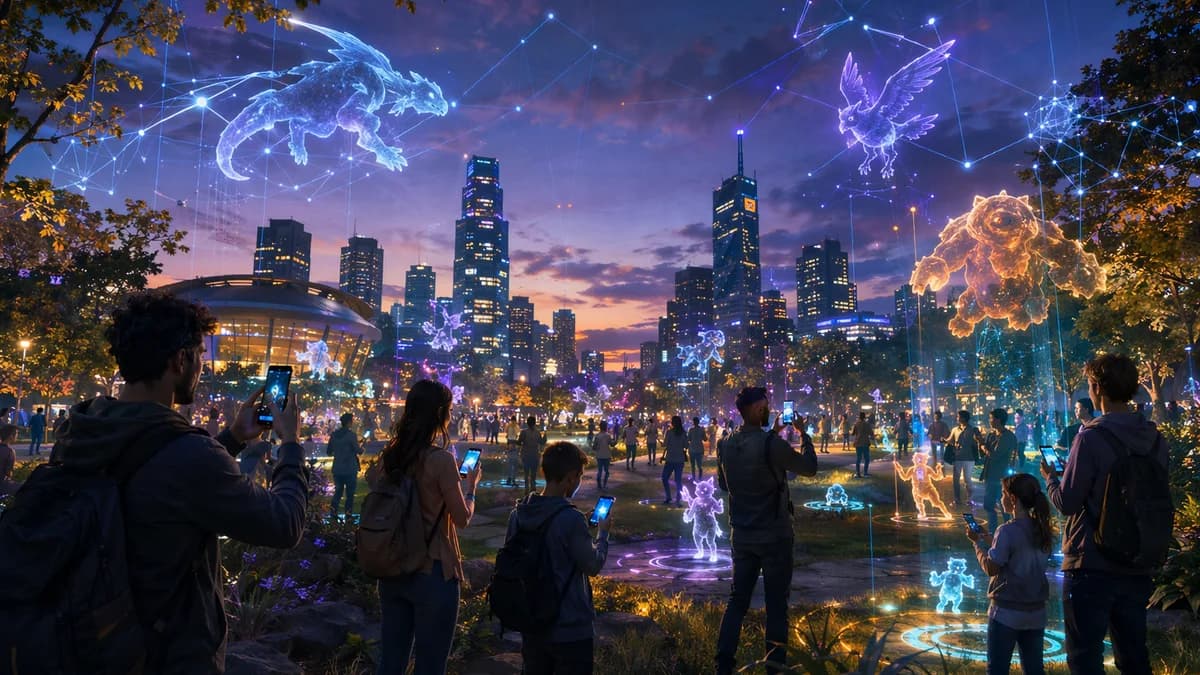
The sharpest read on Pokémon Go's 10th anniversary is that the game survived because it made players visible to one another. The core mechanic, using GPS and augmented reality to place virtual monsters in real-world locations, mattered because it pulled people into parks, waterfronts, shopping malls, and meetups. The monster collection loop was familiar. The public coordination was not.
Michael Steranka, vice president of product at publisher Scopely, frames that as the game's central identity.
"Pokémon Go will always start with community - we think we're only scratching the surface here," he said.
That line can sound like standard platform rhetoric. The evidence makes it harder to dismiss. Steranka told the BBC the company receives wedding invites from players who met through Pokémon Go, and hundreds of players gathered in New York's Times Square on Thursday to battle a giant Mewtwo, a reference to the game's original trailer published over a decade ago.
XOOMAR analysis: the Times Square event matters less as spectacle than as proof of social memory. A mobile game can add features forever, but few can summon people into a public square years after launch and have the reference still land. Our prior coverage of Pokémon Go Finally Unleashes Its 2015 Mewtwo Dream sits in that same nostalgia channel, though the BBC account here verifies only Thursday's anniversary event and its Mewtwo connection.
The decade in numbers shows retention, not just launch heat
The verified numbers are unusually strong for a game that became a mass phenomenon in 2016. Pokémon Go has crossed more than a billion downloads, still has millions of daily players, and has hosted major live events in more than 60 countries. Since the first Go Fest in 2017, those events have averaged more than 400,000 attendees a year.
Scopely also estimates players have explored over 100 billion kilometres while playing. The BBC gives the scale another way: roughly 334 round trips between the Earth and the Sun.
| Measure | Source-supported figure |
|---|---|
| Lifetime downloads | More than a billion across iOS and Android |
| Daily activity | Millions still logging on each day |
| Live event reach | More than 60 countries |
| Go Fest attendance pattern | More than 400,000 attendees a year on average since 2017 |
| Distance explored | Over 100 billion kilometres |
The counterpoint is obvious. The BBC source does not provide revenue, current spending, churn, or monetization data. So any hard claim about in-app purchases, ticketing, subscriptions, or spending pressure would go beyond the available record.
Still, the retention signal is clear. Pokémon Go's 10th anniversary is not a story about recapturing the 2016 launch spike. It's about a daily and event-based routine that survived after the crowd mania cooled. That is a more durable achievement, and a harder one to fake.
From 2016 crowds to anniversary rituals, the game matured without losing its public edge
At launch, Pokémon Go quickly became one of the biggest mobile game launches in history, according to the BBC. Its camera-based overlay made Pokémon appear to stand in front of the player, but the bigger effect was social. Players moved in groups toward real locations because the game made the outside world feel newly mapped.
Matthew Reynolds, editor of Pokémon news website One More Catch, put the original appeal plainly.
"By allowing you to take your mobile phone out into the world to discover virtual creatures, Pokémon Go helped realise the millennial dream of becoming a Pokémon Trainer," said Matthew Reynolds.
That early frenzy also created problems. Police and safety groups warned players not to get lost or put themselves in danger while chasing Pokémon. Reynolds said the game's popularity meant "servers buckled under the strain", with connectivity problems "rife for some time".
XOOMAR analysis: the game now appears less defined by pure surprise and more by shared occasions. The BBC cites Go Fest, Wild Area in South Yorkshire, and the Times Square anniversary gathering. That doesn't prove spontaneous play has vanished. It does show that the game's public life now depends heavily on events that give players a reason to return together.
That shift mirrors a broader entertainment pattern we have covered elsewhere: habit can be more powerful than novelty. See our analysis of Netflix Always-On Channels Expose Streaming's Choice Trap for a different version of the same consumer problem, keeping attention after abundance turns into fatigue.
Scopely inherits a community asset with ownership questions attached
The biggest strategic tension is now ownership. In 2025, Scopely, which the BBC says is itself owned by Saudi Arabia's Public Investment Fund, bought developer Niantic for $3.5bn (then £2.7bn). The BBC reports that some fans questioned how the game's future might change after that deal.
Steranka's answer was cautious.
"My hope is that we prove to players over time that this is definitively a good thing for the game and the community," Steranka says.
XOOMAR analysis: Scopely didn't just acquire a game. Based on the BBC's account, it acquired a long-running social graph of raid groups, event travelers, families, local ambassadors, and daily walkers. That is not the same as buying a dormant IP and trying to reboot it. It is stewardship of a living community that can punish missteps by simply meeting less, playing less, and caring less.
The strongest counterpoint is that the BBC source doesn't show what Scopely will change operationally. It gives no confirmed roadmap beyond Steranka's stated focus on community, memories, and family experiences. So the fair test is not whether fans are anxious now. It is whether Scopely can keep the game's social fabric intact after the acquisition.
Players describe Pokémon Go as friendship infrastructure, not just a collection app
The BBC's player interviews explain why Pokémon Go remains sticky. UK content creator j0beats, who runs one of Twitch's biggest channels dedicated to the game, travels to events such as New York to meet other players. Her best memory, though, was local: in 2025, Wild Area came to Doncaster in South Yorkshire.
"People always think it's crazy that you travel all over just to catch some pixels," she laughs.
"But it's not just about that. When you go to these big events, you're there for the people and for the energy of it."
Austin, a player in Maine who has played since 2017, described a more personal effect. Before playing, he said it was "nearly impossible" to motivate himself because he was anxious and depressed. His first raid meetup changed the pattern.
"When I went to my first raid meetup it was like a warm blanket," he said.
"As I held my phone and walked to the group of strangers in the park, I saw them look at me, and for the first time I wasn't nervous meeting this new group of people, I was actually excited and happy."
That testimony should not be overextended into a medical claim. The source gives personal experience, not clinical evidence. But it does show why the game's community language is not empty. For some players, the app became a socially acceptable excuse to leave the house and approach strangers.
Pokémon Go shows AR worked best when it stopped being only about AR
The app's visual trick is easy to explain: digital creatures appear over a live smartphone camera view. But Pokémon Go's endurance suggests the lasting breakthrough was not the camera overlay alone. It was the combination of location, collection, walking, and group timing.
The BBC source supports that reading through behavior. Players gathered in real places. They traveled to events. They formed relationships. They measured memories through raids, walks, and shared locations rather than through graphics quality or technical novelty.
XOOMAR analysis: this is the lesson for any future location-based game. A visual feature can spark curiosity, but ritual keeps people. Pokémon Go gave players a repeated reason to move through familiar places with other people. That is much harder to copy than an interface.
The counterpoint is that Pokémon itself carries three decades of brand power, beginning with Nintendo's Game Boy in 1996. A weaker franchise might not have pulled the same crowds. That doesn't weaken the argument. It sharpens it: AR alone was never the moat.
The next decade will test whether community can survive scale, ownership, and fatigue
Steranka says the game will keep focusing on community, memories, and experiences families can share.
"No matter where I was and what phase of my life, Pokémon Go has been there for me," he says.
"It meets people where they are, at whatever phase of life they're in."
The watch item now is trust. Evidence that would strengthen the bullish case includes sustained daily activity, continued live event attendance across countries, and player stories that still sound like Austin's and j0beats' rather than complaints about obligation. Evidence that would weaken it would be visible erosion in meetups, event participation, or confidence after the Scopely transition.
Pokémon Go probably won't recreate 2016. It doesn't need to. Its harder task is proving that a mobile game can age into a durable public ritual without draining the community that made it valuable.
The Bottom Line
- Pokémon Go shows that mobile games can endure when they become social habits rather than passing trends.
- Its continued daily player base highlights the power of community-driven design in gaming.
- The anniversary underscores how augmented reality and location-based play can create lasting real-world engagement.
Pokémon Go vs. Typical Viral Mobile Gaming Hits
| Aspect | Pokémon Go | Most Viral Mobile Games |
|---|---|---|
| Longevity | Still active after 10 years | Often fade after the launch frenzy |
| Core strength | Built around real-world movement and community | Usually driven by novelty or short-term attention |
| Player behavior | Encourages walking, gathering, raids, travel, and meetups | Typically remains a more solitary phone-based habit |
Primary Sources & Disclosures

Written by
XOOMAR Insights Team
Research and Editorial Desk
The XOOMAR Insights Team pairs automated research with human editorial judgment. We track hundreds of sources across technology, fintech, trading, SaaS, and cybersecurity, cross-check the facts, and explain what happened, why it matters, and what to watch next. We do not just rewrite headlines. Every article is fact-checked and scored for reliability before it goes live, and we link back to the original sources so you can verify anything yourself.