On Thursday evening in Times Square, nearly 2,000 Pokémon Go players gathered for the kind of Mewtwo battle Niantic teased back in 2015 but could not yet deliver. That timing matters. A full decade after Pokémon Go became a phenomenon, its Pokémon Go 10th anniversary event proved the original pitch wasn’t empty hype. It was early.
XOOMAR Intelligence
Analyst Take
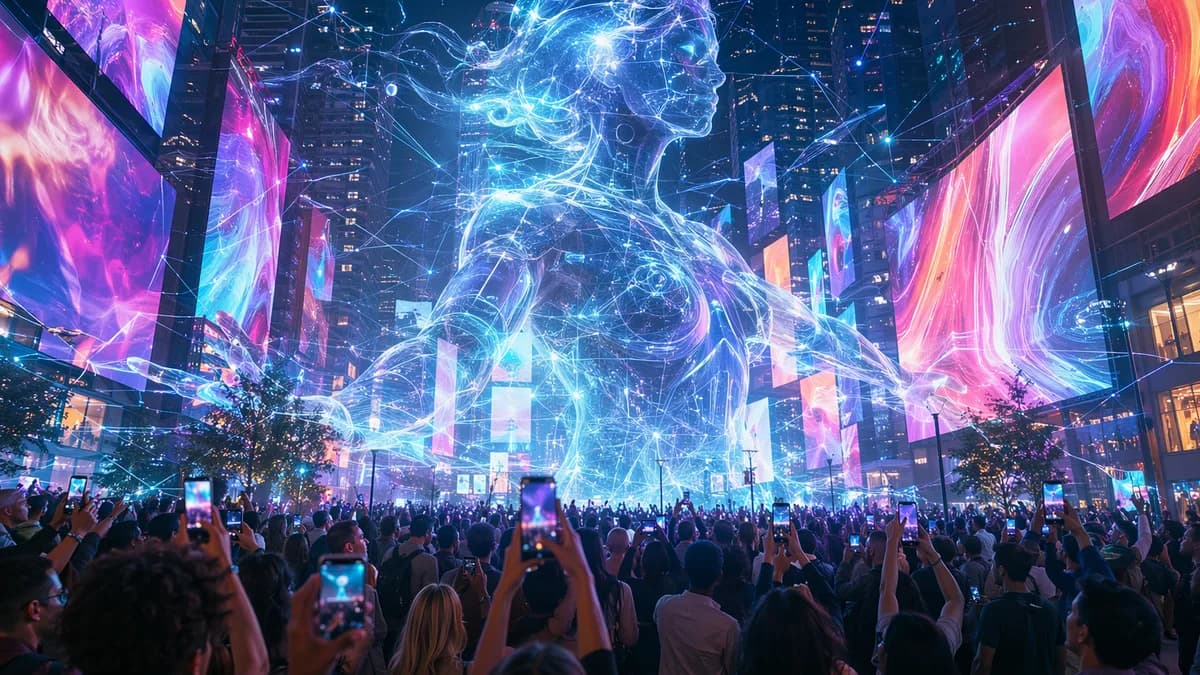
The scene, reported by The Verge, was almost too perfect for the franchise’s own mythology: Times Square briefly went dark, the billboards lit back up, and an escaped Mewtwo appeared while Mega Evolving. The crowd, many of them Pokémon Go influencers, joined a special battle in real time.
That is the point. Pokémon Go didn’t win by making augmented reality look flawless. It won by making people show up together.
Thursday night gave Pokémon Go the Mewtwo fantasy it sold in 2015
The first Pokémon Go trailer in 2015 sold a dream bigger than catching a Pidgey on a sidewalk. It showed public space becoming playable. It implied that strangers could converge, cooperate, and treat a digital creature as a shared civic emergency.
At the time, that looked more like brand theater than product design. Raids were not in the game when it launched in 2016. The idea of crowds assembling to battle legendary Pokémon sounded like the kind of trailer logic that survives only because nobody has to build the servers, handle the crowd, or keep the app from collapsing.
This week, the game finally staged the fantasy at scale.
“When we first dreamt what Pokémon GO might become a decade ago, hosting more than a thousand people in a single, local raid battle was just a pipe dream,” Scopely VP of product Michael Steranka wrote. “Seeing that vision become a reality in Times Square was the perfect way to celebrate 10 years of playing together with our community.”
That quote matters because Scopely, which acquired Niantic’s games business last year, is not framing the event as a nostalgia stunt. It is framing it as the arrival of the original product vision.
| 2015 trailer promise | 2026 Times Square reality |
|---|---|
| Crowds unite around a legendary Pokémon | Almost 2,000 players joined a special battle |
| Public space becomes part of the game | Times Square billboards staged Mewtwo’s reveal |
| Pokémon feels bigger than the phone screen | The crowd reacted together in a real city landmark |
| Legendary encounters feel rare and social | The event centered on Mega Mewtwo |
Times Square turned a mobile loop into public theater
Pokémon Go has always depended on location, but Times Square gave that design a stage no app store screenshot can explain.
The source details are simple and strong: the square went dark, the billboards began lighting up, and Mewtwo appeared as if the city itself had joined the encounter. That is not the same as watching a livestream. The power came from bodies in the same place, phones up, attention synchronized.
The core loop is still familiar: gather, tap, coordinate, react. But scale changes the meaning. A small raid group feels like a feature. Nearly 2,000 people in Times Square makes the same mechanic feel like an event.
That is the hidden achievement. Pokémon Go 10th anniversary programming did not need to make AR technically perfect to make it feel real. It needed enough people to agree, at once, that this digital event deserved physical presence.
For readers tracking apps that push users back into physical behavior, XOOMAR has covered adjacent ideas such as WeWard Walking Mode Locks TikTok Behind 3,000 Steps. Pokémon Go remains the sharper case because the reward is social, not merely behavioral.
The breakthrough was social augmented reality, not better graphics
The old mistake was assuming Pokémon Go would live or die on visual immersion. It never did.
The game’s stronger invention was social augmented reality: strangers looking at the same invisible map layered over real streets, then acting as if that layer matters. Mega Mewtwo was the lure, but the more impressive trick was getting thousands of people to treat one digital threat as real enough to gather for.
That makes Pokémon Go different from AR products that chase hardware spectacle first. The game built habits before polish. It made gyms, raids, routes, and events into rituals. It trained players to read cities as game boards.
The Verge notes that the core gameplay “hasn’t really changed all that much.” That sounds like a criticism, and in some ways it is. But the Times Square event shows the other side of that stability. The game did not need constant reinvention to keep meaning. It needed repeatable reasons for players to meet.
That is also why Pokémon Go’s endurance has been so hard to copy. The Verge reports that Niantic struggled to reproduce the same success with other IP-focused AR games such as Harry Potter: Wizards Unite and Catan: World Explorers. The lesson is blunt: the map alone is not the product. The crowd is.
Years of raids and meetups made the 2,000-player battle feel natural
The Times Square crowd did not appear from nowhere. It was built through years of in-person events, raids, meetups, and a creator class that kept the game visible even after the first cultural explosion cooled.
Influencers are easy to mock. Here, they served a real function. The Verge says many attendees were Pokémon Go influencers, and that matters because live games need social glue. Influencers do not just publish clips. In games like this, they help turn dates on a calendar into places people actually go.
Scopely games president Ed Wu put the company’s thesis plainly:
“What started as an invitation to explore the world around you has become something that brings players together across cities, countries, and cultures, from neighborhood meetups to celebrations that draw hundreds of thousands of people together.”
That claim is backed by scale. According to Scopely, more than 800 million people have downloaded Pokémon Go since launch, and the company brought in $1 billion from Go in 2025 alone.
Those numbers do not prove every player is still enchanted. They prove the game never became a museum piece. For live-service games, that is the harder prize. Retention does not come only from giving players more to grind. It comes from giving them credible reasons to gather.
XOOMAR has also looked at how social apps can bend under their own community dynamics in 300,000 Users Turn Roost Slow-Cial App Into a Warning. Pokémon Go’s Times Square moment shows the opposite outcome: a digital community becoming legible in public without losing the playfulness that made it assemble in the first place.
The skeptics have evidence, but not the stronger argument
The strongest counterargument is not imaginary. Pokémon Go has had rough edges.
The Verge points back to the game’s first major in-person event in 2017 in Chicago, where thousands of players ran into network overloads and software problems. Steranka, who joined Niantic that year to help coordinate that event, said during a press briefing that he thought he “should have been fired” for how it played out.
He also described the internal response:
“I also quickly discovered from this experience that the Pokémon Go team does not point fingers,” Steranka said. “Instead of trying to find someone to blame, everybody came together, and we spun up an offsite in Seattle to learn what went wrong and how to fix things.”
There is another fair critique. A staged anniversary event in Times Square, packed with fans and creators, is not the same as everyday play. It is the best possible version of Pokémon Go, under the brightest possible lights.
But that does not weaken the achievement. It clarifies it.
Most mobile games do not get a tenth-anniversary public spectacle in Times Square. Fewer still can make that spectacle feel directly connected to their first trailer. Pokémon Go survived because its best moments happen outside the app, between people, in places that already mean something.
The next decade should treat Times Square as a blueprint, not a trophy
The next decision for Scopely and the remaining Pokémon Go team is whether Times Square becomes a one-off victory lap or a model for what location-based games should do next.
The practical path is clear from the source material. More city-scale encounters. Better support for local communities. Events that do not depend only on influencer density. Safer and more reliable execution than Chicago 2017. Global events that preserve the feeling of shared effort without pretending every player can stand under Times Square billboards.
The Verge reports that this Saturday and Sunday, 2026’s global Pokémon Go Fest will bring more Mewtwo encounters and cooperative challenges. That is the immediate test. The bigger one comes after, especially with new mainline Pokémon titles expected next year, which Wu says can bring new generations into the game.
The promise of Pokémon Go was never that everyone would stare at their phones forever. It was that a city corner could suddenly become a battlefield.
For one night in Times Square, it did.
The Bottom Line
- Pokémon Go’s anniversary event showed that its original augmented-reality pitch was delayed rather than empty.
- The Times Square raid highlights the game’s enduring strength as a social, location-based experience.
- The event reinforces that Pokémon Go’s biggest innovation was getting people to gather in the real world.
Pokémon Go’s Original Promise vs. Its 10th Anniversary Reality
| 2015 Trailer Vision | Times Square Anniversary Event |
|---|---|
| Public spaces would become shared playable arenas. | Times Square hosted a large real-time Mewtwo battle. |
| Strangers would gather to fight legendary Pokémon together. | Nearly 2,000 players joined the event in person. |
| The concept looked like brand theater before launch. | A decade later, the game delivered the experience at scale. |
Primary Sources & Disclosures

Written by
XOOMAR Insights Team
Research and Editorial Desk
The XOOMAR Insights Team pairs automated research with human editorial judgment. We track hundreds of sources across technology, fintech, trading, SaaS, and cybersecurity, cross-check the facts, and explain what happened, why it matters, and what to watch next. We do not just rewrite headlines. Every article is fact-checked and scored for reliability before it goes live, and we link back to the original sources so you can verify anything yourself.