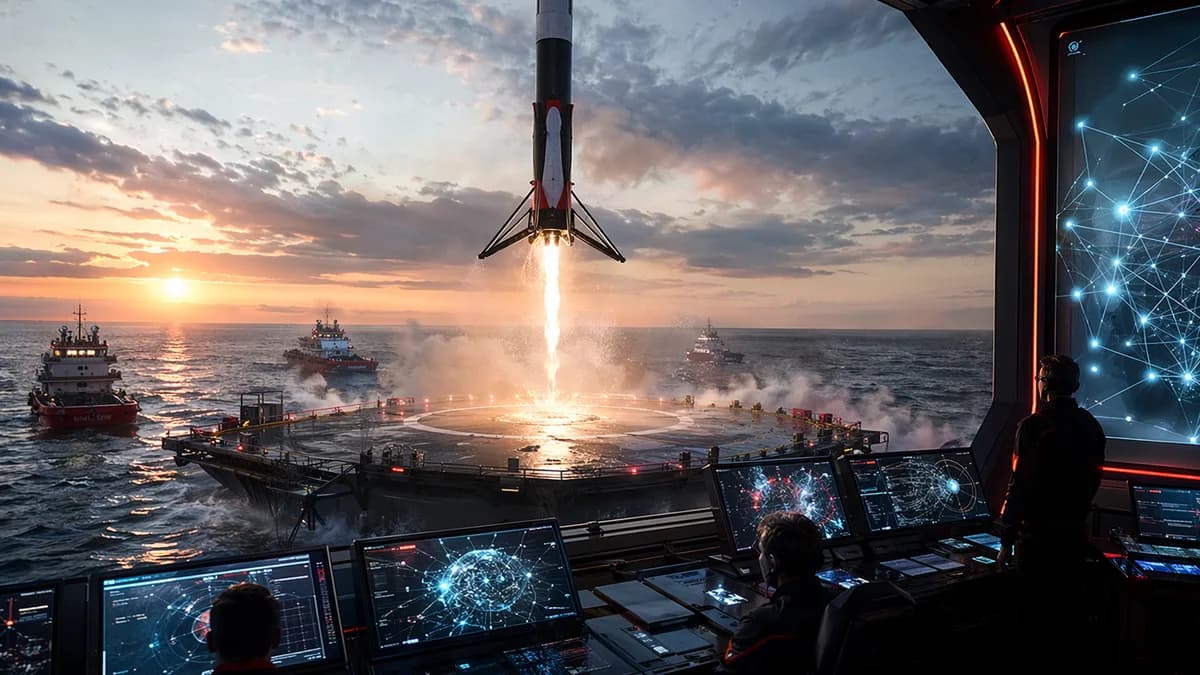
If China reusable rocket launches become routine, does SpaceX still own the cost advantage that built Starlink, or has Beijing just turned Elon Musk’s moat into a race lane?
XOOMAR Intelligence
Analyst Take
China’s state-owned China Aerospace Science and Technology Corporation successfully launched a Long March orbital rocket and recovered its booster on a seagoing vessel, making China the second country to achieve that orbital booster recovery feat, according to TechCrunch. The milestone matters because it targets the same operational trick that pushed SpaceX ahead: flying expensive booster hardware more than once.
That doesn’t put China at parity with SpaceX. Not close. But it does shift the question from whether Beijing can land an orbital-class booster to whether it can turn recovery into cadence, refurbishment, relaunch, and eventually lower launch costs.
Can China reusable rocket recovery become more than a one-off trophy?
The first answer is technical: yes, the recovery proves China can guide a large booster back through descent and capture it at sea.
The harder answer is operational: one recovered booster doesn’t prove a reusable rocket business.
CASC said it would attempt to reuse the booster by the end of the year. That is the real test. Recovery is the opening move. The value comes only if engineers can inspect the vehicle, repair what needs repairing, certify it, and fly it again without turning each mission into a bespoke rebuild.
The Chinese method also differs sharply from Falcon 9. SpaceX lands boosters vertically on legs, either on land or a drone ship. China’s system uses netting across a large frame on a recovery ship to catch the descending rocket. That may avoid landing-leg mass and complexity, but the source material doesn’t yet show whether it improves turnaround, reliability, or operating cost.
“This mission … signifies a historic breakthrough in China’s reusable rocket technology and a solid foundation for accelerating the improvement of China’s space access capabilities,” China Aerospace Science and Technology Corporation said, according to CNN.
XOOMAR analysis: the capture system is less important than the control problem. The booster still has to survive atmospheric reentry, restart engines reliably, hit a moving maritime target, and arrive with enough precision for recovery. That places China inside the same hard engineering arena SpaceX has dominated for years.
How large is the gap between China’s first recovery and SpaceX’s reuse machine?
The obvious gap is flight history.
SpaceX is already breaking annual launch records with a reusable Falcon 9 fleet, TechCrunch reports. The rocket underpins Starlink, NASA work, and U.S. Space Force missions. The BBC adds that Falcon 9 now launches about 150 times a year, with boosters capable of being reused dozens of times.
China has one successful orbital booster recovery in this report.
| Program | Reusable rocket status from supplied sources | Strategic role |
|---|---|---|
| SpaceX Falcon 9 | Launches about 150 times a year and uses boosters capable of dozens of flights, according to BBC | Supports Starlink, NASA, and U.S. Space Force missions |
| CASC Long March 10B | Launched from Hainan and recovered its first-stage booster on a floating platform | Intended step toward reusable Chinese launch capability |
| Blue Origin New Glenn | First-stage recovery completed in November 2025, with reuse earlier this year, according to source material | U.S. reusable launch competitor, delayed after a May pad explosion |
| Rocket Lab Neutron | In development with reusable booster intent | Future reusable competitor |
| Stoke Space | Developing a fully reusable rocket it hopes to test this year | Future reusable competitor |
The economics are just as important as the spectacle. Rockets are expensive because major segments are usually discarded. Reusing boosters, generally the most valuable part, can lower launch costs and reduce turnaround time, as the BBC notes. But savings depend on more than getting the hardware back.
Performance: payload capacity matters. TechCrunch says the recovered Chinese booster can carry about as much payload as Falcon 9, while BBC says Long March 10B can carry at least 16 metric tons to low-Earth orbit.
Inspection: a recovered booster may still need extensive checks before another launch.
Confidence: customers and government buyers need repeated proof before treating reused hardware as normal.
Cadence: SpaceX’s advantage is not just landing. It is repeating launches at scale.
XOOMAR analysis: China’s next data point is not another landing. It is the same booster flying again, then flying often enough that recovery becomes part of factory math rather than a national showcase.
Did Beijing copy SpaceX’s playbook, or did it adapt it?
China clearly chased the same strategic objective: lower the cost of reaching orbit by reusing booster hardware.
The mechanism is different. Falcon 9 unfolds landing legs and settles on a platform. Long March 10B uses “landing hooks” to catch a net attached to a floating platform, according to the BBC. Both approaches require precise guidance, sensors, restartable engines, and structures tough enough to survive descent.
That distinction matters because imitation at the mission level doesn’t mean identical operating economics. A net-capture system could create different maintenance issues. It could impose different weather or sea-state constraints. It could also prove practical. The supplied sources don’t answer that yet.
China’s broader space effort gives this moment political weight. CNN reports that Beijing aims to become a “strong aerospace nation” and has used both national space assets and a commercial space sector to compete with global rivals. That framing makes the booster recovery more than a lab success. It fits a national push for better space access.
For readers tracking China’s wider technology governance and strategic posture, this sits alongside other XOOMAR coverage such as China AI Companion Crackdown Traps ByteDance, Alibaba and China Pacific Missile Test Triggers Wong's Beijing Warning. Different domains, same recurring question: how Beijing converts technical capability into state power.
Who has the most to lose if China’s reusable rocket program scales?
For Beijing, the win is narrative and capability. A recovered orbital booster supports the claim that China can build the infrastructure needed for frequent access to orbit without relying on foreign launch systems.
For SpaceX, this is a warning, not a crisis. Its lead comes from operational maturity: Falcon 9 reuse, Starlink launch demand, NASA work, U.S. Space Force missions, and years of flight data. China has crossed a threshold. SpaceX still owns the operating benchmark.
For satellite operators, the implications are split by geopolitics. TechCrunch says China would not compete directly with SpaceX for launch customers because national security rules effectively divide the global rocket market between the U.S. and Europe on one side, and Russia and China on the other. That limits how much Chinese launch capacity can pressure SpaceX in Western government and commercial markets.
The more direct contest is downstream.
TechCrunch argues that a reusable Chinese rocket could support China’s satellite communications networks and hypothetical orbital data centers, putting more pressure on Starlink in global markets, particularly Africa, the Middle East, and Southeast Asia. For the U.S. military, TechCrunch says it would mean a diminished advantage in space.
That strategic layer sharpened because the booster recovery came days after a consortium of investigative journalists reported documents showing that China and Russia are cooperating on ways to damage Starlink because of its successes in Ukraine, according to TechCrunch.
Could cheaper Chinese launches redraw satellite internet competition?
The practical effect of reusable launch is frequency.
If China wants satellite communications networks that can compete with Starlink-like services, it needs regular launches. A constellation is not a single deployment. It requires replenishment, expansion, replacement, and upgrades. Reusable rockets turn that from an occasional prestige exercise into an industrial process.
That is why the China reusable rocket milestone reaches beyond launch providers. Cheaper, more frequent access to orbit could accelerate satellite broadband rollout, Earth observation capacity, and defense-linked orbital infrastructure. The BBC also reported that shares in China Spacesat and China Satellite Communications each rose by 10%, the daily limit under Chinese market rules, after the news.
The launch market may become more divided, not more open. SpaceX remains dominant in Western commercial and government channels. China can serve domestic demand and politically aligned markets. Other countries and launch providers face pressure to prove their own reusable systems can work, because expendable rockets look weaker once customers believe reuse is safe and frequent.
XOOMAR analysis: the biggest shift is not price today. It is bargaining power tomorrow. If China can launch more often for its own networks, it does not need to win SpaceX’s customers to weaken SpaceX’s strategic edge.
Which proof point decides whether China is truly catching SpaceX?
The next contest will be won by cadence, not first landings.
China’s proof points are specific:
- Relaunch: CASC needs to fly the recovered booster again, as it said it would attempt by year-end.
- Turnaround: the time between recovery and reuse will show whether the system is operationally useful.
- Reliability: repeated engine restarts and controlled descents must hold across more mission profiles.
- Scale: one booster recovery is not a fleet. SpaceX’s advantage is that reuse is routine.
SpaceX’s answer is also visible in the source material. TechCrunch says the company is expected to make another Starship launch attempt this month after the last attempt produced mixed results at best, while a static fire test of the huge booster appeared to go off without a hitch today. If Starship works at scale, it could reset the competitive ceiling again.
For now, China has done enough to make every launch provider pay attention. The reusable rocket era is moving from American disruption into great-power infrastructure competition. The evidence that confirms the shift will be simple: the same Chinese booster flying again, then flying often enough that recovery stops being news.
The Bottom Line
- China’s successful booster recovery shows it is narrowing the technical gap with SpaceX.
- The real test is whether China can reuse the booster reliably and cheaply, not just recover it once.
- If China turns recovery into routine launches, SpaceX’s cost advantage and Starlink-driven moat could face new pressure.
China’s Reusable Rocket Effort vs. SpaceX Falcon 9
| Category | China CASC Long March | SpaceX Falcon 9 |
|---|---|---|
| Orbital booster recovery | Successfully recovered a booster on a seagoing vessel | Established capability with routine booster landings |
| Recovery method | Uses netting across a large ship-mounted frame to catch the descending booster | Lands vertically on legs on land or drone ships |
| Operational status | Recovery achieved; reuse still unproven | Reusable launches are part of regular operations |
| Next key test | CASC says it will attempt to reuse the booster by the end of the year | Continued cadence, refurbishment, and relaunch at scale |
Primary Sources & Disclosures

Written by
XOOMAR Insights Team
Research and Editorial Desk
The XOOMAR Insights Team pairs automated research with human editorial judgment. We track hundreds of sources across technology, fintech, trading, SaaS, and cybersecurity, cross-check the facts, and explain what happened, why it matters, and what to watch next. We do not just rewrite headlines. Every article is fact-checked and scored for reliability before it goes live, and we link back to the original sources so you can verify anything yourself.