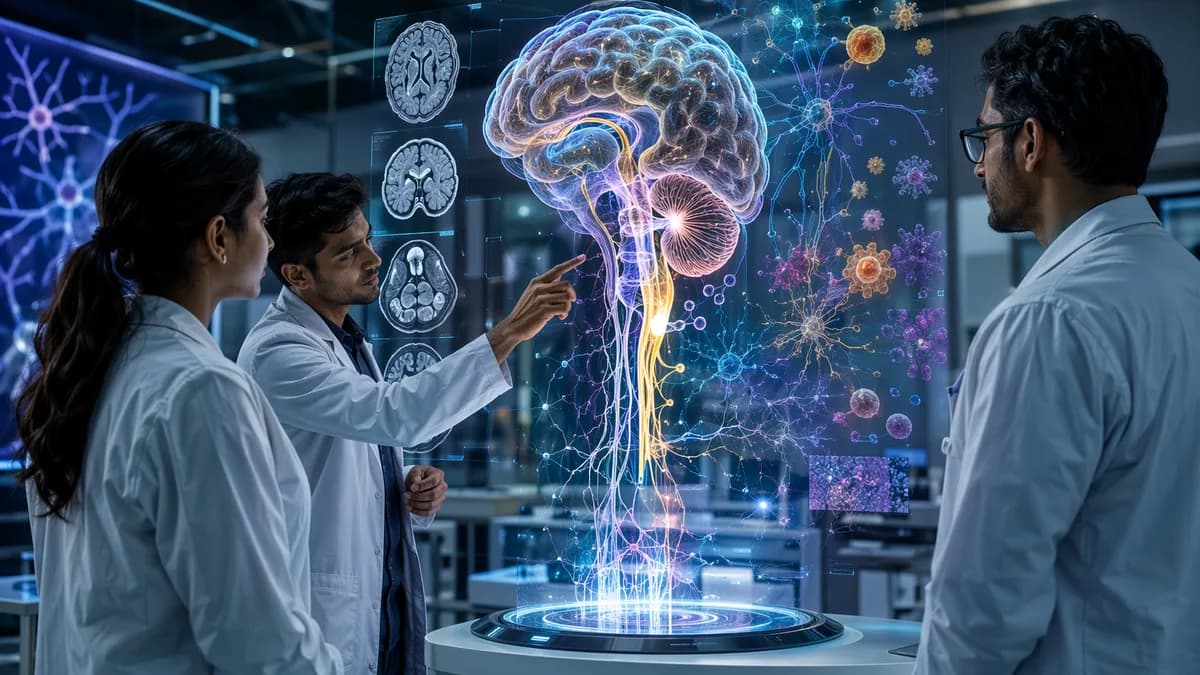
Indian scientists have built what they describe as the world's most detailed three-dimensional atlas of the human brainstem at cellular resolution, a map of one of the brain's least understood regions and a potential reference point for neurologists, neurosurgeons and disease researchers.
XOOMAR Intelligence
Analyst Take
The atlas, called Anchor (Atlas of Neurochemical Characterisation of the Human Brainstem with 3D Reconstruction), was created at the Sudha Gopalakrishnan Brain Centre at the Indian Institute of Technology, Madras, according to BBC World. Its central promise is simple but technically hard: connect the whole-brain view doctors get from MRI with the cellular detail pathologists see under a microscope.
Researchers get a missing bridge between MRI scans and individual neurons
The brainstem is small, but it runs functions that cannot pause: breathing, heartbeat, sleep, wakefulness and movement. It links the brain to the spinal cord. Damage to tiny cell clusters inside it can be catastrophic.
That is why India's brainstem atlas matters now. Neuroscience has long had two powerful but separate views of the brain:
| Tool | What it shows well | What it misses |
|---|---|---|
| MRI | Whole-brain structure | Cellular detail |
| Microscopy | Individual cells in tissue slices | Whole-brain spatial context |
| Anchor | MRI-to-cell navigation in the brainstem | It is still a research atlas, not a diagnostic tool |
Anchor combines more than 500 tissue sections from foetal, childhood and adult brains. It uses high-resolution microscope images, not costlier molecular techniques, and identifies more than 200 clusters of brain cells and nerve pathways. Eight chemical markers help separate cell types.
"We are seeing a visionary programme that puts India at the international table," says Shubha Tole, an Indian neuroscientist at the Tata Institute of Fundamental Research, describing the project as an "unprecedented integration" of engineering, neuroscience and medicine.
The useful leap is not just higher resolution. It is continuity. Users can move from the brainstem as seen on MRI down to individual neurons while preserving spatial relationships.
That matters because routine work often sees only fragments. Rebecca Folkerth, affiliated with Harvard Medical School and New York University, told the BBC that an adult brain weighs about 1.2-1.5kg, yet pathology often samples only a tiny portion.
"For Alzheimer's disease, we may examine only 15 to 20 sections - just a fraction of a percent of the whole organ."
Neuroscientists face a region where small errors carry heavy costs
What makes the brainstem so hard to map? Its architecture is dense. The source material describes it as a sliver of the brain packed with vital cell clusters and nerve pathways. There is little margin for vague labels.
For more than a century, brain study has relied on partial views. The BBC notes that the practice traces back to the pioneering work of Santiago Ramón y Cajal. Modern imaging broadened the view, but it did not erase the gap between large-scale scans and microscopic anatomy.
Anchor tries to close that gap with a digital reference. The team used post-mortem brain tissue, high-resolution images of thin slices, MRI scans and 3D reconstruction. Around 20 scientists spent 18 months manually analysing more than 200 brain sections, according to the source material.
Why does cellular resolution change the questions scientists can ask?
A standard atlas can tell researchers where broad structures sit. A cellular-resolution atlas can help them ask whether disease changes particular clusters, pathways or regions cell by cell.
That is where India's brainstem atlas becomes more than a static map. It gives researchers a shared coordinate system for comparing healthy tissue with diseased tissue.
For XOOMAR readers tracking India's wider science and policy capacity, this is a different kind of national signal from stories such as 12-Year Freeze Snaps on Australia Uranium Exports to India or Death Threats Stalk Judge in India Cow Vigilante Case. Anchor is not about geopolitics or courts. It is about whether Indian labs can build reference infrastructure that global researchers may actually use.
Clinicians may gain a better research base for stroke, Parkinson's and Alzheimer's
Anchor is not a diagnostic tool. That caveat matters. No one should read this as a new bedside test for Parkinson's disease or Alzheimer's disease.
Its clinical relevance is upstream. By comparing healthy brainstem maps with diseased tissue, researchers may better understand disorders including Parkinson's disease, stroke, Alzheimer's disease and sudden infant death syndrome (SIDS). The BBC source also cites potential relevance to autism, dementia and long-term neurological damage after infections including Covid-19.
Partha Mitra of Cold Spring Harbor Laboratory, who has worked with SGBC, told the BBC that detailed atlases like this could have a "transformative impact" on neurological disease research by revealing how affected brains differ from healthy ones cell by cell.
A concrete example: stroke tissue that may still be saved
Folkerth used brain stroke as an example. The atlas has uncovered new features that could help doctors preserve brain tissue that is injured but not yet beyond repair, potentially improving patient outcomes, according to the BBC.
That is a carefully limited claim. It does not mean Anchor now changes stroke treatment protocols. It means a sharper reference map may help researchers interpret damage with more precision, then test whether that knowledge can guide future care.
For neurosurgeons, the appeal is similar. A more precise brainstem map could help them navigate a delicate region with greater confidence. The source does not claim this is already routine surgical software. It frames Anchor as a reference tool that could support safer navigation over time.
Patients will not see a new test tomorrow, but the research pipeline changes
The most immediate users are scientists, neurologists and neurosurgeons, not patients booking appointments. The researchers have made Anchor freely available online, hoping it becomes a global reference tool.
That openness matters because brain atlases do not become useful by sitting inside one lab. They become useful when researchers test them, compare them, challenge their boundaries and apply them to more tissue.
The next step is already defined. SGBC plans to image more than 100 whole human brains across different stages of life and neurological disorders, including Alzheimer's disease and dementia. The goal is a reference library showing how disease reshapes the brain cell by cell.
There are limits. The source material does not establish how Anchor performs across all scanners, hospitals, populations or disease categories. It also does not say when, or whether, the atlas will become part of standard clinical workflows.
That is the practical takeaway: treat India's brainstem atlas as research infrastructure, not a medical product. The near-term watch item is whether outside labs adopt it, whether the planned 100-plus brain library expands its disease comparisons, and whether neurosurgeons and neurologists find that its cellular map changes the questions they can safely ask before they ever change treatment.
Impact Analysis
- The atlas could help researchers connect MRI-scale brain images with cellular-level anatomy.
- Better brainstem maps may support future work on breathing, heartbeat, sleep, wakefulness and movement disorders.
- The project positions Indian neuroscience as a contributor to global brain-mapping research.
How Anchor Bridges Existing Brain Mapping Tools
| Tool | What it shows well | What it misses |
|---|---|---|
| MRI | Whole-brain structure | Cellular detail |
| Microscopy | Individual cells in tissue slices | Whole-brain spatial context |
| Anchor | MRI-to-cell navigation in the brainstem | It is still a research atlas, not a diagnostic tool |
Anchor Brainstem Atlas by the Numbers
Primary Sources & Disclosures

Written by
XOOMAR Insights Team
Research and Editorial Desk
The XOOMAR Insights Team pairs automated research with human editorial judgment. We track hundreds of sources across technology, fintech, trading, SaaS, and cybersecurity, cross-check the facts, and explain what happened, why it matters, and what to watch next. We do not just rewrite headlines. Every article is fact-checked and scored for reliability before it goes live, and we link back to the original sources so you can verify anything yourself.