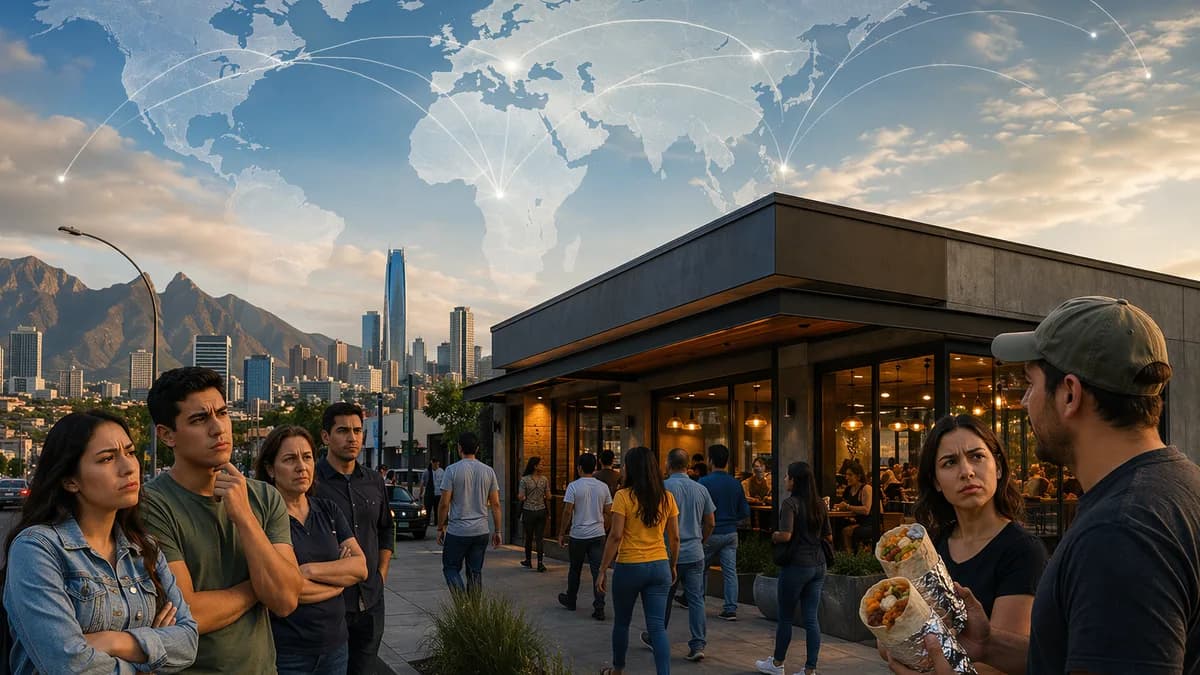
Chipotle Mexico is not just a restaurant launch. It is a US chain walking into the country that inspired its brand and asking Mexicans to buy back a corporate version of their own food.
XOOMAR Intelligence
Analyst Take
That is why the reaction has been so sharp. Chipotle Mexican Grill will open its first Mexican outlet on Thursday in San Pedro Garza García, an upmarket neighbourhood in Monterrey, according to Guardian World. The company calls the move a milestone. Plenty of Mexicans see something more awkward: a burrito-bowl empire testing whether brand polish can outrun culinary memory.
Chipotle in Mexico is a branding gamble wrapped in a burrito bowl
Chipotle can open in Mexico. Nobody should pretend otherwise. The chain has more than 4,000 locations worldwide, and its formula of customizable burritos, tacos and bowls has clearly travelled well beyond its US base.
But Chipotle should not expect Mexicans to treat a US fast-casual chain as an authority on Mexican food.
The company is entering with confidence. Chief executive Scott Boatwright said:
“We are entering Mexico with deep respect for the country’s culinary heritage and a commitment to delivering the Chipotle experience with excellence.”
That is the right tone. It may not be enough.
The backlash is not just online snark. It reflects a deeper irritation with US companies turning Mexican food into an exportable format, then selling that format back to Mexico with corporate discipline, foreign branding and investor-friendly expansion plans.
The Monterrey choice matters. Chipotle is not opening in a random village plaza. It is starting in a northern city, in an upmarket neighbourhood, with plans to open more restaurants in Nuevo León and move into Mexico City next year. That may be smart market entry. It does not erase the cultural tension.
The Monterrey backlash shows food can become a proxy for ownership
The jokes landed because the premise sounds absurd to many people: an American chain selling Mexican-style food in Mexico.
One social media user described the plan as:
“It’s like the dog teaching a duck to fly!”
Another wrote: “Bold move selling Mexico a corporate version of Mexico.” A third compared it to Panda Express opening in mainland China.
The anger was more pointed on Instagram, where one user urged people to back local food businesses:
“Let’s support what’s local. The earnings of Chipotle will go to the USA, they won’t stay in Mexico. On the other hand, if you buy from a local neighbourhood fonda the money goes toward local taxes and generates further economic impact for a circular economy.”
That argument cuts deeper than taste. It frames Chipotle Mexico as a question of cultural and economic ownership. Who gets paid when a cuisine becomes a brand? Who benefits when a local tradition is reformatted for scale?
There is a strong counterargument: customers are free to choose. If Mexicans want Chipotle, they will buy it. If they don’t, the market will say so.
True. But food is never just a product category. It carries family memory, local pride, regional habits and class signals. A burrito bowl can look harmless from a boardroom. On the ground, it can read as a company putting a trademark on someone else’s table.
Chipotle’s US formula was built for a different consumer habit
Chipotle’s genius in the US is not mystery. It sells speed, visible assembly, predictable portions and choice. Customers move down the line, pick proteins, rice, beans, salsa and toppings, then leave with a meal that feels fresher than classic fast food and faster than a sit-down restaurant.
That model works because it solves a specific problem. It gives diners control without making them wait.
Mexico is a harder test because Chipotle is not competing with unfamiliarity. It is competing with people who already know what they like.
The Guardian source notes Chipotle is known for customizable burritos, tacos and bowls. That format may appeal to some consumers in Monterrey, especially those who already understand US fast-casual dining. Inés Carrasco, who writes the blog Cronicas de San Pedro, said Chipotle might attract people who embrace Tex-Mex food because of Monterrey’s proximity to the US.
But Carrasco also warned that the record for US franchises in the region is not encouraging:
“US franchises don’t succeed in Monterrey. Just because one opens doesn’t mean it will do well – Jack in the Box and who knows how many others have flopped in Nuevo León. Some never even made it to Mexico City because they couldn’t cut it in Nuevo León.”
That is the risk in one sentence. Curiosity can fill a first store. Habit keeps it alive.
Authenticity gets awkward when it comes with a franchise agreement
Global brands often monetize authenticity by smoothing it down. The sharp edges become optional. The local chaos becomes a clean ordering system. The recipe becomes a process.
Chipotle’s challenge is that Mexican food is not a single template waiting to be standardized. The company is selling an American fast-casual interpretation of Mexican-inspired food in the country whose food culture made the concept commercially imaginable in the first place.
That does not make the launch immoral. It does make it delicate.
The pricing question will matter, though the supplied source does not give menu prices. If Chipotle lands as a premium novelty, its audience may be limited to consumers who want the brand experience rather than a direct substitute for local food. That could still be a viable business. It would just be a narrower one.
This is where the Chipotle Mexico story becomes more useful than funny. The company does not need to defeat Mexican food. It needs to define a category that enough Mexican consumers see as distinct from everyday local options.
That is a much smaller ambition than “selling Mexican food to Mexico.” It is also the only version of the strategy that makes sense.
Taco Bell’s Mexico failure is the warning Chipotle cannot ignore
The obvious comparison is Taco Bell, and the Guardian source gives the painful history.
Taco Bell tried to launch in Mexico twice. It closed all its restaurants there in 2010. Its 2007 Monterrey opening even included french fries on the menu. At the time, local office worker Marco Fragoso told the Associated Press:
“They’re not tacos. They’re folded tostadas. They’re very ugly.”
The philosopher and journalist Carlos Monsívais described Taco Bell’s Mexico push as:
“like bringing ice to the Arctic”.
That line still stings because it identifies the core mistake: confusing brand recognition with permission.
Chipotle is not Taco Bell. Its positioning is different, its format is different, and its leadership is explicitly talking about respect and learning. Chief business development officer Nate Lawson said the first restaurant will be “an important proof-of-concept” that lets the company “better understand local consumer preferences as we thoughtfully grow in Mexico.”
That is the right strategic frame. A proof-of-concept is not a victory lap. It is a test.
Chipotle is working with Alsea, the Mexican restaurant operator. Alsea chief executive Christian Guirría told Expansión:
“We had been pursuing Chipotle for at least five or six years. I don’t know if we wore them down or won them over, but ultimately, we were very fortunate to secure the franchise for Mexico.”
That partnership gives Chipotle local operating muscle. It does not automatically give it cultural fluency.
The case for Chipotle Mexico is stronger than the mockery admits
The jokes are easy. The business case is not ridiculous.
Foreign reinterpretations of food travel all the time. The Guardian source notes that Starbucks has been somewhat more successful in Italy after opening its first outlet there in 2018, while Domino’s Pizza exited Italy in 2022 after its local franchise filed for bankruptcy and closed all 29 restaurants. Same broad category of cultural risk. Very different outcomes.
| Brand | Country test | Outcome cited in source |
|---|---|---|
| Taco Bell | Mexico | Closed all restaurants there in 2010 |
| Starbucks | Italy | Opened first outlet in 2018, described as somewhat more successful |
| Domino’s Pizza | Italy | Local franchise filed for bankruptcy and closed 29 restaurants in 2022 |
| Chipotle | Mexico | First restaurant opens Thursday in Monterrey |
Chipotle does not need every Mexican consumer to approve. It needs enough customers who want a predictable fast-casual meal, a familiar brand, or a US-style format in a specific setting.
That is the commercial opening. The cultural problem remains.
A line outside the first store would prove curiosity. Repeat visits would prove fit. Neither would prove that Mexicans accept Chipotle as a credible interpreter of their cuisine.
For XOOMAR readers tracking how public acceptance can make or break institutional rollouts, the same pattern appears outside food too. Our coverage of EU Teen Social Media Limits May Force Apps to Prove Safety and Child Lockout Looms as EU Social Media Ban Push Spreads shows a similar lesson: a plan can look clean on paper and still run straight into public resistance.
Chipotle must earn trust instead of treating Mexico as another pin on the map
Chipotle’s next move should be humility with teeth.
That means more than soft language about respect. It means listening to local consumers before scaling too aggressively. It means using its partnership with Alsea to understand regional expectations, not just secure leases. It means avoiding marketing that sounds like it is teaching Mexicans about Mexican food.
The company should also be careful with corporate confidence. Social media ridicule can fade. It can also harden into a brand stain if a company responds as if the public simply needs to be educated.
The practical watch items are clear:
- Repeat demand: Does the Monterrey store keep traffic after the novelty period?
- Local adaptation: Does Chipotle adjust to Mexican preferences in substance, not just branding?
- Expansion discipline: Do more Nuevo León locations and the planned Mexico City move follow evidence, or ambition?
- Cultural tone: Does the company speak like a guest, or like an owner?
Mexico does not need Chipotle to validate its cuisine. Chipotle needs Mexico to decide whether its version deserves a seat at the table.
The Bottom Line
- Chipotle’s Mexico debut tests whether a US fast-casual brand can win over diners in the cuisine’s home country.
- The backlash shows how food branding can become a cultural identity issue, not just a business expansion story.
- The Monterrey launch could shape how global chains approach authenticity when entering culturally sensitive markets.
Chipotle’s Mexico launch: company pitch vs local perception
| Company pitch | Local perception |
|---|---|
| Opening first Mexican outlet in San Pedro Garza García, Monterrey, as a milestone | Seen by critics as selling a corporate US version of Mexican food back to Mexicans |
| Says it has deep respect for Mexico’s culinary heritage | Many Mexicans question whether a US chain can claim authority on Mexican food |
| Plans more restaurants in Nuevo León and Mexico City next year | Expansion highlights tension over foreign branding of local cuisine |
Primary Sources & Disclosures

Written by
XOOMAR Insights Team
Research and Editorial Desk
The XOOMAR Insights Team pairs automated research with human editorial judgment. We track hundreds of sources across technology, fintech, trading, SaaS, and cybersecurity, cross-check the facts, and explain what happened, why it matters, and what to watch next. We do not just rewrite headlines. Every article is fact-checked and scored for reliability before it goes live, and we link back to the original sources so you can verify anything yourself.