
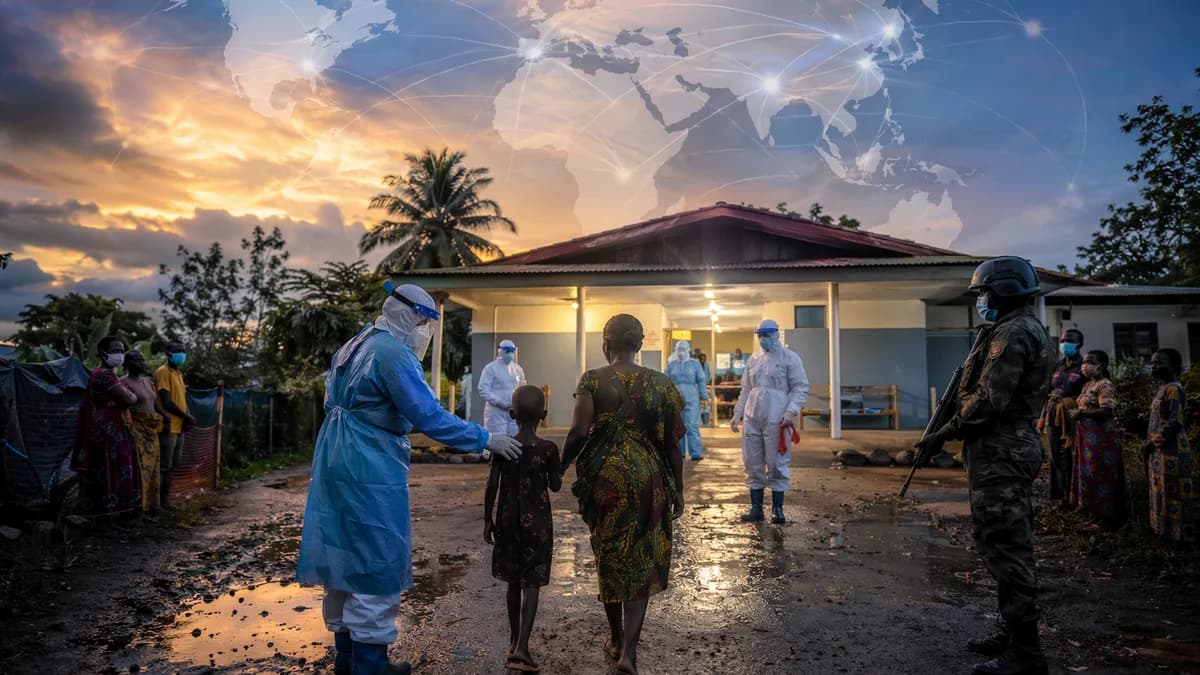
A six-year-old Ebola patient was taken from a hospital in eastern DR Congo by armed men, then found days later at another treatment centre roughly 18km (11 miles) from Butembo, a frightening signal that the DR Congo Ebola outbreak is being fought as much inside communities as inside clinics.
Global TrendsJune 19, 2026· 11 min read· By XOOMAR Insights Team
Snatched DR Congo Ebola Patient Exposes Outbreak Fear
Updated on June 19, 2026
XOOMAR Intelligence
Analyst Take
57/ 100
4 sources analyzedLow confidenceTrend10Freshness94Source Trust92Factual Grounding86Signal Cluster20
The child and her mother are now back in care, and the girl is “doing well,” local health official Dr Lubambo Maboko Gaston told BBC World. That is the good news. The harder truth is that a health system loses precious control when an Ebola patient leaves monitored treatment during an active outbreak.
The DR Congo Ebola outbreak has already produced more than 230 deaths and 890 confirmed cases, according to the BBC report. Health facilities have come under attack multiple times. The child’s removal was not an odd side story. It was a trust failure with clinical consequences.
A six-year-old Ebola patient vanished from care because fear beat public health messaging
The most alarming detail is not only that armed men took a sick child from a hospital. It is that this happened in a place where Ebola treatment should be seen as the safest possible option.
Dr Gaston said on Wednesday that the girl and her mother had been taken two days earlier by “very angry” men from a hospital in Butembo, in North Kivu. By Friday, they had turned up at an Ebola treatment centre about 18km away.
“Her condition is currently considered stable,” Dr Gaston said of the child.
That sentence matters. It means the immediate clinical emergency may have eased. It does not mean the public health emergency created by the removal has disappeared.
Ebola spreads through contact with bodily fluids. Any time a patient moves outside supervised care, responders have to ask basic, urgent questions. Who touched the patient? Who transported her? Where did she sleep? Did relatives provide care? Did anyone clean contaminated materials?
The central lesson is blunt: Ebola containment depends on medicine, logistics, security, and trust. Remove trust, and the rest starts to buckle. A treatment centre that communities fear is not fully functional, no matter how trained the staff are or how well stocked the ward is.
How Ebola treatment centres became targets in DR Congo’s outbreak response
Misinformation and fear have dogged the DR Congo Ebola outbreak. The BBC reports that suspicion around treatment centres has been rife, and facilities have been attacked multiple times during the current outbreak.
That hostility has an emotional logic, even when it creates grave danger. Families see patients isolated. Health workers wear protective equipment. Bodies cannot be handled in familiar ways. Outsiders arrive with rules, warnings, and restrictions. In a frightened community, those measures can look less like care and more like coercion.
Local politician Luc Malembe described the problem plainly last month:
“People are not properly informed or sensitised about what is happening. For a certain segment of the population, especially in remote areas, Ebola is an invention by outsiders - it does not exist,” local politician Luc Malembe told the BBC last month.
“They believe it is the NGOs and hospitals creating this to make money, and this is tragic.”
The attacks described in the BBC report show how fast distrust can turn operational. In Mongbwalu, police fired shots in the air after angry crowds tried to reclaim the bodies of loved ones who had died at a health facility. Days earlier, crowds set fire to isolation tents in Rwampara, a town 85km (53 miles) south-east of Mongbwalu, after being stopped from taking the body of a man thought to have died from Ebola.
That last detail is central. The body of an Ebola victim is highly infectious and can spread the virus further when prepared for burial. Safe burial is not a cultural footnote in an Ebola response. It is one of the core containment tools.
When communities attack facilities, the damage reaches every layer of outbreak control:
- Testing: People avoid clinics if they believe diagnosis will separate them from family.
- Isolation: Patients who leave care can expose caregivers and relatives.
- Contact tracing: Unreported movements create blind spots.
- Treatment: Delays can worsen outcomes.
- Safe burials: Attempts to reclaim bodies can spread infection at the worst possible moment.
XOOMAR analysis: The hospital removal suggests public health messaging is lagging behind community fear. In an outbreak, a rumor can move faster than an ambulance.
The numbers behind the Ebola risk when one patient leaves monitored care
The current outbreak was declared in eastern DR Congo on May 15, although the BBC says transmission had been going undetected for some time. Cases are concentrated in Ituri, South Kivu, and North Kivu. Ituri is the main centre of transmission, accounting for more than 90% of confirmed infections.
The outbreak has been caused by Bundibugyo, a rare species of Ebola. There is currently no vaccine for this species, and the World Health Organisation has said it could take months for a jab to be ready.
| Outbreak pressure point | Reported detail | Why it raises risk |
|---|---|---|
| Confirmed cases | 890+ | Larger case pools make missed contacts more dangerous |
| Confirmed deaths | 230+ | Fatal cases increase the urgency of safe burial controls |
| Main transmission centre | Ituri, more than 90% of confirmed infections | Geographic concentration helps targeting, but also shows where failure could compound |
| Cross-border spread | Uganda: 19 confirmed cases, including two deaths | Movement across borders keeps surveillance pressure high |
| Vaccine gap | No current vaccine for Bundibugyo | Containment leans harder on tracing, isolation, treatment, and trust |
Uganda, which borders DR Congo, has reported 19 confirmed cases, including two deaths. The WHO has said Uganda has not reported any new cases since 5 June. That is encouraging, but it also shows why missed contacts matter. A single infected person moving through households, transport routes, or informal care settings can force responders to rebuild a chain of exposure from fragments.
The child’s stable condition is encouraging. Still, public health teams now need to identify anyone exposed while she and her mother were away from the original facility. That work is harder when the original removal was driven by fear or anger. People may hide contacts if they believe disclosure brings punishment, isolation, or stigma.
The funding picture also shows the scale of the response. The WHO has pledged $3.9m (£2.9m) to tackling the outbreak, while Africa CDC has announced a $319m budget. Money can buy supplies and staff time. It cannot automatically buy cooperation.
Families, doctors, local leaders, and armed groups are pulling the Ebola response in different directions
The family side of this crisis has to be handled carefully. Panic, grief, distrust, and confusion can collide with medical advice, especially when the patient is a child. The instinct to keep a sick child close is powerful. In an Ebola outbreak, that instinct can become dangerous.
Doctors and nurses face a different burden. They carry infection risk, physical danger, and the demoralizing reality that one rumor can undo days of tracing or careful isolation. Health workers in this outbreak are not only treating disease. They are defending the idea that treatment centres are places of survival, not disappearance.
Local leaders sit between those worlds. Religious figures, community organizers, and politicians can calm suspicion if they explain what health teams are doing in terms people trust. They can also deepen the crisis if they repeat claims that Ebola is invented or that hospitals are profiting from fear.
This is where the DR Congo Ebola outbreak becomes more than a medical event. It becomes an institutional trust test. XOOMAR often tracks trust breakdowns in technical systems, including finance products where design gaps can undermine confidence, as in Joint Account Gaps Trip Up Best Neobanks for Couples. The stakes here are far higher, but the pattern is familiar: if users do not trust the system, they route around it.
Eastern DR Congo adds a security layer that makes every public health task harder. The WHO has warned that conflict in the east is complicating the Ebola response. The M23 rebel group controls large parts of both North Kivu and South Kivu, according to the BBC report.
Weak authority, armed groups, and population movement create a hostile environment for contact tracing. Health teams need access, speed, and local permission. Conflict strips away all three.
DR Congo’s Ebola crisis echoes West Africa’s hardest lesson: trust spreads faster than vaccines
The head of Africa CDC said on Tuesday that the current Ebola outbreak could become one of the largest ever, echoing a similar projection made earlier this month by the US CDC, according to the BBC.
That warning lands because Ebola responses have learned a hard lesson before: biomedical tools fail when communities see them as imposed from outside. The BBC’s related reporting and the current account point to the same pressure points that shaped previous Ebola emergencies: unsafe burials, fear of treatment centres, and mistrust of health workers.
There are real response assets now. DR Congo’s health ministry says it has stepped up surveillance systems, contact tracing, and treatment infrastructure, with dedicated centres in several affected towns. International agencies are committing funds. Health workers know more than they did in earlier outbreaks about isolation, infection control, and community response.
But the Bundibugyo species changes the operating picture because there is no current vaccine for it. The WHO has said a jab could take months to be ready. That makes non-vaccine tools even more important.
Those tools are social as well as clinical. Contact tracing requires names. Safe burial requires consent or at least acceptance. Treatment requires families to believe patients have a chance inside the facility. Surveillance requires people to report symptoms before the disease spreads further.
XOOMAR analysis: The DR Congo Ebola outbreak shows that modern outbreak response is a social contract under extreme pressure. The state, clinics, aid agencies, and communities all have to accept the same basic premise: the official response is safer than improvising outside it. The hospital removal shows that premise is not yet secure.
Global health teams cannot treat misinformation as a side operation
The practical lesson for public health agencies is clear. Communication cannot arrive after the doctors. It has to move beside them from the first suspected case.
That means hiring local communicators early, answering rumors quickly, and making treatment centres less opaque. Families need to understand what happens inside isolation, when they can receive updates, what recovery looks like, and why certain burial practices are restricted. Silence creates space for the worst explanation to win.
Survivors can matter here. The BBC report notes that recovery of Ebola patients offers rare moments of joy at the outbreak epicentre. In communities gripped by fear, survivors are not abstract messengers. They are proof that entering care does not automatically mean death.
There is a broader systems lesson too. Technical capacity can fail at the user interface. In fintech, as we wrote in Joint Account Gaps Trip Up Best Neobanks for Couples, a product can look strong on paper while failing in the messy reality of household behavior and trust. In public health, that gap is measured in infections, not churn.
A safe treatment unit that a community will not use is not a functioning treatment unit. It is a building waiting for a trust strategy.
Ebola containment in DR Congo hinges on rebuilding trust before the next scare
The child being found and stable gives responders a narrow opening. They can trace contacts, assess exposure during the time away from care, and use the case to explain why monitored treatment protects families as well as patients.
Health teams will likely tighten security around facilities. That may be necessary after armed men stormed a hospital. But heavier security carries its own risk if treatment centres start to look like detention sites. A frightened family may not distinguish protection from confinement.
The stronger response pairs speed with cultural fluency. Officials need transparent communication about treatment, recovery, deaths, and burial practices. They need local figures who can speak credibly before rumors harden. They need to show families that care is not a one-way handoff into an unknown institution.
The watch item now is not only whether case numbers rise or fall. It is whether families in Ituri, North Kivu, and South Kivu begin choosing care faster, reporting contacts more openly, and accepting safe burials without confrontation. Those behaviors would confirm that trust is being rebuilt.
If more patients are hidden, more bodies are reclaimed, or more facilities are attacked, the opposite case gets stronger. The child’s return is good news. The system remains exposed until communities believe the safest place for an Ebola patient is inside care, not away from it.
Impact Analysis
- The child’s removal from supervised care shows how fear and mistrust can undermine Ebola containment.
- With 890 confirmed cases and more than 230 deaths, any break in monitoring can increase transmission risk.
- Attacks on health facilities make it harder for responders to treat patients and trace contacts safely.
DR Congo Ebola Outbreak Toll
Confirmed cases
people890
Deaths
people230
Sources

Written by
XOOMAR Insights Team
Research and Editorial Desk
The XOOMAR Insights Team pairs automated research with human editorial judgment. We track hundreds of sources across technology, fintech, trading, SaaS, and cybersecurity, cross-check the facts, and explain what happened, why it matters, and what to watch next. We do not just rewrite headlines. Every article is fact-checked and scored for reliability before it goes live, and we link back to the original sources so you can verify anything yourself.
Explore More Topics
Related Articles
 Global Trends
124 Referred as Muckamore Abbey Inquiry Exposes Abuse
Abuse and neglect became routine at Muckamore Abbey Hospital, with 124 people referred for prosecution.
Jun 18, 202614 min
 Global Trends
Child Deaths Rip Open England’s Measles Vaccine Gap
England reported two child measles deaths and 106 new cases, exposing the cost of falling vaccine coverage.
Jun 11, 20268 min
 Cybersecurity
Beats Studio Buds Flaw Let Nearby Hackers Tap Mics
A Beats mic flaw puts accessory security in the spotlight as cloud, airline and Android TV risks pile up.
Jun 19, 20266 min
 Technology
Reliance AI Invades Calls and Homes for 500M Jio Users
Reliance is embedding AI into Jio calls, apps, and homes, giving Ambani instant reach to 500 million users.
Jun 19, 20268 min
 Global Trends
Orderly Exit Push Squeezes Starmer Leadership Challenge
Burnham and Streeting allies want Starmer pushed toward an orderly exit before any Labour ballot can save him.
Jun 19, 20269 min
 Technology
$179 NTS Radio Player Rescues Old Hi-Fi From Phone Apps
$179 NTS Radio Player gives old stereos hi-res internet radio and physical NTS controls, pushing back against phone-first listening.
Jun 19, 20266 min
 Global Trends
Obama Says Iran War Burned Billions and Left US Worse Off
Obama says the Iran war spent billions, strained the military and left the US no better off, with a fragile ceasefire now carrying the damage.
Jun 19, 20268 min
 Cybersecurity
Dormant Key Turns Klue Breach Into Salesforce Theft
A dormant Klue API credential let attackers steal OAuth tokens and Salesforce data, exposing a dangerous SaaS trust chain.
Jun 19, 202613 min
 Global Trends
No Intel Experience, Bill Pulte Lands Top Spy Post
Trump put Bill Pulte atop 18 spy agencies despite no intel background, turning a vacancy into a loyalty test.
Jun 19, 20266 min
 Trading
161.37 USD/JPY Spike Puts Yen Intervention on Edge
USD/JPY's jump to 161.37 has yen traders bracing for Japan intervention after the Fed kept the dollar on the front foot.
Jun 19, 20265 min
Don't miss the signal
Get our weekly roundup of the stories that matter across tech, fintech, and trading. No noise, just signal.
Free forever. No spam. Unsubscribe anytime.