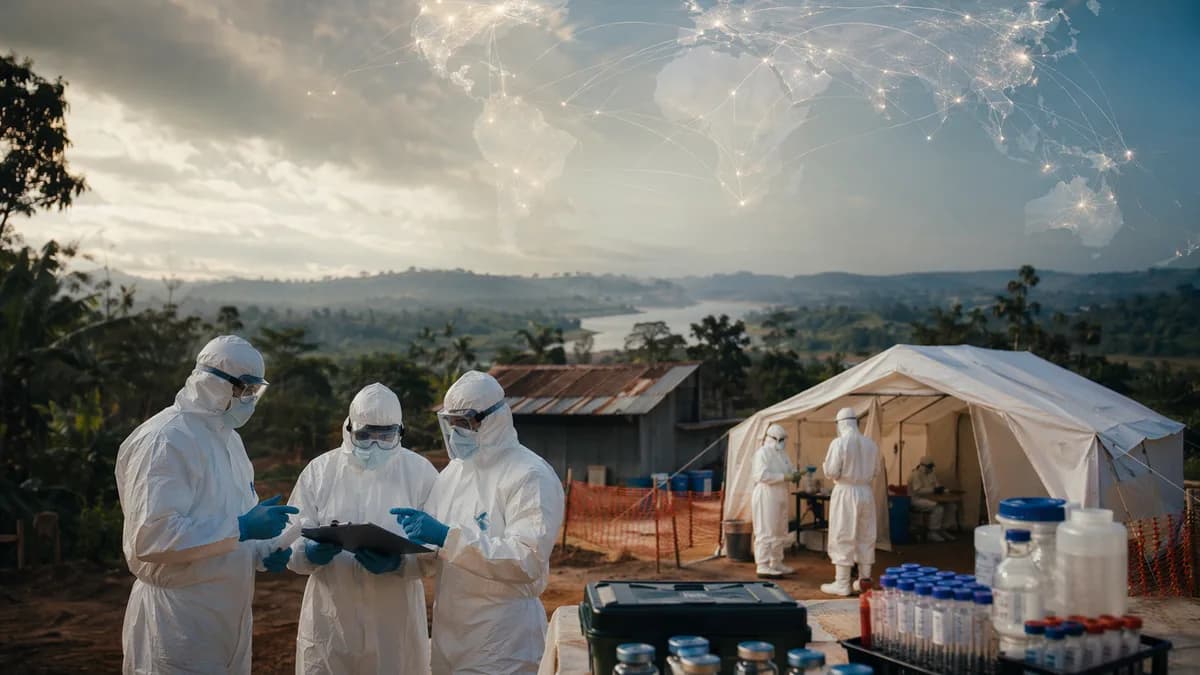
The DRC Ebola treatment trial signals a hard shift from crisis containment to crisis evidence, testing whether doctors can find reliable therapies while the outbreak is still killing patients. The first patient has now been enrolled in the Democratic Republic of Congo, according to BBC World, in a trial aimed at the Bundibugyo virus strain behind the current outbreak.
XOOMAR Intelligence
Analyst Take
That matters because this strain has no approved vaccines or treatments. The trial is sponsored by the World Health Organization and coordinated by scientists at the Institut National de Recherche Biomédicale in DRC, the Institute of Tropical Medicine in Belgium, and the University of Oxford in the UK. It is not a lab exercise waiting for perfect conditions. It is being run inside a live public health emergency.
"The clinical trial of two therapeutics began, with the enrolment of the first patient," WHO chief Tedros Adhanom Ghebreyesus said.
The DRC Ebola treatment trial turns outbreak medicine into a live-fire test
The thesis is simple: DRC is no longer only the site of an Ebola emergency. It is now where outbreak medicine is being stress-tested in real time. The DRC Ebola treatment trial is evaluating therapies while transmission continues, hospitals are strained, and public trust is fragile.
That creates an ethical tension. In a deadly outbreak, the instinct is to give every patient whatever looks promising. But without controlled evidence, clinicians may never learn which drug actually improves survival, which one does little, and whether combinations work better than single agents.
The counterpoint is strong. Randomization during an epidemic can feel cold, especially to families desperate for treatment. Yet the WHO’s framing is that patients in the trial will still receive supportive care and close follow-up. The question is not treatment versus neglect. It is whether treatment can be tested rigorously enough to help this outbreak and the next one.
XOOMAR usually applies a “trial” lens to institutional pressure in other beats, such as SVB FDIC Trial Throws $1.7 Billion Into Legal Fire and Daphne Caruana Galizia Trial Puts Fenech in the Dock. Here, the word is literal, and the stakes are measured in survival.
DRC Ebola numbers show why experimental treatments can't wait
The numbers explain the urgency. WHO data cited by BBC World show 1,406 confirmed Ebola cases in DRC, 301 suspected cases, and 438 deaths as of 30 June. An AFP report carried by RNZ also cites 208 recoveries and a 31 percent case fatality rate in DRC.
| Location | Confirmed cases | Deaths | Date cited |
|---|---|---|---|
| DRC | 1,406 | 438 | 30 June |
| Uganda | 20 | 2 | 1 July |
| France | 1 | Not stated | 1 July |
The confirmed versus suspected split matters. Confirmed cases tell health officials where laboratory evidence exists. Suspected cases show the unresolved perimeter of the outbreak, the patients who may still need testing, isolation, tracing, or clinical assessment. The source material does not say how many suspected cases will become confirmed, so that cannot be assumed.
The death count makes the treatment question immediate. But case totals alone understate the pressure. AFP’s report says there are 650 beds in 22 health centres, with around 96 percent occupied, and 300 more beds planned. That means treatment capacity is already close to saturated even before considering future confirmed clusters.
Fatality rates can shift as conditions change. Early diagnosis, rapid supportive care, patient willingness to enter treatment, and access to trial sites all matter. The source material supports one clear operational point: contact tracing has improved, with four in five contacts now being followed up, but WHO officials said more contacts per case still need to be identified.
Two drugs, four groups, and one hard question: what actually saves lives?
The trial is evaluating the monoclonal antibody MBP134 and the antiviral remdesivir, alone and in combination, according to the AFP report. Patients are expected to be randomized into four groups: remdesivir, MBP134, neither, or both.
That structure is designed to separate signal from hope. A drug may look promising in theory, or in a small number of patients, without proving that it cuts deaths across a broader outbreak population. The DRC Ebola treatment trial is trying to answer that harder question under field conditions.
"Even without approved therapeutics, people are recovering from this disease, but of course, we could save many more lives with safe and effective therapeutics in our toolkit," Tedros said.
The strongest counterpoint is speed. Trials take time, and Vasee Moorthy, who leads the WHO’s research and development blueprint arm, said the study could take months, could run into next year, and might require more than 1,000 patients to produce definitive answers. The trial reportedly has enough remdesivir and MBP134 for 1,200 patients.
Still, access without evidence can trap future patients in the same uncertainty. Compassionate use may help individuals, but it does not reliably show whether a drug works, whether a combination adds benefit, or whether scarce treatment capacity is being directed well. This trial is the mechanism for turning emergency improvisation into usable evidence.
The vaccine gap is also a treatment gap
The Bundibugyo strain exposes a structural weakness in Ebola response. BBC World reports that vaccines must be developed for each individual species of Ebola, of which there are six, though only three are known to cause outbreaks. For this current Bundibugyo outbreak, there are no approved vaccines or treatments.
That distinction matters. Prevention and survival are separate problems. A vaccine can reduce future infections if available and matched to the species. A treatment helps patients who are already sick. The DRC Ebola treatment trial is aimed at the second problem, and the current outbreak shows why that gap cannot be treated as secondary.
The source material does not provide enough detail to compare this trial with past Ebola research programs or earlier outbreaks. So the safer conclusion is narrower: for this outbreak, the scientific bottleneck is not only stopping transmission. It is proving whether specific therapies can change outcomes for infected patients.
What would weaken that thesis? If the trial cannot enroll enough patients, if outbreak geography shifts beyond participating facilities, or if safety and efficacy signals remain unclear after months of work, the result may be useful but not decisive.
Violence and mistrust could decide whether the science works
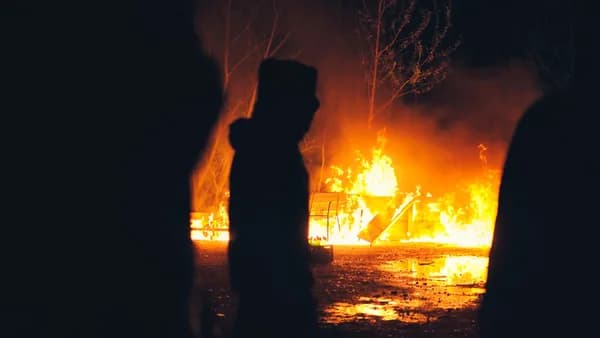
A clinical trial can fail for reasons that have little to do with pharmacology. WHO officials said the response is taking place amid conflict, deep humanitarian needs, mistrust, and violence. Tedros said an Ebola treatment centre in Ituri province was attacked this week, two people died, the centre was set on fire, and patients fled.
"Such acts not only endanger patients and health workers but also impede efforts to stop transmission and save lives," Tedros said.
That is not a side issue. If patients avoid treatment centres, they may arrive later, when care is harder. If contacts are not identified quickly enough, transmission can continue. If health workers are unsafe, treatment capacity becomes a security problem as much as a medical one.
The trial is expected to begin in one treatment facility in Ituri before expanding to others in the province. That staged approach may protect data quality, but it also means geography and trust will shape who can access the study. The source material does not specify consent procedures, drug storage requirements, or site-level staffing, so those operational details remain unclear.
The next six months will test evidence, capacity, and public trust
The clearest success scenario is a strong survival signal from one therapy or a combination, backed by enough enrollment to change care standards quickly. A weaker or mixed result would still matter. It could narrow the field, rule out false promise, and guide future research on Bundibugyo Ebola.
Near-term pressure points are already visible:
- Enrollment: Moorthy said definitive answers may require more than 1,000 patients.
- Capacity: 96 percent bed occupancy leaves little slack.
- Security: the Ituri attack shows treatment sites themselves are vulnerable.
- Surveillance: suspected cases and contact tracing will shape whether clusters are found early.
- Communication: community trust will influence whether patients come forward soon enough.
The DRC Ebola treatment trial will be judged by more than a published result. The test is whether rigorous medical evidence can be produced during an active epidemic, under strained field conditions, without waiting until the outbreak’s human cost is already fixed. Evidence that enrollment rises, treatment centres remain open, and clear safety or efficacy signals emerge would strengthen that thesis. Attacks, stalled recruitment, or unresolved data would weaken it fast.
Impact Analysis
- The Bundibugyo Ebola strain currently has no approved vaccines or treatments.
- Testing therapies during an active outbreak could identify which drugs actually improve survival.
- The trial may shape how future epidemic treatments are studied and delivered in real time.
Primary Sources & Disclosures

Written by
XOOMAR Insights Team
Research and Editorial Desk
The XOOMAR Insights Team pairs automated research with human editorial judgment. We track hundreds of sources across technology, fintech, trading, SaaS, and cybersecurity, cross-check the facts, and explain what happened, why it matters, and what to watch next. We do not just rewrite headlines. Every article is fact-checked and scored for reliability before it goes live, and we link back to the original sources so you can verify anything yourself.