
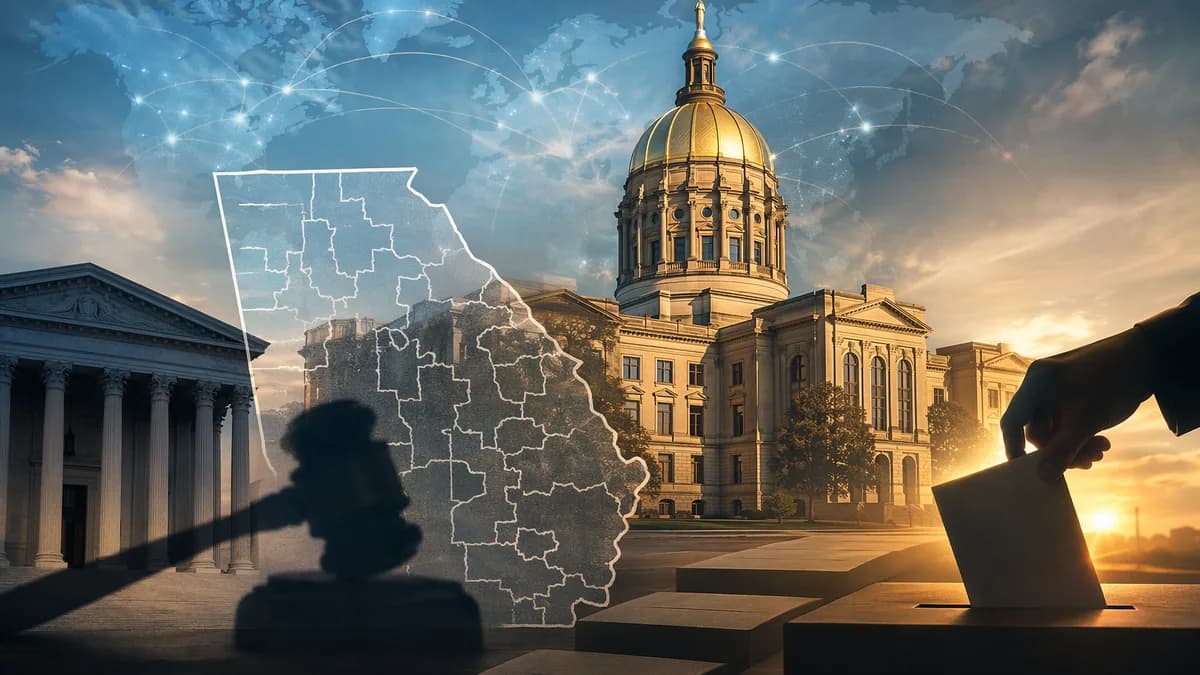
On Wednesday, Georgia Republican leaders refused to redraw the state’s congressional map, turning a rushed post-Supreme Court opening into a delay strategy with national consequences for Georgia redistricting.
Global TrendsJune 17, 2026· 8 min read· By XOOMAR Insights Team
Georgia Redistricting Fight Freezes as GOP Runs Clock
Updated on June 17, 2026
XOOMAR Intelligence
Analyst Take
69/ 100
4 sources analyzedMedium confidenceTrend10Freshness95Source Trust90Factual Grounding92Signal Cluster20
The move came during a special session after a recent US supreme court opinion weakened a major pathway for challenging election maps under the Voting Rights Act, according to Guardian World. The immediate explanation was process. The political effect is sharper: Georgia’s current map stays in place while Republicans, Democrats, voting rights groups, and courts sort through what the ruling now allows.
Wednesday’s Georgia redistricting refusal was process language with political weight
Jon Burns, the Georgia house speaker, framed the decision as a rejection of speed.
“We believe that it’s important to do things the Georgia way, responsibly, transparently, and with ample opportunity for public input,” Burns said.
That argument is not trivial. District maps shape every voter’s congressional choices, and Burns said changes could affect “every voter in Georgia.” He also pointed to other matters before lawmakers, including a moratorium on gasoline taxes, property tax relief, and a legislative change tied to a 2024 law that could cast doubt on the legality of vote-counting machines before the November election.
But process is also power. XOOMAR analysis: by declining to redraw now, Georgia Republicans avoid making a high-risk map change under intense scrutiny while keeping the existing political structure intact for the moment. That is not the same as neutrality. It is a choice to let time work on the current map’s side.
The decision also cuts against pressure from the national GOP. Republicans in several states have moved quickly after the Supreme Court decision, urged by Donald Trump, as they try to protect a narrow majority in the US House of Representatives. AP reported that ten states have already enacted new congressional districts ahead of the November midterm elections.
The April Supreme Court ruling created room, but not a clean playbook
The trigger was Louisiana v. Callais, the Supreme Court case that addressed how race can be considered in drawing maps and how Section 2 of the Voting Rights Act challenges are evaluated. Atlanta News First reported that the decision was 6-3 and that it weakened Section 2, raising hurdles for voters who claim district lines dilute minority voting power.
That matters in Georgia because the fight is not only about partisan advantage. It is also about whether Black and other minority voters have a fair opportunity to elect preferred candidates. The Guardian described the ruling as effectively gutting a major section of the Voting Rights Act. AP said it struck down Louisiana’s congressional map as an illegal racial gerrymander and laid the groundwork for other Southern states to redraw districts.
Burns said lawmakers do not yet understand the full ramifications of the decision. That is plausible. The ruling creates a hard tension for Republican mapmakers: draw too aggressively and invite backlash or litigation, move too slowly and anger national party strategists.
The contradiction is obvious. Special sessions exist because deadlines can be tight. Georgia Republicans are saying this deadline is too tight for a map that could reshape representation across the state.
For readers following how legal timing can alter policy outcomes in very different contexts, XOOMAR has also covered court-driven change in Pakistan Period Tax Falls After Campaigners Sue State. In technology, timing after official fixes can matter just as sharply, as shown in Hackers Pounce on Fortinet FortiSandbox Bugs After Patches. These are separate stories, but each shows how procedural timing can change real-world outcomes.
Georgia’s map fight turns on five districts, 14 seats, and minority voting power
The clearest numbers in the supplied reporting come from AP. Georgia has 14 US House districts. AP reported that five of those districts have electorates that are majority or plurality nonwhite, and that all elected Black Democrats in 2024.
AP also reported that about a third of Georgia’s 180 state representatives are Black, while Latino, Asian, and other minority lawmakers bring the nonwhite share to about 40%, roughly reflecting the state’s overall population.
Those numbers explain why Georgia redistricting is so sensitive. Voting rights law is not supposed to guarantee outcomes. It focuses on whether minority voters have an opportunity to elect candidates of their choice. In practice, that can turn on line-drawing decisions that split, combine, or rearrange communities across metro Atlanta and other growing areas.
Atlanta News First reported that Brian Kemp said voting was already underway for the 2026 election and that Georgia would instead need new maps before the 2028 election cycle. That timing matters. Once voters, candidates, and campaigns start operating under existing boundaries, a late redraw becomes harder to defend as orderly governance.
Burns, Warnock, and activists are arguing over different versions of the same map
Republican leaders are presenting one version of the dispute: a rushed redraw would be irresponsible, the Supreme Court ruling is too fresh, and voters deserve hearings and feedback. Mark Newton, a Republican state representative from the suburban Augusta area, backed that posture.
“He likes to do things with deliberation, not to be rushed,” Newton said of Burns. “When we’ve redistricted in the past, we’ve had meetings. We’ve gotten feedback from all groups.”
Voting rights advocates see another map. For them, delay preserves boundaries they believe already weaken minority voting power, while the legal ground shifts under their feet. The pressure was visible at the Capitol, where AP reported demonstrators chanted “Black voters matter!”
Raphael Warnock, a US senator from Georgia and a prominent Democrat, returned to the state to protest a potential redraw. Speaking before Burns’ announcement, Warnock called the session opening “a dark day in Georgia history,” according to AP.
“If you want to redraw maps and you have the power to do it, I guess you can do it,” Warnock said. “But keep Dr. King’s name out of your mouth.”
The courts are the third force. AP reported that Burns cited pending litigation over existing Georgia districts. The supplied reporting does not establish how judges will rule or whether any court-drawn map will become necessary. It does establish that litigation remains part of the timing problem lawmakers say they are trying to avoid.
| Stakeholder | Stated or reported position | Immediate effect |
|---|---|---|
| Georgia Republican leaders | Avoid a rushed redraw after the Supreme Court ruling | Current boundaries stay in place for now |
| Voting rights advocates | Oppose maps that weaken minority voting power | Pressure shifts to protests and litigation |
| Kemp and national Republicans | Push or prepare for new maps after the ruling | Georgia becomes a public intraparty friction point |
| Voters and candidates | Operate under existing districts unless lines change | Campaign planning remains tied to current boundaries |
The Southern Section 2 fight now runs through timing as much as doctrine
The Georgia decision sits inside a broader Southern fight over Section 2. AP reported that before Callais, Section 2 was understood to require maps that gave historically marginalized minorities a reasonable chance to elect candidates of their choice. The Court’s conservative majority said districts drawn with racial makeup in mind can violate the Constitution’s equal protection clause, and described apportionment as needing to be “race neutral.”
That phrase now carries enormous political weight. In Southern states, AP noted, party loyalty often overlaps with race and ethnicity. That means a rule framed as race-neutral can still reshape partisan outcomes if it redistributes nonwhite voters who tend to support Democrats.
Georgia Republicans are not rejecting redistricting forever. They are rejecting this redistricting moment. XOOMAR analysis: that distinction is the core of the story. The delay buys time, limits immediate exposure to a volatile legal fight, and lets lawmakers keep their options open while other states test the boundaries first.
The next Georgia map decision will test whether delay was caution or strategy
The practical effect is simple for now: voters remain in their current districts unless that changes later through legislation or litigation. Candidates can campaign against known boundaries. Party committees can plan around the map they already have.
The larger test comes before the 2028 election cycle, when Kemp has said Georgia must adopt new maps in response to the ruling, according to Atlanta News First. If Republican leaders continue to emphasize public input, the evidence will be hearings, draft maps, and a slower process. If the process compresses again near an election deadline, the argument for deliberation will look weaker.
The thesis to watch: Georgia redistricting is becoming a timing fight as much as a map fight. Evidence that confirms it would be more procedural delay, more litigation over existing lines, and renewed pressure from national Republicans. Evidence that weakens it would be a transparent map process with real public input before the next cycle forces everyone’s hand.
Impact Analysis
- Georgia’s current congressional map remains in place for now, shaping voter choices in upcoming elections.
- The decision delays action after a Supreme Court ruling weakened a key Voting Rights Act challenge pathway.
- The move has national stakes as Republicans seek to protect a narrow congressional majority.
Redistricting Approaches After Supreme Court Voting Rights Decision
| Actor | Approach | Effect |
|---|---|---|
| Georgia Republican leaders | Declined to redraw the congressional map during the special session | Keeps the current map in place while legal and political questions continue |
| Republicans in several other states | Moved quickly after the Supreme Court decision, urged by Donald Trump | Aims to protect a narrow GOP majority in Congress |
Sources

Written by
XOOMAR Insights Team
Research and Editorial Desk
The XOOMAR Insights Team pairs automated research with human editorial judgment. We track hundreds of sources across technology, fintech, trading, SaaS, and cybersecurity, cross-check the facts, and explain what happened, why it matters, and what to watch next. We do not just rewrite headlines. Every article is fact-checked and scored for reliability before it goes live, and we link back to the original sources so you can verify anything yourself.
Explore More Topics
Related Articles
 Global Trends
Trump’s Georgia Runoff Split Hands Ossoff a Hard-Right Foe
Mike Collins won Trump’s Senate nod, but Georgia Republicans rejected his governor pick, exposing a split GOP map for 2026.
Jun 17, 202613 min
 Global Trends
Trump’s Grip Hits 2026 Midterm Primaries Stress Test
Georgia and Oklahoma test Trump’s primary pull as his administration pushes voting rules that could shape November.
Jun 16, 20266 min
 Global Trends
72% Hands Graham Platner Real Power, Not Moral Immunity
Platner's landslide gives Democrats a Senate shot, but the allegations won't vanish just because Maine voters picked him.
Jun 10, 20267 min
 Global Trends
Scandal-Scarred Graham Platner Survives to Face Collins
Platner won Maine’s Democratic primary, but controversies follow him into a high-stakes fight with Susan Collins.
Jun 10, 20266 min
 Global Trends
JD Vance Freezes 2028 Race as Trump World Reads the Signal
Vance is using the 2026 midterms as cover, delaying 2028 talk while staying Trump's most obvious heir.
Jun 14, 20268 min
 Technology
Near-$2,200 Snap AR Glasses Sink Stock in Price Shock
Snap shares fell over 5% after its nearly $2,200 Specs reveal, putting the AR hardware pitch under investor pressure.
Jun 17, 20265 min
 Global Trends
Trump's US-Iran Agreement Masks a Nuclear Deadline
Trump sells a US-Iran breakthrough, but the text only buys 60 days, reopens Hormuz, and leaves the nuclear fight unresolved.
Jun 17, 20268 min
 Trading
Copy Trading vs Algorithmic Trading Exposes Hidden Risks
Copy trading hands control to a trader. Algorithmic trading hands it to rules, data, and execution systems. Your risk profile decides.
Jun 17, 202620 min
 Global Trends
Burnham Tries to Halt Resignations as Starmer Wobbles
Burnham's allies want ministers to wait, fearing a Makerfield win could trigger a resignation wave that crashes Starmer's government.
Jun 17, 20268 min
 Trading
No-Code Algorithmic Trading Lets Traders Ditch Coders
No-code trading tools can automate strategies fast, but broker access, testing depth, logic, and risk controls separate toys from serious platforms.
Jun 17, 202621 min
Don't miss the signal
Get our weekly roundup of the stories that matter across tech, fintech, and trading. No noise, just signal.
Free forever. No spam. Unsubscribe anytime.