
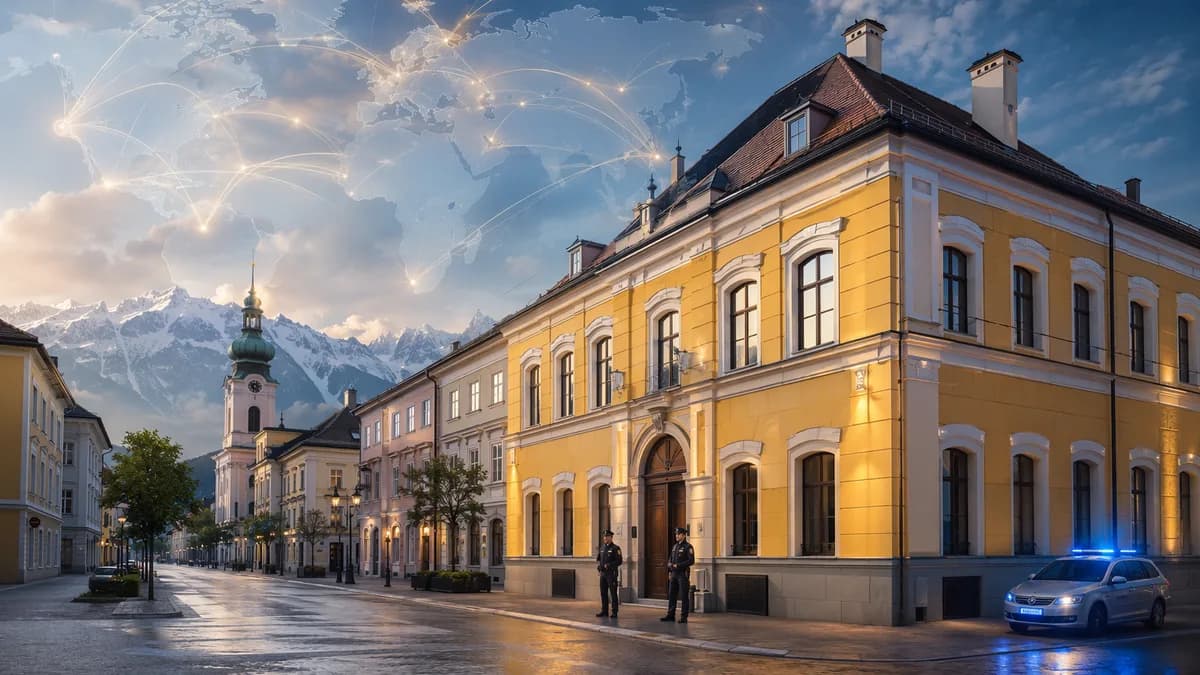
Austria has turned Adolf Hitler’s birthplace into a working police station, betting that the Hitler birthplace police station can make a neo-Nazi symbol feel controlled, ordinary, and hard to exploit.
Global TrendsJuly 27, 2026· 7 min read· By XOOMAR Insights Team
Austria Plants Police Station Inside Hitler Birthplace
Updated on July 27, 2026
XOOMAR Intelligence
Analyst Take
57/ 100
4 sources analyzedLow confidenceTrend10Freshness94Source Trust92Factual Grounding90Signal Cluster20
The opening in Braunau am Inn follows years of argument over the 17th-Century former inn where Hitler was born in April 1889, according to BBC World. The state’s aim is blunt: stop the address from becoming a pilgrimage site while avoiding the charge that Austria is trying to erase the building from history.
Austria turned Hitler’s birthplace into a police station, not a memorial
The decision is a deliberate act of state control over memory. Austria has not made the house a museum. It has not demolished it. It has not left it empty. It has inserted the state into the building, day after day, in uniform.
That choice carries tension. A police station inside the birthplace of a dictator whose regime weaponized state power will not read as neutral to everyone. Supporters see democratic law occupying a toxic address. Critics may see an uneasy symbol, especially if the site lacks visible historical explanation.
Interior Minister Gerhard Karner framed the move as moral responsibility, not real estate management.
Austria was taking "responsibility" for the "terrible legacy" of the past, Karner said.
"This house will now become a place of democracy, rule of law, security, freedom and human dignity."
XOOMAR analysis: the Hitler birthplace police station is best understood as containment. The goal is not to reinterpret the site with a large public narrative. It is to drain its utility for extremists by making it bureaucratic, guarded, and visibly claimed by democratic institutions.
The Braunau address consumed decades, millions, and one unusually loaded property fight
The facts are stark. Hitler was born at Salzburger Vorstadt 15 in Braunau am Inn and lived there only for a few weeks before his family moved elsewhere in the town. They left Braunau for good when he was three years old. He returned briefly in 1938, after annexing Austria to Nazi Germany, on his way to Vienna.
Yet a short biographical connection turned into a long national problem.
For decades, Austria’s interior ministry rented the building from Gerlinde Pommer, a local owner, paying what the BBC describes as a generous rent to stop it being used for extreme right-wing tourism. The house later served for many years as a day centre and workshop for people with special needs through the Lebenshilfe charity. That ended in 2011, when Pommer blocked renovations.
The property then sat empty while the state and owner fought over terms. In 2016, Austria’s parliament passed a law allowing the government to seize the house. Pommer received €812,000 (£690,000) in compensation, later challenged the amount in court, and lost.
The conversion itself was costly. The BBC says millions of euros were spent refurbishing the former yellow-plastered building. The Guardian reported that the estimated cost reached €20m.
Before vs. after Braunau’s conversion:
- Before: Empty, disputed, historically charged, and vulnerable to extremist attention.
- After: White facade, preserved staircase and arched entrance hall, security cameras, police occupancy.
- Before: A contested symbol with no settled civic use.
- After: A functioning police station that officials hope will neutralize the site.
- Before: A building linked to Hitler mainly through notoriety and a street memorial.
- After: Still historically loaded, but harder to stage as a shrine.
Demolition looked decisive, but Austria chose controlled reuse instead
Austria had several bad options. Each solved one problem while creating another.
| Option | Appeal | Risk |
|---|---|---|
| Demolish the building | Removes the physical site | Could look like denial of Austria’s Nazi past |
| Create a museum or memorial centre | Confronts history directly | Could make the address a destination |
| Return it to charity use | Restores a social purpose | The charity feared becoming a political fig leaf |
| Convert it to a police station | Keeps the building useful and guarded | Risks seeming too silent about the past |
The demolition option had political force. Former Interior Minister Wolfgang Sobotka said the building should be torn down and replaced. A Russian MP had earlier offered to buy the house and blow it up. But the backlash was severe. Critics argued that destruction would amount to denying Austria’s Nazi history.
A museum presented the opposite danger. It could educate, but it could also elevate the address. The Guardian cited an expert commission warning that a museum could keep drawing right-wing extremists, especially those attached to “blood and soil” ideology and its fixation on birthplaces and gravesites.
So Austria chose official reuse. In 2019, the government announced the police station plan and began an EU-wide competition for architectural designs.
XOOMAR analysis: this is the logic of neutralization. Don’t sanctify the building. Don’t erase it. Make it work.
Austria’s memory problem sits inside the walls
The building’s physical treatment shows the compromise. It has been substantially refurbished. The facade now looks very different. It is painted white inside and out, with oak woodwork. An old winding staircase and arched entrance hall were preserved.
There is no sign on the house explaining its history. The most direct public marker is the stone outside, erected in 1989, which reads:
"Never again Fascism; In memory of millions of dead."
The stone came from the nearby former concentration camp at Mauthausen. Hitler’s name does not appear.
That absence is the core dispute. The state wants less spectacle. Historians and local critics worry that too little explanation can become avoidance.
Local historian Florian Kotanko told the BBC he would have liked to see Lebenshilfe return, but said the charity did not want to be used as cover for a political fight.
"But even this charity organisation did not want to come back because they thought they would be used as a fig leaf for a political discussion, and so the government had to decide in another way."
His larger point is harder for officials to solve with architecture:
"You have to deal with it, and so we all try to deal with it in an open and correct way. It's not a matter of being proud, but it's a matter of dealing with the fact."
For readers following how police presence can carry public meaning in Europe, this is a very different case from acute incident response such as Vehicle Hits Berlin Pride Event, Triggering Manhunt or Deadly Berlin Pride Attack Sends Police Hunting Suspect. Braunau is not about a single emergency. It is about permanent deterrence through occupation of a symbolic address.
The Hitler birthplace police station creates a model that other cities may study, but not easily copy
The Hitler birthplace police station offers one lesson for governments stuck with toxic landmarks: reuse can work only if the public understands why the reuse exists.
If officials simply change the function and refuse to explain the history, silence becomes part of the message. That is the weak point in Austria’s design. Security cameras may deter neo-Nazi visitors. Police occupancy may prevent wreaths, salutes, or staged photos. But the absence of clear signage leaves the memorial stone to do almost all the public teaching.
The practical tests now are concrete:
- Security: whether the site actually draws fewer extremist visits.
- Memory: whether the lack of signage is accepted or challenged.
- Local life: whether Braunau becomes less defined by one address.
- Narrative control: whether online extremist communities try to mythologize the conversion anyway.
- Public trust: whether Austrians see the station as responsibility or avoidance.
Karner called it a “new chapter.” That chapter will be judged by evidence, not ceremony. If the building fades as a pilgrimage stop while Austria keeps speaking plainly about why it matters, the strategy looks smart. If silence around the site deepens, or if extremists simply shift the shrine online, Braunau will show the limit of architecture as memory policy.
Impact Analysis
- Austria is trying to prevent Hitler’s birthplace from becoming a neo-Nazi pilgrimage site.
- The police station turns a toxic historical address into a daily symbol of democratic law and state control.
- The decision highlights the difficulty of confronting extremist history without erasing it.
Options for Hitler's Birthplace in Braunau am Inn
| Approach | Status | Meaning in the article |
|---|---|---|
| Working police station | Chosen | Uses democratic state presence to make the site controlled, ordinary, and harder for extremists to exploit |
| Museum or memorial | Not chosen | Would create a larger public historical narrative around the building |
| Demolition | Not chosen | Would remove the building but risk accusations of erasing history |
| Leaving it empty | Not chosen | Would leave the site vulnerable to symbolic use or pilgrimage |
Sources

Written by
XOOMAR Insights Team
Research and Editorial Desk
The XOOMAR Insights Team pairs automated research with human editorial judgment. We track hundreds of sources across technology, fintech, trading, SaaS, and cybersecurity, cross-check the facts, and explain what happened, why it matters, and what to watch next. We do not just rewrite headlines. Every article is fact-checked and scored for reliability before it goes live, and we link back to the original sources so you can verify anything yourself.
Explore More Topics
Related Articles
 Technology
FDA Peptide Rule Changes Risk Telehealth Cash Grab
FDA peptide rule changes could turn a gray peptide market into a telehealth gold rush before the science catches up.
Jul 27, 20268 min
 Trading
$60 Rejection Traps Silver Price Forecast at 20-Day EMA
Silver’s rebound is stalling below $60 and the 20-day EMA. Bulls need a close above $59.68 to flip pressure back on bears.
Jul 27, 20268 min
 Global Trends
Cockroach Protests Crack Modi’s BJP Fortress in Delhi
Cockroach protests forced a minister out and exposed fresh weakness in Modi’s BJP after years of dominance.
Jul 27, 20268 min
 Global Trends
33,772 ZIP Codes Redraw the American Dream Index Map
Newsweek's American Dream Index ranks 33,772 ZIP codes and finds opportunity isn't dead. It's just become brutally local.
Jul 27, 20267 min
 Trading
War Pause Sends Bitcoin Back Above $65K as Oil Sinks
Bitcoin reclaimed $65,000 as the U.S. and Iran held fire, sparking a risk rally while oil dropped 5%.
Jul 27, 20266 min
 Global Trends
Epstein Files Scout Daniel Siad Dies Before Questioning
Daniel Siad died before French investigators could question him, leaving a key Epstein files thread unresolved.
Jul 27, 20267 min
 Trading
US Dollar Index Sheds War Premium After Iran Pause
DXY slipped near 101.20 after the US-Iran strike halt dented safe-haven demand, though Red Sea threats keep dollar bears cautious.
Jul 27, 20267 min
 Fintech
Scam Cash-Out Trail Draws $25M Crypto Forfeiture Push
$25M in frozen crypto shows prosecutors are hitting scam networks at the cash-out layer, before wallets can move beyond reach.
Jul 27, 20268 min
 Global Trends
Milei Lula Insult Torches Argentina-Brazil Ties Before Vote
Milei’s attack on Lula in São Paulo pushed a campaign stunt into a diplomatic clash, with Brazil recalling its ambassador.
Jul 27, 20267 min
 Global Trends
Typhoon Noul Rips Hong Kong Scaffolding Into Street
Typhoon Noul tore scaffolding off a Hong Kong building and cancelled 360 flights before China’s strongest 2026 landfall.
Jul 27, 20265 min
Don't miss the signal
Get our weekly roundup of the stories that matter across tech, fintech, and trading. No noise, just signal.
Free forever. No spam. Unsubscribe anytime.