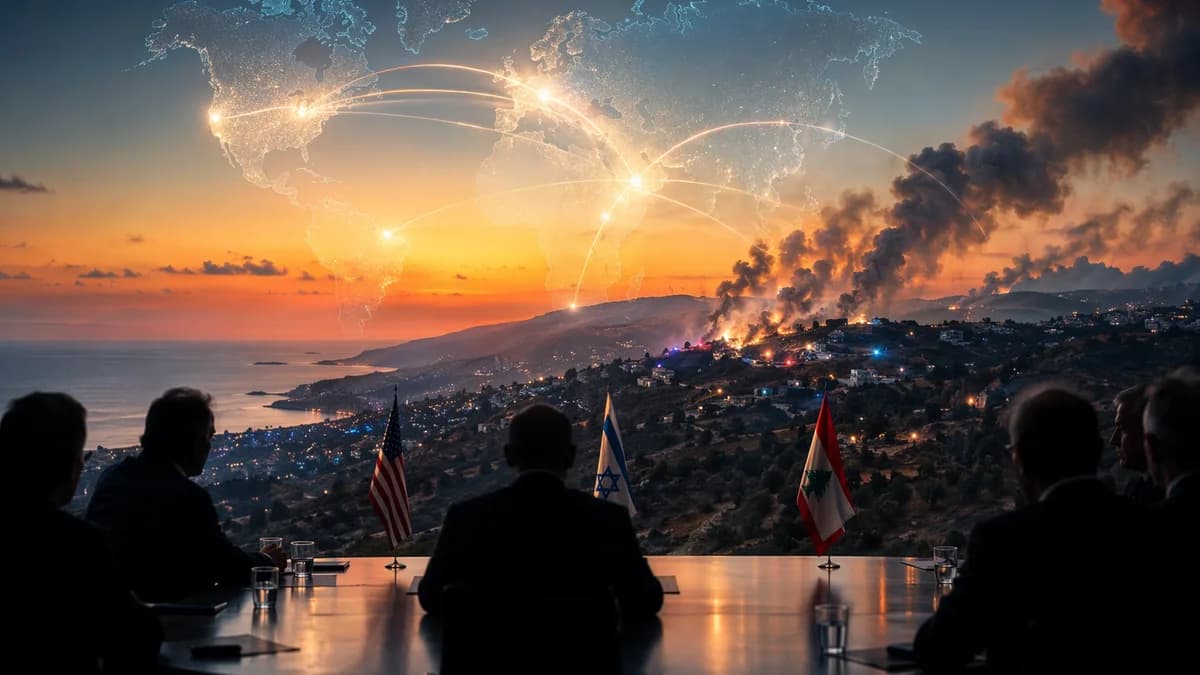
The strikes hit the people living closest to the border first: residents of southern towns already caught between Israeli military operations, Lebanon's fragile state diplomacy, and Hezbollah's armed confrontation with Israel. Lebanon's state news agency said an Israeli drone struck Nabatieh al-Fawqa, then later reported more strikes in the area, with at least two more people wounded, according to BBC World.
The Israeli military said it carried out the drone strike against an individual who posed a threat to its forces. It did not provide further details in the BBC account.
Who exactly was killed, and whether the wounded were civilians or fighters, has not been confirmed in the supplied reporting.
Israeli Prime Minister Benjamin Netanyahu called the Washington agreement "historic" and "a blow to Iran and Hezbollah". But the timing of the strikes shows how quickly the diplomatic track collided with the battlefield.
Under the four-point framework, Israel would withdraw its forces from the South Litani area, while the Lebanese army would take exclusive control of the vacated territory. The deal also permits Israeli forces to remain in an expanded security area in southern Lebanon.
That carveout is already becoming the deal's flashpoint.
"The framework agreement in Washington is humiliating, shameful, and a surrender of sovereignty. This agreement is null and void," Hezbollah leader Naim Qassem said.
Qassem said provisions linking Israel's withdrawal to Hezbollah's disarmament crossed "all red lines". He accused Lebanon's authorities of making a "grave blunder" that "may even lead to the annexation of these lands", and said Hezbollah would continue armed resistance.
Hezbollah was not involved in negotiating Friday's US-brokered agreement, according to the BBC report. That exclusion is central to the immediate political stress inside Lebanon, because the deal tries to move control in the south toward the Lebanese state while the group is vowing to keep fighting.
Analysis: The agreement's core logic is state control. The Lebanese army takes over vacated territory, and "non-state actors" are excluded from pilot zones described in the earlier ceasefire renewal process. Hezbollah's response directly challenges that logic.
The question now is blunt: can a state-to-state framework hold if one of the main armed actors in the conflict rejects it from the start?
The terms reported so far create a sharp divide between the parties' public positions:
| Actor |
Stated position from the source material |
Immediate pressure point |
| Israel |
Says the Washington agreement is "historic"; says it struck a person who threatened its forces |
Wants room to keep forces in a southern security area |
| Lebanon's government |
Signed the US-brokered framework |
Faces Hezbollah's accusation of surrendering sovereignty |
| Hezbollah |
Rejects the deal and vows continued armed resistance |
Opposes withdrawal terms linked to disarmament |
| Residents in southern Lebanon |
Reported strikes, casualties, and injuries in their area |
Remain exposed while diplomacy and combat overlap |
Israeli Defence Minister Israel Katz later said Israeli forces had been ordered to "prepare for an extended stay in the security zone". The BBC says that refers to an area up to 10km (six miles) inside Lebanese territory.
That matters because the Lebanon-Israel framework agreement does not appear, based on the available reporting, to require an immediate full Israeli pullback from southern Lebanon. It sets a route toward withdrawal from the South Litani area, but also allows Israeli troops to remain in an expanded security area.
Analysis: That dual structure gives each side a reason to claim the deal proves its case. Netanyahu can point to a formal framework and pressure on Hezbollah. Qassem can point to continued Israeli presence and call it a sovereignty breach.
The deal follows earlier failed efforts to halt the fighting. A US-brokered ceasefire between Israel and Lebanon on 16 April did not stop the violence. In June, Israel and Lebanon agreed to renew the fragile ceasefire, while the US said it would help guide the creation of "pilot zones in which the Lebanese Armed Forces will take exclusive control of the territory to the exclusion of all non-state actors".
For XOOMAR readers tracking how geopolitical risk intersects with markets and technology coverage, this is a different file from our consumer desk's Price Hike Turns $299 Prime Day iPad Into the Deal and AirFly Pro 2 Prime Day Deal Drops Flight Fix to $47, but the same rule applies: timing changes the story. Here, the strike came before the framework could build political momentum.
The immediate focus is whether Israel strikes southern Lebanon again, whether Hezbollah responds militarily, and whether Lebanon's government defends or clarifies the Washington framework under pressure from Qassem's rejection.
The casualty scale is already severe. The Lebanese health ministry says Israeli attacks in Lebanon have killed at least 4,192 people since the current round of hostilities began. Lebanon says more than 11,600 have been injured and more than 1.2 million have been displaced.
Israel says 36 of its soldiers and four civilians have been killed on both sides of the border.
The current fighting began after 2 March, when Iran-backed Hezbollah launched missiles into Israel in retaliation for an Israeli strike that killed Iran's supreme leader, according to the source material. Israel answered with an air campaign across Lebanon and a ground invasion in the south.
The next confirmations matter: which locations were hit after Nabatieh al-Fawqa, who was killed, who was wounded, and whether Israeli officials provide more detail about the person they said threatened their forces.
Can the Lebanon-Israel framework agreement survive its first test if the security zone becomes a standing point of confrontation?
Analysis: The framework's durability will be judged less by the signing ceremony in Washington and more by three near-term signals: Israeli troop posture in the security zone, Hezbollah's operational response, and whether the Lebanese army can move into areas Israel vacates without triggering a wider clash.
For now, the deal has not stopped the violence. It has exposed the hardest bargain inside it. Israel wants security depth in southern Lebanon. Lebanon's government has accepted a framework that shifts control to the national army. Hezbollah is calling the whole arrangement void.
That leaves southern Lebanon waiting on the next move, not the last signature.
- The strikes show how quickly diplomacy between Lebanon and Israel can be undermined by battlefield escalation.
- Hezbollah's rejection signals that any peace framework faces major resistance from the region's most powerful armed non-state actor.
- Residents in southern Lebanon remain exposed as security arrangements and sovereignty disputes remain unresolved.