
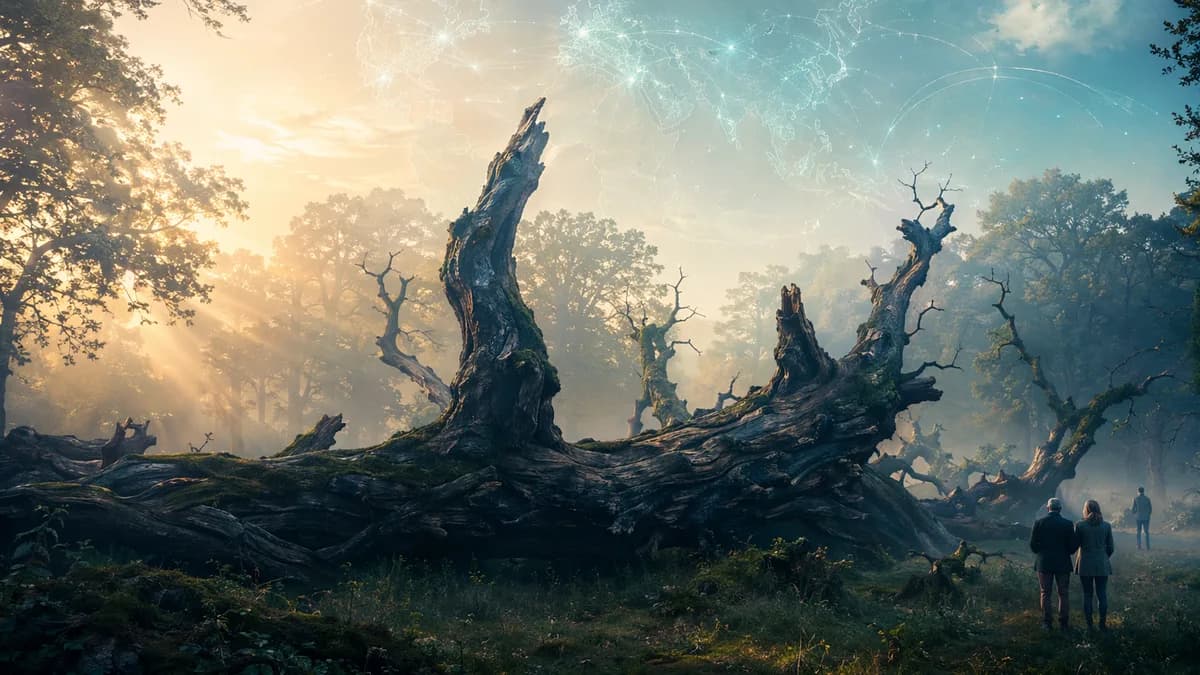
For the first time in 1,000 years, the Major Oak failed to produce leaves, turning one of Britain’s most famous living symbols into a test of how a country mourns a tree it treated almost like a monument.
Global TrendsJune 28, 2026· 8 min read· By XOOMAR Insights Team
Britain Loses Major Oak, Its 1,000-Year Robin Hood Relic
Updated on June 28, 2026
XOOMAR Intelligence
Analyst Take
69/ 100
4 sources analyzedMedium confidenceTrend10Freshness96Source Trust90Factual Grounding92Signal Cluster20
The Major Oak in Sherwood Forest has died after centuries of public fascination, childhood visits, Robin Hood mythology, and conservation effort, according to Guardian World. The reaction matters because this was never just a tree. It was a shared memory site, a regional emblem, a tourist draw, and a habitat for other life.
The Major Oak's death exposes Britain's uneasy bargain with ancient trees
The Major Oak sat at the point where folklore, family memory, local identity, and conservation all met. That made its decline emotionally sharp. Readers who wrote to the Guardian did not describe a distant natural feature. They described school trips, grandparents, childhood imagination, and the feeling that history had briefly become touchable.
Joanna de Graaf from Leicestershire recalled visiting from Nottingham as a child:
“I can remember being so excited to actually be inside the Major oak where Robin Hood and his merry men had hidden (and, for a little girl in the 1960s, Maid Marian too).”
That line explains the public grief better than any official statement could. The Robin Hood association gave the tree a narrative charge, but the physical encounter made it stick. Children could stand near, and at one time inside, something that seemed to collapse centuries into a single moment.
XOOMAR analysis: the deeper signal is uncomfortable. The Major Oak was loved because it felt permanent. Yet its fame also made it harder to treat as an ordinary living organism with limits, decline, and an end.
A 1,000-year-old Sherwood Forest icon in numbers: age, size, support, and strain
The supplied sources give slightly different age framing. The Guardian describes the Major Oak as a tree that failed to produce leaves for the first time in 1,000 years. USA Today describes it as up to 1,200 years old.
USA Today also lists the tree’s physical scale:
| Feature | Major Oak figure cited by USA Today |
|---|---|
| Species | Pedunculate Oak, Quercus Robur |
| Canopy spread | 92 feet |
| Trunk circumference | 36 feet |
| Height | 52 feet |
| Age | Up to 1,200 years |
A deciduous oak that does not come into leaf has lost the basic visible sign of seasonal recovery. The sources do not give a full arboricultural diagnosis, but they do report that the tree has been declared dead after failing to come to leaf.
USA Today cites the Royal Society for the Protection of Birds as saying poor soil, human interventions, and a weakened root system were major factors in the tree’s decline. It also reports that climate change, recent heat waves, and drought compounded the challenges.
The same report notes that the Major Oak’s branches rested on supports. That detail captures the contradiction of its later life: a wild organism maintained like a heritage structure.
Robin Hood folklore turned the Major Oak into a national memory machine
The Major Oak became inseparable from the Robin Hood story because it gave the legend a place to stand. The tree was said to have offered sanctuary for Robin Hood, and readers returned again and again to the idea of seeing the same shapes, knots, and hollows that the outlaw might have seen.
Ian, who did not give his surname, described a school visit when children were still allowed inside the tree:
“I recall being totally amazed by the fact (at least in my infant school mind) that I was looking at exactly the same shapes and curls and knots in the wood that Robin Hood saw when he was hiding from the Sheriff of Nottingham.”
That is the Major Oak’s cultural function in one sentence. It did not just represent the past. For visitors, it appeared to transmit it.
Jens Binder, an associate professor at Nottingham Trent University, said he had taken friends from Spain, Germany, Portugal, Hong Kong, El Salvador, India, and India to see it. His phrase became the emotional core of the Guardian piece:
“To me, it has always been an instant connection with the past, down the centuries.”
XOOMAR analysis: that “instant connection” is what heritage bodies try to create with interpretation boards, visitor centres, and guided trails. The Major Oak did it without explanation. That made its death feel personal, even for people who had only seen it once.
From medieval survivor to propped-up celebrity, the Major Oak shows what preservation can and can't do
Ancient trees do not age like buildings. A castle can be repaired stone by stone. A veteran oak can be supported, protected, and monitored, but it cannot be frozen in one public-facing state forever.
The Major Oak’s value also did not stop at its green canopy. USA Today reports that it provided food and shelter for generations of insects, fungi, birds, and mammal species. That matters because a dead or declining ancient tree can still hold biological value, even after the public stops seeing it as “alive” in the simple leafy sense.
The comparison with other famous ancient trees shows what made the Major Oak distinctive. It was not the oldest or largest. Its power came from a combination of age, form, story, and access.
| Tree | Location | Age cited in USA Today | Why it matters |
|---|---|---|---|
| Major Oak | Sherwood Forest, England | Up to 1,200 years | Robin Hood association and public memory |
| General Sherman | Sequoia National Park, California | About 2,200 years | Largest tree in the world by volume |
| Methuselah | Inyo National Forest, California | Estimated 4,850 years | Oldest living non-clonal tree cited |
| Alerce Milenario | Alerce Costero National Park, Chile | 2,400 to 5,500 years | Age remains difficult to confirm |
| Fortingall Yew | Perthshire, Scotland | 2,000 to 5,000 years | Possible Europe’s oldest living tree |
The Major Oak’s celebrity brought attention. It also created pressure. The sources support that tension through visitor memories, the history of people entering the tree, and the later need for physical supports.
Families, conservationists, and local communities won't grieve the Major Oak the same way
The Guardian responses split the loss into several forms.
Families mourn the childhood landmark. Joanna de Graaf took her own children and friends from around the world to see it. Pat Hutton from Stroud wrote that she had loved the tree since childhood visits from Cleethorpes to see her “Granpop” in Worksop.
Local voices see it as part of Nottinghamshire identity. Guy Birkin wrote:
“Very sad to hear about the death of this iconic tree, so much a part of Nottinghamshire history and legend.”
Conservation-minded readers see a warning. Birkin added that the Major Oak was protected by being well-known, while other old trees are “not so lucky.” He argued that trees support adaptation to increasing temperatures, especially in urban areas, and that woodland promotes mental and physical wellbeing.
That claim stays close to the supplied text. It also points to the practical question now facing Sherwood Forest: how to honor one famous tree without letting the story narrow to one trunk.
For readers tracking how communities respond when familiar places or civic symbols are shaken, XOOMAR’s broader coverage includes Andy Burnham Stakes 15% of His MP Pay on Local Causes and 188 Dead After Venezuela Earthquake Crushes Homes in Seconds. The contexts differ sharply, but each story turns on public attachment to place.
The Major Oak's decline forces a harder conversation about climate, heritage, and tree tourism
The Major Oak now sits in a category that heritage managers cannot handle with nostalgia alone. It was a living attraction. That means its future involves biology, safety, memory, and storytelling at once.
The sources identify several pressures: poor soil, human interventions, a weakened root system, heat waves, and drought. They also show mass affection through generations of visitors. The lesson is not that visitors killed the tree. The evidence supplied does not support that simple claim. The stronger reading is that public love, conservation intervention, and environmental stress combined around an already ancient organism.
XOOMAR analysis: the best tribute would be to stop treating ancient trees as permanent stage props for national myth. They need successor planning. Sherwood Forest is still home to other extraordinary oaks, as Binder noted, “most of them hidden more safely away in the greenwood.” That sentence may be the most practical one in the Guardian piece.
Future evidence to watch is concrete: whether managers keep the Major Oak standing as deadwood habitat, how close visitors are allowed to get, how its Robin Hood story is retold, and whether attention shifts to protecting less famous veteran trees before they reach the same crisis point.
The Major Oak will remain a destination. But its meaning has changed. It is no longer only a living wonder. It is now relic, habitat, warning, and memorial. Nostalgia alone would be a poor final act.
Why It Matters
- The Major Oak’s death marks the loss of a roughly 1,000-year-old symbol tied to Sherwood Forest and Robin Hood mythology.
- Public reaction shows how ancient trees can become shared memory sites, not just natural landmarks.
- Its decline highlights the tension between celebrating famous living monuments and protecting them as fragile ecosystems.
Sources

Written by
XOOMAR Insights Team
Research and Editorial Desk
The XOOMAR Insights Team pairs automated research with human editorial judgment. We track hundreds of sources across technology, fintech, trading, SaaS, and cybersecurity, cross-check the facts, and explain what happened, why it matters, and what to watch next. We do not just rewrite headlines. Every article is fact-checked and scored for reliability before it goes live, and we link back to the original sources so you can verify anything yourself.
Explore More Topics
Related Articles
 Global Trends
Manchester No 10 Plan Pits Burnham Against London Power
Burnham’s Manchester No 10 plan would test whether devolution can move real power out of London, not just rebrand it.
Jun 28, 20268 min
 Global Trends
£369m Buckingham Palace Refit Turns Home Into Royal HQ
A £369m revamp will make Buckingham Palace a state headquarters, not King Charles's home.
Jun 28, 20269 min
 Global Trends
Rachel Reeves Hands Andy Burnham Her Treasury Fate
Reeves backed Burnham but wouldn't fight for No 11, signaling the Treasury may be his first big cabinet call.
Jun 28, 20268 min
 Global Trends
Andy Burnham Stakes 15% of His MP Pay on Local Causes
Andy Burnham will donate 15% of his MP salary to Makerfield causes, making his Westminster return an early test of trust.
Jun 28, 20267 min
 Global Trends
Venezuela Earthquake Rescuers Race a 72-Hour Clock
Rescuers in Venezuela are racing the 72-hour survival window as foreign teams arrive and missing counts keep shifting.
Jun 27, 20267 min
 Technology
CMA Fest 2026 Stream Map Reveals Free ABC, CTV Paths
CMA Fest 2026 hits ABC on June 25, with Hulu next day, free CTV in Canada and Stan in Australia.
Jun 27, 20268 min
 Trading
Bitcoin Rainbow Chart Cracks as $62K Tests BTC Faith
Bitcoin hit the Rainbow Chart's 'dead' zone near $62,500, exposing a bigger problem: crypto's old cycle maps may be breaking.
Jun 28, 20268 min
 Cybersecurity
14.2 Million Email Accounts Exposed by KDDI Data Breach
A third-party software flaw may have exposed 14.2 million email accounts across six Japanese ISPs using KDDI's platform.
Jun 28, 20267 min
 Global Trends
Heidesee Lake Ban Makes German the Price of Safety
Halle's Heidesee lake barred non-German speakers over safety fears. City officials say lift the ban or risk legal action.
Jun 28, 20267 min
 Technology
Prime Day Home Gadget Deals Slash Messes before Midnight
Late Prime Day home deals are best when they erase weekly chores, from pet stains to hard-floor messes, plus one pricey TV splurge.
Jun 28, 20268 min
Don't miss the signal
Get our weekly roundup of the stories that matter across tech, fintech, and trading. No noise, just signal.
Free forever. No spam. Unsubscribe anytime.