
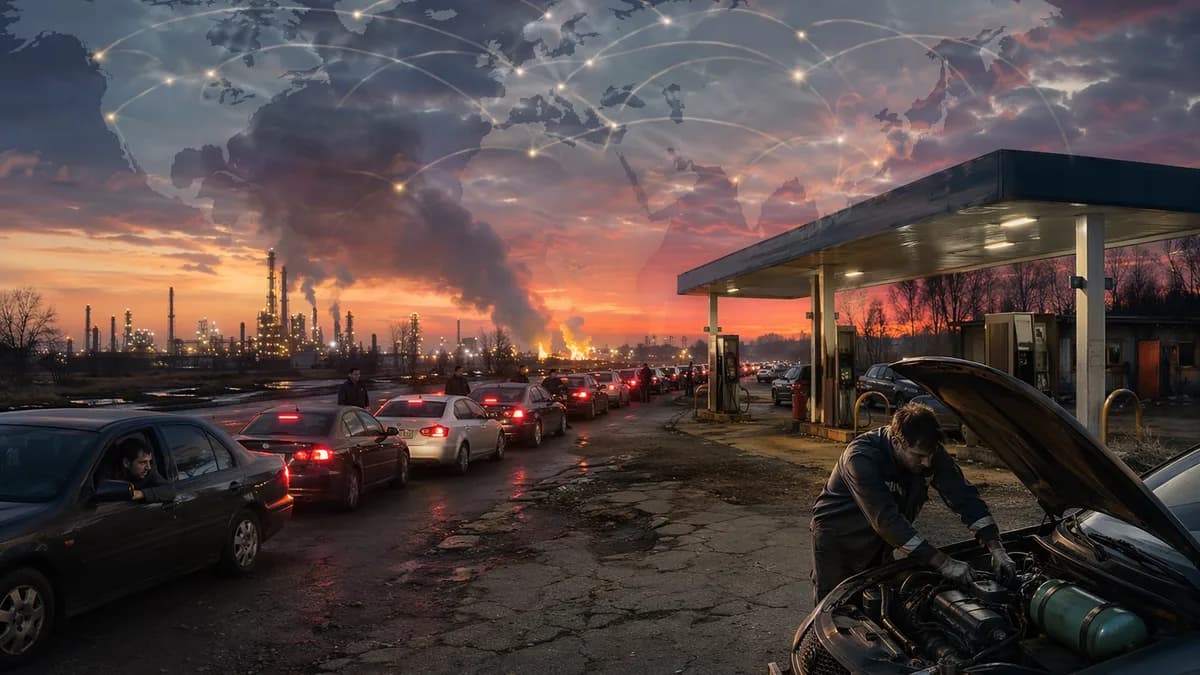
How does the Russia fuel shortage get severe enough that drivers in one of the world’s major energy producers start refitting cars for LPG just to avoid the pump?
Global TrendsJuly 10, 2026· 8 min read· By XOOMAR Insights Team
Drivers Ditch Gasoline as Russia Fuel Shortage Bites
Updated on July 10, 2026
XOOMAR Intelligence
Analyst Take
58/ 100
4 sources analyzedLow confidenceTrend20Freshness90Source Trust82Factual Grounding94Signal Cluster20
That is the hard signal beneath the headline. Russians are converting cars to run on liquefied petroleum gas as gasoline shortages, rising petrol prices, and long queues spread across the country, according to Independent World. The immediate trigger is clear in the reporting: recent Ukrainian attacks on Russian refineries have tightened domestic supply.
But the deeper story is not just scarcity. It is a pressure test of Russia’s managed energy system, where refinery damage, rationing, price stress, logistics, and public patience are now colliding at filling stations.
Why is the Russia fuel shortage showing up first in drivers’ behavior?
Because household fuel demand is where refinery stress becomes visible.
The most concrete sign is not a government statement. It is the waiting list at conversion shops. Egor Popov, whose Moscow-based Garant-Gas installs LPG conversion equipment, said demand has surged beyond normal capacity.
"demand had multiplied"
He added:
"We have a waiting list until September"
That matters because LPG was already widely used in Russia before this crunch. The country used around 3.5 million metric tons of LPG as car fuel in 2024, according to the World Liquid Gas Association. Russian official data cited in the source says motor fuel accounted for 54% of Russia’s LPG consumption last year, while just over a third went into petrochemical feedstock.
In other words, Russian drivers are not discovering LPG from scratch. They are accelerating a shift toward a fuel that is already relatively cheap and abundant in the country.
Sergei Medvedev, who runs Medvedev GBO, said his company received far more inquiries than it could handle.
"We had 276 calls in a day, but could only process around 30 or 40"
His pitch was blunt:
"No queues, with prices 50% or two thirds lower than gasoline at filling stations."
That is the consumer calculation. If gasoline means waiting, rationing, and uncertainty, LPG becomes a practical hedge.
Which numbers show this is more than a local pump problem?
The available figures point to a national supply strain, even though exact retail price series are not supplied in the source material.
The Independent World report says domestic gasoline prices have on occasions exceeded those in the United States and Europe. It does not give a full national price table, so the strongest data comes from refinery and regional disruption indicators.
| Pressure point | Source-supported detail | Why it matters |
|---|---|---|
| LPG vehicle fuel use | 3.5 million metric tons in Russia in 2024 | Shows LPG already had scale before the shortage |
| LPG consumption split | Motor fuel was 54% of Russia’s LPG use last year | Confirms cars are a major LPG demand channel |
| Omsk refinery capacity | Around 22 million metric tons of oil per year | Damage or disruption at this scale can affect national supply |
| NORSI damaged unit | CDU-6 processes 25,700 metric tons per day, around 190,000 barrels | A single damaged unit can remove a large stream of refined output |
| NORSI capacity share | CDU-6 accounts for 53% of the refinery’s overall capacity | Explains why one strike can force a major operational hit |
CNN’s supplied analysis adds that almost all of Russia’s 83 regions are seeing shortages or reported supply disruptions, with more than 50 internationally recognized regions officially reporting supply problems. It also cites Sumit Ritolia of Kpler, who estimates Russian gasoline production is running around 20% below domestic demand because of Ukrainian strikes.
Those numbers explain why national averages can mislead. A country can still produce oil, still refine fuel, and still report market control, while specific regions face empty pumps, limits, or long waits.
Why are Ukrainian refinery strikes changing the domestic equation?
Because the attacks are landing on the part of the oil system Russian consumers actually need: refining capacity.
This week, Russia’s largest oil refinery in Omsk was reportedly targeted deep inside Siberia. Kyiv’s military and Russian local authorities confirmed it was one of the longest-range attacks of the war. Governor Vitaly Khotsenko said Russian air defences destroyed most of the drones involved. The damage was not immediately clear.
The reach matters. Omsk is not a border facility. The reported strike shows Ukraine can threaten energy infrastructure far from the front.
The NORSI refinery, Russia’s fourth-largest and owned by Lukoil, was also hit for a second time on July 2, according to sources cited in the supplied material. Crude processing was suspended after damage to CDU-6, the primary refining unit.
This is where the Russia fuel shortage becomes a war-economy story. Crude reserves do not fill cars. Refineries do. If those refineries operate below need, local shortages appear even in an oil-rich state.
For XOOMAR readers, the useful parallel is infrastructure stress becoming consumer friction. We saw that dynamic in a different context in Heatwave Forces Neso Power Warning as Grid Runs Tight. Russia’s case is harsher because the source material identifies physical refinery attacks as a direct driver.
How are Russian drivers adapting when gasoline runs out?
They are doing what consumers do when official supply becomes unreliable: switching, waiting, limiting trips, and searching for alternatives.
The strongest documented shift is toward LPG conversions. The source also describes long queues at filling stations, and the related reporting says many stations are imposing limits or running out. The Straits Times material says most Russian regions imposed some form of fuel restrictions in June, limiting how much gasoline or diesel drivers can buy at a time.
The human detail is sharper than the policy language. In Russia’s Leningrad region, a driver named Daria said her car kept stalling as it crawled forward in a long filling station line.
"I don't know if I'll make it to the filling station. Since they won't sell fuel in canisters, I'll probably have to leave the car right here"
That is how shortage psychology spreads. If drivers believe fuel may not be available later, they have an incentive to queue earlier, buy whenever possible, and treat a full tank as insurance. The source material does not prove widespread hoarding, black-market pricing, or business disruption across sectors, so those should remain watch items rather than stated facts.
What is documented is enough: restrictions, queues, empty pumps, LPG conversion backlogs, and visible frustration.
The war also has a separate cyber dimension, which XOOMAR has covered in FBI Tip Triggers Russian Hacktivist Arrest in Spain. Here, though, the pressure channel is physical: refinery capacity and fuel distribution.
Why can’t Moscow simply calm the market with official assurances?
Because the state is trying to preserve two things that now conflict: cheap domestic fuel and a wartime energy system under attack.
President Vladimir Putin promised measures in late June to stabilize the market, according to the supplied Straits Times material. Authorities have urged calm and said supply chain issues are being addressed promptly.
Yet the public mood data in the same reporting shows fuel is already political. A Levada Center survey said Russians saw Ukraine’s long-range drone attacks and fuel issues as the standout events of June. The share of people who felt the country was on the right track fell to 52% from 61% in May, the biggest monthly decline since 2018. Putin’s approval dropped to 74% in June, the lowest since the start of Russia’s war in Ukraine in early 2022, according to that poll.
That does not mean fuel shortages threaten the Kremlin by themselves. The source material does not support that leap. But petrol scarcity cuts into the state’s claim that ordinary life remains controlled and stable.
The clearest XOOMAR inference is this: Moscow can describe the shortage as temporary, but drivers judge the system by whether pumps work, whether prices stay tolerable, and whether queues shrink.
Which evidence will show whether this shortage is temporary or structural?
The next phase turns on repair speed, strike frequency, and whether regional restrictions ease or spread.
Evidence that would support a short-lived crunch:
- Refinery recovery: Omsk damage proves limited, and NORSI processing resumes without further disruption.
- Queue reduction: Filling stations stop imposing limits and “Out of Order” signs become less common.
- LPG demand normalization: Conversion shops like Garant-Gas and Medvedev GBO see waiting lists shrink.
Evidence that would strengthen the structural-fragility thesis:
- Repeated refinery hits: Ukraine keeps striking major processing units, especially primary distillation capacity.
- Regional rationing expands: More regions impose limits, heightened alerts, or sales restrictions.
- Public frustration deepens: Polling continues to show fuel shortages cutting into confidence and approval measures.
Russia’s energy wealth is not the same as fuel reliability. The Russia fuel shortage shows the gap between producing hydrocarbons and delivering refined product to drivers under wartime pressure. If refinery damage and logistics stress persist, expect a wider split between official reassurance and local pump reality.
Impact Analysis
- Fuel shortages are becoming visible in everyday Russian life through long queues and forced vehicle conversions.
- The shift to LPG shows how refinery damage is pressuring Russia’s domestic energy system despite its status as a major producer.
- Rising demand for conversions could deepen public frustration if gasoline supply and prices remain unstable.
Gasoline vs LPG for Russian Drivers
| Fuel | Current situation | Driver response |
|---|---|---|
| Gasoline | Shortages, rising petrol prices, and long queues are spreading after Ukrainian attacks on Russian refineries tightened supply. | Drivers are facing pump scarcity and price stress. |
| LPG | Russia used around 3.5 million metric tons of LPG as car fuel in 2024, and motor fuel made up 54% of national LPG consumption. | Drivers are increasingly converting cars to LPG, with conversion shops reporting demand beyond capacity. |
Russia LPG Used as Car Fuel in 2024
LPG car fuel
million metric tons3.5
Sources
- [1] Independent World
- [2] Russian drivers' patience is tested as fuel shortages drag on
- [3] Russia's fuel crisis is so bad that a mom and her baby waited in line for 18 hours to get gas — 'Are we in the Soviet Union?' | Fortune
- [4] Almost every Russian region hit by fuel crisis, as Ukraine escalates drone attacks | CNN

Written by
XOOMAR Insights Team
Research and Editorial Desk
The XOOMAR Insights Team pairs automated research with human editorial judgment. We track hundreds of sources across technology, fintech, trading, SaaS, and cybersecurity, cross-check the facts, and explain what happened, why it matters, and what to watch next. We do not just rewrite headlines. Every article is fact-checked and scored for reliability before it goes live, and we link back to the original sources so you can verify anything yourself.
Explore More Topics
Related Articles
 Global Trends
Russia Fuel Shortages Fail to Crack Putin's War Bet
Putin is downplaying Russia fuel shortages while escalating strikes on Ukraine, betting public pain won't slow the war.
Jul 3, 20268 min
 Global Trends
Russia Missile Attack Kills 22 as Patriot Gap Bites
Russia's barrage killed 22 and exposed Ukraine's Patriot shortage just as Zelenskyy heads to NATO for more interceptors.
Jul 7, 20268 min
 Global Trends
Trump's Patriot Missile Licence Won't Save Kyiv Soon
Trump offered Ukraine a Patriot production licence, but factory timelines mean Kyiv's interceptor shortage won't ease fast.
Jul 8, 20268 min
 Global Trends
Trump’s 1,400-Person NATO Summit Entourage Tests Allies
Trump’s giant delegation reassures NATO allies, but his spending fight and Zelenskyy’s air-defense push put Ankara on edge.
Jul 7, 20266 min
 Global Trends
Zelensky Forces Nato Air Defence Fight After Kyiv Strikes
Zelensky wants Nato to send Patriot missiles now after deadly Russian strikes exposed Ukraine's thin air defences.
Jul 7, 20266 min
 Global Trends
Rohingya Camp Landslide Buries School, Kills 5 Children
A monsoon landslide buried a school in Cox's Bazar, killing five Rohingya children as rescuers searched for more victims.
Jul 10, 20264 min
 Trading
WTI Price Forecast Puts Bulls on Trial Near $77 EMA
WTI is back above $72, but bulls still need $75.81 and the $77.18 EMA to turn a bounce into a real trend repair.
Jul 10, 20267 min
 Trading
MSTR Panic Fades as Bitcoin Market Bottom Takes Shape
Bitcoin’s bottom case looks cleaner as the MSTR forced-selling scare fades. Now flows, liquidity and spot demand have to prove it.
Jul 10, 20268 min
 Trading
Chip Rally Yanks Bitcoin Price Near $64,000 as Yen Jumps
Bitcoin's jump near $64,000 came from AI chip euphoria and yen strength, showing macro trades are steering crypto.
Jul 10, 20266 min
 Technology
No Heir Named as Fidji Simo Steps Back From OpenAI Apps
Fidji Simo is stepping back for health reasons, leaving OpenAI’s apps push without an obvious full-time owner.
Jul 10, 20266 min
Don't miss the signal
Get our weekly roundup of the stories that matter across tech, fintech, and trading. No noise, just signal.
Free forever. No spam. Unsubscribe anytime.