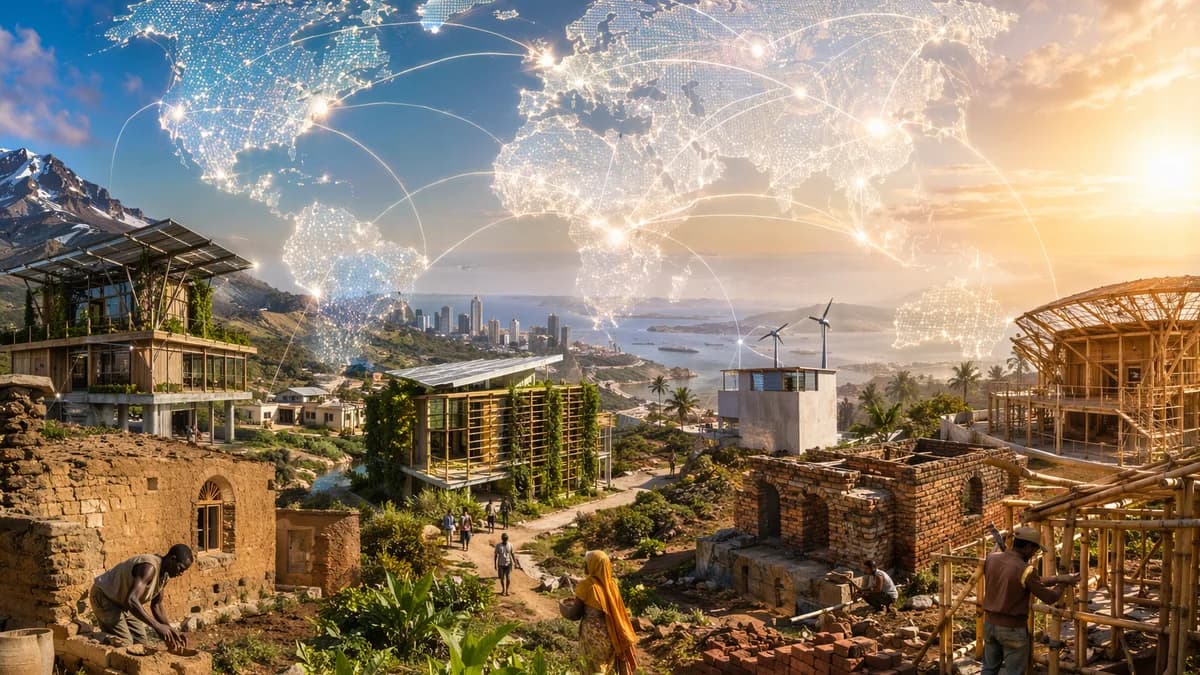
Sustainable construction is moving away from universal materials and toward local systems that fit the climate, labor, and risks of each place. The trigger is blunt: the construction industry accounts for 34 percent of the world’s carbon emissions, with concrete production carrying a major share of the burden, according to Wired.
XOOMAR Intelligence
Analyst Take
The projects Wired highlights are not one neat category. Some revive old methods. Others use engineered timber, modular pods, recycled materials, or solar and wind power. The common thread is sharper: build with what the site can support, not with a global template that ignores heat, fire, seismic risk, transport, and maintenance.
Sustainable construction is becoming local by necessity, not nostalgia
The strongest examples in this roundup treat local materials as performance tools. In Niger, soil becomes compressed-earth masonry. In England, clay-rich earth and demolition aggregate become rammed-earth walls. In New Zealand, recycled local rimu wood, wool insulation, rainwater collection, and on-site wastewater treatment turn a rural house into a self-sufficient system.
That matters because embodied carbon sits inside every material decision. Wired frames it as the emissions released across a material’s life, from extraction and manufacturing to transport and disposal. The less a project depends on distant, carbon-heavy supply chains, the more room architects have to cut emissions before anyone switches on a light.
XOOMAR analysis: The practical test is repeatability. A beautiful one-off house proves a material can work. A neighborhood, apartment block, or public building proves whether builders, inspectors, and residents can trust it.
California’s mass timber prototypes turn fire recovery into a material test
Atelier Jones, the Seattle-based firm led by Susan Jones, has spent more than a decade working with mass timber, an engineered wood product Wired describes as locally harvestable, low-carbon, structurally strong, and highly fire-resistant. Jones used it for Heartwood, a 67,000-square-foot apartment building in Seattle that became the first tall mass timber structure in the US in late 2023.
The more revealing case is in Greenville, Northern California, where Jones and the Sierra Institute for Community and Environment created the Sierra Houses after the town was devastated by fire in 2021. The three prototype homes come in one-, two-, and three-bedroom models, with Cor-ten steel and aluminum façades around visible mass timber interiors.
The counterpoint is scale. Three prototypes do not solve wildfire housing demand. Still, the project shows why sustainable construction is not only about carbon math. In fire-prone regions, material choice has to answer safety, speed, local supply, and livability at the same time.
Antarctica’s solar-powered pods show how far “light touch” design can go
White Desert operates two Antarctic explorer camps, Echo Base and Whichaway, using highly insulated, igloo-like modular pods that can be dismantled without leaving a trace at the end of their lifespan. The setting is extreme: average outdoor temperatures range from 14°F on the coast to −76°F inland.
The pods use floor-to-ceiling windows and take advantage of Antarctica’s 24-hour sunlight in summer. Their suites, including what Wired identifies as the first showers with running hot water in Antarctica’s hospitality industry, are powered entirely by solar and wind energy.
“For us, true luxury is about creating a sense of ease and comfort in an extreme setting,” White Desert CEO and founder Patrick Woodhead says, “while ensuring that Antarctica remains exactly as we found it.”
The limit is obvious. Antarctica is not a housing market. But the lesson travels: if a building must be removable, energy-aware, and site-sensitive in one of the harshest environments on Earth, that raises the bar for permanent buildings in less hostile places.
Niger’s compressed-earth blocks challenge concrete’s default status
In Niamey, Niger’s capital, architect Mariam Issoufou and united4design collaborators Elizabeth Golden, Yasaman Esmaili, and Philip Sträeter built Niamey 2000, an 18,300-square-foot multifamily housing project using local compressed-earth masonry blocks and passive thermal design.
The design draws from precolonial mud-brick construction in Mali, Nigeria, and Niger. Thick earthen walls regulate indoor temperatures, while shaded circulation areas and carefully placed windows help residents cope with extremely arid heat waves.
Issoufou is now using the approach in an office tower built with bricks made from soil collected on-site. Wired reports that it will be the tallest building in Niamey when completed, with cooling needs reduced by the material performance and a self-shading triangulated facade.
XOOMAR analysis: This is the clearest case for local building as urban policy. If rapid migration is creating an affordable housing shortage, climate-responsive materials have to work at density, not just in detached houses.
New Zealand’s Kāpiti House treats the building as part of the land system
Stephen McDougall, founding director at Studio Pacific Architecture in Wellington, designed Kāpiti House as his personal off-grid retreat within 16 acres of regenerated wetlands on the Kāpiti coast. Wired describes the home as operationally carbon positive, removing more carbon dioxide from the atmosphere than it contributes.
The compound includes a 1,750-square-foot barn-like main house and a separate two-story guest tower. Its material list is deliberately regional and lower-carbon: cross-laminated timber, tempered hardboard, recycled local rimu wood, New Zealand wool insulation, and fly ash concrete.
Solar panels, rainwater collection, on-site wastewater treatment, and a permaculture garden and orchard make the project self-sufficient. Passive design does the rest: deep eaves, cross-ventilation, and a high-efficiency envelope mean it requires no heating or cooling.
“This approach reflects a shift from designing isolated buildings to designing systems that support the land over time,” McDougall says.
That line captures the bigger shift. Sustainable construction is not just a substitution problem, replacing concrete with timber or plastic with bamboo. It is a systems problem.
Chile’s quincha revival makes seismic design local again
In Chile, architects are reviving quincha, an 8,000-year-old wattle-and-daub technique. It uses an interwoven wood framework covered with mud and straw, then waterproofed with lime plaster. Wired says the lattice-like timber structure and heavy thermal mass make it inherently stable, allowing it to shake without damage.
Outside Santiago, architect Marcelo Cortés designed Casa Peñalolén, a 1,075-square-foot, two-story home using quincha metálica. This contemporary version covers a steel frame and metal wire with tecno-barro, mud stabilized with lime, to reinforce walls and ceilings.
Architects Bárbara Barreda and Felipe Sepulveda of Base Studio are also testing the method in a new form, adding local clay and wrapping a house in 10,000 fired tiles. Wired reports that they are building a 1:1 scale mockup this fall.
The point is not that old methods automatically beat modern engineering. It is that in a seismic country, a vernacular system built around movement may deserve a serious second look.
Malaysia’s bamboo, earth, and recycled plastic reject the glass-box model
Architect Eleena Jamil is using a former palm oil plantation in Selangor, about 40 minutes south of Kuala Lumpur, to test a lower-carbon material mix. The project includes a 4,000-square-foot home and a 1,600-square-foot studio.
The materials are intensely local and improvised in the best sense: bamboo culm columns and roof trusses, compressed-earth block walls, roofing made from recycled plastic food containers, and salvaged hardwood doors, furniture, and fencing. The buildings are oriented away from direct sun, raised slightly from the ground, and shaped around wind gaps, overhangs, and indoor-outdoor circulation.
“Experimental in nature, [this project] is drawn from my practice’s longstanding interest in material culture … and how to create an architecture that grows from place,” Jamil says.
This connects directly to the wider sustainable construction argument. Jamil is not selling one miracle material. She is assembling a climate-specific building kit.
England’s rammed earth house turns demolition waste into structure
In Wiltshire, England, Tuckey Design Studio used clay-rich soil from a former Victorian brick factory site to build an 8,720-square-foot private home in 2024. The method was unstabilized rammed earth, a manually compacted mix of water, clay, gravel, and brick and concrete aggregate from demolition on the same site, with no chemical binders.
With help from Austrian specialist Martin Rauch of Lehm ton Erde, the team built walls layer by layer inside wooden formwork. The house also uses Douglas fir and oak frames, cedar shingle roofing, and copper drainpipes.
The best signal comes after completion. Wired reports that the firm has since designed a community of 30 terraced rammed-earth houses in nearby Gloucestershire, where soil conditions and construction waste aggregate make prefabricated blocks possible.
| Place | Local system | Main problem addressed |
|---|---|---|
| California | Mass timber prototypes | Fire recovery and lower-carbon housing |
| Niger | Compressed-earth blocks | Heat and affordable urban density |
| Chile | Quincha and quincha metálica | Seismic resilience |
| Malaysia | Bamboo, earth, recycled plastic | Hot, humid climate and material waste |
| England | Rammed earth | Embodied carbon and site reuse |
For adjacent XOOMAR coverage on how local systems collide with global assumptions, see 4 States Drag FIFA World Cup Ticketing Into Legal Fire and These Digital Banks Slash Month-End Bookkeeping Work.
The bigger picture
The next phase of sustainable construction will not be won by one universal material. It will be won by matching place, climate, risk, and maintenance reality with materials that local builders can repeat.
The Wired examples point in the same direction: ancient methods and advanced systems are converging around lower embodied carbon and better fit. The watch item is not which pilot looks most striking. It is which of these approaches can move from showcase projects into housing, offices, and public buildings that contractors can price, inspectors can approve, and communities can repair.
Impact Analysis
- Construction accounts for 34 percent of global carbon emissions, making material choices a major climate issue.
- Local building systems can cut emissions tied to extraction, manufacturing, transport, and disposal.
- The key challenge is proving these methods can scale beyond one-off projects into trusted public and residential buildings.
Local Sustainable Building Approaches Highlighted
| Location | Local Solution | Purpose |
|---|---|---|
| Niger | Compressed-earth masonry made from soil | Uses available material while reducing reliance on carbon-heavy supply chains |
| England | Rammed-earth walls using clay-rich earth and demolition aggregate | Turns local and reused materials into structural building components |
| New Zealand | Recycled local rimu wood, wool insulation, rainwater collection, and on-site wastewater treatment | Creates a more self-sufficient rural home system |
| California | Mass timber prototypes | Tests lower-carbon materials for rebuilding and fire recovery contexts |
Construction Share of Global Carbon Emissions
Primary Sources & Disclosures

Written by
XOOMAR Insights Team
Research and Editorial Desk
The XOOMAR Insights Team pairs automated research with human editorial judgment. We track hundreds of sources across technology, fintech, trading, SaaS, and cybersecurity, cross-check the facts, and explain what happened, why it matters, and what to watch next. We do not just rewrite headlines. Every article is fact-checked and scored for reliability before it goes live, and we link back to the original sources so you can verify anything yourself.