
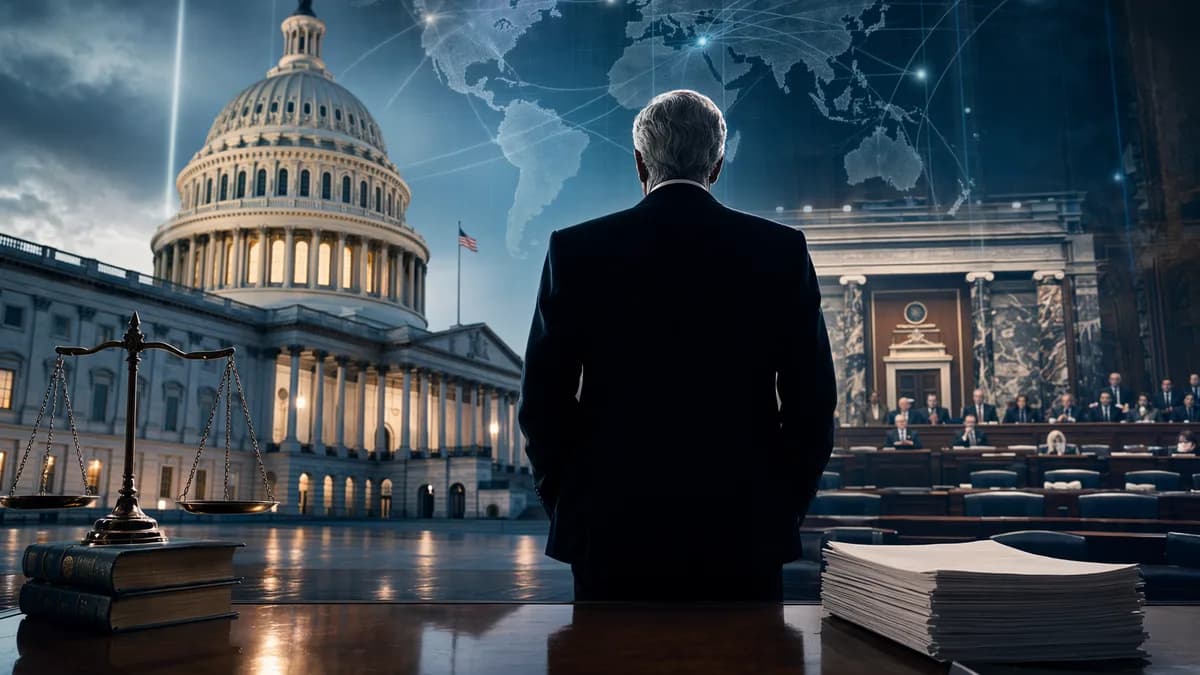
Todd Blanche’s nomination asks the Senate to bless a stark merger of roles: Donald Trump’s former personal criminal defense lawyer now seeking permanent control of the Justice Department.
Global TrendsJune 9, 2026· 9 min read· By XOOMAR Insights Team
Trump Lawyer Todd Blanche Seizes DOJ in Loyalty Test
Updated on June 9, 2026
XOOMAR Intelligence
Analyst Take
71/ 100
4 sources analyzedMedium confidenceTrend10Freshness97Source Trust88Factual Grounding91Signal Cluster20
Trump formally nominated Todd Blanche, the current acting attorney general, to take the job permanently after Pam Bondi’s ouster, according to Time. The confirmation fight won’t turn mainly on whether Blanche knows federal law. He clearly does. It will turn on whether senators believe he can separate Trump’s personal legal interests from the country’s law enforcement priorities.
Blanche’s nomination puts DOJ loyalty, not legal skill, on trial
The problem is concrete. Blanche represented Trump in three of the four criminal cases the president has faced. He then entered the Justice Department as deputy attorney general, became acting attorney general after Bondi was removed, and is now Trump’s pick to run DOJ permanently.
That sequence matters because acting authority isn’t ceremonial. In the weeks after Trump tapped Blanche for the acting role, he was already tied to decisions and controversies that will now define his nomination: the proposed “anti-weaponization” fund, the department’s handling of the Jeffrey Epstein files, and the broader charge that DOJ’s independence from the White House has weakened under Trump.
The sharpest version of the Senate’s question came from Sen. Thom Tillis, a Republican on the Senate Judiciary Committee, who said his support could hinge on Blanche’s position on the Jan. 6, 2021, Capitol attack.
“J6 is a circuit breaker for me. It’s not a gray area for me,” Tillis said. “He either equivocated and said harming these Capitol police officers was an okay thing, or he didn’t, and we’ll find that in the due diligence.”
XOOMAR analysis: This is why Blanche’s confirmation is bigger than one personnel fight. It is a test of whether the attorney general’s office is still treated as a public-law role with political accountability, or as an extension of presidential grievance management.
The résumé cuts both ways: prosecutor, defense lawyer, Trump courtroom insider
Blanche’s defenders have a real résumé to cite. He served as a federal prosecutor, worked for years in private practice at firms including WilmerHale and Cadwalader, Wickersham & Taft, and later became a founding partner at Blanche Law in April 2023. Additional background material says he worked in the Southern District of New York’s violent-crimes division for eight years.
That experience gives Blanche obvious technical strengths. He understands charging pressure, federal investigative tactics, courtroom sequencing, and the way high-profile cases move under media glare. Those are not small qualifications for an attorney general.
But the same résumé carries the conflict narrative.
Blanche served as Trump’s lead defense attorney in the New York hush-money trial, where Trump was convicted on 34 felony counts of falsifying business records tied to a 2016 payment to an adult film star. He also defended Trump in the federal cases brought by Special Counsel Jack Smith over alleged efforts to overturn the 2020 election and alleged mishandling of classified documents. Both federal cases were dismissed after Trump won reelection in 2024.
That is different from having been a campaign lawyer, policy adviser, or party operative. Blanche’s recent relationship with Trump was attorney-client, in criminal matters involving the man who now wants him to supervise federal law enforcement.
The confirmation math is simple. The politics are not.
The Senate only needs a majority to confirm Blanche if his nomination reaches the floor. Republicans hold the upper chamber, but Time reports that several Republican senators have not treated the outcome as automatic.
Sen. Chuck Grassley, the Judiciary Committee chair, has backed Blanche.
Blanche is “well-qualified and has shown his dedication to restoring law and order across our country. The Senate Judiciary Committee’s work to process Blanche’s nomination is underway.”
But Tillis has attached his scrutiny to Jan. 6. Sens. John Cornyn of Texas and John Kennedy of Louisiana have also suggested they are not yet decided, according to Time.
Democrats are already framing Blanche as structurally compromised. Sen. Adam Schiff said Blanche has failed to leave behind his role as Trump’s personal defense lawyer.
“At every turn, Todd Blanche has been unable to put aside his role as Donald Trump’s criminal defense lawyer and represent the American people instead,” Schiff said.
Sen. Richard Durbin, the top Democrat on the committee, said Trump “has been engaged in the most corrupt enterprise in the history of the Presidency” and that Blanche “apparently has not noticed.”
The supplied source material does not provide current DOJ workforce, budget, or office-count figures, so any precise scale claim would be unsupported here. The safer point is narrower and more important: the attorney general controls federal enforcement priorities, litigation posture, and the department’s public credibility. That power is why Blanche’s past representation of Trump is central, not incidental.
The anti-weaponization fund gives senators their cleanest pressure point
Blanche has already faced controversy over the effort to create an “anti-weaponization” fund to compensate people the Trump Administration deemed unfairly targeted by the federal government. He drew particular criticism after declining to rule out the possibility that people charged in connection with Jan. 6 could be compensated through the fund.
The Administration later said it would not move forward with creating the fund after pushback from bipartisan lawmakers and the courts.
That reversal does not erase the issue. It sharpens it. Senators can ask whether Blanche opposed the idea internally, merely defended it publicly, or helped shape it. They can also ask whether he believes taxpayer-backed compensation for politically favored defendants is compatible with equal enforcement.
| Stakeholder | Likely focus in Blanche hearing | Source-grounded reason |
|---|---|---|
| Republican supporters | Legal credentials and “law and order” framing | Grassley publicly backed Blanche as well-qualified |
| Undecided Republicans | Jan. 6, DOJ direction, and Blanche’s independence | Tillis, Cornyn, and Kennedy have not all committed support |
| Democrats | Trump loyalty, recusals, and politicized DOJ claims | Schiff and Durbin issued direct criticism |
| Public institutions | Whether DOJ decisions look personal or national | Blanche recently represented Trump in criminal cases |
XOOMAR analysis: The fund controversy is the easiest issue for senators to translate into a yes-or-no test. Blanche can talk broadly about law enforcement. Harder questions will ask who should never receive federal compensation, and why.
Epstein files scrutiny adds another institutional credibility problem
Blanche has also faced scrutiny over DOJ’s handling of the investigation into Jeffrey Epstein. Bondi claimed in a transcribed House Oversight and Government Reform Committee interview that Blanche “was in charge of … the entire release of the Epstein files.”
Blanche has defended the department’s work.
“I’m not trying to defend Epstein. I’m not,” Blanche said on Katie Miller’s podcast. “I do defend the work that that this department is doing today, right now, which is going after every single perpetrator anywhere. And if there’s a narrative that exists that we’re ignoring Epstein victims, that is false.”
The Epstein issue matters because it combines legal secrecy, political suspicion, and public distrust. XOOMAR readers following the broader Epstein record can see the same institutional tension in Jeffrey Epstein Assistant Puts His Machine on Trial: once a case becomes a proxy for power, every disclosure decision looks political to someone.
Blanche’s answer will need to be procedural, not emotional. Who made release decisions? What standards governed redactions? Which files remain withheld, and under what authority? The source material does not answer those questions.
Business and markets get fewer answers than they should
For markets, Blanche’s nomination creates a subtler risk. DOJ leadership affects the enforcement posture companies live under, but the supplied sources do not identify Blanche’s views on antitrust, crypto enforcement, corporate settlements, sanctions coordination, or merger scrutiny.
That silence is useful. It means the confirmation fight, as documented so far, is not about a business enforcement agenda. It is about political control, sensitive prosecutions, and the department’s relationship to Trump.
Still, companies should not treat this as Washington theater. XOOMAR analysis: leadership changes at DOJ can alter legal risk without a new statute, a new rule, or a public market signal. Charging priorities, settlement appetite, appeals decisions, and the treatment of politically sensitive defendants can all change the risk math for regulated firms.
The evidence to watch is practical:
- Recusals: Does Blanche commit to staying out of Trump-related matters?
- Policy memos: Does DOJ issue new instructions on politically sensitive investigations?
- Personnel moves: Do U.S. attorney changes align with Trump’s public targets?
- Dropped or revived cases: Do decisions map to legal weakness, or political convenience?
- Epstein disclosures: Does DOJ provide a consistent standard for releases and redactions?
The hearing comes down to whether Blanche can say no to Trump
Blanche will likely emphasize his prosecutorial background, private-practice record, and commitment to enforcing the law. That is the easy part. The harder test is whether senators force specific commitments on recusals, Jan. 6 compensation, Epstein file handling, and cases involving Trump’s allies or critics.
Trump has already praised Blanche as “a very talented and respected legal mind.” Blanche, after being named acting attorney general, thanked Trump for “the trust and the opportunity” and said DOJ would continue “backing the blue, enforcing the law, and doing everything in our power to keep America safe.”
Those words will not settle the nomination. Early decisions will.
If Blanche is confirmed, his first personnel moves and case calls will define him faster than any hearing answer. If he is blocked, the fight will still have moved the boundary by making a former personal criminal defense lawyer for the president a plausible nominee for attorney general.
The live test is narrow and unforgiving: whether Blanche can show, in public and on paper, that his loyalty now runs to the office rather than the client who put him there.
Impact Analysis
- Blanche’s nomination tests whether the Justice Department can remain independent from Trump’s personal legal interests.
- His role in Trump’s criminal defense and later DOJ leadership creates a major conflict-of-interest concern for senators.
- The confirmation fight could hinge on how Blanche addresses Jan. 6, DOJ politicization, and high-profile controversies like the Epstein files.
Sources

Written by
XOOMAR Insights Team
Research and Editorial Desk
The XOOMAR Insights Team pairs automated research with human editorial judgment. We track hundreds of sources across technology, fintech, trading, SaaS, and cybersecurity, cross-check the facts, and explain what happened, why it matters, and what to watch next. We do not just rewrite headlines. Every article is fact-checked and scored for reliability before it goes live, and we link back to the original sources so you can verify anything yourself.
Explore More Topics
Related Articles
 Global Trends
Trump’s $1.15tn NDAA Squeaks Through Bitter House Revolt
A $1.15tn NDAA barely cleared the House as Democrats turned Trump’s Iran war and voting agenda into a Senate showdown.
Jul 23, 20266 min
 Global Trends
9-8 Vote Throws Jay Clayton DNI Nomination Into Peril
Jay Clayton cleared committee 9-8, leaving Trump's DNI pick facing a tense Senate fight over loyalty and intelligence experience.
Jul 21, 20266 min
 Global Trends
Trump Tariffs Twist Court Loss into Checkout Tax Fight
Trump recast his tariffs after a court loss. Democrats see an opening, calling them a sales tax on squeezed Americans.
Jul 25, 20269 min
 Global Trends
Trump Tariffs Mint $151 Billion While Factories Shed Jobs
Trump tariffs raised $151 billion, but factory jobs fell by 89,000, undercutting the factory revival pitch.
Jul 24, 20266 min
 Global Trends
Trump Tariffs Drag 80 Countries Into Legal Showdown
Trump's new tariffs hit 80-plus countries and set up a fresh fight over presidential power, import costs, and Congress's tax authority.
Jul 24, 20267 min
 Technology
DoorDash Drone Delivery Seizes FAA Clearance to Fly
DoorDash won FAA clearance for DoorDash Air, signaling a bigger bet on owning delivery from couriers to bots to drones.
Jul 29, 20269 min
 Fintech
Musk Turns Paid X Users Into X Money App Banking Test
X Money is live for paid U.S. subscribers, turning Premium users into Musk’s first real test of banking inside X.
Jul 28, 20268 min
 Trading
Gold Price Risks $4,000 Breakdown Before Fed Decision
Gold is slipping near $4,000 as traders wait for the Fed's rate signal, with yields and dollar strength threatening support.
Jul 29, 20268 min
 Technology
Fast Metals Mines Toxic Red Mud for Critical Minerals
Fast Metals raised $4.3M to mine critical minerals from red mud. Now it has to prove the leftover waste is safer.
Jul 29, 202612 min
 SaaS & Tools
Nearly 60 Webinar Tools Expose the Best Webinar Software
Webinar platforms are now judged by pipeline, not polish. Zapier’s 2026 picks show marketers which tools turn attendance into action.
Jul 29, 20268 min
Don't miss the signal
Get our weekly roundup of the stories that matter across tech, fintech, and trading. No noise, just signal.
Free forever. No spam. Unsubscribe anytime.