
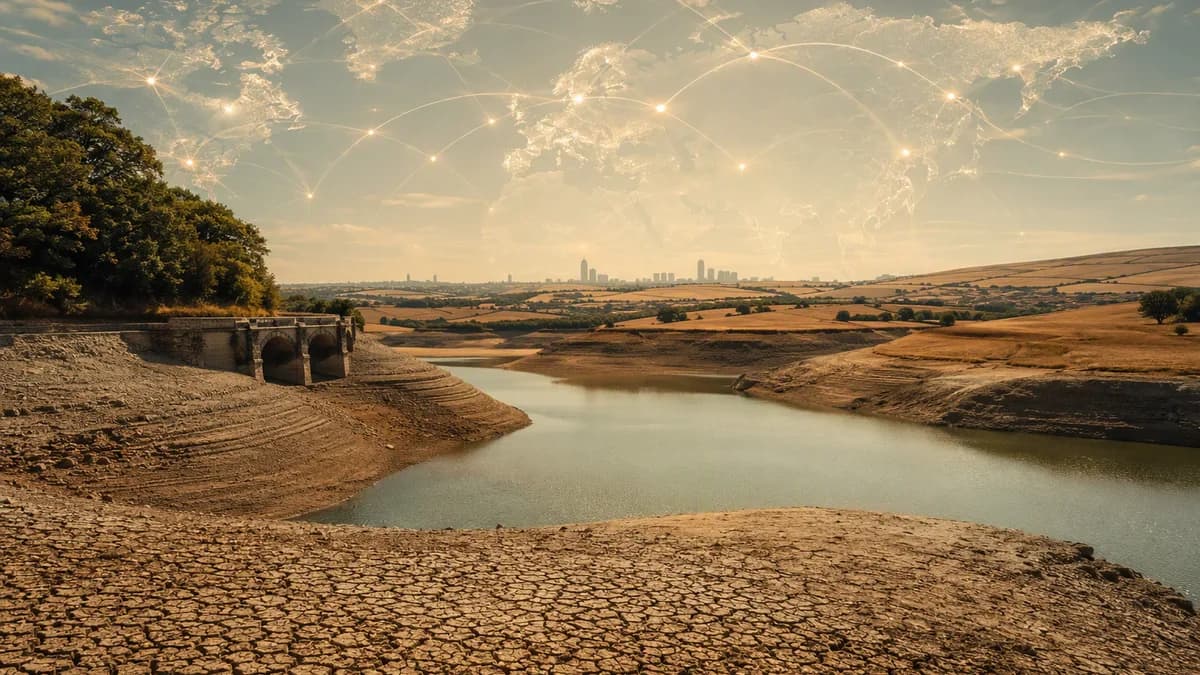
The UK drought is arriving before summer has even peaked: half of England and the whole of Wales are officially in drought after July delivered near-total rainfall failure across key regions.
Global TrendsAugust 2, 2026· 7 min read· By XOOMAR Insights Team
UK Drought Hits Early as July Rainfall Vanishes in South
Updated on August 2, 2026
XOOMAR Intelligence
Analyst Take
68/ 100
1 source analyzedMedium confidenceTrend10Freshness95Source Trust90Factual Grounding88Signal Cluster20
July is set to be the driest month on record for England and Wales, according to Guardian World, after four record-breaking heatwaves since May helped dry out farmland, parks, protected habitats, rivers, and reservoirs.
UK drought is no longer waiting for late summer
The sharpest signal is timing. This drought was not declared after a long, slow fade into autumn. It has arrived after repeated heatwaves at the front end of summer.
The Environment Agency and Natural Resources Wales made drought announcements this week. The Guardian reports this is the third such event over the past five years, which makes the current dry spell harder to dismiss as a one-off weather anomaly.
XOOMAR analysis: The source supports a clear conclusion: the UK’s drought risk is becoming more compressed, more visible, and more disruptive. Heatwaves are no longer separate from water stress. They amplify it by drying soil, vegetation, rivers, and green space at the same time.
That matters because the UK still has a buffer in one place: drinking water. Water companies are not currently presented as expecting an immediate threat to drinking supplies. But that does not protect every part of the system. Drought status, local restrictions, and visible environmental stress show that water pressure is already practical, not theoretical.
Southern England’s 1% rainfall figure shows how extreme July became
The rainfall numbers are brutal.
Southern England received just 1% of its long-term average rainfall for July, according to the report. That is not a dry month in the ordinary sense. It is a near-total failure of rainfall across one of the country’s most exposed regions.
| Measure | Reported figure |
|---|---|
| Drought status | Half of England and the whole of Wales |
| Southern England rainfall in July | 1% of long-term average |
| Recent heat pattern | Four record-breaking heatwaves since May |
The physical effects are already visible. The Guardian reports damaged greenery in parks, protected land, and sports fields. Rivers and lakes have shrunk, adding another layer of stress to places that depend on steady summer flows.
The rainfall collapse also lands at a difficult time for farms and habitats. Crops need water during the growing season. Wildlife and protected land have less room to absorb repeated stress when heat and dry weather arrive together.
For households, the most immediate effect is restriction where local controls apply. For farmers, it is triage.
Heatwaves, wildfires, and low rivers now reinforce each other
The current UK drought is best read as a chain reaction.
Dry weather reduces water availability. Heatwaves raise demand and increase evaporation. Dry vegetation then becomes fuel. The result is not one crisis, but several linked pressures hitting at once.
The source uses the phrase “whiplash” wet-then-dry weather to describe the pattern: wet conditions encourage vegetation to grow, then heat and drought dry it out. That sequence creates fire risk.
Firefighters have already faced serious wildfire pressure during the dry spell, with evacuations and emergency responses showing how quickly environmental stress can become a public-safety issue. The exact scale may vary by location, but the mechanism is clear: heat, dry ground, and dry vegetation reinforce one another.
That is the core of the story. The drought is not only about missing rain. It is about heat converting missing rain into wider damage, from parks and playing fields to farms, habitats, and fire response.
Farmers, water companies, households, and habitats face the same shortage differently
The drought does not hit every stakeholder in the same way.
For farmers, the pressure is immediate because water demand rises at exactly the point when supply becomes less reliable. Hotter growing conditions increase crop stress, irrigation needs, and pressure on labour. Earlier harvesting, crop prioritisation, and difficult decisions over where limited water goes are the kinds of farm-level signals to watch.
The same shortage looks different for water companies. Their task is to maintain drinking-water resilience while managing demand and local restrictions. That does not make the wider drought less severe. It simply means the public-water system and the natural environment can experience the same dry spell differently.
For households, drought is most visible when restrictions arrive, gardens dry out, local green space deteriorates, and rivers or lakes visibly shrink. For habitats, there is no easy workaround. Protected land, wildlife corridors, and aquatic ecosystems must absorb the combined pressure of heat, low rainfall, and reduced flows.
XOOMAR analysis: The source does not prove national food-price effects from this drought. It does show the mechanism to watch: irrigation limits, crop prioritisation, early harvesting, and heat stress. Those are the farm-level signals that would need to broaden before stronger claims about grocery costs are justified.
For a separate pressure point on household budgets, XOOMAR has also covered grocery shocks and consumer confidence. The drought story is distinct, but both sit in the same real-world place: consumers and producers absorbing shocks they do not fully control.
The UK was built around wetter assumptions than this July delivered
The old national image of Britain as rainy and water-secure looks weaker when southern England records 1% of normal July rainfall.
The source does not provide evidence on leakage, reservoir development, housing growth, or water-company investment. Those debates matter, but they are outside the verified material here. What the article does show is simpler and harder to ignore: repeated heatwaves and sharply reduced rainfall can still push large parts of England and Wales into drought by summer.
That is the deeper planning problem. Storage can help drinking supply, but it does not prevent parched parks, low rivers, stressed farms, wildfire risk, or water restrictions when heat and dry weather coincide.
The forward frame is therefore not a single projection or a distant date. It is the direction of travel already visible in this summer’s conditions. If hotter, drier summers become more common, July 2026 looks less like an outlier and more like a stress test.
XOOMAR also tracks stress in other critical systems, including security and state capacity. The common thread is not the cause. It is the penalty for underestimating system strain until the pressure is visible.
Record-dry July turns adaptation from slogan into operating requirement
The strongest practical lesson is that waiting for wetter weather to “reset” the problem is not planning.
By July, half of England and all of Wales were in drought. Southern England had recorded only 1% of its normal July rainfall. Parks, protected land, rivers, lakes, farms, and communities were all showing different versions of the same problem: heat and dry weather can overwhelm assumptions built around a wetter climate.
That combination tells policymakers and water managers where the test now sits:
- Timing: Can drought triggers respond before visible damage spreads?
- Farming: Can water planning keep pace with hotter growing seasons?
- Habitats: Can protected land withstand repeated dry spells?
- Fire response: Can crews handle severe wildfire periods without sustained strain?
- Public restrictions: Can demand controls arrive with enough clarity to preserve cooperation?
The next UK drought will test whether ministers and agencies treat water as critical infrastructure, not seasonal inconvenience. Evidence that would confirm the stronger-risk thesis is straightforward: more record-low river readings, more severe wildfire seasons, wider restrictions, and more farms reporting water shortages before late summer. Evidence that would weaken it would be a sustained return to normal rainfall without repeated heat stress.
For now, July has already delivered the warning. The surprise would be acting surprised again.
Impact Analysis
- Half of England and all of Wales are already in drought before summer has peaked.
- Southern England receiving just 1% of normal July rainfall signals severe stress on land, rivers, and habitats.
- Four record-breaking heatwaves since May show how extreme heat is intensifying water pressure.
Southern England July Rainfall
Southern England
% of long-term average1
Sources

Written by
XOOMAR Insights Team
Research and Editorial Desk
The XOOMAR Insights Team pairs automated research with human editorial judgment. We track hundreds of sources across technology, fintech, trading, SaaS, and cybersecurity, cross-check the facts, and explain what happened, why it matters, and what to watch next. We do not just rewrite headlines. Every article is fact-checked and scored for reliability before it goes live, and we link back to the original sources so you can verify anything yourself.
Explore More Topics
Related Articles
 Global Trends
Passengers Pay Early as Heathrow Higher Fares Loom
Passengers may pay for Heathrow’s £320m expansion planning bill decades before a third runway delivers anything.
Jul 31, 20268 min
 Global Trends
Cockroach Protests Crack Modi’s BJP Fortress in Delhi
Cockroach protests forced a minister out and exposed fresh weakness in Modi’s BJP after years of dominance.
Jul 27, 20268 min
 Global Trends
£100 a Story Offer Drags CT Group Into Press Cash Storm
CT Group was filmed discussing £100 payments for published stories, raising fresh questions over hidden lobbying in UK newspapers.
Jul 26, 20267 min
 Global Trends
Gatwick Airport Water Outage Shuts Toilets, Restaurants
A water outage shut toilets and restaurants across Gatwick’s terminals after a treatment plant power failure hit pressure.
Jul 26, 20266 min
 Global Trends
Police Probe £500k Reform UK Donations via Tice Firm
Met police are probing £500k routed to Reform UK through Richard Tice's company, widening scrutiny of 2024 election funding.
Jul 25, 20266 min
 Technology
Watch Adults Marathon Day Online Without the Date Trap
The 20-minute Adults prequel streams on FXX, Hulu, and Disney+, but check listings first. The listed air times don't fully match.
Aug 2, 20267 min
 Technology
$2,499 Price Trips Up De'Longhi PrimaDonna Aromatic
De'Longhi's $2,499 flagship nails convenience, but cheaper models make its luxury price hard to defend.
Aug 1, 20267 min
 Trading
Warjiyo Exit Jolts Indonesian Rupiah at Stress Levels
Warjiyo's surprise exit turns the Indonesian rupiah slide into a credibility test for Bank Indonesia.
Aug 2, 20267 min
 Fintech
$68.8M BaaS Shock Crushes Coastal Financial Shares
One fintech partner triggered a $68.8M hit at Coastal Financial, turning BaaS concentration risk into real balance-sheet damage.
Aug 2, 20268 min
 Global Trends
Mall Floor Caves In as Japan Earthquake Kills 13 People
Rescuers are searching Aeon Mall after a deadly Japan earthquake collapsed part of the building and left people trapped.
Aug 2, 20266 min
Don't miss the signal
Get our weekly roundup of the stories that matter across tech, fintech, and trading. No noise, just signal.
Free forever. No spam. Unsubscribe anytime.