Can Agility Robotics turn humanoid robots into paid warehouse labor before Tesla’s Optimus becomes useful outside Tesla’s own factories?
XOOMAR Intelligence
Analyst Take
Agility Robotics is opening a 60,000-square-foot Fremont facility to train and refine its Digit humanoid robots, putting its commercial robotics push just up the highway from the factory where Tesla is expected to start manufacturing Optimus this year, according to TechCrunch. The Agility Robotics Fremont facility is designed as a training and capabilities hub for Digit, the company’s six-foot-tall humanoid built for manufacturing and warehouse work.
Agility said in a July 16 announcement that the Fremont site will house nearly 200 existing and new employees across hardware engineering, AI/ML software engineering, and field operations. The company says the facility complements its RoboFab manufacturing operations in Salem, Oregon, and will help Digit learn new skills for customer environments.
Can the Agility Robotics Fremont facility turn Digit training into deployable warehouse labor?
The obvious answer is that Agility needs more space to train robots. The harder answer is that humanoid robotics now faces a deployment problem, not just a demo problem.
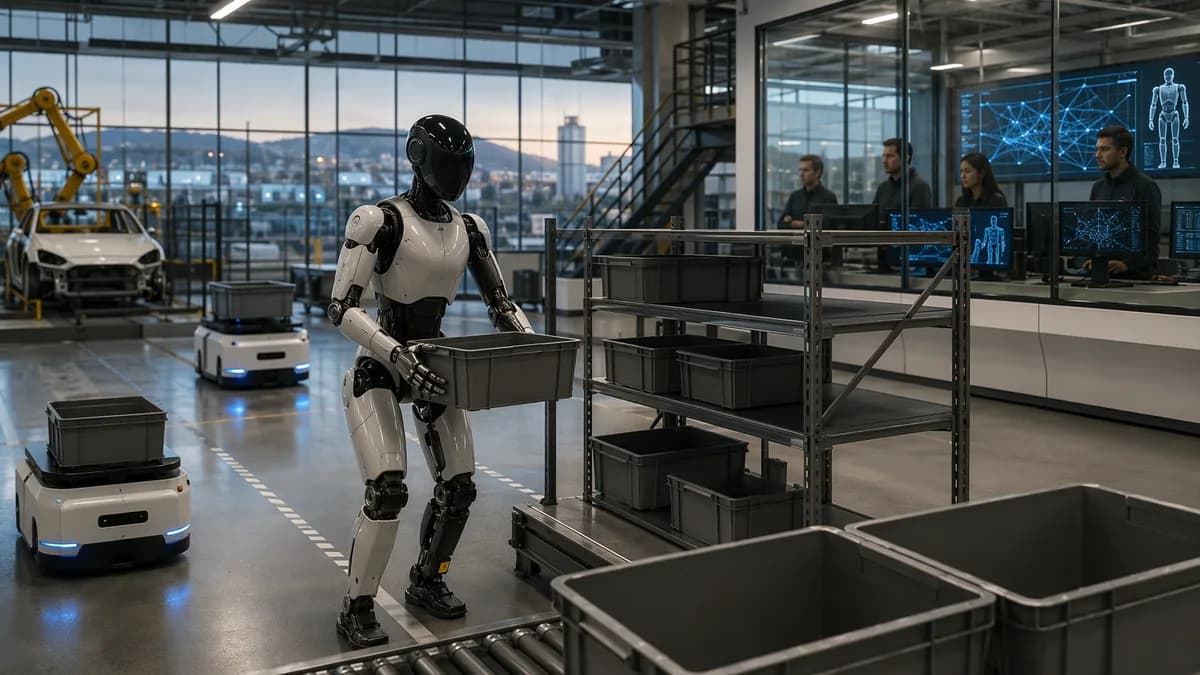
Digit already carries totes and bins in manufacturing and warehouse settings for customers including Amazon, GXO, Schaeffler, and Toyota Motor Manufacturing Canada, according to TechCrunch. Agility also says it has secured $300 million in contract orders for its robots.
The new Fremont facility is meant to speed up that kind of work. Agility says engineering teams will train, test, and improve the AI technologies that let Digit learn new skills and perform more sophisticated tasks in customer environments.
“Being in the heart of Silicon Valley brings us into one of the world's leading AI talent and innovation ecosystems, allowing us to develop new capabilities for Digit faster and put them to work for customers immediately,” said Peggy Johnson, CEO of Agility.
The keyword is “immediately.” Agility isn’t pitching a home robot. It’s targeting constrained commercial settings where tasks repeat, workflows are mapped, and safety rules can be engineered into the deployment.
Digit’s current work is practical: moving totes and bins. TechCrunch reports that Agility has said Digits have moved 100,000 totes at a GXO logistics facility. Agility hasn’t disclosed how many Digits it has built or deployed, but outside observers estimate that dozens have worked in pilot or revenue-generating deployments.
That gap matters. A few dozen deployed robots can prove a use case. It doesn’t prove a fleet business.
Does Fremont put Digit too close to Tesla Optimus for comfort?
Fremont gives the story its edge. Agility’s new site sits near Tesla’s manufacturing footprint, while Tesla is expected to start manufacturing Optimus robots this year.
Elon Musk has increasingly talked up Optimus. TechCrunch cites Musk saying he expects it to become “the biggest product ever” once it is “useful outside of Tesla sometime next year.”
Agility’s counterpoint is less theatrical: Digit is already doing paid work.
“It’s great to have [Tesla] in the same area as us, because really, for a long time Agility was out there alone, and it’s good to have others in the humanoid space,” Johnson told TechCrunch. “We have commercialized. We now know what it takes to walk into these facilities and meet their safety bars, their regulatory bars, compliance, plug into their IT infrastructure, plug into their warehouse management system.”
That quote is the center of the competitive contrast. Tesla has capital, manufacturing ambition, and Musk’s platform. Agility has customer deployments, integration scars, and a focused logistics play.
| Company | Robot | Near-term posture from source material | Commercial proof cited |
|---|---|---|---|
| Agility Robotics | Digit | Warehouse and manufacturing deployments, with Fremont hub for training and AI capabilities | Customers named include Amazon, GXO, Schaeffler, Toyota Motor Manufacturing Canada, plus $300 million in contract orders |
| Tesla | Optimus | Expected to start manufacturing this year, with Musk saying it may be useful outside Tesla sometime next year | No external commercial deployment cited in the supplied source |
The Agility Robotics Fremont facility matters because training humanoids for customer sites is not the same as training models in isolation. Robots have to move through facilities, handle real objects, pass safety checks, connect to warehouse systems, and perform consistently enough that customers keep paying.
Agility is also making a specific technical bet. It wants AI to help Digit scale into more tasks, but it doesn’t want generative AI making safety-critical decisions.
“When you think about self-driving cars, you know, as a non-humanoid example, you really don’t want the anti-lock brake controller under AI control,” Agility co-founder and chairman Damion Shelton told TechCrunch. “The analog with humanoids is all the safety stuff needs to go through a path that’s not generative AI, right? You don’t want to get creative with your safety stack.”
That’s a sharp line. AI can expand what Digit can learn. Safety, in Agility’s telling, stays on a more controlled path.
Can Agility scale Digit before the humanoid field catches up?
Agility’s next test is not whether Digit can move another tote. It’s whether the company can convert pilots, contracts, and training into repeatable robot labor at scale.
The company says more than 30 customers are in talks about deploying Digit. Its Fremont facility will train the robot in environments similar to the ones it will face in the field. Agility has also said it has active humanoid deployments with Schaeffler, GXO, Toyota Motor Manufacturing Canada, and Mercado Libre, according to its company release.
The public-market angle raises the stakes. Johnson is leading Agility through a reverse merger expected to make it the first pure-play humanoid robot company on public markets later this year. Agility also announced a planned public listing through a business combination with Churchill Capital Corp XI.
That listing, if completed, would give investors a cleaner way to bet on humanoid robotics. It would also put pressure on Agility to show more than technical progress.
Decision-makers will care about the unglamorous metrics:
- Reliability: Can Digit keep working across shifts without frequent intervention?
- Integration: Can it plug into warehouse management systems and IT infrastructure without custom work every time?
- Safety: Can version 5 operate near people, not just in robot-only zones?
- Unit economics: Can customers justify deployments beyond pilots?
- Task expansion: Can Digit move from totes and bins into picking, kitting, cardboard, and trailer loading?
Agility says Digit v5, expected to be unveiled this fall, will be able to sense humans and won’t need to remain in a robot-only zone. That would mark a meaningful shift, because Digit currently operates in a human-free space.
For readers tracking the broader AI buildout beyond robotics, XOOMAR has also covered infrastructure pressure points in New York Data Center Moratorium Hits AI's Power Grab and New York Data Center Moratorium Freezes AI Buildout. Those are separate fights, but they show how physical infrastructure is becoming a hard constraint for AI companies.
Which Digit milestone will answer the question months from now?
The milestone to watch is not a splashy demo from the Agility Robotics Fremont facility. It’s whether Agility can show more customers, more deployed robots, and more tasks completed safely in live commercial settings.
Co-founder and chief robot officer Jonathan Hurst framed the work as a sequence: bins and totes first, then picking and kitting, then harder materials like cardboard, plus loading and unloading tractor trailers.
“Let’s start with the bins and the totes, and then let’s do the picking and the kitting,” Hurst told TechCrunch. “And then let’s like start working on cardboard, which is really hard, and loading and unloading tractor trailers and things like that. Okay, now we’re at 100 million robots, you know? A trillion-dollar company.”
That last line is ambition, not evidence. The evidence will come from deployments.
If Digit v5 can work near people, if the Fremont site speeds customer-specific training, and if the company turns its pipeline into repeat orders, Agility will have something Tesla still has to demonstrate in the supplied record: humanoid robots doing useful work for outside customers at commercial scale.
The Bottom Line
- Agility is moving closer to Silicon Valley talent as humanoid robotics shifts from demos to real deployments.
- Digit already has warehouse and manufacturing customers, giving Agility a commercial head start over many rivals.
- The Fremont facility puts Agility near Tesla as competition intensifies over who can make humanoid robots useful at scale.
Agility Digit vs. Tesla Optimus
| Company/Robot | Current focus | Key location | Commercial status |
|---|---|---|---|
| Agility Robotics / Digit | Training and refining humanoid robots for manufacturing and warehouse work | New 60,000-square-foot Fremont facility, plus RoboFab manufacturing in Salem, Oregon | Used with customers including Amazon, GXO, Schaeffler, and Toyota Motor Manufacturing Canada; $300 million in contract orders |
| Tesla / Optimus | Humanoid robot expected to begin manufacturing this year | Tesla factory near Fremont | Expected to be useful first inside Tesla’s own factories |
Primary Sources & Disclosures

Written by
XOOMAR Insights Team
Research and Editorial Desk
The XOOMAR Insights Team pairs automated research with human editorial judgment. We track hundreds of sources across technology, fintech, trading, SaaS, and cybersecurity, cross-check the facts, and explain what happened, why it matters, and what to watch next. We do not just rewrite headlines. Every article is fact-checked and scored for reliability before it goes live, and we link back to the original sources so you can verify anything yourself.