
Who gets power first when AI data centers receive a federal fast lane to the grid, but the grid still doesn't have enough electricity to go around?
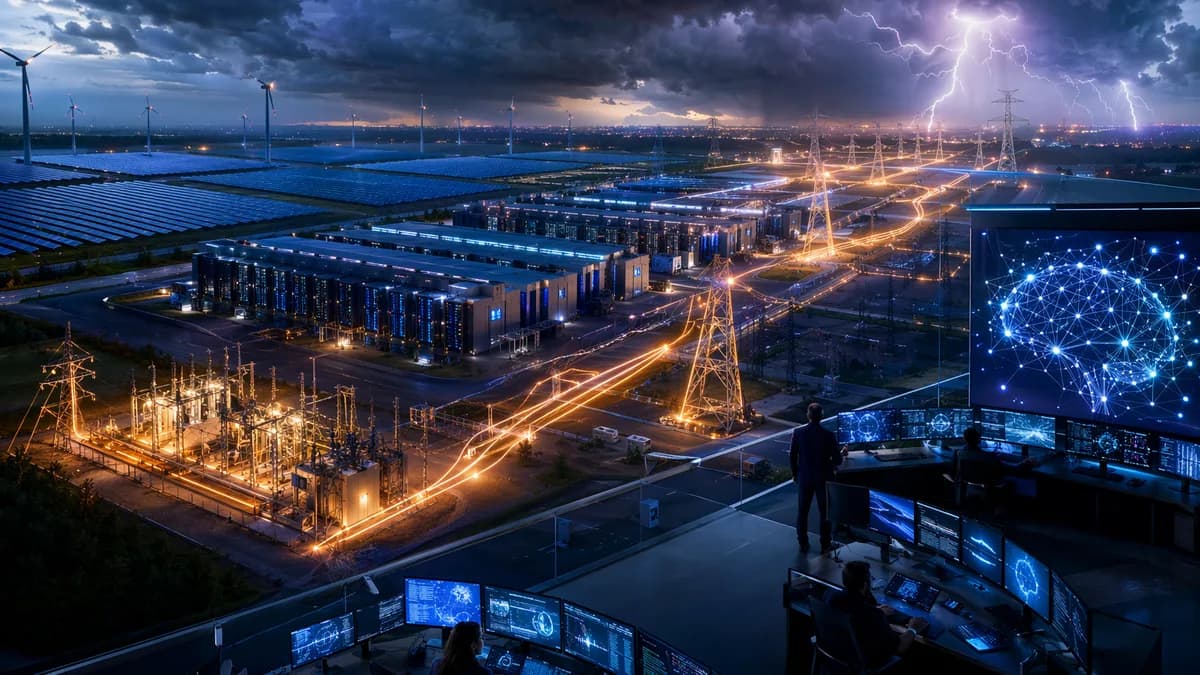
TechnologyJune 20, 2026· 8 min read· By XOOMAR Insights Team
AI Data Centers Grab a Federal Fast Lane to the Grid
Updated on June 21, 2026
XOOMAR Intelligence
Analyst Take
58/ 100
4 sources analyzedLow confidenceTrend10Freshness97Source Trust90Factual Grounding91Signal Cluster20
That is the real question behind FERC’s AI data center interconnection order. The Federal Energy Regulatory Commission told six major grid operators on Thursday, June 18, to speed up interconnection processes for data centers and other large power users, according to TechCrunch. The move may cut paperwork and queue delays. It does not create new generation, new transmission, or cheap firm power.
XOOMAR analysis: this order turns AI infrastructure into a priority load class. Not formally, and not with a national rule that says data centers jump every line. But politically, the signal is clear. AI compute is now being treated as strategic infrastructure, not just another commercial customer asking a utility for service.
FERC directed grid operators to show that data centers are “able to connect to the transmission system in a timely and orderly manner.”
That phrase matters. “Timely and orderly” sounds procedural. The fight beneath it is physical. The United States can move faster on studies, tariffs, and interconnection paperwork, but if there isn’t enough spare generating capacity, the bottleneck shifts from the application desk to electricity prices, reliability planning, and ratepayer protection.
Can an AI data center interconnection fast lane fix a queue that is already overloaded?
Only partly.
FERC’s order tells six major grid operators to adapt their processes for large electricity users, including AI data centers. Data centers must pay the costs of their own interconnections. Commissioners approved the orders unanimously. Grid operators now face two immediate deadlines:
- 30 days: submit a report on how much generating capacity they have to spare, if any.
- 60 days: “defend or revise” electricity rates within their regions.
That is a sharp regulatory shove. It asks grid operators to stop treating hyperscale AI campuses as normal load additions when their power needs can arrive faster than planning cycles were built to handle.
But interconnection is not supply. Permission to connect to the grid is not a guarantee that enough affordable electricity exists at the right node, at the right hour, under peak stress.
The existing queue problem is already severe. At the end of 2023, grid connection requests for power plants exceeded the total capacity of the existing power plant fleet, according to the supplied source material. Put simply, the line to get new generation onto the grid was larger than the power system it was trying to join.
That makes the AI data center interconnection order both logical and incomplete. It attacks delays in connection processes. It does not solve the harder problem: new power plants are also struggling to connect.
If the fast lane opens, who pays when the grid has to expand?
FERC is trying to draw a bright line. Data centers should pay for the costs of their own interconnection. That is meant to protect households and smaller businesses from subsidizing private AI campuses.
The risk is that grid costs rarely stay neatly boxed. A large new load can trigger transmission upgrades, capacity procurement, reliability planning changes, and local infrastructure spending. Some costs are direct. Others show up through regional power prices.
TechCrunch reported that wholesale electricity rates are up as much as 267% compared with five years ago, citing Bloomberg. The source material also says enough projects have connected that electricity prices have soared in many regions.
That is the uncomfortable sequence:
- AI developers need power quickly.
- Grid operators face overloaded queues and limited spare capacity.
- Utilities see demand growth after years of near-zero growth.
- Consumers worry that bills rise while private campuses secure scarce capacity.
FERC also directed grid operators to consider “alternative transmission technologies.” The commission did not name specific tools, but TechCrunch noted that the directive could include solid-state transformers or superconducting transmission lines. That gives grid tech startups a regulatory opening, but not a guaranteed market. Operators still have to show these tools work within reliability rules, cost recovery structures, and regional planning processes.
Why is AI power demand straining planning models built for slow growth?
Because data centers are no longer a niche load in grid planning.
Electricity demand from data centers is expected to nearly triple through 2035, according to the source material. Grid operators had grown accustomed to near-zero demand growth over the last two decades. That old assumption is now broken.
Some data center projects seek hundreds of megawatts, and related reporting in the supplied material says some large customers are seeking gigawatt-scale power commitments. That pushes AI infrastructure into the same planning conversation as major industrial load, but with a faster clock. A data center campus can move through site selection and development faster than transmission lines, large power plants, or major grid upgrades can be permitted and completed.
The order also pushes grid operators to be more accommodating to behind-the-meter power for data centers. That matters because tech companies and developers have already turned to on-site power when grid connections move too slowly. The source describes that route as typically more expensive and complicated, but increasingly attractive when the alternative is waiting years.
For adjacent XOOMAR coverage on how data-heavy businesses create new strategic pressure points, read Retail Data War Pits Amazon Against Walmart for Ad Cash. For a related data center operating-risk thread, see Firing Threat Shadows Amazon Data Center Moratorium.
Are FERC, utilities, cloud companies, and consumers even solving the same problem?
No. They are solving overlapping problems with different winners.
| Stakeholder | What they want from the order | Main constraint in the source material |
|---|---|---|
| AI developers and cloud companies | Faster grid access for large campuses | Slow interconnections and limited power availability |
| Grid operators | Clearer rules for large-load requests | Study backlogs, transmission constraints, reliability risk |
| Utilities | Load growth and infrastructure investment | Sudden demand additions without enough generation |
| Consumers and local communities | Protection from higher bills and local burdens | Rising rates, siting concerns, water, noise, and land use |
| FERC | Faster processes without overriding state authority | It can reform tariffs, but cannot instantly create supply |
Energy Secretary Chris Wright pushed FERC to act after saying in October that delays in data center grid connections threatened U.S. competitiveness in AI. That framing helped turn interconnection into a national competitiveness issue.
Public sentiment has moved the other way. The source says sentiment toward AI and data centers has soured considerably. Related reporting in the supplied material cites concerns over energy use, water use, noise, air pollution, water shortages, and loss of open space or farmland.
That tension is the core political bind. Washington wants more AI compute. Communities and ratepayers want proof they won’t be left with the bill or the local costs.
Does the supply side match Washington’s AI ambitions?
Not yet, based on the supplied facts.
The clearest contradiction sits in the power stack. FERC is pushing grid operators to accommodate more large load, while the federal government is also reshaping generation choices. The Trump administration said it would pay $765 million to wind developer Invenergy to cancel offshore wind leases near California, Maine, and New York. Invenergy said it would use the money to build natural gas plants in the Midwest and geothermal projects in the West.
One of Invenergy’s wind projects would have generated as much as 2.4 gigawatts of power, enough at peak output to supply roughly 1.8 million homes. Altogether, the Trump administration has now spent about $2.6 billion to scuttle offshore wind developments, according to the source material.
This does not mean every canceled wind project would have solved data center load. Location, timing, transmission access, and dispatchability all matter. But it shows the mismatch: AI demand is accelerating while the generation mix remains contested.
XOOMAR analysis: the next bottleneck will be less about forms and more about firm capacity. Expect more AI developers to pursue direct arrangements around natural gas, geothermal, solar-plus-storage, nuclear, and behind-the-meter generation where available. The supplied source already shows the behind-the-meter move is happening out of desperation in places where grid access is too slow.
What evidence will show whether the fast lane works or just moves the fight?
The first test comes quickly. Grid operators have 30 days to reveal how much spare generating capacity they have, if any. That filing will show whether this is mainly a process problem or a supply problem wearing a process disguise.
The second test comes at 60 days, when operators must defend or revise regional electricity rates. That is where the affordability fight becomes more concrete.
Watch for three signals:
- Capacity evidence: Do grid operators report meaningful spare generation, or do they confirm tight supply?
- Cost allocation rules: Do tariffs clearly force large-load customers to pay for the upgrades they trigger?
- Curtailment and flexibility terms: Do data centers accept operating limits during grid stress, or demand always-on service?
FERC can accelerate the AI data center interconnection queue. It can push grid operators to modernize tariffs, study processes, and technology options. It can make behind-the-meter power easier to integrate.
It cannot repeal scarcity.
The AI buildout won’t be limited by paperwork alone. It will be limited by electrons, wires, local tolerance, and the political question now moving to the center of the grid: when power is constrained, who gets priority?
Impact Analysis
- AI data centers could gain faster access to the grid even as electricity supply remains constrained.
- The order may shift grid bottlenecks from permitting delays to power prices, reliability, and ratepayer impacts.
- FERC’s move shows federal regulators increasingly view AI infrastructure as strategically important.
What FERC’s AI Data Center Order Changes—and What It Doesn’t
| Area | Impact |
|---|---|
| Interconnection process | May reduce paperwork, studies, and queue delays for AI data centers and other large power users |
| Electricity supply | Does not create new generation, transmission capacity, or cheap firm power |
| Grid priority | Signals that AI compute is being treated as strategic infrastructure rather than a routine commercial load |
Sources

Written by
XOOMAR Insights Team
Research and Editorial Desk
The XOOMAR Insights Team pairs automated research with human editorial judgment. We track hundreds of sources across technology, fintech, trading, SaaS, and cybersecurity, cross-check the facts, and explain what happened, why it matters, and what to watch next. We do not just rewrite headlines. Every article is fact-checked and scored for reliability before it goes live, and we link back to the original sources so you can verify anything yourself.
Explore More Topics
Related Articles
 Technology
xAI Unpermitted Turbines Drag Out Memphis Power Fight
SpaceX says xAI’s unpermitted turbines may run until July 2027, turning a stopgap into an AI power fight.
Aug 1, 20267 min
 Technology
$14B AMD AI Deal Pulls Core Scientific From Bitcoin Mining
Core Scientific’s $14B AMD AI leases mark a hard pivot from bitcoin mining, with options that could expand capacity to 2.5 GW.
Aug 2, 20265 min
 Technology
Watch Adults Marathon Day Online Without the Date Trap
The 20-minute Adults prequel streams on FXX, Hulu, and Disney+, but check listings first. The listed air times don't fully match.
Aug 2, 20267 min
 Technology
£713k Grid Fees Threaten Britain's Datacentre Land Grab
Ofgem wants heavy grid fees on datacentre projects after requests hit 73GW, exposing how AI demand is clogging Britain's power queue.
Jul 31, 20267 min
 Technology
Nintendo Hides $300M Tariff Refund From Buyers
Nintendo booked a massive $902 million quarterly profit, supercharged by a $300 million US tariff refund it has no plans to pass on to the customers who origina
Aug 6, 20267 min
 Global Trends
Trump Slaps 15% Tariff on China's Chip Silicon
A new US policy levies a 15% tariff and minimum price on imported polysilicon, directly targeting Chinese control over the foundational material for chips and s
Aug 7, 20268 min
 Global Trends
Watch Every NFL Preseason Game Free Legally
A complete guide to legally watching the entire 2026 NFL preseason for free using official trials, the DAZN platform, and VPNs, covering every game without a ca
Aug 6, 20266 min
 Fintech
Google Wallet Creates Parent-Controlled Money Pools for Kids
Google Wallet now lets U.S. parents set up a secure, supervised balance for kids under 18, offering a middle ground between cash and a traditional debit card to
Aug 6, 20267 min
 Technology
Streamer’s Death Earns Convictions, But No Prison
Two men received suspended sentences for violence and incitement tied to the live-streamed death of Kick streamer Raphaël Graven, but no one was held legally re
Aug 7, 20266 min
 Technology
Tiny AI Model Outperforms Giants on a Raspberry Pi
Liquid AI's 2.6B parameter LFM2.5 model, small enough to run on a Raspberry Pi, outperforms far larger models, threatening the economic core of cloud-dependent
Aug 7, 20269 min
Don't miss the signal
Get our weekly roundup of the stories that matter across tech, fintech, and trading. No noise, just signal.
Free forever. No spam. Unsubscribe anytime.