
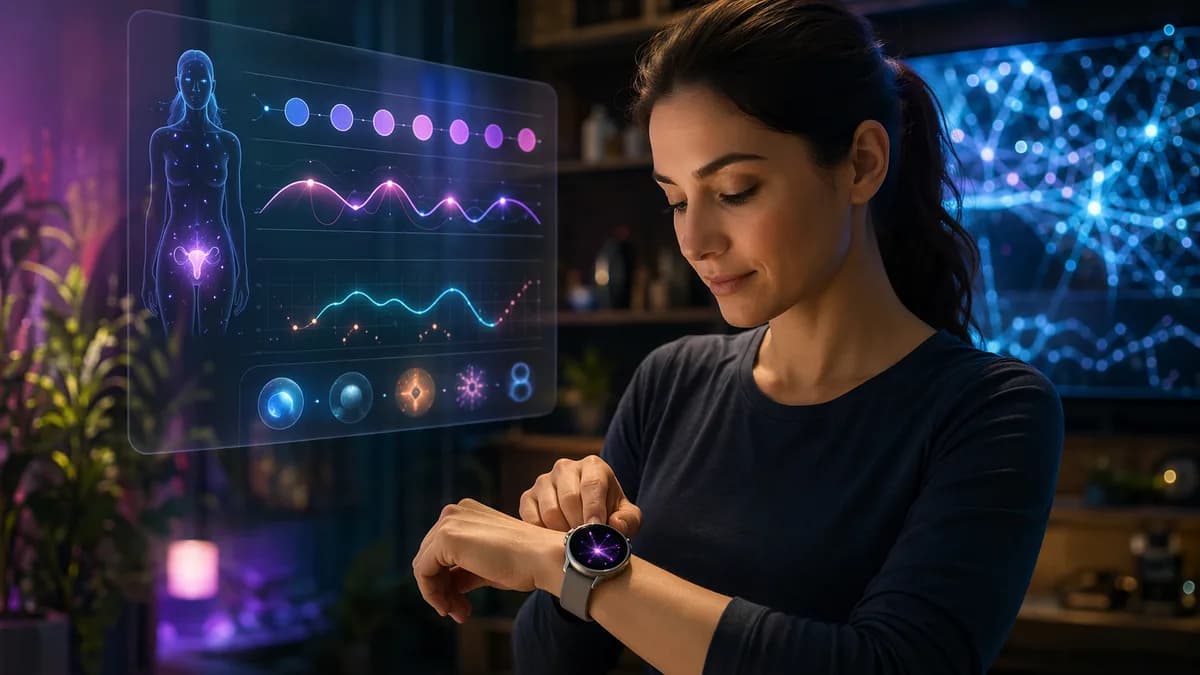
Apple is turning menopause tracking from a niche app feature into a default layer of mainstream consumer health software. That matters because perimenopause can stretch across years, and the signals are often messy: irregular periods, hot flashes, night sweats, sleep disruption, anxiety, brain fog, and cycle changes that don’t fit neatly into old-school period tracking.
TechnologyJune 12, 2026· 9 min read· By XOOMAR Insights Team
Apple Watch Pulls Perimenopause Into the Mainstream
Updated on June 14, 2026
XOOMAR Intelligence
Analyst Take
57/ 100
4 sources analyzedLow confidenceTrend10Freshness100Source Trust84Factual Grounding91Signal Cluster20
The update puts perimenopause and menopause inside Apple Health, under Cycle Tracking, according to Tom's Guide. With iOS 27, users aged 40 and over can receive a notification if logged cycle deviations suggest perimenopause. The important caveat: Apple isn’t saying the Apple Watch diagnoses menopause. The useful part is more basic, and potentially more practical. It can turn scattered symptoms into a timeline someone can actually bring to a clinician.
Why does Apple Health adding menopause tracking matter now?
The thesis: Apple is treating menopause as a core health stage, not an edge case. That’s the shift. Cycle Tracking started with period logging, then grew into fertility and pregnancy-related use cases. Apple is now extending that continuity into perimenopause and menopause, a stage Dr. Lauren Cheung, Apple Health Director, told Tom’s Guide “probably affects roughly half the world's population” but has been “underresearched, misunderstood, and very often stigmatized.”
That framing matters because many people don’t immediately recognize perimenopause. The source notes that clinical criteria have often focused on bleeding cycles, even though symptoms such as anxiety, brain fog, and sleep disruption can appear before periods become irregular. Apple’s update gives users a place to log the change while it’s happening, instead of reconstructing months of symptoms from memory during a short appointment.
“This is a life stage that probably affects roughly half the world's population, but has historically been underresearched, misunderstood, and very often stigmatized, and that's perimenopause and menopause,” Cheung said.
The counterpoint is obvious: a consumer app can’t close the medical research gap by itself. It also can’t replace a clinician. But it can improve the raw material of a medical conversation. That’s where the update has teeth.
Apple’s health push also sits inside a broader trust question across its software products, from private health data to Siri AI fixes, a theme we’ve tracked in Siri AI Shuts Up, and Apple Bets You'll Trust It More.
Can an Apple Watch detect perimenopause from wrist temperature and cycle data?
The short answer: no, not in the diagnostic sense. The Apple Watch can collect useful signals, but Apple’s perimenopause notification is based on manual cycle logging, not an automated hormone reading from the wrist.
Cheung was explicit on this point:
“It is all based on manual logging. However, what the temperature and heart rate data on Apple Watch do is improve the accuracy of our predictions.”
That distinction is the whole story. The watch can support cycle predictions with wrist temperature and heart rate data. Apple says wrist temperature can help with retrospective ovulation estimates and improve period and fertile-window predictions. But the new perimenopause logic is not scanning hot flashes, reading estrogen levels, or diagnosing a life stage from sleep disruptions.
Apple uses a six-month window and looks for more than one abnormal occurrence before surfacing an alert. Cheung said Apple wanted to avoid overreacting to one or two unusual cycles, since that can happen for many reasons.
| Apple Health signal | What it can help with | What it does not prove |
|---|---|---|
| Manual cycle logs | Pattern changes over months | A menopause diagnosis |
| Wrist temperature | Better period and ovulation predictions | Hot flash detection |
| Sleep tracking | Visibility into sleep changes | Cause of sleep disruption |
| Heart rate data | Prediction accuracy support | Hormone status |
| Symptom logs | Timeline for appointments | Medical certainty |
The strongest counterpoint is that perimenopause symptoms often overlap with other health issues. Apple partially addresses this by using FIGO guidelines, from the Federation of International Obstetrician-Gynecologists, for irregular and infrequent menses. Cheung said anyone can receive those cycle deviation notices, but after age 40, such deviations are more likely to be related to perimenopause.
What would weaken Apple’s case? If users interpret alerts as diagnoses, or if sparse logging produces misleading patterns. Apple’s own explanation keeps the feature in the “pay attention and discuss” category, not the “you have perimenopause” category.
What exactly changed inside the Health app?
Apple added a menopause-aware layer to Cycle Tracking. Users can now log whether they’re in perimenopause or menopause, track symptoms, and monitor cycles over time. Apple is also adding educational articles inside the Health app to explain perimenopause and menopause.
The update includes a notification path for users aged 40 and over when cycle deviations are suggestive of perimenopause. Crucially, users don’t need an Apple Watch. They can use Cycle Tracking on iPhone or iPad.
The source does not say Apple will automatically link night sweats to sleep disturbances. Cheung said those systems are “not linked at this point in time.” Users can track symptoms, including sleep changes, then export a PDF to review symptoms alongside cycle history.
That makes the feature less magical but more credible. Apple isn’t claiming a sensor can identify a night sweat. It’s giving users a structured record.
Apple also announced Strong Through Menopause, a Fitness+ program built around yoga and strength training. Julz Arney, Apple’s Director of Fitness, said the program runs for 3 weeks, with three 20-minute sessions a week, and is designed around strength, balance, mobility, stress reduction, pelvic floor health, and cardiovascular health.
This follows Apple’s broader pattern of tying software features to hardware and services, the same bundling logic readers may recognize from our coverage of 2 Apple Intelligence Perks Lock Older iPhones Out.
How should users track symptoms without overreading the data?
The practical rule: treat Apple Health as a logbook, not a lab test. The value depends on consistency. One bad night, one strange cycle, or one elevated metric does not equal perimenopause. A pattern across weeks and months is more useful.
Women’s Health reported that Kristi Tough DeSapri, MD, asks patients to track bleeding, mood, sleep, energy, hot flashes, anxiety, and depression, and said patterns may require “over [at least] six weeks” to see. That aligns with Apple’s own caution in using a six-month window before flagging cycle irregularities as potentially meaningful for users over 40.
A strong tracking routine would focus on the categories Apple actually supports or discusses:
- Cycle changes: irregular, infrequent, skipped, or changing periods.
- Symptoms: hot flashes, night sweats, sleep changes, mood shifts, and related notes.
- Sleep: disruptions that show up in Apple Watch sleep tracking or user logs.
- Activity: participation in routines such as Strong Through Menopause.
- Exportable history: the Health app PDF that can be reviewed during an appointment.
The trap is treating wrist temperature like a hormone panel. Apple says the temperature sensor provides “one aggregated reading of relative temperature over the course of a night.” It is not presented as a hot flash detector. It is also not currently linked to night sweat logging.
The better use is simpler: collect enough signal to ask better questions.
How could a 47-year-old Apple Health user turn messy symptoms into a clearer appointment?
Picture a 47-year-old user who has had several months of irregular cycles, poor sleep, and night sweats. Before this update, she might tell a clinician, “My periods are weird and I’m exhausted.” That’s real, but vague. With Apple Health, she can show logged cycle deviations, symptom entries, and sleep changes over time.
The app still doesn’t diagnose her. That’s the point. It gives her a structured symptom history instead of a foggy recollection.
A clinician can then ask sharper questions: when did cycle changes begin, how often are symptoms happening, whether sleep disruption tracks with night sweats, and whether the pattern fits perimenopause or needs a different medical workup. Apple’s PDF export could make that discussion faster, especially when symptoms fluctuate and memory fails.
Strong Through Menopause adds a second track. If she starts the 3-week Fitness+ program, with three 20-minute sessions per week, she can see whether regular movement lines up with better sleep or improved consistency in activity. Arney said the program is progressive, repeatable, and includes trainer discussion of pelvic floor activation and confidence in movement.
That’s not treatment by app. It’s better documentation plus guided exercise.
Where do Apple’s menopause tools still leave gaps?
Apple can improve tracking, but it can’t fix the health-care bottleneck around menopause. Short appointments, uneven clinical attention, and the broader research gap remain outside the Health app. Apple can surface patterns. A clinician still has to interpret them.
There are also unanswered product questions. The source explains age thresholds, manual logging, FIGO-based cycle deviation rules, Apple Watch temperature support, and the Fitness+ program. It does not fully spell out how these tools will work across every complex scenario, including users with PCOS, fertility-related histories, or nonstandard cycle patterns. The Apple Women’s Health Study, run with Harvard T.H. Chan School of Public Health and NIEHS, does include research interests tied to menstrual cycles, infertility, menopause, and PCOS, according to Harvard.
Privacy is central because reproductive health data is sensitive. Harvard’s Apple Women’s Health Study page says participation is controlled by the user, data is encrypted on device, and “Apple will not have access to any contact information or other identifying data that you provide through the Research app.” Users can also withdraw from a study at any time, ending future data collection.
The useful way to read Apple’s update is narrow and practical: Apple Watch is not a perimenopause detector. Apple Health is becoming a better menopause record. If the new tools help users spot patterns, export cleaner histories, and ask clinicians more precise questions, they’ve done something meaningful. The next test is whether Apple can keep that boundary clear as the Health app gets more predictive.
Impact Analysis
- Apple is making perimenopause and menopause tracking part of mainstream Apple Health rather than a niche feature.
- Users aged 40 and over may get alerts when logged cycle deviations suggest possible perimenopause.
- The feature does not diagnose menopause, but it can help users organize symptoms into a timeline for clinicians.
Sources

Written by
XOOMAR Insights Team
Research and Editorial Desk
The XOOMAR Insights Team pairs automated research with human editorial judgment. We track hundreds of sources across technology, fintech, trading, SaaS, and cybersecurity, cross-check the facts, and explain what happened, why it matters, and what to watch next. We do not just rewrite headlines. Every article is fact-checked and scored for reliability before it goes live, and we link back to the original sources so you can verify anything yourself.
Explore More Topics
Related Articles
 Technology
Download iOS 27 Free Today Without Wrecking Your iPhone
iOS 27 is free to test through Apple’s public beta, but back up first and don’t risk your main iPhone unless you accept bugs.
Jul 20, 20267 min
 Technology
OpenAI Claims ChatGPT Health Can Outreason Clinicians
OpenAI is putting health records inside ChatGPT while claiming its models can reason beyond clinicians.
Jul 23, 20266 min
 Technology
Apple Maps Grabs the Wheel in Ford's $30,000 EV Bet
Ford will put Apple Maps inside its 2027 EV platform, starting with a $30,000 electric truck that still has to prove it can scale.
Jul 23, 20267 min
 Technology
Apple Mac AI Overhaul Throws Mac Buyers Into Limbo
Apple reportedly wants every Mac refreshed for AI, with M6 MacBook Pro and iMac updates kicking off a rollout that stretches into 2027.
Jul 22, 20267 min
 Technology
Avoiding AI Workshops Turn Libraries Into Big Tech Revolt
Public libraries are becoming AI opt-out clinics as users push back against forced defaults from Apple, Google, and Big Tech.
Jul 25, 202613 min
 Global Trends
Logo Revolt Haunts Cracker Barrel CEO Masino's Exit
Julie Masino is leaving after Cracker Barrel's logo revolt became a culture-war test. David Deno inherits the bruised brand.
Jul 27, 20266 min
 Global Trends
53 Years Later, Chile Jails Víctor Jara Murder Fugitive
Chile jailed Nelson Haase Mazzei, the last fugitive in the Víctor Jara murder case, 53 years after the singer was killed.
Jul 27, 20268 min
 Technology
A $9 Autonomous Key Turns App Addiction Into Real Work
Autonomous Key uses a $9 NFC fob to make addictive apps harder to reopen, betting tiny friction can beat reflexive scrolling.
Jul 27, 20268 min
 Global Trends
Years on Run End As Police Catch Victor Jara Murder Fugitive
Nelson Haase, convicted in Victor Jara’s murder, was captured after fleeing a 25-year sentence in a landmark Pinochet-era case.
Jul 27, 20265 min
 Global Trends
Tariff Detours Crush the US Manufacturing Jobs Pitch
Tariffs haven't sparked a US factory jobs boom. Chinese inputs are taking longer routes, with higher costs and more automation.
Jul 27, 20268 min
Don't miss the signal
Get our weekly roundup of the stories that matter across tech, fintech, and trading. No noise, just signal.
Free forever. No spam. Unsubscribe anytime.