
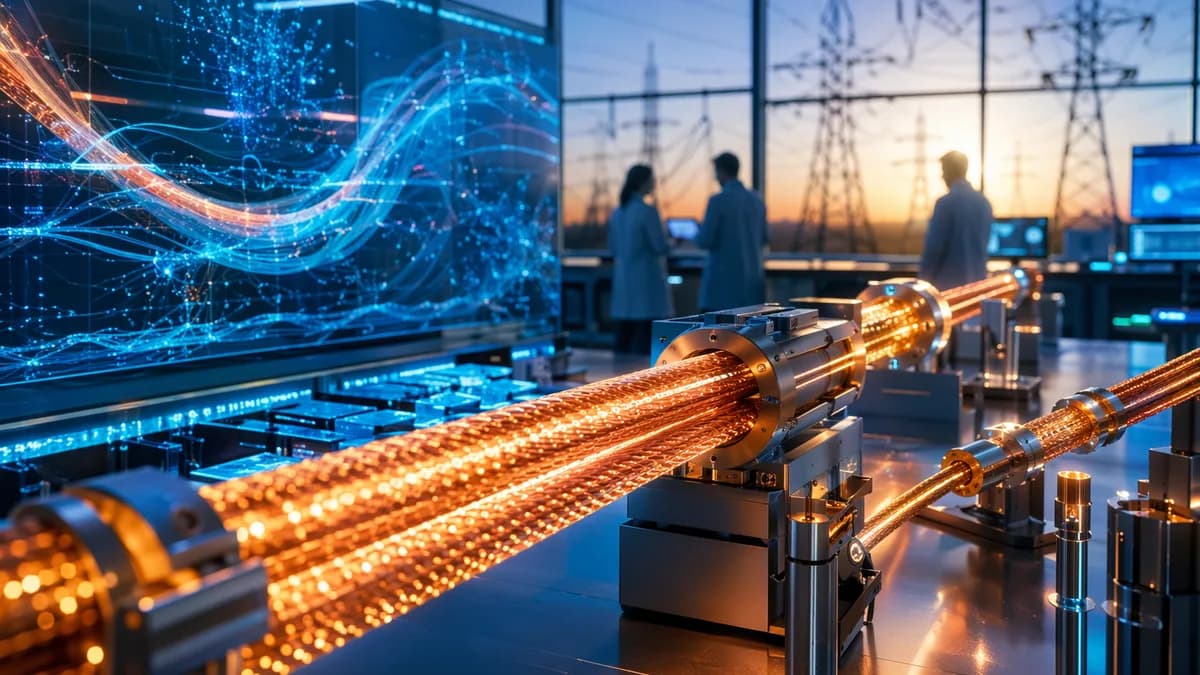
On June 30, 2026, Arcturus emerged from stealth with an $8 million seed round and a claim that its nano-infused copper could halve electrical grid losses.
TechnologyJune 30, 2026· 8 min read· By XOOMAR Insights Team
Nano-Infused Copper Sends Arcturus After Grid Losses
Updated on June 30, 2026
XOOMAR Intelligence
Analyst Take
60/ 100
4 sources analyzedLow confidenceTrend10Freshness100Source Trust90Factual Grounding89Signal Cluster40
That claim matters because the grid is being asked to move more power through infrastructure that already wastes energy as heat. Arcturus says its laser-made material could let the same-size power lines carry more electricity, unlocking “around 3% more electricity on average and up to 10% more during the most congested times,” according to TechCrunch.
June 30, 2026: Arcturus turns nano-infused copper into a grid-capacity claim
Arcturus is not pitching a new power plant. It’s pitching a better conductor.
The Los Angeles advanced materials startup says it uses lasers to infuse carbon nanomaterials into copper and aluminum, aiming to reduce the energy that electrical conductors lose as heat. If that works beyond the lab, the effect is simple: more useful electricity moves through the same physical infrastructure.
“We’re hitting this inflection point of AI and the electrification of nearly every industry, and it’s creating this point where we have overburdened and overstressed the energy grid,” Amir Mashal, founder and CEO of Arcturus, told TechCrunch.
The company’s first public financing is a seed round led by Initialized Capital, with participation from Toyota Ventures, Breakthrough Energy Discovery, 1517, and Wireframe Ventures. In a separate company announcement, Arcturus said it is building carbon-infused metals for applications including motor windings, bus bars, heat sinks, data center infrastructure, and eventually transmission lines and broader grid infrastructure.
The key word is eventually. Arcturus is starting far smaller than the power grid.
From Malibu centimeters to tens of meters: the manufacturing gap
Right now, Arcturus is still early. Mashal has been developing the material in a garage in Malibu, California, where the company can produce several centimeters of wire as a proof of concept. With the new funding, he plans to scale that to tens of meters so the material can be tested in real applications.
That gap matters. Materials startups often look strongest at sample scale. The hard part is making the same material again, and again, with the same properties, at useful lengths and tolerances.
Arcturus says its process is designed to create a “drop-in replacement” for existing copper and aluminum applications.
“Same form factors, no system redesign, no new training for folks to handle or crimp the material,” Mashal told TechCrunch.
That is the right target. Utilities, manufacturers, and data center operators don’t want exotic materials that require a full redesign. They want something that fits into known components, survives known operating conditions, and beats the incumbent material after cost, qualification, and manufacturing risk are counted.
How lasers and carbon nanomaterials could change copper’s behavior
Copper is already an excellent conductor, which is why improving it is difficult. Arcturus’ bet is that carbon nanomaterials can push past limits that conventional copper and aluminum are now running into under higher power loads and higher temperatures.
Mashal framed the problem as heat.
“Copper loses conductivity as it heats up, so the hotter it gets, the more energy it wastes as heat,” he said.
That creates a feedback loop in high-current systems. More current means more heat. More heat can mean worse conductivity. Worse conductivity means more wasted energy.
Arcturus’ laser process is meant to infuse carbon nanomaterials into the metal rather than merely coat or mix them in a way that fails under real manufacturing. The company has not disclosed enough detail to judge the process, and that’s the point investors and customers will press hardest.
The open questions are not cosmetic:
- Repeatability: Can Arcturus make the same material consistently across longer wire lengths?
- Durability: Does the conductivity gain survive heat, mechanical stress, and long use?
- Manufacturability: Can the laser process scale without crushing the economics?
- Integration: Can factories use it without major process changes?
- Validation: Do independent tests confirm the loss reductions claimed?
Carbon nanomaterials also carry a wider scientific halo, though Arcturus is applying them in a very specific industrial context. For a very different carbon-related technology story, see XOOMAR’s coverage of AI cracking a Vesuvius papyrus scroll sealed in carbon. Here, the issue is not reading carbonized history. It’s whether engineered carbon structures can help metals move power with less waste.
The first ripple effects: drones, robotics, motors, and data centers
Arcturus says the grid is the ultimate destination, but its first commercial targets are smaller systems where performance gains can be tested faster: drones, robotics, electric motors, and data centers.
That sequencing makes sense. A utility-scale conductor has to clear a high trust bar. A component inside a motor winding, a busbar, or a thermal management system can prove value in a more bounded environment before anyone asks it to shoulder grid infrastructure.
| Application area named by Arcturus | Why lower losses matter | What still needs proof |
|---|---|---|
| Drones | Less heat and weight pressure could improve useful performance | Material strength, weight trade-offs, durability |
| Robotics | Higher power density can matter in compact systems | Repeatable manufacturing and integration |
| Electric motors | Windings are a direct conductor use case | Thermal cycling and long-term performance |
| Data centers | Less wasted energy can also reduce cooling needs | Cost, uptime impact, component qualification |
| Grid infrastructure | Same-size lines could carry more electricity | Decades-long reliability and field validation |
Mashal connected these markets directly.
“All those industries have the same kinds of bottlenecks, whether your drone wants to have double the flight time or your graphics card is just heating up too much,” he said. “Those are all areas where our material can fundamentally disrupt things.”
That is the company’s thesis in one sentence: heat and power density are not just system design problems. Arcturus wants to attack them at the material layer.
A grid-scale example: what a 3% electricity unlock would mean
The most striking number in the Arcturus pitch is not the seed round. It’s the claimed grid effect.
TechCrunch reports that replacing traditional copper with Arcturus’ material in same-size power lines could cut electrical grid losses in half. In practical terms, that would unlock around 3% more electricity on average and up to 10% more during the most congested times.
Arcturus says the low end is about a year’s worth of demand growth in the U.S.
That’s the core appeal of nano-infused copper. It doesn’t require new generation in the first instance. It tries to recover electricity that is already being produced but lost as heat while moving through conductors.
The engineering choices opened by better conductors are straightforward:
- Lower losses: Carry the same current while wasting less energy as heat.
- Higher capacity: Carry more current through the same physical footprint.
- Less material pressure: In some applications, hit the same performance target with less metal.
- Lower cooling burden: Reduce heat that downstream systems have to manage.
This would not solve every grid problem. It would not erase permitting delays, generation constraints, or the need for new infrastructure. But if the material works at commercial scale, it could make existing electrical hardware more productive.
That is a rare kind of upgrade: quiet, physical, and potentially broad.
The next decision point: proof at useful length, then proof in real components
Arcturus now has funding to move from centimeter-scale samples toward tens-of-meters-scale testing. That is the next serious milestone.
The company needs to show that nano-infused copper can perform in components customers already understand: motor windings, busbars, heat sinks, power distribution equipment, and later grid conductors. Lab conductivity alone won’t be enough.
Buyers will want measured data on electrical performance, thermal behavior, mechanical strength, corrosion resistance, batch consistency, and the cost of processing. They’ll also want to know whether the material behaves predictably when handled, crimped, bent, heated, and used under load.
The fair read is this: Arcturus has a compelling target and a clean industrial logic. The grid and data centers both need more usable power, and conventional metals are carrying more stress. If Arcturus proves its material at scale, nano-infused copper could become an invisible but valuable upgrade inside the electrical economy.
If the performance fades outside controlled samples, or the manufacturing cost overwhelms the efficiency gain, it becomes another promising materials story that never crosses the factory floor. The next useful signal is not another claim. It’s longer wire, tested in real hardware, with results customers can trust.
Impact Analysis
- Arcturus says its material could move more electricity through existing grid infrastructure without building new power lines.
- The company’s $8 million seed round signals investor interest in advanced materials for grid bottlenecks.
- If the technology scales beyond the lab, lower heat losses could help meet rising demand from AI, electrification, and data centers.
Arcturus claimed electricity gains from nano-infused conductors
Average conditions
%3
Most congested times
%10
Sources
- [1] TechCrunch
- [2] Arcturus | Metals Infused with Advanced Carbon Nanomaterials
- [3] Arcturus Emerges from Stealth with $8M in Seed Funding to ‘Rewire the World’ with Metals Infused with Carbon Nanomaterials | FinancialContent
- [4] Why This Carbon-Based Innovation Could Completely Transform Power Grids Forever - Futura-Sciences

Written by
XOOMAR Insights Team
Research and Editorial Desk
The XOOMAR Insights Team pairs automated research with human editorial judgment. We track hundreds of sources across technology, fintech, trading, SaaS, and cybersecurity, cross-check the facts, and explain what happened, why it matters, and what to watch next. We do not just rewrite headlines. Every article is fact-checked and scored for reliability before it goes live, and we link back to the original sources so you can verify anything yourself.
Explore More Topics
Related Articles
 Global Trends
Zambia Reelection Cemented Amid Austerity and Turmoil
Zambia’s President Hakainde Hichilema secures a second term with over 61% of the vote, a mandate to continue economic austerity and debt restructuring despite a
Aug 18, 20265 min
 Fintech
Fireblocks Hires SEC Veteran As Crypto Rulemaker
Fireblocks hiring ex-SEC Commissioner Elad Roisman signals a pivotal shift: major crypto infrastructure is moving from protesting regulation to directly writing
Aug 18, 20266 min
 Fintech
Labour Suspends MP Over Pandemic Loan Eligibility Probe
Labour MP Bayo Alaba is suspended as his party investigates the eligibility and attempted winding-up of a company that received pandemic loans.
Aug 18, 20265 min
 Technology
Indonesia Quake Paralyzes Island As Death Toll Climbs
A powerful shallow earthquake on Flores Island has killed at least 53 people and overwhelmed local response capabilities, highlighting Indonesia's persistent vu
Aug 18, 20269 min
 Trading
Yen Ignores 80% Bank of Japan Rate Hike Odds
Despite an 80% market probability of a September rate hike, the yen remains weak, highlighting the limited power of domestic policy against overwhelming global
Aug 18, 20267 min
 Trading
Gold Soars Past $4,400 As US Dollar Weakening Continues
Gold surged over 1% to $4,422 as a weakening US Dollar, driven by expectations of a more dovish Federal Reserve, ignited a sharp rally in the precious metal.
Aug 18, 20267 min
 Fintech
Ebanx Plants Executives in Foreign Markets for Growth
Payments giant Ebanx is decentralizing its leadership, placing senior executives directly in high-growth markets to address local complexity and drive its next
Aug 18, 20266 min
 Future Fiction
Tupac Refused to Name Attackers in Final Moments
The Tupac Shakur murder trial hinges on the rapper's final, defiant statement, which prosecutors say created a 'black box' of silence and conspiracy that outran
Aug 18, 20269 min
 Trading
New Zealand Dollar Stalls on China’s Slumping Consumer
The New Zealand Dollar slumped as weak Chinese economic data proved it's now a direct proxy for China's volatile consumer, not its own domestic story.
Aug 18, 20268 min
 Trading
Canadian Dollar Defies Safe-Haven Crush as Oil Hits $83
The Canadian Dollar is holding near multi-week highs against a strengthening US dollar, as soaring crude oil prices overwhelm the traditional safe-haven currenc
Aug 18, 20268 min
Don't miss the signal
Get our weekly roundup of the stories that matter across tech, fintech, and trading. No noise, just signal.
Free forever. No spam. Unsubscribe anytime.