Busy Bar turns the old “do not disturb” sign into a connected desk device, and its real pitch is aimed at workers whose availability has become too easy for everyone else to assume. The device, built by the team behind Flipper Zero, goes on sale and starts shipping on July 14th, according to The Verge.
XOOMAR Intelligence
Analyst Take
First announced in April 2025, Busy Bar is described as a "productivity multitool" with a pixelated LED display meant to reduce interruptions and help users stay focused. XOOMAR analysis: the clever part is not the timer, the LEDs, or even the app integrations. It’s that Busy Bar makes distraction socially awkward. A person has to ignore a visible signal before interrupting you.
Flipper's Busy Bar turns focus into a public status symbol
The Busy Bar sells a simple promise that software status dots never fully solved: make your focus visible without forcing anyone to open Slack, check a calendar, or guess whether your headphones mean “deep work” or “I forgot I’m wearing these.”
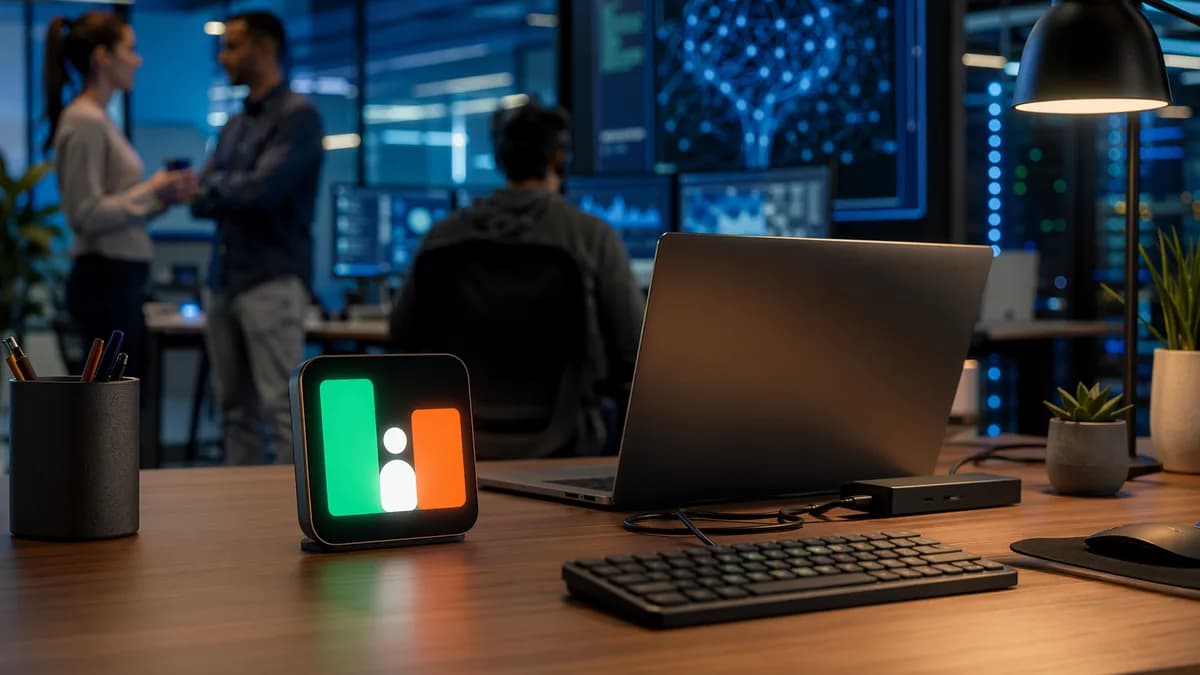
The device looks closer to an alarm clock than a workplace dashboard. That matters. A status message on a shared screen or phone is private by default. A desk-facing LED sign is public by design.
The Busy Bar makes it obvious to others when you don’t want to be distracted. | Image: Flipper Devices
XOOMAR analysis: this makes Busy Bar a cultural product as much as a gadget. It reflects a workplace problem that software helped create. Pings, calls, meeting spillover, household interruptions, and the expectation of instant response all collapse into one question: are you available right now?
The risk sits in the same place as the appeal. If focus becomes something workers must visibly perform, the Busy Bar could turn protection into theater. The key question: does the device give users more control, or does it create one more status they have to manage?
The Busy Bar launch math: $179 waitlist price, $199 early drop, $249 retail
The pricing tells you Flipper Devices is not positioning Busy Bar as a throwaway LED sign.
| Buyer group | Price | Condition |
|---|---|---|
| Earlier waitlist members | $179 | Previously joined the Busy Bar waitlist |
| First launch buyers | $199 | First 3,000 units purchased on July 14th |
| Standard buyers | $249 | Normal retail price |
At $249, Busy Bar has to beat cheaper substitutes: a paper sign, a smart bulb, a calendar status light, or simply turning on Do Not Disturb. Those alternatives are ugly, limited, or easy to ignore. They are also cheap.
So the hardware has to justify itself through polish. The Verge says Busy Bar uses a pixelated LED display. TechCrunch reports a 72 x 16 LED matrix display, up to 400 nits of brightness, 16 million colors, and an automatic brightness sensor. It also lists Wi-Fi, Bluetooth, and USB connection options.
The pricing strategy is direct. The $199 early batch creates urgency. The $179 waitlist price rewards people who paid attention during the long pre-launch period. The key question: will buyers treat this like desk infrastructure, or like a novelty that feels expensive after the first week?
Flipper Devices is using hacker-tool credibility to sell office discipline
Flipper Devices built its reputation with Flipper Zero, a wireless multitool associated with tinkerers, radios, Bluetooth, RFID, NFC, and sub-1GHz experimentation. Busy Bar pushes that same hardware personality into a calmer problem: protecting attention.
That tonal shift is sharp. Flipper Zero invited users to probe the hidden systems around them. Busy Bar asks them to defend a calendar block.
The design keeps some of the brand’s playful character. TechCrunch says the device has a mode selector switch, a start/stop button, an indicator, and a scroll wheel for menus and time setting. Notebookcheck describes physical controls on top and a smaller rear display facing the user.
For Flipper’s existing audience, that tactility matters. This is not just another menu buried in an app. The device wants to be touched.
That also creates a brand risk. Gadget fans may see productivity hardware as tame. Mainstream office workers may not care who made the Flipper Zero. The key question: can Flipper Devices convert hacker-tool credibility into a product people trust for ordinary daily work?
For readers tracking this hardware pivot, the launch also sits near XOOMAR’s earlier desk-gadget coverage: $249 Flipper Busy Bar Bets Hacker Cred Can Win Desks.
From Do Not Disturb signs to Slack status lights: the long fight over interruptions
Busy Bar belongs to a long line of interruption defenses: closed doors, paper signs, calendar blocks, focus modes, status lights, and away messages.
Digital signals often fail because they are too easy to miss or too easy to rationalize away. A calendar block can be overrun. A status icon can be ignored. A phone focus mode protects the phone, not the person sitting beside you.
Busy Bar’s bet is ambient computing. A physical object communicates an invisible state: I’m on a call, I’m in a timer, I’m unavailable, come back later.
TechCrunch says the device can show custom messages and support Pomodoro-style timers. Notebookcheck says users can display a timer with the scroll wheel, show a custom message, or connect it to a phone or computer. When connected to a computer, it can automatically display an “On Call” status once the microphone or camera is active.
The irony is obvious. A screen meant to reduce distraction must avoid becoming another toy on the desk. The key question: does Busy Bar fade into the room after setup, or does it invite constant fiddling?
Workers, managers, and gadget fans won't read the Busy Bar the same way
For workers, Busy Bar offers a visible shield. That could help in shared homes, studios, coworking spaces, and open offices where people need quick social cues without joining the same workplace software.
For managers, clearer availability signals can help teams avoid accidental interruptions. XOOMAR analysis: the darker version is that status becomes something people police. If “busy” becomes a signal colleagues second-guess, the device loses its protective value.
Households may be the cleaner use case. Partners, roommates, and kids don’t need access to your work calendar to understand a bright status message on a desk.
Gadget fans will judge a different product. They will care about customization, build quality, integrations, and whether it stays fun after the novelty fades. The open side helps: TechCrunch says developers can use an open HTTP API, MQTT, and official Python and TypeScript libraries to build widgets and complications.
The key question: who becomes the primary buyer, the focus-starved worker or the hardware enthusiast?
What Busy Bar means for hybrid workers and productivity hardware
Busy Bar points to a broader signal: some productivity problems are moving off the main screen and back onto the physical desk.
The device is built for that role. It can sit on a desk, mount to a monitor, or be placed where others can see it. Notebookcheck says it has a 3,250mAh rechargeable battery with up to 8 hours of use and up to 2 weeks of standby, with USB-C charging and 15W fast charging.
Its integration story is the real test. TechCrunch says Flipper Devices is releasing apps for iOS, Android, and macOS, with Windows support planned. It also says Busy Bar is Matter-certified, which allows it to work with smart home setups across Amazon, Apple, and Google-based systems.
That raises an etiquette issue. A public focus display can set boundaries, but it also broadcasts working patterns, availability, and possibly mood. Some users will like that clarity. Others won’t want their day rendered as a glowing status feed.
The key question: can Busy Bar make focus visible without making the worker feel watched?
This same buyer psychology appears in other single-purpose hardware, including dedicated writing devices like BYOK Turns a $199 Plastic Slab Into a Writer's Escape.
After July 14, Busy Bar's real test will be software, integrations, and copycats
The first sales wave will likely depend on Flipper’s existing audience and the pull of the $199 launch price. Broader success depends on repetition. A productivity device earns its place only if people use it every day without thinking too hard.
The features that matter most are practical: call detection, timers, custom messages, notification muting, app blocking, smart home triggers, and developer hooks. If those work reliably, Busy Bar can become desk infrastructure. If setup feels like a weekend project, it becomes another clever object in a drawer.
XOOMAR analysis: if the early batch sells quickly, imitators are easy to imagine. The basic idea, a visible LED status display for focus, is not hard to copy. Flipper’s defense would have to come from software, developer community, industrial design, and trust.
Busy Bar won’t fix broken workplace culture. It can’t make meetings shorter or managers more respectful. But it may expose how badly workers need permission to be unavailable.
The evidence to watch after July 14th is simple: whether buyers keep using Busy Bar after the first rush, whether integrations expand cleanly, and whether the device becomes a real boundary instead of another blinking request for attention.
What This Means For You
- Busy Bar addresses a common workplace problem: interruptions when availability is assumed.
- Its public LED display makes focus harder for others to ignore than software status indicators.
- The device could help workers set boundaries, but it may also add pressure to visibly justify focus time.
Availability Signals Compared
| Method | How it signals focus | Main limitation |
|---|---|---|
| Busy Bar | Uses a desk-facing pixelated LED display to make focus status visible | Could turn focus protection into another status users must perform |
| Software status dots | Shows availability inside apps like workplace communication tools | Requires others to check the app or notice the status |
| Headphones | Can imply someone is busy or in deep work | Ambiguous because others may not know what they mean |
Primary Sources & Disclosures

Written by
XOOMAR Insights Team
Research and Editorial Desk
The XOOMAR Insights Team pairs automated research with human editorial judgment. We track hundreds of sources across technology, fintech, trading, SaaS, and cybersecurity, cross-check the facts, and explain what happened, why it matters, and what to watch next. We do not just rewrite headlines. Every article is fact-checked and scored for reliability before it goes live, and we link back to the original sources so you can verify anything yourself.