
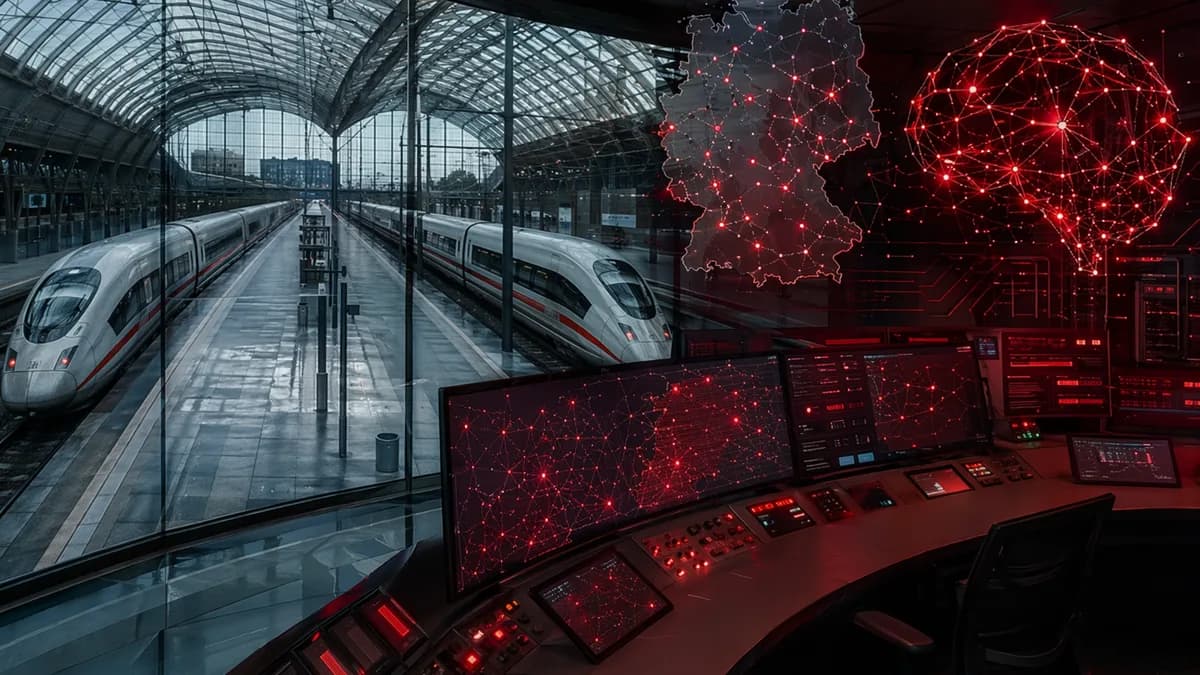
Deutsche Bahn outage brought passenger rail across Germany to a full stop on Tuesday night after a malfunction hit the country’s digital railway radio network, forcing trains to remain at stations nationwide.
TechnologyJune 24, 2026· 5 min read· By XOOMAR Insights Team
Deutsche Bahn Outage Freezes Every Train in Germany
Updated on June 24, 2026
XOOMAR Intelligence
Analyst Take
58/ 100
4 sources analyzedLow confidenceTrend10Freshness96Source Trust92Factual Grounding91Signal Cluster20
The disruption was later fixed after more than two-and-a-half hours of standstill, with services gradually resuming, according to BBC World. The affected system was GSM-R, the railway communications network used between train drivers and traffic control centres.
Deutsche Bahn outage freezes trains across Germany after GSM-R malfunction
Deutsche Bahn said at 22:30 local time (21:30 BST) that a nationwide disruption of the Global System for Mobile Communication for Railways (GSM-R) meant all trains were being held at stations.
That made this more than a routine delay. The failure hit a core internal communications layer, not a single line, station or region. Deutsche Bahn said the disruption affected internal communication channels and that the cause had been identified, though it did not specify the exact technical fault.
"Our IT experts worked tirelessly to resolve the issue, successfully. The disruption was quickly fixed, and service is now gradually resuming," Deutsche Bahn said.
The company added:
"We thank all passengers for their patience."
The Deutsche Bahn outage affected the operator’s long-distance and regional services. It also hit S-Bahn trains, which connect suburbs with city centres. S-Bahn Berlin later said the outage to the GSMR "has been resolved" and that "S-Bahn trains can run again".
| Rail layer | Confirmed impact |
|---|---|
| Long-distance trains | Held at stations during the nationwide disruption |
| Regional transport | Included in Deutsche Bahn’s paused services |
| S-Bahn services | Came to a halt Tuesday evening, including Berlin services |
| Passenger support | Taxi and hotel vouchers offered to affected passengers |
| Replacement transport | Deutsche Bahn said it would offer it where possible |
GSM-R is a dedicated wireless communications tool for railway operations. In this case, the operational consequence was blunt: without reliable driver-to-control-centre communication, trains were stopped rather than allowed to keep moving through a compromised command channel.
Passengers faced station waits, cancellations and forced alternatives
The immediate burden fell on passengers already in the system. Trains were held at stations, travellers waited on platforms and service points, and Deutsche Bahn warned of major delays and cancellations.
Passengers were urged to find alternative modes of transport while the Deutsche Bahn outage was active. The company also apologised and said it would provide taxi and hotel vouchers to affected passengers.
Deutsche Bahn CEO Evelyn Palla told German newspaper Bild, according to Deutsche Welle:
"we are now trying to get the trains into stations so that travellers can disembark"
That detail matters. The priority was not just restarting a timetable. It was getting passengers safely off trains and into stations during a nationwide communications failure.
The BBC report said Deutsche Bahn did not say at the time how long the disruption could last or how many trains and passengers had been affected. That leaves the scale of the passenger impact incomplete, even after the technical fix.
For Germany’s transport system, a national rail pause can spill over quickly. The confirmed measures point to the pressure points: taxis, hotels and replacement transport where available. The supplied reports do not confirm effects on airports, ride-hailing networks or road traffic, so those remain outside the verified record for now.
S-Bahn Berlin’s restart notice also came with a warning, not an all-clear. It told passengers:
"Please still expect that there may be delays and train cancellations on lines"
That is the practical reality after a network-wide stop. Even when the communications fault is fixed, trains, crews and passengers are no longer where the timetable expects them to be.
Engineers restored service, but Deutsche Bahn has not named the root fault
Deutsche Bahn said technicians identified the cause of the disruption and worked to resolve it. The company did not publicly specify whether the malfunction came from software, network equipment, an internal systems failure or another technical fault.
There is also no confirmed evidence in the supplied reports of a cyberattack. Deutsche Bahn described the incident as an IT disruption and a malfunction involving GSM-R, while later saying the cause had been identified.
That distinction matters for readers tracking infrastructure risk. A communications failure can stop a physical transport network even without any confirmed malicious activity. The railway did not fail because tracks disappeared or trains broke down across the country at once. It stopped because the system used to coordinate safe movement failed nationally.
XOOMAR has separately covered operational risk in other technology domains, including Forged Proofs Trigger $1.7M Taiko Bridge Exploit Halt and China's LineShine Supercomputer Dethrones El Capitan. Those stories are unrelated to Deutsche Bahn’s rail outage, but they sit in the same reader file: critical systems are increasingly judged by how they fail, not only by how they perform.
For passengers, the near-term issue is service recovery. Deutsche Bahn said operations were gradually resuming, while S-Bahn Berlin warned that delays and cancellations could continue on lines even after the GSM-R outage was resolved.
The next hard facts to watch are specific: whether Deutsche Bahn discloses the root cause, whether compensation guidance expands beyond taxi and hotel vouchers, and whether German transport officials comment on the resilience of GSM-R after a single nationwide fault brought trains to a standstill.
Impact Analysis
- The outage exposed how dependent Germany’s rail system is on its GSM-R communications network.
- A single nationwide IT malfunction was enough to halt long-distance, regional and urban rail services.
- The disruption created major passenger delays and highlighted the need for resilient backup systems.
Confirmed impact across Germany’s rail network
| Rail layer | Confirmed impact |
|---|---|
| Long-distance trains | Held at stations during the nationwide disruption |
| Regional transport | Included in Deutsche Bahn’s paused services |
| S-Bahn services | Came to a halt Tuesday evening, including Berlin services |
Sources

Written by
XOOMAR Insights Team
Research and Editorial Desk
The XOOMAR Insights Team pairs automated research with human editorial judgment. We track hundreds of sources across technology, fintech, trading, SaaS, and cybersecurity, cross-check the facts, and explain what happened, why it matters, and what to watch next. We do not just rewrite headlines. Every article is fact-checked and scored for reliability before it goes live, and we link back to the original sources so you can verify anything yourself.
Explore More Topics
Related Articles
 Technology
China's LineShine Supercomputer Dethrones El Capitan
LineShine hit 2.198 exaflops and debuted at No. 1, knocking the US-made El Capitan into second.
Jun 24, 20267 min
 Global Trends
17-65 Wizards Bet on AJ Dybantsa in NBA Draft Gamble
Washington made AJ Dybantsa the No. 1 pick, betting its 17-65 rebuild on a 19-year-old BYU scorer with star-level production.
Jun 24, 20266 min
 Global Trends
Goldman Falls as Mamdani-Backed Candidates Sweep New York
Mamdani-backed candidates swept three New York primaries as Gaza politics turned into a weapon against incumbents.
Jun 24, 20267 min
 Global Trends
Congress Corners Trump With Iran War Powers Measure
Congress rebuked Trump’s Iran war for the first time under the 1973 War Powers law, turning a symbolic vote into real political pressure.
Jun 24, 20268 min
 Cybersecurity
Cisco Unified CM Flaw Now Hands Attackers a Root Path
CVE-2026-20230 is now being exploited, pushing Cisco Unified CM teams from routine patching to active compromise checks.
Jun 24, 202611 min
 Technology
Superhuman Buys GPTZero as AI Writing Trust War Starts
Superhuman is buying GPTZero, turning AI detection into a core trust layer for writing tools, not a side feature.
Jun 24, 20267 min
 SaaS & Tools
Pay Equity AI Takes the Wheel as Syndio Buys Embrace.ai
Syndio is buying Embrace.ai to push agentic AI deeper into pay decisions before mistakes become costly.
Jun 24, 20267 min
 Technology
$390 Cuts Drag Dyson Prime Day Deals Into Practical Range
Dyson Prime Day deals cut up to $390 off big-ticket gear, but the smartest buy depends on the job, not the steepest markdown.
Jun 24, 20267 min
 Technology
$1B Hadrian Funding Claim Collides with a Flat Denial
Hadrian denies a reported $1B funding round at a $7.5B valuation, leaving its AI factory growth story stuck in limbo.
Jun 24, 20265 min
 Technology
Alibaba Defence Blacklist Suit Corners the Pentagon
Alibaba is suing the Pentagon, arguing its defence blacklist label turns routine China compliance into an unsupported military claim.
Jun 24, 20268 min
Don't miss the signal
Get our weekly roundup of the stories that matter across tech, fintech, and trading. No noise, just signal.
Free forever. No spam. Unsubscribe anytime.