
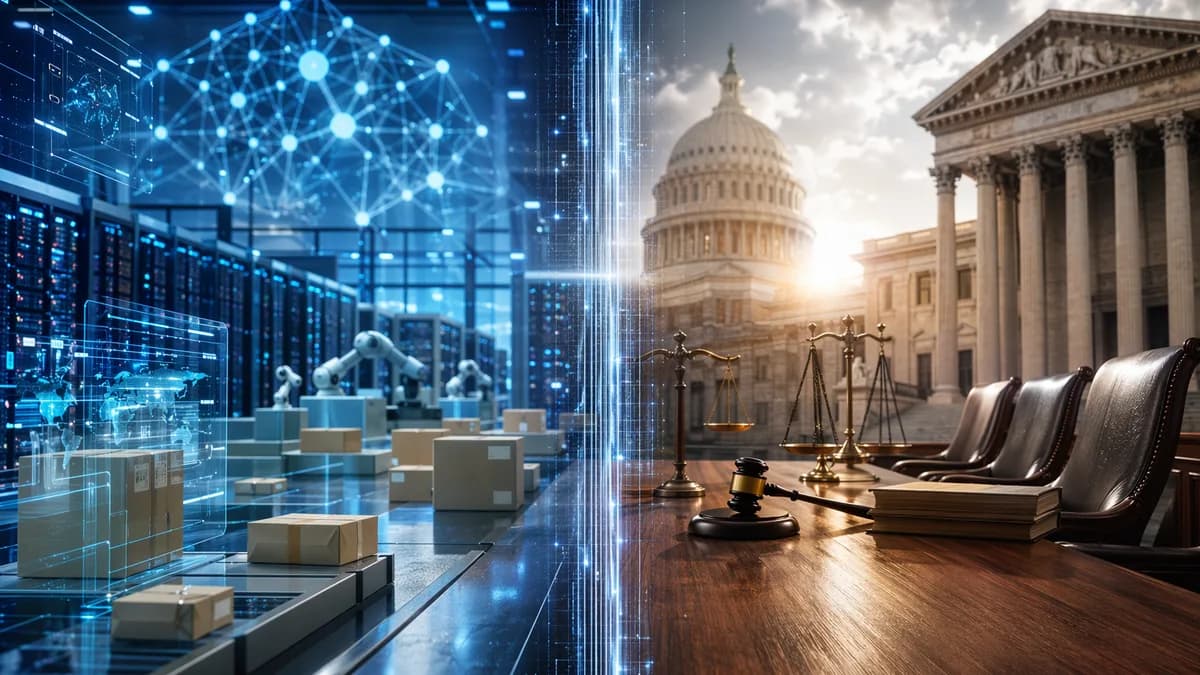
Alibaba's lawsuit against the US government signals a direct challenge to Washington's ability to convert routine Chinese regulatory compliance into a military-risk label. The Alibaba defence blacklist fight is not just about one company trying to clean up its name. It tests whether the Pentagon can put a major Chinese retail and cloud platform into a defence-risk category without, at least publicly, showing a direct military link.
TechnologyJune 24, 2026· 8 min read· By XOOMAR Insights Team
Alibaba Defence Blacklist Suit Corners the Pentagon
Updated on June 24, 2026
XOOMAR Intelligence
Analyst Take
61/ 100
4 sources analyzedLow confidenceTrend10Freshness98Source Trust92Factual Grounding92Signal Cluster40
The company has sued the US Department of Defense after being added to the Pentagon's 1260H list, according to BBC World. The list identifies companies the Pentagon says are connected to China's military. Alibaba says the designation is legally and factually unsupported.
"Alibaba is not a Chinese military company nor part of any military-civil fusion strategy," the company told the BBC.
That sentence is the core of the case. Alibaba is arguing that Washington has mistaken operating under Chinese technology rules for operating as part of China's defence apparatus.
Washington's Alibaba Defence Blacklist Tests How Far Security Labels Can Stretch
The real issue is not whether Alibaba is a Chinese company. It clearly is. The issue is whether that fact, plus compliance with Chinese regulators, is enough to justify a US military-linked designation.
The Pentagon's stated basis, according to the source material, is that Alibaba complies with Chinese technology regulators and is therefore effectively tied to the Chinese military. The defence department placed Alibaba on the 1260H list as a "military-civil fusion contributor to the Chinese defence industrial base" because of its regulatory ties to Beijing.
Alibaba's counter is narrow and direct. It says none of the members of its independent board has any military affiliation. It also argues that every multinational operating in China, including American companies, must follow the same local rules. Its platforms, Alibaba says, are built for retail and cloud computing, not weapons or intelligence.
XOOMAR analysis: That is why this case matters beyond Alibaba. If compliance with Chinese technology regulation can become evidence of military affiliation, the line between commercial operation and defence risk gets much harder to see. That does not prove the Pentagon is wrong. It does mean the government may have to show more than a broad theory of exposure to Beijing's regulatory system.
Readers tracking platform risk should separate this from ordinary commercial pressure. This is a different kind of problem than the operating competition we covered in Flipkart Quick Commerce Puts Amazon India on the Clock, or the consumer-brand expansion play in Bose Records Turns a Headphone Giant Into a Media Gamble. Alibaba's issue is not a product bet. It is a sovereign-risk label.
The 1260H Fight Turns on Evidence, Process, and a 30 June Contract Ban
Alibaba's legal pressure point is process. The company says it was branded a military-linked firm without notice, a fair hearing, or a defensible factual basis.
The lawsuit was filed in a California federal court, with additional source material identifying the court as being in San Jose, California. Alibaba says the Pentagon's determinations "have no basis in fact or law." It also says the agency designated the company after Alibaba had already asked to meet, submitted material addressing the military-affiliation concerns, and presented evidence of its US economic contributions.
The complaint says the agency did not raise further concerns or ask for more information. Instead, Alibaba says it was "designated Alibaba without notice or a fair hearing". The DoD declined to comment, telling the BBC: "We do not comment on ongoing litigation".
The immediate penalty is not a full financial freeze. That distinction matters. The blacklist does not instantly ban all business with Alibaba or freeze its assets. Its direct bite, based on the supplied record, is procurement. Starting 30 June, the Pentagon is legally barred from doing business with any blacklisted firm.
| Issue | What the supplied record supports |
|---|---|
| List type | Pentagon 1260H list of companies identified as linked to China's military |
| Immediate effect | DoD cannot do business with listed firms from 30 June |
| Not established here | A full financial freeze or universal transaction ban |
| Alibaba's claim | The designation is arbitrary, unsupported, and procedurally unfair |
| Pentagon response | No comment on ongoing litigation |
The Hard Numbers Are Procedural, Not Financial
The available numbers show a timing and scope problem, not a market valuation story.
The supplied material does not provide Alibaba's market capitalization, revenue mix, cloud revenue, share price reaction, index exposure, or US sales contribution. Those would be useful for a fuller investor model, but they are not in the source record. A disciplined read has to stick to the numbers actually available.
Those numbers are still important:
- 23 June 2026: BBC published the report on Alibaba's lawsuit.
- 30 June: The procurement restriction begins.
- June 9: Additional source material says the Department of Defence added Alibaba and other Chinese companies to the list.
- 188 entities: Additional source material says the expanded Section 1260H list included this number of entities.
- Named additions: The source record names Baidu, BYD, Nio, Unitree Robotics, and TP-Link among companies added alongside or in the same expansion.
XOOMAR analysis: The absence of financial figures does not make the case small. It changes the type of risk. The near-term damage described in the source is operational and reputational, not a disclosed hit to revenue. The bigger question is whether advisers, contractors, and counterparties treat the label as radioactive before a court decides whether it was justified.
Alibaba's Strongest Counter Is That Compliance Is Not Control
Alibaba's cleanest argument is that obeying Chinese law does not make a company part of China's military.
That argument is especially important because the Pentagon's stated rationale, as reported, rests heavily on Alibaba's relationship with Chinese technology regulators. Alibaba says this logic sweeps too broadly. If every company operating in China must obey local rules, then regulatory compliance alone cannot separate military-linked firms from ordinary commercial businesses.
The strongest counterpoint is obvious. The Pentagon is not treating all technology as neutral. It has grouped Alibaba with other large Chinese companies in sectors including artificial intelligence, biotechnology, solar, electric vehicles, search, robotics, and networking equipment, according to the additional source material. Washington's concern, as reflected in the designation, is that commercial technology can contribute to China's defence industrial base even when a company does not make weapons.
XOOMAR analysis: Alibaba does not need to prove that cloud computing or large retail platforms are irrelevant to national security. It needs to convince the court that the Pentagon's specific designation of Alibaba lacked adequate evidence or process. That is a narrower fight, and it may be the company's best terrain.
The Risk Hits Advisers Before It Hits the Balance Sheet
The most unusual pressure point is not direct Pentagon spending. It is the rule affecting US contractors that share a lobbyist or law firm with a blacklisted entity.
The BBC report says the law extends to any US contractor that shares a lobbyist or law firm with a blacklisted company. Alibaba argues this creates a functional blockade. Its long-term American advisers may have to cut ties to protect their own defence contracts.
That matters because the blacklist arrives at the exact moment Alibaba needs legal and political representation in Washington. If the company loses access to advisers because those advisers have defence-linked clients, the procedural harm compounds. The company is not just fighting a label. It is fighting the possibility that the label weakens its ability to contest the label.
"The decision to place Alibaba on the 1260H list is arbitrary and capricious, and we are filing a lawsuit against the Department of War to demand removal from the list," Alibaba told the BBC.
The wording is aggressive because the stakes are practical. A company can survive bad headlines. It has a harder time defending itself if the designation scares off the very firms that would normally help it challenge the government.
Three Paths From Here, and the Evidence That Will Matter
The court fight now turns on whether the Pentagon can justify the Alibaba defence blacklist with more than a broad theory of regulatory proximity.
One path is a legal reversal or remand, where the court finds the process inadequate and forces the government to revisit the designation. Another is a procedural off-ramp, where Alibaba supplies more material and secures removal without a sweeping ruling. A third is a hard defence by the Pentagon, which would keep the listing in place and make the Alibaba case a warning to other Chinese technology companies named in the expansion.
The evidence to watch is specific. Does the government produce concrete support for the "military-civil fusion contributor" label? Does the court focus on classified or non-public evidence, or on whether Alibaba received fair process? Do law firms and lobbyists actually sever relationships before or after 30 June?
If Alibaba wins, it would weaken this specific designation, not erase Washington's broader concern about Chinese technology firms. If it loses, the Alibaba defence blacklist becomes a much stronger signal: large civilian platforms can be pulled into US defence restrictions based on how Washington reads their regulatory ties to Beijing.
Impact Analysis
- The case could test how much evidence the US government must show before labeling a foreign company a defence risk.
- A ruling for Alibaba could limit Washington's use of national-security lists against Chinese technology firms.
- The dispute highlights the growing tension between routine business compliance in China and US military-risk assessments.
Alibaba vs. Pentagon Positions
| Issue | Pentagon Position | Alibaba Response |
|---|---|---|
| Blacklist designation | Added Alibaba to the 1260H list of companies linked to China's military | Says the designation is legally and factually unsupported |
| Regulatory compliance | Cites Alibaba's compliance with Chinese technology regulators as part of the basis | Argues compliance with Chinese rules does not make it part of China's defence apparatus |
| Military connection | Labels Alibaba a military-civil fusion contributor to China's defence industrial base | Says it is not a Chinese military company and has no military-affiliated independent board members |
Sources

Written by
XOOMAR Insights Team
Research and Editorial Desk
The XOOMAR Insights Team pairs automated research with human editorial judgment. We track hundreds of sources across technology, fintech, trading, SaaS, and cybersecurity, cross-check the facts, and explain what happened, why it matters, and what to watch next. We do not just rewrite headlines. Every article is fact-checked and scored for reliability before it goes live, and we link back to the original sources so you can verify anything yourself.
Explore More Topics
Related Articles
 Technology
Pentagon Bets $1.4B on China-Free Battery Breakthrough
The Pentagon issued a $1.4 billion loan to Sila Nanotechnologies to build next-generation batteries in the U.S., a direct move to break China's grip on critical
Aug 10, 20265 min
 Technology
Honda's Profit Doubles After Worst Annual Loss Ever
Honda's quarterly profit more than doubled to $2.9 billion in a dramatic recovery, just months after posting its first-ever annual loss, driven by vehicle sales
Aug 9, 20264 min
 Technology
DeepSeek Demands $8bn as China's AI Plays Catch-Up
DeepSeek is pushing to close an $8 billion funding round at a $74 billion valuation, a massive jump just weeks after its last raise, underscoring China's aggres
Aug 6, 20264 min
 Technology
Amazon's Gas Plant Permits 33 Million Tons of CO2
Amazon's planned Texas data center, powered by a dedicated natural gas plant, has a permit to emit 33 million tons of CO2 annually, potentially making it the la
Aug 8, 20267 min
 Technology
Nintendo Hides $300M Tariff Refund From Buyers
Nintendo booked a massive $902 million quarterly profit, supercharged by a $300 million US tariff refund it has no plans to pass on to the customers who origina
Aug 6, 20267 min
 Trading
Strait of Hormuz Shutdown Lifts Oil Prices 6%
WTI crude oil jumped over 6% after Iran confirmed talks on shipping routes don't mean the Strait of Hormuz will reopen, setting the stage for a prolonged geopol
Aug 10, 20268 min
 Trading
Stocks Ignore Record Job Losses as Fed Pledge Trumps Payrolls
The Dow Jones Industrial Average showed no fear after July's shocking job losses, as investors bet weak labor data will keep the Federal Reserve from raising ra
Aug 10, 20266 min
 Global Trends
China Evacuates a Million Ahead of Record Typhoon Strikes
Authorities have relocated over a million people as China's most powerful storm this year, Typhoon Dolphin, slams into the coast, causing widespread flooding an
Aug 10, 20264 min
 Global Trends
Court Cancels Russia's Only Anti-War Party on 'Extremism'
A Moscow court disqualified Russia's only registered anti-war political party from parliamentary elections, using allegations of extremism and copyright infring
Aug 10, 20266 min
 Fintech
Banks Invade Earned Wage Access, Force Fintechs Out
Major banks and credit unions are launching earned wage access to retain customers and gather data, forcing original fintech providers into a defensive scramble
Aug 10, 20264 min
Don't miss the signal
Get our weekly roundup of the stories that matter across tech, fintech, and trading. No noise, just signal.
Free forever. No spam. Unsubscribe anytime.