
Flipkart quick commerce has crossed 1,000 micro-fulfillment centers in India, turning what began as a fast-grocery experiment into a warehouse race that now threatens to redefine daily online shopping for consumers, brands, kiranas, delivery workers, and Amazon.
TechnologyJune 24, 2026· 11 min read· By XOOMAR Insights Team
Flipkart Quick Commerce Puts Amazon India on the Clock
Updated on June 25, 2026
XOOMAR Intelligence
Analyst Take
59/ 100
4 sources analyzedLow confidenceTrend10Freshness100Source Trust90Factual Grounding91Signal Cluster20
The milestone, reported by TechCrunch, matters because Flipkart is no longer testing whether Indians want delivery in minutes. It is building the physical network needed to make that habit hard to break. The immediate pressure falls on Amazon India, which is accelerating Amazon Now before Flipkart, Blinkit, Zepto, and Swiggy Instamart lock up the high-frequency orders that make retail platforms more valuable.
Flipkart quick commerce builders are turning neighborhood warehouses into the new moat
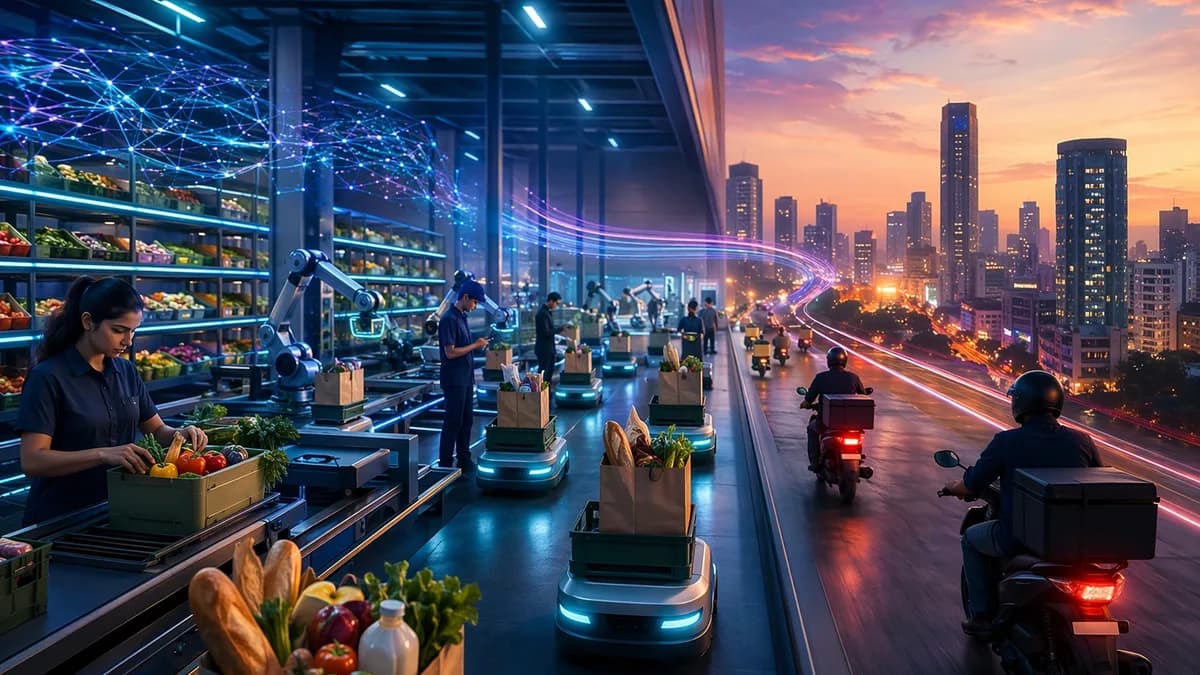
Flipkart Minutes launched in August 2024. Less than two years later, it has reached 1,000 micro-fulfillment centers, the small neighborhood warehouses that keep inventory close enough for deliveries measured in minutes rather than days.
That scale changes the contest. App design and discounts still matter, but they don’t deliver a carton of milk, a phone charger, or a beauty product on time. Dense local inventory does. The fight now sits inside a tighter operating loop: which company has the right products in the right neighborhood, with enough riders nearby, at a cost that doesn’t break the model?
Flipkart says it plans to expand to 1,500 micro-fulfillment centers by the end of 2026. It also says it will keep opening 75 to 100 centers a month. If those targets hold, the company could become India’s second-largest quick-commerce network by micro-fulfillment center count, behind Blinkit, which operates 2,243 such centers, according to a Jefferies note cited by TechCrunch.
The builder’s question is blunt: can Flipkart scale local density without letting waste, stockouts, delivery costs, and discounts swallow the benefit?
“We will continue to expand rapidly, will not slow down after 1,000 stores as well, and we are going all in,” Kunal Gupta, head of Flipkart Minutes, told TechCrunch.
XOOMAR analysis: Flipkart’s signal is not “we can deliver fast.” Everyone in the category says that. The signal is that Walmart-backed Flipkart sees quick commerce as core retail infrastructure, not a side feature attached to its main e-commerce app.
Operators now have to prove 1,000 micro-fulfillment centers can carry the economics
A micro-fulfillment center is only useful if it improves the local math. More sites can mean tighter delivery zones, faster replenishment, better inventory accuracy, and a higher chance that a 10 to 30 minute promise survives peak demand. They can also mean higher fixed costs, more fragmented inventory, and tougher execution.
Flipkart says Minutes now reaches more than 130 cities and 8,000 postal codes. Growth is increasingly coming from smaller cities beyond India’s largest metros, with those markets recording more than 4,000% year-over-year growth, aided by expansion into 90 new cities, according to the company.
That number is dramatic, but it needs context. Smaller-city growth can look explosive when it starts from a low base. TechCrunch also notes that Flipkart’s order growth and retention figures came from the company and could not be independently verified.
The operating equation has several moving parts:
- Order density: More orders per store, per hour, make delivery routes and staffing easier to justify.
- Average order value: Low-value baskets are harder to serve profitably when each order needs rapid picking and delivery.
- Utilization: A dark store that sits idle outside peak hours burns cash.
- Assortment discipline: Groceries, personal care, electronics accessories, and impulse products each require different stocking logic.
- Delivery cost per order: Speed raises the penalty for distance, traffic, and poor batching.
Flipkart says demand on Minutes is shifting beyond groceries into electronics, beauty, and personal care products. It also says orders have grown about 400% from a year earlier, while customer retention has risen 20% year-over-year. Again, both figures are company-provided.
“What began as a way to fulfill everyday essentials has evolved into a fundamentally new shopping habit for millions of Indians,” Gupta said. “Customers are not just ordering more; they are ordering differently.”
XOOMAR analysis: That category shift is the real prize. Groceries create frequency. Beauty, electronics accessories, and personal care can improve basket economics if the platform gets pricing, assortment, and replenishment right.
Amazon’s Prime machine faces a frequency threat in India
Amazon Now is already available in more than 15 cities and operates over 500 micro-fulfillment centers, according to TechCrunch. Amazon plans to expand the service to 100 cities with more than 1,000 micro-fulfillment centers, while broadening assortment beyond groceries into apparel, electronics, and home products.
Amazon’s move is defensive as much as offensive. If Indian shoppers start using Flipkart Minutes, Blinkit, Zepto, or Swiggy Instamart for daily essentials, Amazon risks losing the most valuable behavior in retail: repeat, habitual purchasing. A marketplace can still win big-ticket orders, but daily frequency shapes app placement, payments behavior, recommendations, and ad inventory.
Amazon has real advantages. It has Prime, logistics expertise, seller relationships, demand data, and a wide product catalog. TechCrunch reports that Amazon said 70% of new Prime members come from smaller markets and that it remains on track to double its Prime membership base from 2023 levels by year-end. Amazon also said everyday essentials now account for one in every two units shipped on Amazon.in, with Amazon Now increasing shopping frequency.
The constraint is that quick commerce punishes abstraction. National logistics strength doesn’t automatically translate into a neighborhood-level promise. The inventory map has to be local. The routing has to be precise. The assortment has to match the block, not just the city.
The Amazon question is whether Prime can become a quick-commerce habit in India before Flipkart and the local quick-commerce specialists own that mental shelf.
Amazon’s play in India also differs from the way shoppers encounter Amazon in other contexts. XOOMAR’s coverage of Prime Day TV deals shows how Amazon can create large shopping moments around Prime. Quick commerce asks for something harder: small shopping moments, repeated constantly, with little room for failure.
Rivals from Blinkit to Swiggy Instamart now confront Walmart’s capital and local execution
India’s instant-commerce market already has formidable operators. Blinkit, owned by Eternal, remains the leader by micro-fulfillment center count in the TechCrunch-cited Jefferies data. Zepto and Swiggy Instamart are also expanding their networks. Flipkart and Amazon are now bringing deeper balance sheets and broader retail ambitions into a category those quick-commerce players helped popularize.
| Player | Source-supported footprint | Announced direction | XOOMAR read |
|---|---|---|---|
| Blinkit | 2,243 centers, per Jefferies note cited by TechCrunch | Market leader by cited center count | The benchmark Flipkart is chasing |
| Flipkart Minutes | 1,000 centers, 130+ cities, 8,000 postal codes | 1,500 centers by end-2026 | Fastest signal that quick commerce is now core to Flipkart |
| Amazon Now | 500+ centers, 15+ cities | 100 cities, 1,000+ centers | Playing catch-up before daily essentials shift elsewhere |
| Zepto | Expanding network, per TechCrunch | Not quantified in the supplied source | Still part of the pressure group |
| Swiggy Instamart | Expanding network, per TechCrunch | Not quantified in the supplied source | Competing from a food-delivery-adjacent base |
Walmart’s ownership matters here. Walmart acquired Flipkart in February 2018 for $16 billion, according to the supplied Business Standard context. Walmart International CEO Kathryn McLay has described India as a major e-commerce opportunity, with online penetration at 9% and India’s internet economy estimated to reach $1 trillion by 2030, primarily due to e-commerce.
McLay also said quick commerce represents about 20% of India’s e-commerce market and is growing at a 50% annual growth rate, based on the supplied context. Those numbers explain why Walmart is backing a format that compresses the old one-to-two-day e-commerce promise into minutes.
The rival question is whether local quick-commerce specialists can defend speed and customer intimacy once Flipkart and Amazon compete on infrastructure, assortment, and capital at the same time.
XOOMAR analysis: Flipkart’s advantage is not only Walmart’s money. It is the combination of Walmart’s retail process knowledge with Flipkart’s local marketplace experience. That mix gives Flipkart a plausible path to build quick commerce without treating it as a disconnected grocery app.
Shoppers, kiranas, brands, and riders inherit a new bargain
For shoppers, the appeal is obvious. Flipkart says customers use Minutes alongside its main e-commerce platform rather than as a replacement. That matters because it suggests instant delivery can increase purchase frequency instead of merely shifting orders from one Flipkart surface to another.
The company also said average order values for fruits and vegetables rose 30% year-over-year. If that holds at scale, fresh produce could become a repeat-use anchor rather than a low-margin headache. Gupta cited Patna, Guwahati, and Siliguri as markets where new stores are ramping faster than expected, and described Lucknow as one of Flipkart Minutes’ best-performing markets despite incomplete city coverage.
The shopper question is whether convenience will broaden choice or quietly concentrate routine buying inside a few dominant apps.
For kiranas and neighborhood retailers, the pressure is sharper. The supplied source does not quantify kirana impact, so this is XOOMAR analysis: quick commerce can drain high-frequency, high-repeat purchases from local stores if platforms consistently deliver essentials faster and with wider assortment. At the same time, local retail networks may find partnership or supply roles if platforms need neighborhood knowledge, localized inventory, or last-mile proximity.
Brands and sellers face their own trade-off. Quick-commerce shelves can be powerful for FMCG, packaged food, beauty, and electronics accessories because the use case is urgent and repeated. But visibility on these platforms usually comes with platform dependence, promotional pressure, and less control over discovery.
Delivery workers sit at the most physical edge of the model. More density can reduce travel distance per order, but it can also increase route pressure and performance demands. City-level issues such as congestion and safety become more important as dark-store networks multiply.
India already has more than 5,500 dark stores, according to Bernstein data cited by TechCrunch, and analysts expect the number to rise to about 7,500 by 2030.
Investors and platforms should watch discipline, not delivery slogans
Indian retail is moving toward a split model. Large planned purchases can still live on main e-commerce platforms. Urgent needs migrate to instant delivery. Offline stores fight across both use cases, sometimes as competitors, sometimes as supply nodes, and sometimes as the fallback when apps fail.
For investors, the headline store count is only the first screen. The better tests are less glamorous:
- Repeat frequency: Are customers returning without heavy discounts?
- Average order value: Are baskets rising as assortment widens?
- Center productivity: How many orders can each site handle profitably?
- Discount intensity: Is growth bought or earned?
- Contribution margin: Does local scale improve the order-level economics?
- Retention quality: Do users stick after promotions fade?
The platform question is which company can turn quick commerce into a data advantage rather than just a delivery expense.
That means demand forecasting, localized assortment planning, route optimization, payments data, and ad placement all become competitive weapons. Quick commerce also creates more frequent touchpoints for subscriptions, private labels, financial products, and retail media, if the platform can avoid overwhelming users with promotions.
This is where Walmart and Amazon’s broader retail machines matter. In the U.S., Walmart uses membership and value positioning to pull shoppers closer, a pattern visible in XOOMAR’s coverage of the $49 Walmart Plus deal. In India, the supplied data points to a different center of gravity: not a membership discount headline, but the infrastructure needed to make fast retail dependable.
The next phase of Flipkart quick commerce rewards boring reliability
Flipkart says it won’t slow after 1,000 centers. Amazon says it is expanding Amazon Now toward 100 cities and 1,000-plus centers. Blinkit remains ahead by cited store count. Zepto and Swiggy Instamart are still expanding. The race is crowded, expensive, and increasingly physical.
The next phase will likely reward the companies that prove three things at once: they can keep local inventory fresh and available, they can increase order frequency without excessive discounts, and they can deliver reliably outside the richest urban pockets.
The watch item is evidence, not promises. Flipkart’s thesis strengthens if smaller-city growth keeps maturing beyond the initial launch spike, average order values rise across more categories, and the company maintains retention without leaning too hard on promotions. It weakens if store expansion outruns demand density or if broader assortment adds complexity without improving margins.
Amazon’s thesis strengthens if Amazon Now becomes tightly linked to Prime behavior and everyday essentials continue lifting shopping frequency. It weakens if the service remains a bolt-on feature rather than a daily habit.
The winner in India quick commerce won’t be the company that shouts the fastest delivery time. It’ll be the one that makes instant retail boringly reliable, locally stocked, and financially durable.
The Bottom Line
- Flipkart’s 1,000-center milestone shows quick commerce is becoming core infrastructure, not just a grocery experiment.
- Amazon faces pressure to scale Amazon Now before rivals lock in daily shopping habits.
- Dense neighborhood inventory could reshape how Indian consumers buy essentials, electronics, and beauty products online.
India Quick-Commerce Network Race
| Player | Quick-commerce move | Micro-fulfillment centers |
|---|---|---|
| Flipkart Minutes | Launched in August 2024 and expanding 75–100 centers a month | 1,000+ current; 1,500 target by end-2026 |
| Blinkit | Current network leader cited by Jefferies | 2,243 |
| Amazon Now | Accelerating in India as rivals scale high-frequency local delivery | Not stated |
Micro-Fulfillment Center Counts in India Quick Commerce
Flipkart Minutes current
centers1,000
Flipkart Minutes 2026 target
centers1,500
Blinkit current
centers2,243
Sources

Written by
XOOMAR Insights Team
Research and Editorial Desk
The XOOMAR Insights Team pairs automated research with human editorial judgment. We track hundreds of sources across technology, fintech, trading, SaaS, and cybersecurity, cross-check the facts, and explain what happened, why it matters, and what to watch next. We do not just rewrite headlines. Every article is fact-checked and scored for reliability before it goes live, and we link back to the original sources so you can verify anything yourself.
Explore More Topics
Related Articles
 Technology
AirPods Pro Plunge to $189 in Rare $60 Sale
The AirPods Pro have dropped to $189.99, their lowest price since June, in a coordinated sale across Amazon, Walmart, and Best Buy signaling a final pre-holiday
Aug 6, 20266 min
 Technology
Amazon's Luxury Kindle Costs Four Times the Paperwhite
Amazon's new Kindle Scribe Colorsoft costs $630, roughly four times a Paperwhite, pushing e-readers into the luxury accessory category with color features more
Aug 8, 20267 min
 Technology
Lord of the Rings 4K Trilogy Hits $50 High-Def Deal
The complete Lord of the Rings trilogy on 4K Blu-ray is on sale for $49.99, a near-Black Friday price for owning the definitive high-definition edition outright
Aug 7, 20266 min
 Technology
Hall Effect Keyboard Hits Historic Low At $104
Keychron's flagship Hall effect keyboard has dropped to its lowest-ever price of $104, part of a broader trend where premium PC and gaming hardware is becoming
Aug 10, 20265 min
 Technology
Honda's Profit Doubles After Worst Annual Loss Ever
Honda's quarterly profit more than doubled to $2.9 billion in a dramatic recovery, just months after posting its first-ever annual loss, driven by vehicle sales
Aug 9, 20264 min
 Global Trends
Court Cancels Russia's Only Anti-War Party on 'Extremism'
A Moscow court disqualified Russia's only registered anti-war political party from parliamentary elections, using allegations of extremism and copyright infring
Aug 10, 20266 min
 Fintech
Banks Invade Earned Wage Access, Force Fintechs Out
Major banks and credit unions are launching earned wage access to retain customers and gather data, forcing original fintech providers into a defensive scramble
Aug 10, 20264 min
 Fintech
Brazil Aims Pix Payments at Global Payment Giants
Brazil's central bank is pushing its dominant Pix instant payment system onto the global stage, aiming to reshape cross-border payments and challenge establishe
Aug 10, 20267 min
 Technology
Zuckerberg's Personal AI Pitch Betrays Meta's True Motive
Mark Zuckerberg's new AI manifesto, promising universal 'personal superintelligence,' inadvertently exposes the commercial engagement and data-harvesting logic
Aug 10, 20265 min
 Technology
Tech Giants Lose Major Ruling, Face 2,400 Addiction Suits
A federal appeals court refused to let Meta, Google, TikTok, and Snapchat use Section 230 to quickly dismiss thousands of lawsuits accusing them of intentionall
Aug 10, 20266 min
Don't miss the signal
Get our weekly roundup of the stories that matter across tech, fintech, and trading. No noise, just signal.
Free forever. No spam. Unsubscribe anytime.