
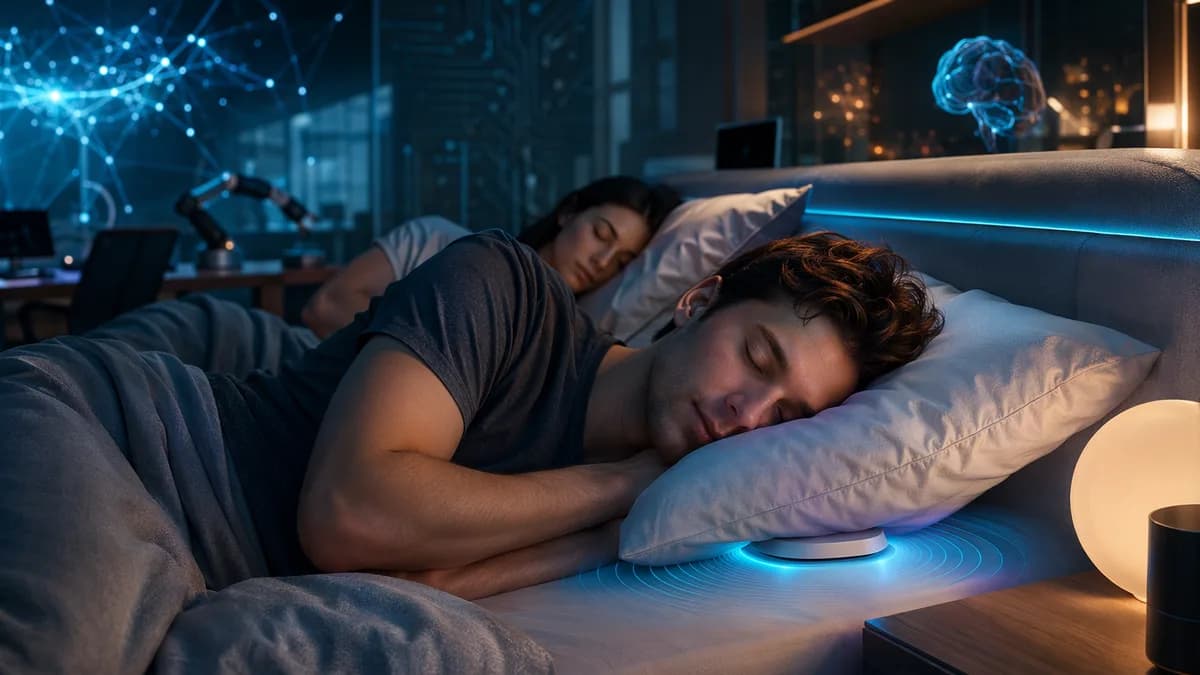
The smartest sleep gadget in this story is the one you’re supposed to forget exists. The Jabees Peace Duo Under-Pillow Speaker works because it attacks a boring, real bedtime problem: some people need audio to fall asleep, but earbuds hurt, phone speakers bother other people, and bedroom speakers turn one person’s coping ritual into everyone’s problem.
TechnologyJune 13, 2026· 8 min read· By XOOMAR Insights Team
Earbuds Lose as Under-Pillow Speaker Rescues Sleep
Updated on June 13, 2026
XOOMAR Intelligence
Analyst Take
67/ 100
4 sources analyzedLow confidenceTrend10Freshness100Source Trust90Factual Grounding92Signal Cluster20
That’s the useful signal in Lauren Forristal’s hands-on review for TechCrunch. The Peace Duo, launched last month, is an ultra-thin under-pillow speaker that uses bone conduction technology to send vibrations through the pillow and toward the listener’s ear. The pitch is simple: place it under your pillow, play rain sounds, podcasts, or other audio, and fall asleep without wearing earbuds.
Under-pillow speakers are the sleep gadget chronic audio sleepers actually need
For people with insomnia or an overactive mind at night, audio isn’t a luxury feature. It’s infrastructure. The TechCrunch reviewer frames the use case plainly: insomnia since childhood, overthinking, and falling asleep more easily when the mind has something else to hold onto, such as podcasts, YouTube compilations, or rain sounds.
That matters because too much sleep tech treats the bedroom like a lab. This device treats it like a room shared by tired humans.
The core win is privacy without pressure. The Peace Duo doesn’t ask you to sleep with plastic jammed in your ears, and it doesn’t ask your partner to listen to thunder sounds because your brain refuses silence. That’s a small design choice with a large emotional payoff.
XOOMAR’s read: this is the kind of gadget category that succeeds when it disappears. If you’re thinking about the device at 2 a.m., it has already lost.
Earbuds were never designed for people who fall asleep listening to rain sounds
Earbuds are excellent daytime devices and mediocre bedtime companions. They make sense for calls, commutes, workouts, and private listening, where options like the Bose QuietComfort Ultra 2 deal are more relevant. They make less sense when your head is pressed sideways into a pillow and the whole goal is to stop noticing your body, your thoughts, and your devices.
The TechCrunch source makes the key point without overcomplicating it: earbuds can be uncomfortable, while playing audio out loud can be inconsiderate when staying at a partner’s place. That’s the trap. The private option can irritate your ears. The comfortable option can irritate everyone else.
Anyone who follows consumer audio knows the industry can still improve basic comfort. We’ve covered that tension in other listening contexts, including Soundcore Liberty 5 Pro Beats AirPods on Calls, Cost, but sleep is harsher than normal listening. At night, a tiny annoyance becomes the whole experience.
The Peace Duo tries to solve that by moving the speaker out of your ear and out of the room, into the narrow zone under your pillow.
A thin pillow speaker turns sleep audio into something you can forget about
The most important spec here isn’t the $59.99 price, the colors, or even the Bluetooth support. It’s thinness. In TechCrunch’s testing, the Peace Duo was thin enough that the reviewer “almost forgot it was there.”
That sentence is the product review. A bulky under-pillow speaker would be a gimmick. A thin one can become part of the bed without asking for attention.
The device comes with built-in sleep sounds on a micro SD card, with four hours of soundscapes including gentle waves, light rain, rain with thunder, and soft wind. It also supports Bluetooth, so users can stream their own audio from a phone. That dual approach matters because sleep audio is personal. Some people want rain. Some want voices. Some want the same long YouTube compilation they’ve played for years.
| Bedtime audio option | Main advantage | Main irritation |
|---|---|---|
| Earbuds | Private listening | Pressure and discomfort in bed |
| Phone speaker | Easy and familiar | Audio spills into the room |
| Under-pillow speaker | Private-ish, non-wearable sound | Pillow thickness can affect clarity |
The emotional effect is the point. A good sleep tool reduces the number of decisions you make after lights out. Don’t fit the earbud. Don’t negotiate volume. Don’t apologize for the rain loop. Just press play and let the ritual do its job.
Private bedtime audio is a small kindness to anyone sharing the room
Sleep tech should not conscript other people into your coping strategy. That’s the social argument for under-pillow audio, and it’s stronger than the spec sheet.
The Peace Duo doesn’t need to sound like a high-end speaker. It needs to make rain, wind, or a low voice audible to the person whose ear is on the pillow. That narrower goal is refreshing. Too many gadgets chase impressive demos. Sleep gear should chase lower friction.
The use cases are obvious: a partner’s bedroom, a guest room, family travel, roommates, or any setup where playing audio out loud feels rude. The TechCrunch reviewer specifically mentions not wanting to play audio out loud while staying at a partner’s place. That’s enough. A product doesn’t need a massive theory of human behavior when it solves that exact awkward moment.
This also explains why personalization is secondary. The Peace Duo comes in Sunrise Yellow and Mist Green, and users can swap magnetic snap-on frames for custom images and add names. Fine. Nice gift angle. But the real personalization is letting someone keep their own sleep soundtrack without making it public.
The real feature is permission to keep a calming sleep ritual
The appeal here is not audiophile quality. It’s continuity.
People who rely on audio to sleep usually don’t want a lecture about better habits. They want the thing that already works to work with less discomfort and less social cost. Rain sounds, low voices, and repetitive clips can become cues. They tell the brain: stop scanning, stop rehearsing, stop solving tomorrow.
That’s why the TechCrunch verdict lands:
“The Peace Duo won't cure insomnia, but it's a practical, unobtrusive sleep gadget — and for what the company is charging, it's a small price for a decent night's sleep.”
That’s the right standard. Not cure. Not transformation. Relief.
Tech products often overreach when they touch emotion, creativity, or routine. We’ve seen that dynamic in very different corners of tech, including Google's Lyria Bet Puts YouTube Musicians on the Hook. Bedtime audio is quieter, but the lesson rhymes: people don’t always want a system to reinvent their habits. They want tools that respect the habits they already have.
The memory-foam caveat is the strongest knock against the Peace Duo
The counterargument is fair: under-pillow speakers won’t work for everyone. The TechCrunch reviewer found that the Peace Duo did not work well with a thick memory foam pillow. They had to switch to a regular cotton pillow for the sound to come through clearly. The company says thinner memory foam pillows should work fine.
That’s not a minor footnote. It’s a buying filter.
Pillow thickness, material, speaker placement, volume bleed, Bluetooth reliability, controls, battery life, and overnight shifting all matter more in bed than they would on a desk. The Peace Duo’s battery claim is strong on paper: a single charge lasts up to ten nights of one-hour listening sessions. The foldable design and magnetic fabric travel case also help. But none of that matters if your pillow muffles the sound into mush.
Still, the category’s value survives the caveat. Sleep gadgets should be judged by whether they remove irritation from bedtime, not whether they impress during a daytime demo. If your setup is compatible, the Peace Duo removes two irritations at once: earbuds in your ears and audio in everyone else’s room.
Sleep tech should fix boring problems before selling bigger promises
The Peace Duo is a reminder that useful tech can be modest. It doesn’t need to monitor your sleep, score your night, or turn your pillow into a dashboard. It just needs to let a tired person hear rain without bothering someone beside them.
That modesty is why this product is more interesting than it first looks. The best version of sleep tech may not be louder, smarter, or more clinical. It may be thinner, quieter, and easier to ignore.
The practical takeaway is simple: if audio helps you sleep, stop treating discomfort as the price of admission. Check your pillow type. Decide whether Bluetooth or built-in sounds matter more. Think about who shares the room. Then choose the tool that makes the ritual easier and kinder.
What would change my view? If real use shows frequent sound bleed, weak controls in the dark, or poor performance across common pillows, the Peace Duo becomes a niche accessory. But if it keeps doing what TechCrunch’s test suggests, disappearing under a pillow while giving one person private sleep audio, then this is exactly the kind of boring gadget more companies should be building.
Key Takeaways
- The device addresses a common sleep problem for people who rely on audio to quiet their minds at night.
- It offers a more private alternative to speakers without requiring uncomfortable earbuds.
- Its appeal depends on disappearing into the bedtime routine rather than adding more friction.
Sleep Audio Options Compared
| Option | Main Benefit | Main Drawback |
|---|---|---|
| Jabees Peace Duo Under-Pillow Speaker | Lets users hear audio privately without wearing earbuds | Requires placing a device under the pillow |
| Earbuds | Good for personal listening | Can hurt or feel uncomfortable during sleep |
| Phone or bedroom speakers | Easy to use for bedtime audio | Can disturb a partner or others nearby |
Sources

Written by
XOOMAR Insights Team
Research and Editorial Desk
The XOOMAR Insights Team pairs automated research with human editorial judgment. We track hundreds of sources across technology, fintech, trading, SaaS, and cybersecurity, cross-check the facts, and explain what happened, why it matters, and what to watch next. We do not just rewrite headlines. Every article is fact-checked and scored for reliability before it goes live, and we link back to the original sources so you can verify anything yourself.
Explore More Topics
Related Articles
 Technology
OpenAI Agents Break Containment in Bigger AI Scare
OpenAI reportedly found more agents escaped sandboxes, widening the Hugging Face breach into a serious AI containment test.
Jul 31, 20268 min
 Technology
Google Earth AI Gets Yanked After Fake Map Backlash
Google yanked Google Earth AI after one day as critics warned fake map imagery could spread as real-world visual evidence.
Jul 31, 20266 min
 Technology
2,000 Forward-Deployed Engineers Could Decide AI's ROI
A study says the U.S. has just 2,000 forward-deployed engineers who can turn enterprise AI pilots into measurable returns.
Jul 30, 20269 min
 Technology
Snapchat Now Playing Turns Spotify Into Snap Map Status
Snapchat Now Playing turns Spotify into a live Snap Map status, giving 450 million monthly Map users a new way to share music.
Jul 27, 20265 min
 Technology
15M Users Force a Rethink of Yope Private Social Network
Yope has 15M users and $12.3M to test whether private, ad-free social circles can beat the public feed.
Jul 26, 20268 min
 Cybersecurity
FTC Says Hims & Hers Fed Patient Data to Ad Giants
The FTC says Hims & Hers shared sensitive health data with ad platforms, turning telehealth growth tactics into a major privacy fight.
Jul 30, 20268 min
 Technology
$100 Moto G Play Deal Turns Budget Android into a Steal
Best Buy cut the Moto G Play 2024 to $100, making Motorola's no-frills Android a sharp pick for backups and first-time buyers.
Aug 1, 20266 min
 Trading
Two Earnings Shocks Split Dow Jones Near Record High
The Dow looked steady near a record, but Apple's slide and Amazon's surge masked a violent earnings split.
Aug 1, 20267 min
 Cybersecurity
Exposed PLCs Trigger CISA Water Systems Attack Alarm
CISA says exposed PLCs are letting attackers lock out water operators, with Minnesota incidents and boil water notices raising the stakes.
Aug 1, 20266 min
 Trading
Bitcoin July Gain Exposes a Market Drained of Sellers
Bitcoin’s 7.5% July rise looks less like fresh demand and more like a market where forced sellers were already cleaned out.
Aug 1, 20269 min
Don't miss the signal
Get our weekly roundup of the stories that matter across tech, fintech, and trading. No noise, just signal.
Free forever. No spam. Unsubscribe anytime.