The Nopia synth is close to becoming the rare viral music-gear prototype that actually turns into a product you can buy. After first blowing up online in 2023, creators Martin Grieco and Rocío Gal are now saying the instrument is “basically finished,” with a launch expected in “a couple of months” at “around £550,” according to The Verge.
XOOMAR Intelligence
Analyst Take
That changes the story. Nopia is no longer just a mint green curiosity with a nice demo video. It is now a test of whether a harmony-first hardware instrument can move from internet fascination to a practical tool for songwriting, performance, and electronic production.
Why are producers still talking about the mint green Nopia synth?
The thesis: Nopia stayed interesting because it promises fast harmonic control, not just another synth voice in a pretty box. The original prototype drew attention in 2023, and MusicRadar’s related coverage says that early video reached almost 3m views in just over a week. That kind of response can fade quickly. Nopia didn’t disappear, largely because its core idea remained unusually specific.
The instrument is described by its creators as a “harmony machine.” That phrase matters. Nopia is not being pitched as a flagship workstation, a clone of a classic synth, or a maximalist studio brain. Its appeal is narrower: help a player move through chords, bass, arpeggios, and pads as one connected musical action.
“You don’t need to know theory; Nopia takes care of that,” reads a statement on Nopia’s website, according to MusicRadar.
The counterpoint is obvious. Viral gear demos often flatter prototypes. A short video can make an unfinished interface look more immediate than it feels after weeks of use. Nopia’s long tease raises the bar, because buyers will expect the finished hardware to match the charm and speed of the clips.
Still, the reported launch window and around £550 price give the Nopia synth a sharper frame. This is no longer just a mood board. It is a product claim waiting to be tested.
How does Nopia turn chords, bass, arp, and pads into one playable performance?
The thesis: Nopia’s real trick is that it treats harmony as the center of the instrument, then makes multiple parts follow that decision. Instead of one keyboard controlling one patch, Nopia blends keys, bass, arp, and pad modules into a single performance structure. The Verge compares the approach to a drumless groovebox, which is a useful frame because Nopia appears built for layered musical movement rather than isolated note entry.
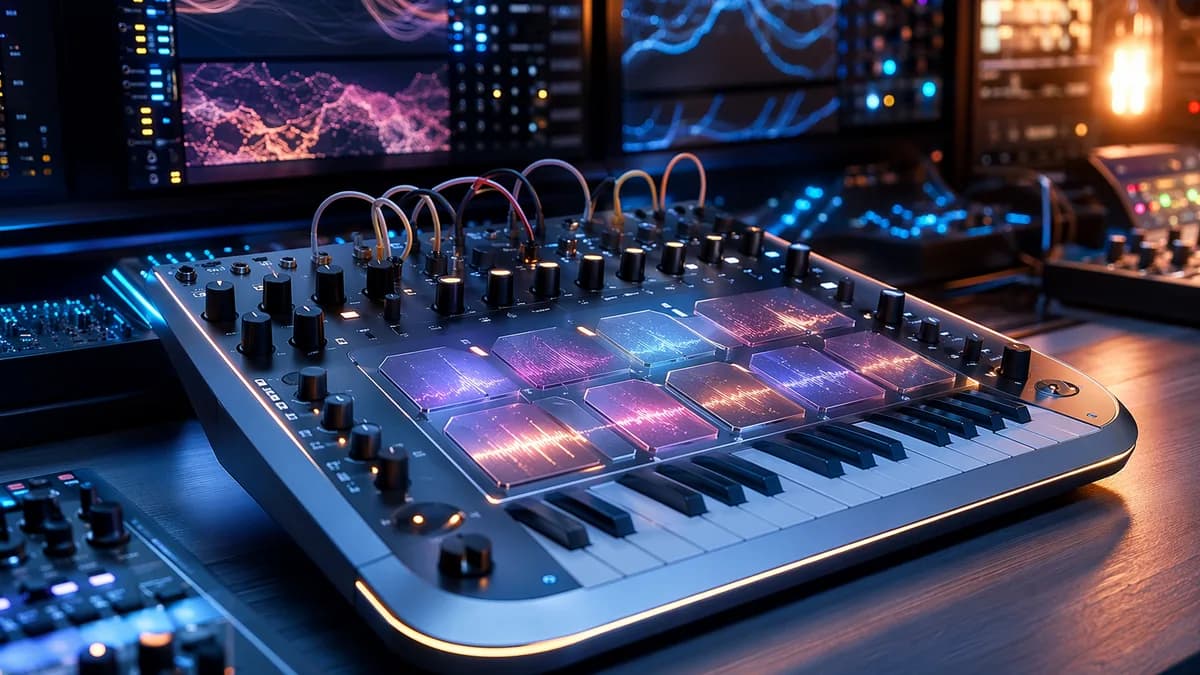
The core controls explain the concept. Nopia has a one-octave keyboard called the Chord Builder, a 12-button Tonal Selector, and an Extensions Dial that shapes chord key and voicing. The purpose is to let a player trigger more complex harmonic material with “just a finger or two,” as The Verge puts it.
That makes the Nopia synth different from a normal small keyboard experience. The Chord Builder is not just there to play single notes. It is there to generate harmonic movement quickly, with the Tonal Selector defining the tonal center and the Extensions Dial adding color.
There are also performance controls. The top-right strum plate can pluck specific notes from a chord, while a slider handles full chord pitch bends. MusicRadar’s related reporting says the production-ready Nopia MK1 also includes an OLED display for chord information and parameter values.
The strongest counterpoint is that fewer steps can mean less control. If a musician wants to voice every note manually, Nopia’s guided structure may feel opinionated. But that opinionated design is also the point. The instrument is built to compress harmonic decision-making into touchable gestures.
What makes Nopia different from a regular synth, groovebox, or MIDI chord tool?
The thesis: Nopia’s pitch is coherence and speed, not raw synthesis depth. The supplied specs mention virtual analog and sample-based synth engines, plus effects such as delay, reverb, tape emulation, and beat repeat. Those are useful, but they are not the story by themselves. The story is that those sounds are organized around harmonic control.
Here is the clean contrast:
| Tool type | Main interaction | Where Nopia differs |
|---|---|---|
| Conventional synth | Play or sequence a sound | Nopia links multiple modules to one harmonic system |
| Groovebox | Build patterns across parts | Nopia is described as drumless and harmony-centered |
| MIDI chord helper | Generate chord data | Nopia puts chord generation inside dedicated hardware with performance controls |
The device also has a serious integration angle. The Verge says Nopia includes “a ton of connectivity options,” including per-module MIDI output for controlling other instruments with its harmonic engine. MusicRadar’s related coverage says each sound module has its own dedicated TRS MIDI output.
That could matter more than the internal sounds. If the Nopia synth can send bass, keys, arp, and pad information out separately, it becomes a harmonic controller for a larger setup, not just a self-contained pastel box.
For XOOMAR readers tracking creator tools across hardware and software, Nopia sits beside very different interface stories, from Stolen Clips Face X Video Editor's First iOS Tools to Open Web Fights Back With HyperTexting App's Social Feed. The shared thread is not the category. It is the pressure to make creative control feel immediate without hiding the important decisions.
Who is Nopia really for: beginners, hardware synth fans, or live electronic artists?
The thesis: Nopia is probably most compelling for musicians who want harmonic ideas fast, but it doesn’t look limited to beginners. The creators’ own message points to accessibility. If Nopia handles tonal relationships, a player can explore chords without first mapping out every scale degree manually.
That beginner-friendly angle is real, but it is not the whole pitch. Experienced players may care because constraints can be productive. A device that narrows the starting point to harmony, then spreads that choice across bass, arp, pad, and keys, can push a musician into patterns they might not reach through a blank keyboard.
Live performers are another plausible audience, based on the controls described. A strum plate, chord pitch bends, module-based layers, and MIDI outputs all point toward real-time manipulation. The source material does not prove how reliable or expressive that will feel on stage, so that remains a launch test, not a settled fact.
The caution: anyone expecting a traditional keyboard, deep standalone sequencing, or an all-purpose production center should be careful. Based on the information available, Nopia looks more like a companion instrument with a very strong organizing idea than a replacement for a full setup.
What would a real Nopia session look like for a bedroom producer?
The thesis: a Nopia session starts with harmonic direction before arrangement detail. Based on the described workflow, a producer could select a tonal center with the 12-button Tonal Selector, shape chord color with the Extensions Dial, and perform a progression on the one-octave Chord Builder. From there, the keys, bass, arp, and pad modules would respond as connected layers.
A simple sketch might begin as a pad-heavy ambient progression. The same harmonic movement could then be pushed into a more rhythmic idea by emphasizing the arp module and using beat repeat. The strum plate could pull notes out of a chord for a more performed feel, while pitch bending the full chord would add motion without rewriting the underlying progression.
This is analysis, not a confirmed workflow review. No source says how fast the final unit is in daily use, how presets behave, or how much menu interaction remains. But the control layout suggests the practical advantage Nopia is chasing: get a coherent harmonic bed moving before the producer gets lost in separate parts.
The limitation is just as clear. Drums, final arrangement, detailed editing, and mixing will still likely happen elsewhere. Nopia’s strength is the start of the idea, not necessarily the finished track.
What should buyers know before paying around £550 for Nopia?
The thesis: around £550 makes Nopia a considered purchase, so the launch details matter. The reported price is specific enough to anchor expectations, but several buyer-relevant questions remain open until release.
Before joining the waitlist or buying, users should verify:
- Final specs: whether all described controls and modules match the shipping unit.
- Connectivity: how the per-module MIDI outputs behave in real setups.
- Build quality: whether the finished hardware feels durable beyond the demo table.
- Sound behavior: how patches, samples, effects, and parameter control are managed.
- Firmware support: whether the team plans updates after launch.
- Availability: how many units will ship and where buyers can get them.
The long wait cuts both ways. It gave Martin Grieco and Rocío Gal time to move from prototype to production-ready hardware, but it also gave the audience time to imagine an ideal version of the instrument. That imagined version may be hard to satisfy.
The practical takeaway is simple. If the Nopia synth delivers the fast, harmony-first workflow shown in demos, it could occupy a distinctive slot for producers who want musical structure without starting from a blank grid. If the final hardware feels slow, limited, or awkward outside curated videos, the charm will not be enough. The launch test is not whether Nopia is cute. It is whether the “harmony machine” stays useful after the first hour.
The Bottom Line
- Nopia appears close to turning a viral 2023 prototype into a real purchasable synth.
- Its harmony-first design could appeal to producers who want fast chord, bass, arpeggio, and pad control without deep theory knowledge.
- The expected launch at around £550 will test whether online hype can convert into sustained demand for a niche hardware instrument.
Primary Sources & Disclosures

Written by
XOOMAR Insights Team
Research and Editorial Desk
The XOOMAR Insights Team pairs automated research with human editorial judgment. We track hundreds of sources across technology, fintech, trading, SaaS, and cybersecurity, cross-check the facts, and explain what happened, why it matters, and what to watch next. We do not just rewrite headlines. Every article is fact-checked and scored for reliability before it goes live, and we link back to the original sources so you can verify anything yourself.