
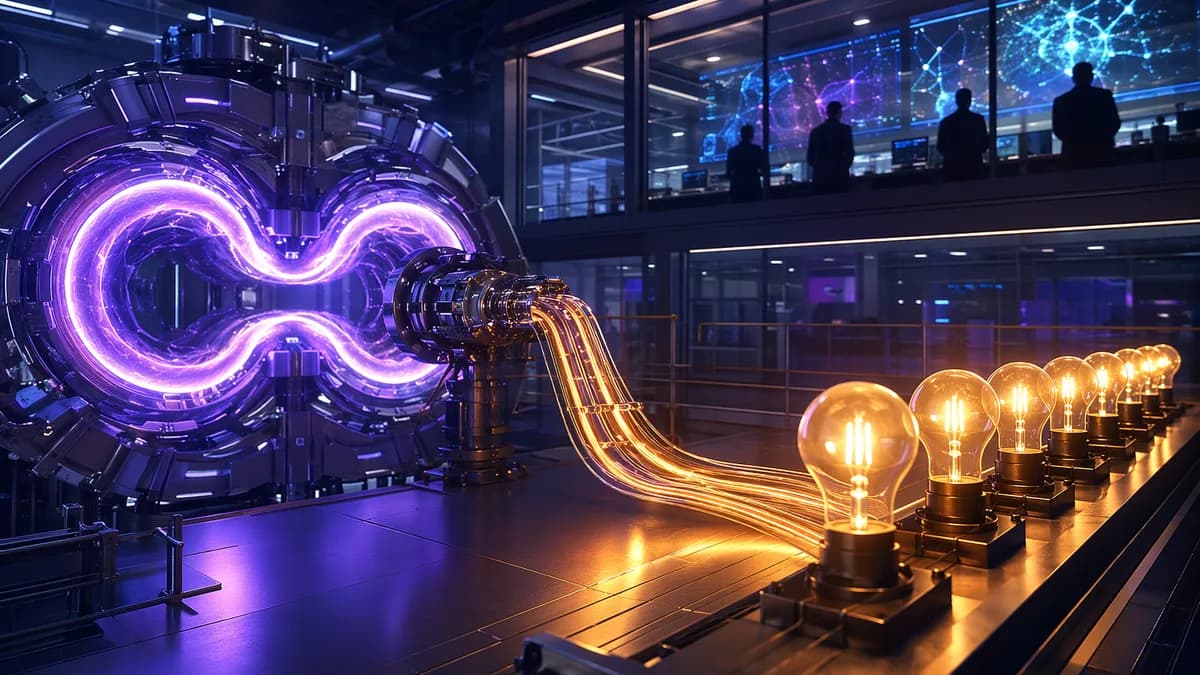
On Tuesday, Realta Fusion said it had done something fusion companies usually talk about rather than show: it pulled electricity directly from plasma in its WHAM fusion device, without sending heat through a steam turbine first.
TechnologyJuly 1, 2026· 7 min read· By XOOMAR Insights Team
100 Volts Put Realta Fusion's Plasma Power Claim in Play
Updated on July 1, 2026
XOOMAR Intelligence
Analyst Take
58/ 100
4 sources analyzedLow confidenceTrend10Freshness95Source Trust90Factual Grounding96Signal Cluster20
The June 19 experiment produced “multiple amps” at around 100 volts and powered several light bulbs, according to TechCrunch. That’s small in power-market terms. But the architecture matters. If Realta Fusion direct energy conversion scales, fusion plants may not have to behave like extremely expensive boilers.
June 19 put Realta Fusion direct energy conversion on the table
Realta’s claim is not that it built a commercial fusion plant. It didn’t.
The company says it attached a prototype electricity converter to the end of WHAM, the Wisconsin HTS Axisymmetric Mirror, and harvested electricity from charged particles in the plasma. Realta operates WHAM in collaboration with the University of Wisconsin-Madison.
“We can take power from a plasma,” Realta co-founder and CEO Kieran Furlong told TechCrunch.
The company says it is the first private fusion company to publicly demonstrate this kind of direct electricity extraction from a fusion machine. In its own announcement, Realta called it the first commercial demonstration of direct energy conversion of plasma kinetic energy into electricity.
That wording matters. The achievement is not “fusion happened.” The achievement is that Realta says it captured some of the energy carried by charged particles and turned it into current directly.
A useful way to separate the signal from the hype:
| Realta says it demonstrated | Realta has not demonstrated |
|---|---|
| Multiple amps of current at around 100 volts | Net electricity from a fusion plant |
| Powering several light bulbs | Commercial-scale fusion output |
| Direct conversion on WHAM | A full plant without major system losses |
| A proof-of-concept for plasma energy capture | A market-ready power source |
Realta’s own chief scientific officer, Dr. Derek Sutherland, drew that line clearly.
“While we’ve demonstrated DEC works on WHAM, this is not yet a demonstration of net-electricity or a large-scale conversion of fusion power directly into electricity. Those are milestones for our future fusion machines.”
That caveat is the difference between a technical milestone and a power business.
Why skipping the steam turbine could change fusion economics
Most power plants use a familiar chain: make heat, boil water, spin a turbine, drive a generator. Fusion concepts often keep that structure because much of fusion energy can become heat.
Realta is trying to capture a slice of the energy before it enters that thermal route. The company’s commercial plan still includes a traditional thermal cycle. But it says 20% of the fusion power in its first-generation plants would come through direct energy conversion operating at over 90% efficiency, while 80% would run through a thermal cycle operating at up to 45% efficiency, according to the company’s June 30 release.
That is the economic hook. Realta says the direct conversion boost could offset all the energy it injects into plasma to start up and sustain fusion conditions, raising energy gain and lowering the cost per kilowatt hour by at least 10-20%.
TechCrunch reported a similar efficiency contrast from Furlong: direct conversion at about 90% versus steam turbines in today’s fission reactors at about 33%.
This is where Realta Fusion direct energy conversion becomes more than a lab trick. Every fusion reactor has to spend energy to operate. If a reactor can recirculate part of its own plasma energy back into heating and sustaining the plasma, the plant’s internal power burden shrinks.
“You’re basically able to recirculate the electricity,” Furlong said.
He estimated that this circularity could boost a commercial-scale plant’s total output by 20% to 30%.
How direct fusion electricity works without a turbine
Realta describes its converter as a device that slows charged particles at one end of WHAM, building electrical potential that drives current. Put simply: instead of waiting for plasma energy to become heat, the converter tries to extract electrical work from particle motion.
The particles Realta is interested in are alpha particles, charged helium nuclei. TechCrunch reports that about 20% of the energy from deuterium-tritium fusion, the fuel type Realta plans for commercial reactors, comes from alpha particles.
That gives Realta a target. Capture enough alpha power and it can feed electricity back into the reactor systems that need it most.
This is also why direct conversion doesn’t erase the need for the rest of the plant. Realta’s own commercial outline still relies mostly on a thermal cycle. Direct conversion is a high-efficiency add-on to the power architecture, not a full replacement for every energy pathway in the machine, at least in the first-generation plants the company describes.
The best analogy is a power plant with an internal cashback loop. The plant still has to sell electricity to the grid, but it also wants to reclaim enough of its own output to pay for the energy it spends keeping the reaction alive.
WHAM’s magnetic mirror design gives Realta a specific test bed
Realta’s device, WHAM, is built to demonstrate the magnetic mirror approach to fusion power. The supplied material does not give a full comparison with tokamaks or stellarators, so the useful point here is narrower: WHAM gave Realta a machine where it could install a converter at one end and test whether plasma energy could be drawn out electrically.
The company says direct energy conversion was first proposed by Lawrence Livermore National Laboratory’s Dr. Richard Post in 1974. It also says the idea has appeared in academic and national laboratory settings, including the “venetian blind” converter in the 1970s, TMX in the 1980s, and GAMMA 10 as recently as 2008.
Realta’s claimed first is commercial, not conceptual. The physics idea is old. The startup is arguing that it has now moved the idea into a private fusion machine.
That distinction keeps the story grounded. Realta didn’t invent direct conversion. It says it showed that a commercial fusion company can apply it to plasma in a working experimental device.
The commercial version still has to clear the hardest fusion test
Realta says its first-generation fusion power plants are expected to start in the mid-2030s. That timeline leaves a long list of proof points between a few light bulbs and a power plant.
The next questions are practical:
- Repeatability: Can Realta reproduce the result under controlled conditions?
- Scale: Can it move from light bulbs to meaningful plant-level power flows?
- Duration: Can the system operate long enough to matter for a power plant?
- Efficiency: Can it actually deliver the over 90% direct conversion performance Realta is targeting?
- Net electricity: Can the full system produce more usable electricity than it consumes after losses?
Realta has financial momentum, but not proof of commercialization. TechCrunch reported that the company raised $36 million in a Series A led by Future Ventures in 2025, and that Furlong said Realta is raising a new round. The company also says it is backed by Khosla Ventures and Future Ventures, and is one of eight companies selected for the U.S. Department of Energy’s Milestone-Based Fusion Development Program.
The direct electricity result deserves attention because it attacks one of fusion’s least glamorous problems: conversion losses. Fusion physics may get the headlines, but plant economics decide whether electricity buyers care.
For now, Realta Fusion direct energy conversion is a credible proof-of-concept with unusually clear caveats. The next decision point is not whether the light bulbs turned on. It’s whether Realta can show the same architecture working at higher power, longer duration, and with enough system efficiency to move from a promising experiment into an investable plant design.
Why It Matters
- Direct energy conversion could make future fusion plants simpler than systems that rely on steam turbines.
- The demonstration is small, but it shows electricity can be pulled directly from plasma in Realta’s WHAM device.
- Realta’s claim highlights a key distinction between a technical milestone and commercially viable fusion power.
What Realta Fusion Demonstrated vs. What It Has Not Demonstrated
| Realta says it demonstrated | Realta has not demonstrated |
|---|---|
| Multiple amps of current at around 100 volts | Net electricity from a fusion plant |
| Powering several light bulbs | Commercial-scale fusion output |
| Direct conversion of plasma kinetic energy into electricity | A proven replacement for steam-turbine power generation |
Sources

Written by
XOOMAR Insights Team
Research and Editorial Desk
The XOOMAR Insights Team pairs automated research with human editorial judgment. We track hundreds of sources across technology, fintech, trading, SaaS, and cybersecurity, cross-check the facts, and explain what happened, why it matters, and what to watch next. We do not just rewrite headlines. Every article is fact-checked and scored for reliability before it goes live, and we link back to the original sources so you can verify anything yourself.
Explore More Topics
Related Articles
 SaaS & Tools
Google NotebookLM Turns Research Into TikTok-Style AI Clips
Google NotebookLM is turning uploaded sources into 60-second AI videos, starting with paid AI Pro and Ultra subscribers.
Jul 1, 20265 min
 Technology
Anthropic Fable 5 Roars Back After U.S. AI Freeze Ends
Fable 5 is back globally, but Mythos 5 remains U.S.-only. The shutdown proved frontier AI can disappear by government order.
Jul 1, 20266 min
 Technology
Runaway AI Spending Forces a Return to Cloud Controls
AI bills now rise with every prompt and agent step, pushing companies to adapt cloud-era cost controls before budgets get torched.
Jul 1, 20268 min
 Technology
Anti-Vaccine Myths Cluster Around AI Chatbot Users
Frequent AI health users were more likely to believe vaccine myths, though the poll doesn't prove chatbots caused those beliefs.
Jul 1, 20268 min
 Technology
AI Jobs Panic Cracks as Ramp Study Finds Faster Hiring
Ramp's study found the heaviest AI spenders grew headcount 10% and entry-level hiring 12%, challenging the layoff panic.
Jul 1, 20267 min
 Technology
Billions Ride on AWS Public Sector AI's Cloud Grab
AWS is spending billions to make its cloud the default home for government AI, from classified workloads to spy agency migrations.
Jul 1, 20268 min
 Technology
NASA May Turn Nuclear Mars Rover Into Moon Base Shortcut
NASA may send Promise, Perseverance's nuclear-powered test rover, to scout the Moon's south pole instead of leaving it at JPL.
Jul 1, 20268 min
 Global Trends
55% Still Stay After Article 8 Asylum Reforms Clamp Down
The Home Office expects 11,700 extra refusals a year, but 55% of rejected asylum seekers may still remain in the UK.
Jul 1, 202611 min
 Global Trends
LeBron James Free Agency Turns Lakers Goodbye Into Leverage
LeBron James' polite Lakers goodbye makes his free agency feel less like drama and more like a controlled exit.
Jul 1, 20268 min
 Cybersecurity
FTC Hits Amazon With $2.25M Identity Theft Fine Over Records
Amazon will pay $2.25M after the FTC said identity theft victims were denied records needed to prove fraud on fake accounts.
Jul 1, 20268 min
Don't miss the signal
Get our weekly roundup of the stories that matter across tech, fintech, and trading. No noise, just signal.
Free forever. No spam. Unsubscribe anytime.