
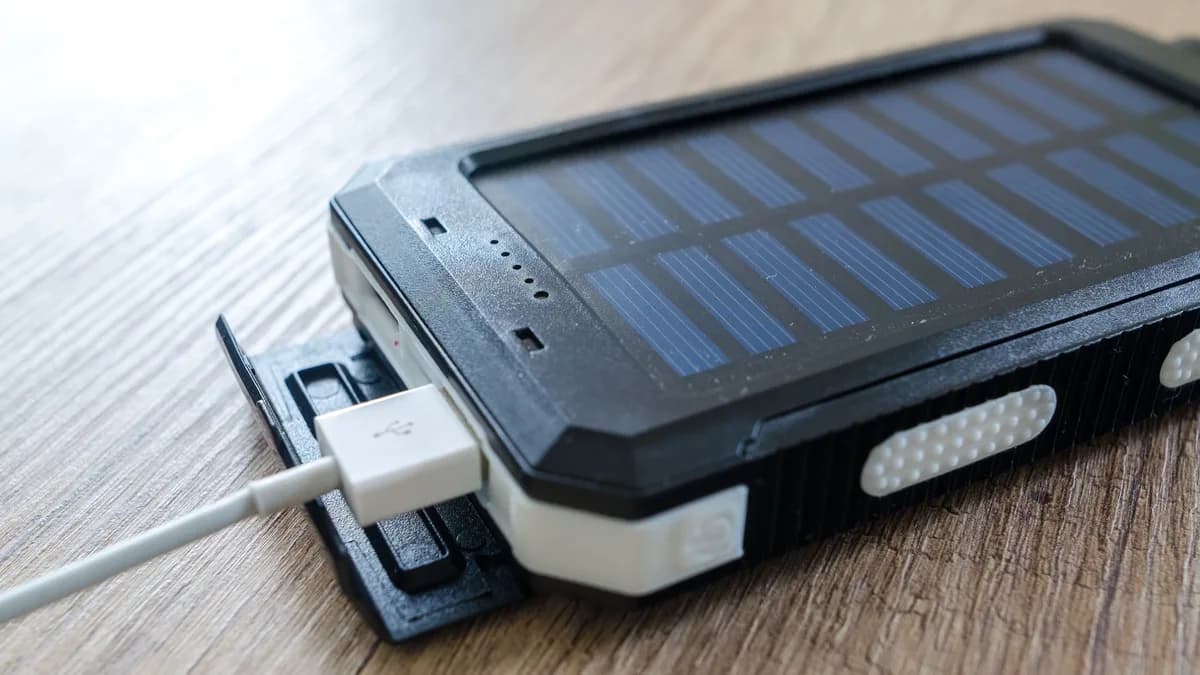
Lithium-ion power banks are certified for safe air travel, yet videos show them sparking "rogue" fires in overhead bins. The single, logical device you're required to bring to keep your phone alive also carries the innate risk of a thermal event. That contradiction is why a new class of semi-solid-state power banks, like the $49.99 ReelCharge 5000mAh, is arriving as a direct solution for a nervous public according to ZDNet. It’s not a performance upgrade. It’s a safety retrofit.
TechnologyAugust 13, 2026· 7 min read· By XOOMAR Insights Team
New Power Bank Ditches Fire-Prone Lithium-Ion Batteries
Updated on August 13, 2026
XOOMAR Intelligence
Analyst Take
57/ 100
4 sources analyzedLow confidenceTrend10Freshness98Source Trust85Factual Grounding88Signal Cluster20
Why Your Pocket Power Bank is a Ticking Time Bomb
The statistics make the risk clear in scale, if not in probability. Over the last year, industry giant Anker has issued recalls for several power bank models, with one model alone accounting for more than a million units. This is a manufacturing problem meeting a fundamental chemistry problem.
The core conundrum is energy density versus fire risk. As senior contributing editor Adrian Kingsley-Hughes points out, a 5,000mAh power bank holds about as much energy as half a teaspoon of gasoline. "In an overhead locker, surrounded by all sorts of flammable materials, that power is enough to cause significant problems," he writes. Airlines permit power banks up to 27,000mAh routinely, which scales that gasoline comparison to a couple of teaspoons. While the vast majority never fail, the sheer volume in circulation, inside everything from phones to "rechargeable dog brushes", means absolute failure numbers are significant.
The flaw is in the liquid electrolyte inside every standard lithium-ion cell. If the cell is damaged, defective, or overheats, that liquid can ignite, triggering an unstoppable chain reaction called thermal runaway. You’re carrying a potential fire in your bag because the dominant battery technology for the last 30 years has always been one.
The Safer Chemistry Hiding in Plain Sight: Semi-Solid State
The alternative exists in a practical, available form: semi-solid-state batteries. This is not the futuristic, ceramic solid-state battery promised for next decade’s EVs. This is a hybrid.
The fundamental swap is simple: the volatile liquid electrolyte is replaced by a thick, mostly inert gel or paste. It’s the difference between a soup that can boil over and a damp clay that resists ignition.
“You get the benefits of lithium-ion, the energy density and recharge cycle lifespan, but with less scope for fire if the cell is punctured or overheats.”
This design represents a direct engineering fix to the most common catastrophic failure mode. “Without the flammable electrolyte, there’s a lot less to burn,” the analysis concludes. It’s a lateral move in performance metrics, but a vertical leap in fundamental safety. The trade off is cost, not capability.
Why Big Brands Aren't Selling You "Safer" Power Banks
If the technology is demonstrably safer and available, a natural question arises: why aren’t market leaders like Anker rushing to adopt it?
Industry feedback suggests two major barriers. First, marketing a "safer" power bank implicitly declares previous products "less safe," a message no established brand wants to broadcast. Kingsley-Hughes notes that when companies shifted to safer LiFePO4 batteries in large portable power stations, they focused on lifespan and "automotive grade" claims, not fire suppression.
Second, scale and cost. The global supply chain for liquid lithium-ion cells is vast and cheap. Semi-solid-state cells, for now, come from a "handful" of specialized manufacturers and cost "about two to three times as much." This checks out at retail: the ReelCharge 5000mAh costs $49.99, while a comparable lithium-ion model can be half that price. The premium is real.
This leaves the market to smaller, disruptive brands like ReelCharge and STATIK, which are using safety as their primary differentiation. As we've seen in other fintech pivots, sometimes a sharp focus on a single, underserved advantage is the only way to crack an established market.
A $50 Real-World Test: Can You Feel the Difference?
In a hands on test by ZDNET, the ReelCharge unit performed as a standard, competent power bank. It offers 15W magnetic wireless charging and 20W output via USB C, with a small LCD showing capacity. The tester's primary critique? "The rattle from the tiny button on the bottom." The safety isn't felt in daily use, only in its absence, the absence of excessive heat or anxiety.
So what does $50 buy you here? The core specs:
- Capacity: 5,000mAh (also available in 10,000mAh for $69.99)
- Charging: 15W wireless, 20W USB C wired
- Construction: Aluminum shell acting as a heatsink
- Key Feature: Semi-solid-state internal battery cells
This isn't a hyper fast, 140W laptop charger. It’s a travel ready, safety first battery pack. The value is in peace of mind, a feature that’s hard to quantify until you picture your bag in an overhead bin. It passed all standard charge/discharge and thermal tests. Tellingly, the reviewer declined to perform a destructive puncture test, having done so previously with similar batteries: "the most I can get from a semi-solid-state battery is a few sparks and a wisp of smoke."
How to Spot a True Semi-Solid-State Power Bank
As this category grows, marketing confusion will follow. The ZDNET review notes a key issue: "companies, ReelCharge included, often mix up semi-solid-state and solid-state. Even the box for the power bank I tested lists it as having a solid-state battery." That's either shorthand or obfuscation.
Here's what to look for:
- Ignore: Vague "solid-state" or "advanced battery" claims without specifics.
- Seek: The precise phrase "semi-solid state" or "semi-solid electrolyte" in the technical specifications or detailed product copy.
- Verify: Look for specific safety claims tied to the chemistry, like "non flammable electrolyte" or "puncture resistant."
- Remember: No battery is indestructible. Safer chemistry reduces risk dramatically but doesn't eliminate the need for proper care. Don't crush it, submerge it, or expose it to extreme heat.
The promise is a device you can use without a latent, low probability, high consequence fear. That’s a different value proposition than the tech industry typically sells. This shift mirrors broader moves towards secure infrastructure, whether it's in cross border digital finance or consumer tech.
From Power Banks to Everything Else: A Safety Reckoning
The implications of semi-solid-state adoption extend far beyond a niche accessory. If consumer demand and airline pressure rise for demonstrably safer portable power, the entire portable electronics industry faces a reckoning.
Airlines and regulatory bodies are the immediate catalyst. Safer, verifiable chemistry could ease operational anxiety and might eventually influence carry on regulations. A clearly safer alternative exists, and the travel industry is highly incentivized to prefer it.
The broader electronics market is next. If consumers start valuing "semi-solid-state inside" for power banks, that preference will bleed into smartphones, laptops, tablets, and the exploding universe of wearable and IoT gadgets. It resets the baseline expectation for battery safety.
XOOMAR Analysis: This isn't merely a stopgap. True, pure solid state batteries remain years away from mass market, high volume consumer applications. Semi-solid-state is the viable, manufacturable middle ground for the next product cycle, perhaps the next decade. It solves the most urgent safety flaw without requiring a complete reinvention of manufacturing lines. The premium will shrink as scale increases.
The ultimate question isn't about specs. It's about risk tolerance. For $49.99, you're not just buying 5,000mAh of capacity. You're buying out of a known, quantifiable risk. In an era where we scramble to secure our digital financial links and personal data, applying that same principle to the physical energy storage in our pockets is a logical, tangible next step. The technology to make your gear safer is already here. The only thing burning now should be the old assumption that fire risk is just part of the deal.
Why It Matters
- Widespread lithium-ion power bank recalls (e.g., over a million Anker units) highlight systemic safety risks many travelers unknowingly carry.
- Semi-solid-state power banks directly address the fire hazard in crowded spaces like airplane overhead bins, a critical public safety upgrade.
- This shift signals a move from prioritizing only energy density to valuing inherent safety in consumer battery technology.
Power Bank Safety Comparison
| Feature | Lithium-Ion Power Bank | Semi-Solid-State (ReelCharge) |
|---|---|---|
| Typical Chemistry | Liquid electrolyte | Semi-solid-state electrolyte |
| Safety Risk | Thermal runaway/fire if damaged/defective | Non-flammable/greatly reduced fire risk |
| Travel Safety | Certified but documented incidents (e.g., fires in overhead bins) | Positioned as direct safety solution |
| Example Price (5,000mAh) | Varies (some recalled models) | $49.99 |
| Key Issue | Energy density vs. fire risk; recall scale (e.g., Anker's million+ units) | Safety retrofit, not performance upgrade |
Sources
- [1] ZDNet
- [2] This $50 power bank is safer than my lithium-ion battery - and it's coming on my next flight
- [3] This $50 power bank is safer than my lithium-ion battery - and it's coming on my next flight
- [4] STATIK unveils new semi-solid State MagSafe Power Bank that 'eliminates fire and explosion risks' [Launch deal]

Written by
XOOMAR Insights Team
Research and Editorial Desk
The XOOMAR Insights Team pairs automated research with human editorial judgment. We track hundreds of sources across technology, fintech, trading, SaaS, and cybersecurity, cross-check the facts, and explain what happened, why it matters, and what to watch next. We do not just rewrite headlines. Every article is fact-checked and scored for reliability before it goes live, and we link back to the original sources so you can verify anything yourself.
Explore More Topics
Related Articles
 Technology
Anker's Universal Charger Halts Travel Adapter Chaos for $20
The Anker Nano Travel Adapter consolidates four international plug types into one compact device on sale for $19.99, but it only adapts plugs, not voltage.
Aug 10, 20267 min
 Technology
Your Phone Battery Myths Are Costing You Money
Most common phone charging tips are based on old battery tech and actively harm modern lithium-ion batteries, creating unnecessary anxiety and potential cost.
Aug 9, 20266 min
 SaaS & Tools
Best Tech SEO Audits Find Hidden Traffic Gaps
Fixing technical SEO flaws is now the fastest shortcut to organic growth, and the right audit tools expose the hidden bottlenecks that Google Search Console mis
Aug 13, 202614 min
 SaaS & Tools
Email Tool Battle: Creator Revenue Trumps Marketing Metrics
ConvertKit (now Kit) is built for creator revenue with native commerce, while Mailchimp remains a general marketing tool requiring external integrations. The ch
Aug 13, 202610 min
 SaaS & Tools
Buffer Streamlines Publishing as Hootsuite Manages Teams
Buffer is a streamlined publishing tool ideal for creators, while Hootsuite is a full management suite built for teams needing analytics and complex workflows.
Aug 13, 202611 min
 SaaS & Tools
Video Editing's Big Choice: Desktops or Clouds Win
Choosing between a desktop and cloud-based editor shapes your creative control, team collaboration, and tech budget. The 'best' tool depends entirely on your sp
Aug 13, 202613 min
 SaaS & Tools
Podcast Audio Becomes Multi-Platform Content Factory
You're leaving 90% of your podcast's value on the table. We show you how to atomize a single episode into a week's worth of social clips, articles, and posts, e
Aug 13, 202613 min
 SaaS & Tools
Podcast Hosting Picks: Best Low-Cost Start For Creators
You don't need a big budget to start a pro podcast. The best 2026 hosting services give you essential tools and room to grow for free or cheap.
Aug 13, 202613 min
 SaaS & Tools
Creator's Dilemma: Ceding Control for Clicks in 2026
For creators in 2026, picking a video stack means choosing between AI's raw speed and a traditional SaaS suite's creative control. Your business goals decide th
Aug 13, 202615 min
 SaaS & Tools
Video Podcast Hosts Face Unprecedented Bandwidth Crisis
Choosing a video podcast host in 2026 is a critical business decision, as standard audio platforms are fundamentally broken for handling video files that are up
Aug 13, 202613 min
Don't miss the signal
Get our weekly roundup of the stories that matter across tech, fintech, and trading. No noise, just signal.
Free forever. No spam. Unsubscribe anytime.