
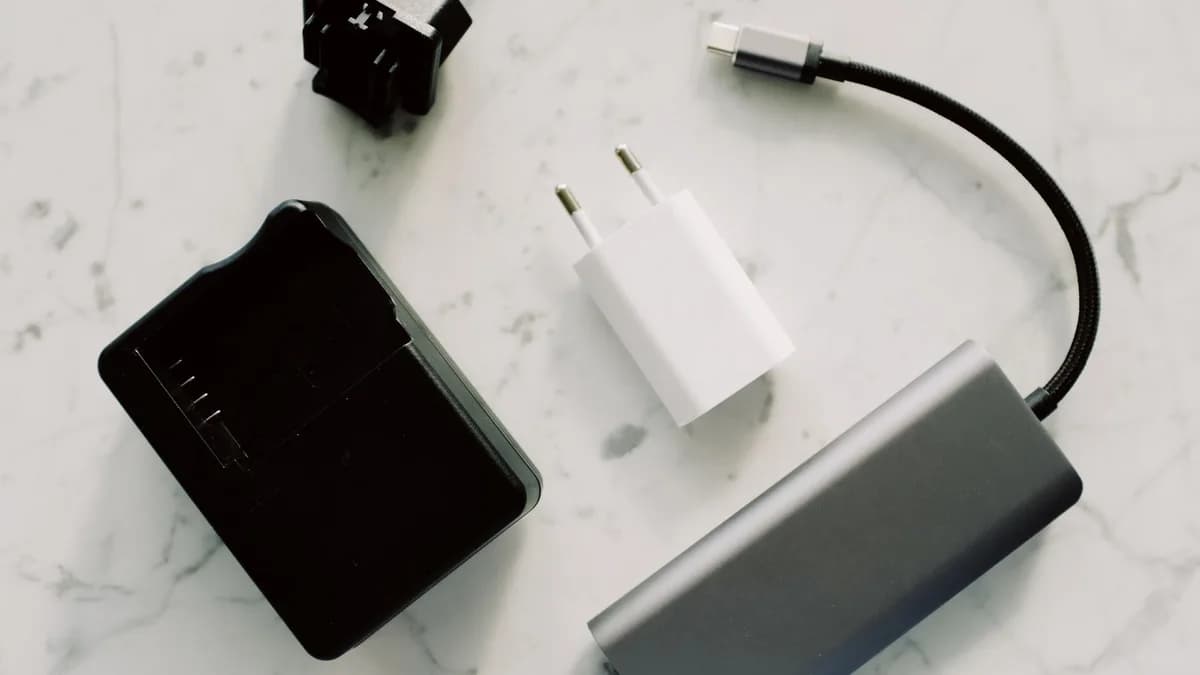
The writer from ZDNet declares the Satechi ChargeView 240W charger "replaced my ugly power brick." This isn't just a product endorsement. It's a subtle declaration of war on the fundamental, accepted chaos of the modern workstation. The question his review answers isn't just "Is this a good charger?" It's a deeper, more technical one: What does it take to kill the desktop power brick for good?
TechnologyAugust 8, 2026· 6 min read· By XOOMAR Insights Team
Is This the Last Power Brick You'll Ever Buy?
Updated on August 8, 2026
XOOMAR Intelligence
Analyst Take
57/ 100
1 source analyzedLow confidenceTrend10Freshness99Source Trust85Factual Grounding91Signal Cluster20
The answer, according to the hands-on testing, is a combination of 240 watts of total power distributed across six USB-C ports, and a small, clear screen that tells you exactly what's happening. This product isn't an incremental upgrade. It's an attempt to solve the core physical and informational problems that have kept us tethered to a tangle of adapters.
What's the Minimum Wattage to Power an Entire Desk?
A single laptop charger is easy. Powering an ecosystem is a math problem. The Satechi ChargeView 240W provides the necessary budget. Its six ports are arranged in three banks:
The two 140W-capable ports can handle two high-performance laptops simultaneously, like a MacBook pulling full power and another drawing 100W.
The two 100W-capable ports are ready for another laptop or a power-hungry tablet.
The two 30W-capable ports efficiently handle phones, earbuds, or smartwatches.
The intelligence is in the distribution. When multiple devices are connected, the charger outputs the maximum power each device can take, up to the 240W ceiling. This means you can realistically have a laptop, a tablet, a phone, and other accessories all charging at their optimal, fast speeds without one crippling another. The reviewer confirms testing all outputs and that the charger "has no problem at all delivering full power."
This capability turns a charger from a single-device tool into a desk's central power utility. It matches the real-world need: one hub for laptop, phone, tablet, buds, watch, and a spare.
Why Add a Screen to Something That Just Sits There?
Most high-wattage chargers are "big, brick-like lumps," as the review describes competitors. They are dumb black boxes. You plug in a device and hope. The ChargeView’s core innovation isn't its wattage, but its feedback. The display shows real-time power output per port or a combined total.
"The display can be configured to show the power output for each port separately or the combined power output for all the ports."
This solves a persistent, minor agony of modern tech: the unknown failure. Was that cable broken? Did the port negotiate correctly? Is my phone fast-charging or trickling? The screen provides immediate verification, turning guesswork into data. The reviewer appreciates that the display powers down after a minute to avoid being a distraction, only waking when you interact with the unit. This transforms the charger from an appliance into an instrument, giving the user control and transparency over a process that's usually opaque.
Is a 'Charging Computer' More Than Just Marketing Hype?
Satechi packs the unit with Power Delivery 3.2 with AVS (Adjustable Voltage Supply) on the two high-power ports, and PD 3.0 PPS (Programmable Power Supply) on the rest. This technical jargon translates to a simple promise: regardless of what device you plug in, it should get the fastest, safest charge that device supports, including the latest iPhones.
This intelligence extends to thermal management. The reviewer notes the charger can get warm under load but is "very well engineered to dissipate heat." Crucially, it has three built-in modes to throttle charging to cool itself down if necessary. This combination of advanced power negotiation and proactive thermal protection is what justifies the "charging computer" label. It's managing complex electrical and thermal loads in real-time, a step beyond simply converting AC to DC.
Does Elegant Design Justify a $150 Price Tag?
The Satechi ChargeView 240W has a $149.99 price tag. The competition is starkly utilitarian. The review directly compares it to the Ugreen Nexode 500W, calling it a "big, heavy, hulking gray brick" with no interface beyond a power light. Another competitor, the Ugreen Nexode Pro 300W, costs $170 and has a busier interface with more ports (including a legacy USB-A and a DC port), but cannot be oriented vertically.
Satechi ChargeView 240W vs. Key Alternatives
| Feature | Satechi ChargeView 240W | Ugreen Nexode 500W (as described) | Ugreen Nexode Pro 300W |
|---|---|---|---|
| Total Power | 240W | 500W | 300W |
| Port Layout | 6x USB-C | Not Fully Specified | 6x USB-C, 1x USB-A, 1x DC |
| Key Feature | Power display per port; vertical/horizontal stand | Raw high wattage | Multiple port types; knob interface |
| Price | $149.99 | Not Given | $170 |
| Design Note | Compact; oriented for desk aesthetics | "Big, gray brick" | Horizontal only; busier controls |
The analysis here is clear: You are paying a premium for design integration (vertical or horizontal placement), user feedback (the screen), and a focused, modern port selection. It’s the cost of replacing clutter with a considered component of your workspace. For those with fewer devices, Satechi offers the 4-port ChargeView 140W for $100, which follows the same design philosophy.
What Does the All-USB-C Port Decision Actually Cost You?
The charger has no USB-A ports. For the reviewer and the target user moving with modern tech, this is a non-issue. An adapter solves any rare legacy need. For the industry, it's a statement. This is a charger built for the USB-C ecosystem that has largely arrived. It forces a standard, pushing users and manufacturers further away from the deprecated USB-A. The convenience of a universal cable type across all six ports arguably outweighs the minor inconvenience for older accessories.
Will This Charger's Philosophy Become the New Baseline?
The Satechi ChargeView points to a near-future norm for workspaces. The roadmap visible in this product is about consolidation, intelligence, and user awareness.
The immediate future is the multi-port, high-wattage hub as a desk standard, not a luxury. As GaN technology improves, these will shrink further.
The next iteration won't just be about more ports or wattage, but smarter context-aware charging. Where you plug in could trigger optimized profiles, and units might learn daily routines to manage power flow and heat, similar to how AI agents are beginning to learn user preferences in complex fields like travel.
The endgame hinted at is the charger's disappearance into furniture. But until that wireless utopia arrives, the battle is to make the necessary hardware as unobtrusive, intelligent, and reliable as possible. This charger is a significant skirmish won in that longer war. For the informed user tired of ugly power bricks, it represents a tangible, available upgrade that solves today's problem elegantly, while pointing squarely at tomorrow's solution. The quest for better hardware utility and transparency, turning a dumb tool into an intelligent instrument, echoes a broader trend in technology, from powerful new tools for digital artists to sophisticated systems that anticipate user needs and moods.
Key Takeaways
- It solves the 'desk power tangle' problem by consolidating many chargers into one centralized, high-wattage hub.
- It provides intelligent, dynamic power distribution (up to 240W total) to charge multiple high-performance devices (like laptops and tablets) at their optimal speeds simultaneously.
- The built-in screen transforms the product from a simple charger into an informational utility, addressing the common frustration of not knowing a device's charging status. This focus on user feedback and control is a hallmark of premium modern tech, much like how the most capable systems are now being measured by their real-world utility and return on investment.
Satechi ChargeView 240W Power Distribution
2x 140W Ports (Maximum)
W140
2x 100W Ports
W100
2x 30W Ports
W30
Sources

Written by
XOOMAR Insights Team
Research and Editorial Desk
The XOOMAR Insights Team pairs automated research with human editorial judgment. We track hundreds of sources across technology, fintech, trading, SaaS, and cybersecurity, cross-check the facts, and explain what happened, why it matters, and what to watch next. We do not just rewrite headlines. Every article is fact-checked and scored for reliability before it goes live, and we link back to the original sources so you can verify anything yourself.
Explore More Topics
Related Articles
 Technology
12 Keychain Gadgets That Fight Tiny Daily Disasters
Your keyring isn't a gadget shelf. The best keychain gadgets solve small failures fast, from dead cables to dark stairs.
Aug 1, 20269 min
 Technology
Block Axes 40% of Staff, Code Output Jumps 150%
Six months after cutting 40% of its workforce, Block's radical AI shift is showing results, with the number of code changes per engineer soaring 150% and featur
Aug 6, 20266 min
 Technology
$9 Autonomous Key Turns App Addiction Into an Errand
$9 Autonomous Key makes app access physically annoying, turning compulsive scrolling into a deliberate choice.
Aug 1, 20268 min
 SaaS & Tools
Rippling Burned Millions on AI Before Building an ROI Tool
After discovering its AI token spend was ballooning to match payroll, fintech company Rippling built an internal tool to track costs per employee and task, and
Aug 7, 20269 min
 Cybersecurity
Phishing Attack Breaches Missile Tech Supplier Inbox
A phishing attack on defense contractor IEH Corporation gave attackers access to an email inbox containing sensitive engineering documents and potentially expor
Aug 8, 20264 min
 SaaS & Tools
Build Your Forever Home Gym with These 12 Essentials
A complete guide to the 12 essential, affordable pieces of equipment you need to build a permanent home gym and cancel your costly membership for good.
Aug 8, 20265 min
 Global Trends
HBO Grounds DC Universe in Gritty Cop Noir Lanterns
Streamers are shifting to gritty, high-stakes sci-fi and crime dramas to retain subscribers, with HBO's 'Lanterns' series leading the charge by reimagining Gree
Aug 8, 20265 min
 Technology
Corporate Boards Face AI Liability Under New EU, California Law
The AI regulation wave is no longer about user disclosures. It's a corporate governance earthquake making company boards and senior executives directly liable f
Aug 8, 202610 min
 Technology
AmEx GBT's AI Agent Books a $1.6 Trillion Test
American Express Global Business Travel is deploying an AI agent to autonomously plan and pay for corporate trips, testing the technology's ability to handle tr
Aug 8, 20266 min
 Global Trends
BBC Grills Infantino in Colombia As FIFA Resignation Calls Mount
FIFA President Gianni Infantino was publicly asked by the BBC if he would resign as UEFA and other major figures demand his exit over a failed $40 million tourn
Aug 8, 20264 min
Don't miss the signal
Get our weekly roundup of the stories that matter across tech, fintech, and trading. No noise, just signal.
Free forever. No spam. Unsubscribe anytime.