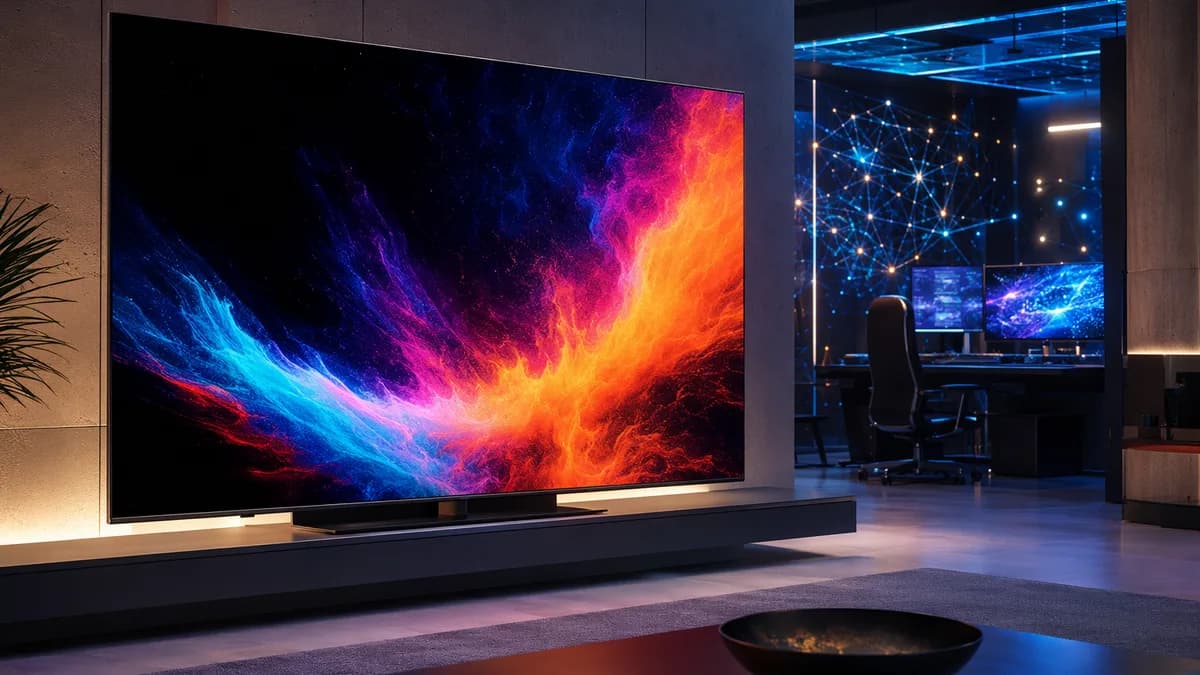
Sony Bravia 9 II makes the hardest premium TV question uncomfortable: if OLED is still the safe luxury pick, why does Sony’s new RGB LED TV look this convincing in bright rooms?
XOOMAR Intelligence
Analyst Take
That tension sits at the center of John Higgins’ review for The Verge, which calls the Bravia 9 II the best RGB LED TV he has seen this year, while still saying he would personally buy an OLED for most people.
“Sony’s flagship Bravia 9 II is the best RGB LED TV I’ve seen this year.”
That’s the useful part for buyers. This isn’t a simple “new TV is brighter” story. It’s a test of whether RGB LED can solve the usual LCD problem: delivering huge brightness and saturated HDR without making movies look harsh, flat, or haloed by blooming.
Why Sony’s Bravia 9 II makes OLED buyers pause
The Sony Bravia 9 II is positioned as a flagship TV with a very specific pitch: OLED-like premium intent, but with the brightness and reflection handling that OLED buyers often worry about in sunlit rooms.
The Verge’s viewing examples are telling. Dungeons & Dragons: Honor Among Thieves looked natural in its Faerûn landscapes, while magic from the Red Wizards of Thay came through as vibrant and colorful. HDR highlights stood out in Xenk’s glowing sword in the Underdark, explosions in Mad Max: Fury Road, and sunlight reflecting off waves in The Meg.
Those are not lab-demo scenes. They’re messy real content. A TV has to handle dark caves, desert glare, fantasy color, skin tones, motion, and pinpoint HDR brightness without turning everything into showroom candy.
The Bravia 9 II also carries a serious premium. The 65-inch model reviewed by The Verge is $3,600, compared with $2,600 for the 65-inch Bravia 7 II and $3,000 for the 65-inch Sony Bravia 8 II OLED. That pricing is why the review lands in a more nuanced place: brilliant TV, specific buyer.
For readers weighing premium hardware trade-offs across categories, that same “specs versus value” discipline shows up in XOOMAR’s consumer tech coverage, including the XGIMI Elfin Flip 4K review. The product category is different. The buyer problem is familiar.
How RGB LED differs from Mini LED already on shelves
RGB LED changes the backlight, not the basic fact that this is still an LCD TV.
Traditional LED and many Mini LED TVs use a blue or white backlight, then rely on filters, quantum dots, panel behavior, and processing to create the final color image. RGB LED starts earlier in the chain. It uses clusters of red, green, and blue LEDs in the backlight itself, blending those colors before the image reaches your eyes.
That matters because brightness and color are linked. A TV can hit a high peak brightness number and still lose color richness when pushed hard. RGB LED is meant to help preserve color intensity at high brightness, especially in HDR scenes where a glowing object or sunlight reflection should look bright without washing out.
But the technology doesn’t erase LCD’s core dependency: dimming control.
The Bravia 9 II has more dimming zones than the Bravia 7 II, according to The Verge, and that gives it finer control over transitions between bright and dark areas. More zones usually mean less blooming, where light from a bright object bleeds into nearby dark parts of the image.
Still, blooming remains. The Verge saw only a slight glow around subtitles or a dim haze around fireworks when viewed straight on or slightly off angle. From farther off axis, the blooming became more visible, including white and color bleeding into neighboring colors.
That’s the OLED counterargument in one sentence: RGB LED can get spectacularly bright, but it still has to manage a backlight.
How the Bravia 9 II makes HDR pop without turning fake
The most useful number in the review is 3,800 nits. That is what The Verge measured for HDR highlights on the Bravia 9 II. A full-field white screen measured 885 nits.
By comparison, the Bravia 7 II measured 2,200 nits for highlights and 848 nits full-field. Translation: the flagship pulls ahead most dramatically in small, intense HDR highlights, while broader full-screen brightness is much closer between the two Sony RGB LED sets.
| TV | 65-inch price in The Verge review | HDR highlights | Full-field white | Key distinction |
|---|---|---|---|---|
| Sony Bravia 9 II | $3,600 | 3,800 nits | 885 nits | Anti-reflective screen, more dimming zones |
| Sony Bravia 7 II | $2,600 | 2,200 nits | 848 nits | Similar RGB LED approach, lower price |
| Sony Bravia 8 II OLED | $3,000 | Not provided | Not provided | Pixel-level control |
Specular highlights are the small bright hits that make HDR feel alive: fire, metal reflections, magic effects, sunlight, sparks. The Verge’s examples line up with exactly that kind of content: Xenk’s sword, Fury Road explosions, and sunlight on water.
Sony’s processing matters here. The review says the Bravia 9 II’s algorithms help control how the TV uses brightness and color, and that gamma and EOTF tracking in Professional mode were even better than on the Bravia 7 II. That showed up as detailed shadows and images with proper depth.
There was one caveat. The review found the same SDR issue as the Bravia 7 II, with reds oversaturated and not as bright as they should be. For a flagship this expensive, that’s not nothing. But it did not dominate the reported viewing experience.
What Dungeons & Dragons reveals about color, contrast, and real content
Dungeons & Dragons: Honor Among Thieves is a better test than a pristine demo loop because it keeps changing visual demands.
Faerûn landscapes need natural greens, browns, skies, and skin tones. Red Wizard magic pushes saturated color. The Underdark asks for black-level control and shadow detail. Xenk’s glowing sword adds bright HDR highlights inside a dark sequence.
The Verge’s description suggests the Sony Bravia 9 II handled that mix well. Landscapes looked natural and real. Magic looked vibrant. The sword highlight popped without the whole scene collapsing into haze.
That combination is the reason RGB LED is interesting. Bright TVs are common. Convincing bright TVs are harder.
A shopper should take the right lesson from this. Don’t judge a flagship TV only with store demo footage. Demo reels are designed to flatter contrast, color, and motion. Use varied scenes: a dark cave, a bright outdoor sequence, a face in mixed lighting, subtitles over black, and fast movement. The Bravia 9 II’s strongest case comes from holding together across that kind of content.
Where Bravia 9 II beats OLED, and where OLED still wins
The Bravia 9 II’s clearest win is the bright room.
The Verge calls its anti-reflective screen the best the reviewer has seen. Bright lamps and windows were reduced to a dim glow that was hard to notice when content was playing. Even with the TV off, reflections did not draw much attention. The effect weakened off angle, but only became distracting close to 70 degrees off axis.
That is why this TV makes sense for sports, daytime viewing, and living rooms with windows. The review even cites World Cup games from an ATSC 3.0 antenna, watched with curtains open and sunlight coming through the windows, where image detail remained easy to see. If live sports are part of your buying calculus, our guide to Watch The Open 2026 Without Getting Blacked Out Early is a reminder that the content pipeline matters too, not just the panel.
The drawbacks are equally clear.
Only two of the Bravia 9 II’s four HDMI ports are HDMI 2.1. It supports 4K/120Hz, ALLM, and VRR, but The Verge still notes Sony has not matched the high-end expectation of four HDMI 2.1 ports. It also remains an LED TV, so blooming exists, especially off axis.
OLED still owns the cleanest contrast story because it has pixel-level control. The Verge’s final preference reflects that: the Sony Bravia 8 II OLED would be the reviewer’s first choice, because contrast remains king to human eyes.
The practical prescription is simple. If your room is bright, reflections are a daily problem, and you want a very high-end LCD, the Sony Bravia 9 II belongs on the shortlist. If you mostly watch movies in controlled lighting and care most about black levels, OLED still has the cleaner argument. The next thing to watch is whether Sony can push this RGB LED performance down in price without losing the anti-reflective screen and dimming control that make the flagship special.
Key Takeaways
- Sony’s Bravia 9 II challenges OLED’s premium-TV dominance by delivering strong brightness and HDR performance in bright rooms.
- The $3,600 price makes it a specialist buy rather than an obvious upgrade for every premium-TV shopper.
- Buyers now have a tougher choice between OLED’s proven strengths and RGB LED’s advantages in brightness and reflection handling.
Sony Premium TV Options Mentioned
| Model | Positioning | 65-inch price | Buyer takeaway |
|---|---|---|---|
| Sony Bravia 9 II | Flagship RGB LED TV | $3,600 | Best for bright rooms and high-impact HDR |
| Sony Bravia 7 II | Lower-priced Bravia option | $2,600 | Costs $1,000 less than the Bravia 9 II |
| Sony Bravia 8 II OLED | Sony OLED alternative | $3,000 | Still the reviewer’s likely pick for most people |
65-inch Sony TV Prices Mentioned
Primary Sources & Disclosures

Written by
XOOMAR Insights Team
Research and Editorial Desk
The XOOMAR Insights Team pairs automated research with human editorial judgment. We track hundreds of sources across technology, fintech, trading, SaaS, and cybersecurity, cross-check the facts, and explain what happened, why it matters, and what to watch next. We do not just rewrite headlines. Every article is fact-checked and scored for reliability before it goes live, and we link back to the original sources so you can verify anything yourself.