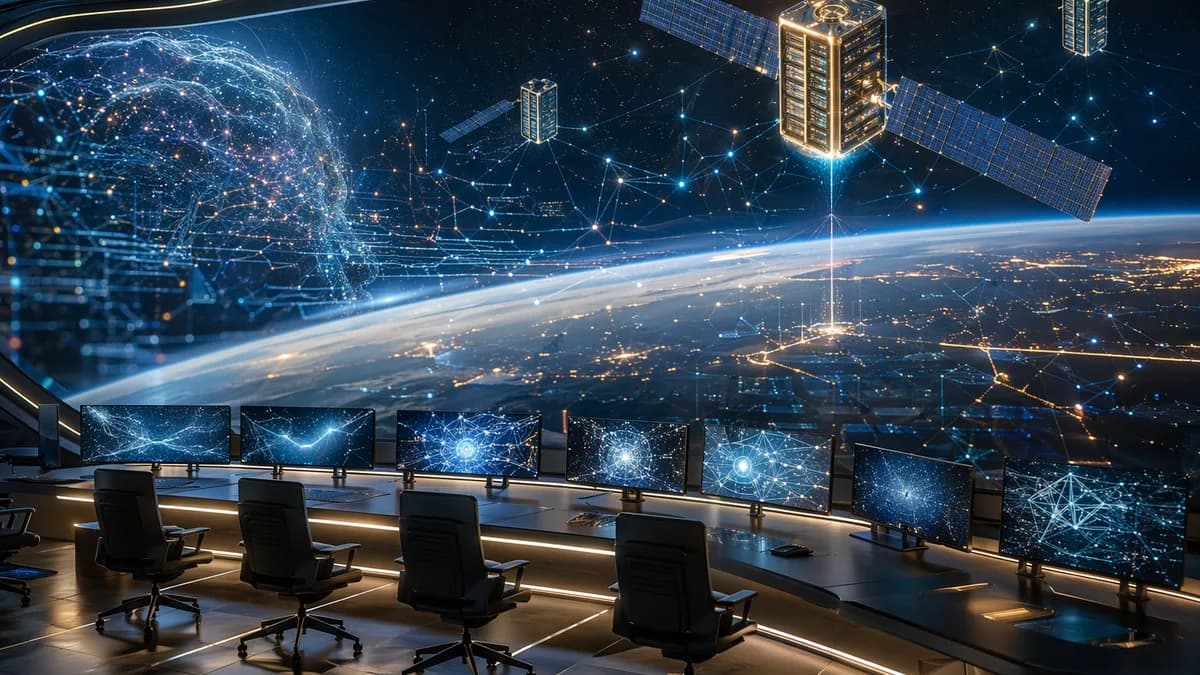
Why are public investors being asked to treat space data centers as a near-term AI infrastructure solution when the people who have run the numbers keep saying the timeline doesn't work?
XOOMAR Intelligence
Analyst Take
That is the real issue buried inside Sam Altman and Elon Musk's weekend slap fight. After Musk accused him of being a scammer, Altman fired back: “homeboy you’re the one sellling [sic] public market investors on short-term space datacenters.” Crude, yes. Also directionally right, according to TechCrunch.
My view: Altman's trash talk lands because space data centers are being sold as an answer to today's AI compute squeeze before the basic economics, hardware durability, launch cadence, and repair model have caught up. That doesn't make orbital compute a bad idea forever. It makes near-term orbital compute a bad investment story.
“homeboy you’re the one sellling [sic] public market investors on short-term space datacenters.”
Why does Altman’s jab hit harder than ordinary billionaire sniping?
Because this isn't just two tech bosses trading insults. It's a reminder that AI infrastructure has become a valuation machine.
TechCrunch frames the argument around SpaceX's plans to launch a fleet of orbital data centers to perform AI inference tasks. The bullish version is that compute in orbit could eventually support AI workloads or resemble a new kind of cloud infrastructure, but the near-term investment case depends on assumptions that are still very hard to prove.
That is a very large market narrative resting on a very difficult engineering stack.
The critique isn't anti-space. It isn't anti-AI. It's anti-fantasy accounting. If a company wants public market investors to price in short-term revenue from orbital compute, investors should demand short-term evidence that the system can be built, launched, powered, cooled, serviced, and refreshed at scale.
Right now, the expert consensus described by TechCrunch points the other way.
What breaks first when AI compute leaves Earth?
The first thing that breaks is the tidy investor slide.
A data center is not a rack of chips. It is power, cooling, networking, storage, redundancy, software operations, spare parts, maintenance crews, physical security, procurement cycles, and constant upgrades. On Earth, all of that is hard. In orbit, every one of those components becomes a mission constraint.
Tom's Hardware reports that it costs $5.6 million to launch 1,764 pound (800kg) into low Earth orbit using a SpaceX rocket. It also notes that one Nvidia NVL72 GB200 rack-scale solution weighs 3,000 to 3,245 pounds (1,360 to 1,472kg), depending on configuration, before data center-scale connectivity, cooling, and power infrastructure.
That comparison is brutal. It doesn't kill the concept. It kills the idea that orbit is a shortcut to cheap compute soon.
The source material says SpaceX is targeting AI inference tasks, not full-scale training. That distinction matters. Inference can be more flexible than training. But even for inference, the hardware still has to survive radiation, shed heat, move data, and avoid becoming obsolete too quickly.
For investors tracking the terrestrial version of this same capital intensity problem, XOOMAR has covered related AI infrastructure pressure in AI Data Centers Blow Up Microsoft Emissions by 25% and the finance-side scramble around compute exposure in Empery Digital Dumps Half Its Bitcoin for AI Data Centers. The space pitch sits on top of that same AI compute hunger, but with rockets attached.
Why doesn’t abundant sunlight settle the power problem?
The strongest pro-space argument is obvious. Orbit offers solar exposure, avoids local zoning fights, and escapes some terrestrial grid bottlenecks. That sounds attractive when AI data centers are already straining energy planning on Earth.
But chips don't just need power. They need to dump heat.
Vacuum does not give server operators a magic cooling discount. Without air or water-based terrestrial systems, heat has to be rejected through engineered thermal systems. The more compute you pack into orbit, the more cooling hardware becomes part of the payload.
Sam Altman put the problem more bluntly at a press conference hosted by The Indian Express:
“It will make sense someday, but if you just do the very rough math of launch costs relative to the cost of power we can produce on Earth, not to mention how you are going to fix a broken GPU in space, and they still break a lot, unfortunately, we are not there yet.”
That last line is the part investors should underline. GPUs fail. Systems degrade. Components need replacement. On Earth, a technician swaps hardware. In orbit, maintenance becomes logistics, robotics, launch capacity, and cost.
Space sunlight doesn't matter if the servers cook themselves or if the cooling system becomes the real data center.
Why is radiation a bigger problem than the hype admits?
Modern AI chips are built for performance, not for space.
TechRadar reports that advanced AI accelerators and high-performance processors use modern process technologies such as 4nm-class nodes, while radiation-resistant semiconductor technologies exist on much older nodes that lack the performance required for today's large AI workloads. Tom's Hardware similarly notes that leading-edge process technologies such as TSMC's N4 are not radiation-hardened, while radiation-hardened fabrication technologies tend to be older, citing 90nm as an example.
That gap matters. You can launch a computer into orbit. Launching competitive AI infrastructure is a different claim.
The orbital compute pitch needs hardware that combines advanced performance with radiation tolerance. It also needs space-worthy power and cooling systems capable of supporting large-scale AI accelerators. Those are not details. They are the business.
This is where the near-term sales pitch gets thin. A demo satellite is not a fleet. A fleet is not a cloud region. A cloud region is not a profitable, serviceable, upgradable business.
Can Starship close the business case fast enough?
Musk's answer is predictable: Starship.
If SpaceX can make Starship fly repeatedly and cheaply, the economics of orbit change. That is the best counterargument, and it deserves to be taken seriously. SpaceX has already changed launch markets before.
But that does not make orbital data centers a near-term business by itself. Reusable heavy-lift launch would still have to become routine, predictable, and cheap enough to support not just deployment, but replacement, upgrades, and maintenance. The difference between a successful test program and an operating infrastructure business is enormous.
There is another problem. Any version of the plan that depends on incomplete reusability, high refurbishment costs, or constrained launch availability would weaken the economics of space data centers quickly.
Musk's rejoinder, “we start flying them next year,” sounds impressive only if "flying them" means the same thing as "operating a scalable business." It doesn't.
A single high-speed processing satellite next year would prove capability. It would not prove manufacturing scale, launch cadence, repair economics, or long-term unit economics. Those are the questions that determine whether the concept becomes infrastructure or remains spectacle.
Why do investors keep buying the orbital compute story?
Because it turns infrastructure limits into spectacle.
AI companies and their backers have a problem: the compute story keeps getting bigger, messier, and more expensive. Power is hard. Cooling is hard. Hardware supply is hard. Refresh cycles are unforgiving. Orbit offers a cleaner narrative. More sun. More room. Fewer terrestrial constraints.
But a cleaner narrative is not a cleaner operating model.
The strongest case for space data centers belongs to the long game. If launch costs fall sharply, if reusable operations become routine, if space-grade AI chips improve, if robotics can handle servicing, and if orbital platforms can be manufactured at low cost and in volume, then some workloads may eventually make sense above Earth. TechCrunch's own expert framing leaves room for that future.
The mistake is compressing that future into the next few years.
Public investors should not accept "someday" as a revenue model. They should ask for hard numbers on launch cost, payload mass, cooling mass, power generation, latency, radiation tolerance, hardware failure rates, replacement cycles, and launch priority against other commercial and government commitments.
AI leaders should fix Earth-bound compute before selling servers in orbit. Space may someday host data centers. For now, the smartest compute strategy is still grounded.
The Bottom Line
- AI infrastructure hype is increasingly influencing public market valuations.
- Space data centers may have long-term potential, but the near-term business case remains highly uncertain.
- Investors need evidence on economics, durability, launch cadence, and repair models before pricing in orbital compute revenue.
Orbital AI Compute: Investment Narrative vs. Practical Reality
| Claim | Near-Term Concern |
|---|---|
| Space data centers could support AI inference workloads | Experts question whether launch, power, cooling, servicing, and hardware refresh economics are ready |
| Orbital compute may become a future cloud infrastructure model | The article argues it is not yet credible as a short-term AI infrastructure solution |
| Public investors are being asked to value short-term space data center revenue | The evidence needed to justify that timeline remains unproven |
Primary Sources & Disclosures

Written by
XOOMAR Insights Team
Research and Editorial Desk
The XOOMAR Insights Team pairs automated research with human editorial judgment. We track hundreds of sources across technology, fintech, trading, SaaS, and cybersecurity, cross-check the facts, and explain what happened, why it matters, and what to watch next. We do not just rewrite headlines. Every article is fact-checked and scored for reliability before it goes live, and we link back to the original sources so you can verify anything yourself.