
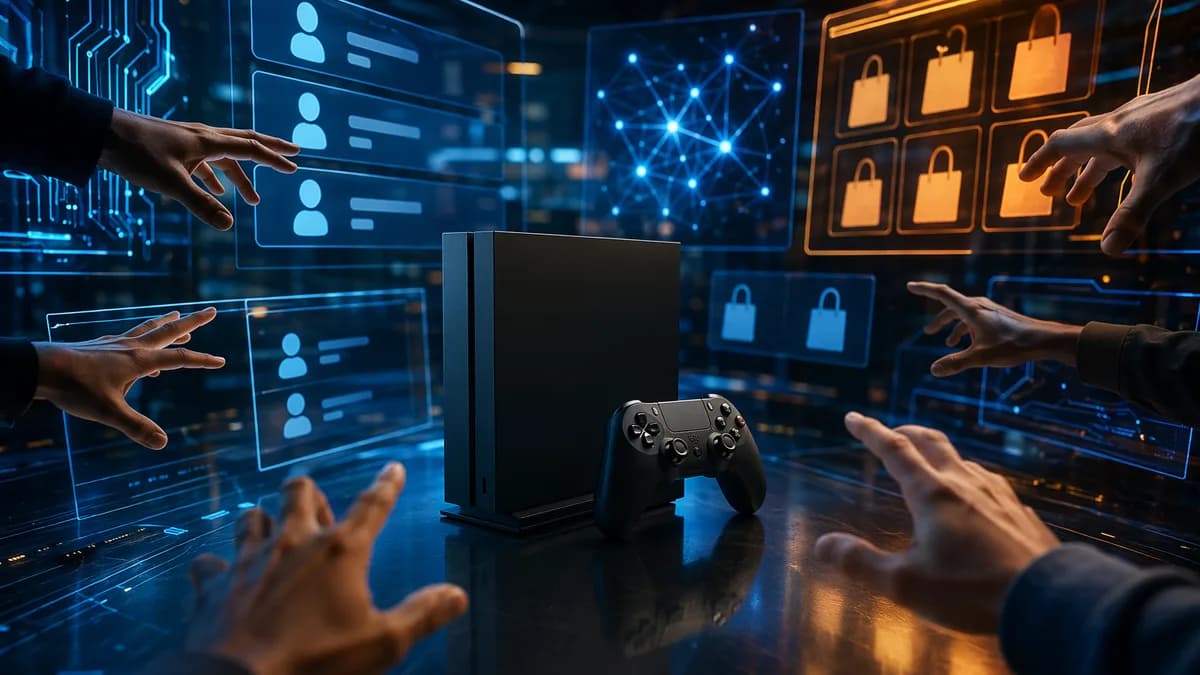
Valve tried to slow scalpers with a randomized reservation queue. Steam Machine scalping started anyway, before the device even reached store shelves.
TechnologyJune 28, 2026· 7 min read· By XOOMAR Insights Team
Steam Machine Scalping Flips Valve's Queue for $2,899
Updated on June 28, 2026
XOOMAR Intelligence
Analyst Take
72/ 100
4 sources analyzedMedium confidenceTrend10Freshness99Source Trust84Factual Grounding95Signal Cluster20
Successful reservation holders have begun listing Steam Machine reservation slots on eBay at steep markups, including one cited at $2,275, while Valve’s entry model starts at $1,049, according to Tom's Guide. The hardware is set to hit stores on Monday, June 29, but the resale market is already trying to turn queue access into a premium product.
That matters because these listings aren’t for finished hardware sitting in a box. They’re for the right to buy. That distinction makes the launch messier. Valve’s pricing debate was already hot, as we covered in At $1,049, Steam Machine Trips Over Its Own Promise. Now the first public price signal many buyers see is not Valve’s MSRP, but a speculative eBay markup.
Steam Machine scalping is turning queue access into the product
The central tension is simple: Valve designed a reservation system to reduce launch chaos, but scalpers found a way to monetize the queue itself.
Tom’s Guide reported eBay listings from around $1,600 to more than $2,500, with some marked as sold. IGN cited a sold listing for the 512GB Steam Machine with a controller, priced by Valve at $1,128, that sold for $1,500. IGN also reported a 2TB Steam Machine with a controller, retailing at $1,428, sold for $2,100, while a 2TB model without a controller sold for $2,899 against Valve’s $1,349 asking price.
That’s the part to separate carefully:
| Item | Valve price cited by sources | Resale example cited by sources | What the buyer is really paying for |
|---|---|---|---|
| 512GB Steam Machine, no controller | $1,049 | Listings above retail reported | Access plus urgency |
| 512GB Steam Machine with controller | $1,128 | $1,500 sold listing via IGN | Queue certainty |
| 2TB Steam Machine with controller | $1,428 | $2,100 sold listing via IGN | Early allocation |
| 2TB Steam Machine, no controller | $1,349 | $2,899 sold listing via IGN | Scarcity premium |
Asking prices do not equal real demand. A seller can list anything at $2,899. Completed sales matter more. The reported sold listings suggest at least some buyers are willing to pay above Valve’s price, but the available source material does not show enough completed transaction data to prove a broad resale market at those levels.
That distinction should guide buyers. Steam Machine scalping looks ugly. It does not yet prove the device will be impossible to buy through official channels.
Valve’s anti-scalper design slowed hoarding, not resale behavior
Valve did not use a standard first-come, first-served preorder system. It used a randomized reservation process, with limits meant to keep the launch from rewarding bots, speed, and timing luck.
Tom’s Guide says Valve limited reservations to one per household and required users to have a Steam account in good standing with at least one purchase made before April 27, 2026. Tom’s Hardware quoted Valve’s reasoning from its FAQ:
“A launch that starts at a specific day and time tends to reward bots, people with fast internet connections, talented gaming fingers for quick F5/refresh reactions, and those who can schedule their life around that moment. By accepting reservation signups over the course of a few days, without any incentive to be first, we're hoping to take away some of that friction.”
That system appears to have raised the cost of mass scalping. It did not remove the incentive for individual reservation holders to flip access.
The before and after is stark:
- Before launch controls: A fast checkout race would likely reward speed, scripts, and timing.
- After Valve’s queue system: The scarce asset shifted from the device itself to the reservation slot.
- Before hardware ships: Buyers can’t fully judge post-launch reliability from broad owner experience.
- After resale listings appear: The launch narrative starts orbiting scarcity before normal buyers even reach checkout.
That is the real lesson. Anti-bot controls can protect inventory allocation, but they don’t automatically stop people from reselling access once they win the allocation.
The markup math makes Valve’s official price look almost secondary
Valve’s official Steam Machine price was already a hurdle. A $1,049 starting point puts the device in a serious buying decision category, not an impulse hardware slot.
The resale listings distort that further. A buyer looking at $2,100, $2,275, or $2,899 is no longer evaluating Valve’s machine on Valve’s terms. They’re evaluating a scarcity event.
That creates a warped signal:
- For buyers: The high listings may imply the device is more unavailable than Valve has confirmed.
- For scalpers: Any completed sale validates the reservation flip.
- For Valve: The launch risks being judged by resale screenshots instead of official supply, reviews, and user experience.
- For marketplaces: The activity draws attention, but it also puts speculative reservation sales in public view.
XOOMAR analysis: the most important fact here is not that scalpers exist. That was predictable. The sharper point is that Valve’s queue design made finished inventory harder to hoard, so the speculative trade moved one layer upstream. The reservation became the scarce object.
That’s a useful signal for future high-demand hardware launches. Purchase limits and account checks help. They don’t end resale pressure when buyers believe early access itself has value.
Buyers are paying for uncertainty, not just a Steam Machine
Anyone considering a flipped reservation should be clear about what they’re buying. They are not buying a Steam Machine sitting in a warehouse ready to ship from Valve. They are relying on a third-party seller to convert a reservation into a completed transaction, then deliver on whatever arrangement was promised.
Tom’s Guide directly warns against paying the markup, citing scam risk on third-party marketplaces like eBay. The same report says Valve is expected to keep working through its waitlist as reservation holders cancel or fail to complete purchases within the 72-hour purchase window.
That weakens the case for panic buying.
The source material does not confirm how Valve treats attempted reservation transfers. That uncertainty alone should make buyers cautious. Add the premium, the possibility of cancellation, and the lack of broad post-launch owner feedback, and the risk-reward looks poor.
There is also a separate value question. Tom’s Hardware reported that the first batch of Steam Machines will have one 16GB stick of RAM, and said Valve indicated this may change. That does not prove future units will be better. It does mean early buyers may be paying inflated prices before the hardware picture fully settles. For the wider pricing context around PC hardware pressure, see our coverage of AI Data Centers Turn RAM Prices Against Cheap New PCs.
Steam Machine scalping will fade only if official supply catches up quickly
Valve’s next problem is narrative control. If official ordering keeps moving and waitlisted buyers get invitations without a long delay, these eBay listings become embarrassing noise. If supply stays tight and sold listings keep appearing above retail, Steam Machine scalping could become the launch story.
Two outcomes are now on the table:
| Launch path | Evidence that would support it | Likely effect |
|---|---|---|
| Scalping fades | Waitlist invitations continue, cancellations recycle slots, official buying remains realistic | Resale premiums look irrational |
| Scalping defines the launch | More completed sales appear above retail, buyers struggle to access official stock | Scarcity overshadows the device |
The evidence to watch is concrete: completed resale prices, official queue movement, cancellation rates if Valve discloses them, and whether Valve tightens transfer enforcement or reservation verification.
Valve can survive scalpers. What it can’t afford is a launch where the most visible way to get a Steam Machine is through someone who never intended to use one.
The Bottom Line
- Scalpers are turning Steam Machine reservation access into a resale product before launch.
- Reported resale prices are well above Valve’s official pricing, worsening concerns about affordability.
- Valve’s randomized queue did not stop buyers from monetizing high-demand reservation slots.
Steam Machine MSRP vs. Reported Resale Prices
| Model | Valve price | Reported resale price | Markup |
|---|---|---|---|
| 512GB Steam Machine with controller | $1,128 | $1,500 | $372 |
| 2TB Steam Machine with controller | $1,428 | $2,100 | $672 |
| 2TB Steam Machine without controller | $1,349 | $2,899 | $1,550 |
| Entry 512GB Steam Machine without controller | $1,049 | $2,275 cited listing | $1,226 |
Steam Machine MSRP vs. Reported Resale Prices
512GB + controller MSRP
$1,128
512GB + controller resale
$1,500
2TB + controller MSRP
$1,428
2TB + controller resale
$2,100
2TB no controller MSRP
$1,349
2TB no controller resale
$2,899
Entry model MSRP
$1,049
Cited listing
$2,275
Sources
- [1] Tom's Guide
- [2] Scalpers Are Already Flipping Steam Machine Reservations On eBay For $2,700–$2,900, Roughly Double Valve's Price
- [3] Steam Machine Reservation eBay Listings Double Retail Price as Scalpers Take Hold of Valve's New Console
- [4] Steam Machine scalping hits $3,000 on eBay as sellers list preorder reservations — scalpers already flipping queues for 2X the MSRP of the 2TB model

Written by
XOOMAR Insights Team
Research and Editorial Desk
The XOOMAR Insights Team pairs automated research with human editorial judgment. We track hundreds of sources across technology, fintech, trading, SaaS, and cybersecurity, cross-check the facts, and explain what happened, why it matters, and what to watch next. We do not just rewrite headlines. Every article is fact-checked and scored for reliability before it goes live, and we link back to the original sources so you can verify anything yourself.
Explore More Topics
Related Articles
 Technology
EBay Live Explodes Eightfold, Now Mandatory for Sellers
eBay is betting its survival on livestream commerce, forcing sellers to adopt Live after an 800% jump in volume, aiming to recapture auction-house energy and fi
Aug 9, 20266 min
 Technology
AI Coffee Crawl Stumbles Over Real Cup of Coffee
Using ChatGPT to plan a coffee shop crawl delivers a perfectly optimized but utterly soulless checklist, stripping away the personal discovery that defines a re
Aug 12, 20265 min
 Technology
Samsung's Galaxy Watch Ultra 2 Beats Apple Watch in Run Test
In a real-world 10K test, the Samsung Galaxy Watch Ultra 2 outperformed the Apple Watch Ultra 2 for a dedicated runner in three key areas, challenging Apple's p
Aug 10, 20267 min
 Technology
Ninja Slashes Kitchen Appliance Prices Up to 40%
Ninja is discounting its entire line of premium kitchen appliances on Amazon by up to 40%, a surprising move that trades margin for sales volume.
Aug 9, 20265 min
 Technology
Smeg's $259 Retro Coffee Maker Rejects Complex Tech
The Smeg Retro Coffee Maker is a high-end, style-forward machine that delivers a clean, flavorful brew with simple, one-button operation, directly challenging t
Aug 8, 20267 min
 Global Trends
Father's Day Gifts Shift From Novelty to Skincare Essentials
For Father's Day 2026, leading gift guides are pivoting from novelty items to functional, expert-curated skincare and haircare, signaling male grooming's move i
Aug 12, 20265 min
 Cybersecurity
Germany Scraps Postwar Spy Curbs After Security Lapses
Germany dismantles the core legal restrictions on its intelligence agencies established after WWII, a historic pivot from defensive caution toward proactive, of
Aug 12, 20265 min
 Technology
Apple Splits iPhone 18 Launch, Delays Base Model Until 2027
Apple is fracturing its iconic September launch, planning to debut only iPhone 18 Pro models this fall and holding the standard iPhone 18 until 2027.
Aug 12, 20267 min
 Fintech
Western Union Buys a Sinking Ship for $500 Million
Western Union's $500 million deal for remittance firm Intermex looks disastrous as revenue plunges 18%, revealing the company's frantic—and failing—defense agai
Aug 12, 20266 min
 Technology
AI's Founders Declare Open Models Unstoppable
Three AI pioneers argue that open-weight models are an irreversible reality, and the US must compete within that open world or risk ceding control to a closed e
Aug 12, 20266 min
Don't miss the signal
Get our weekly roundup of the stories that matter across tech, fintech, and trading. No noise, just signal.
Free forever. No spam. Unsubscribe anytime.