
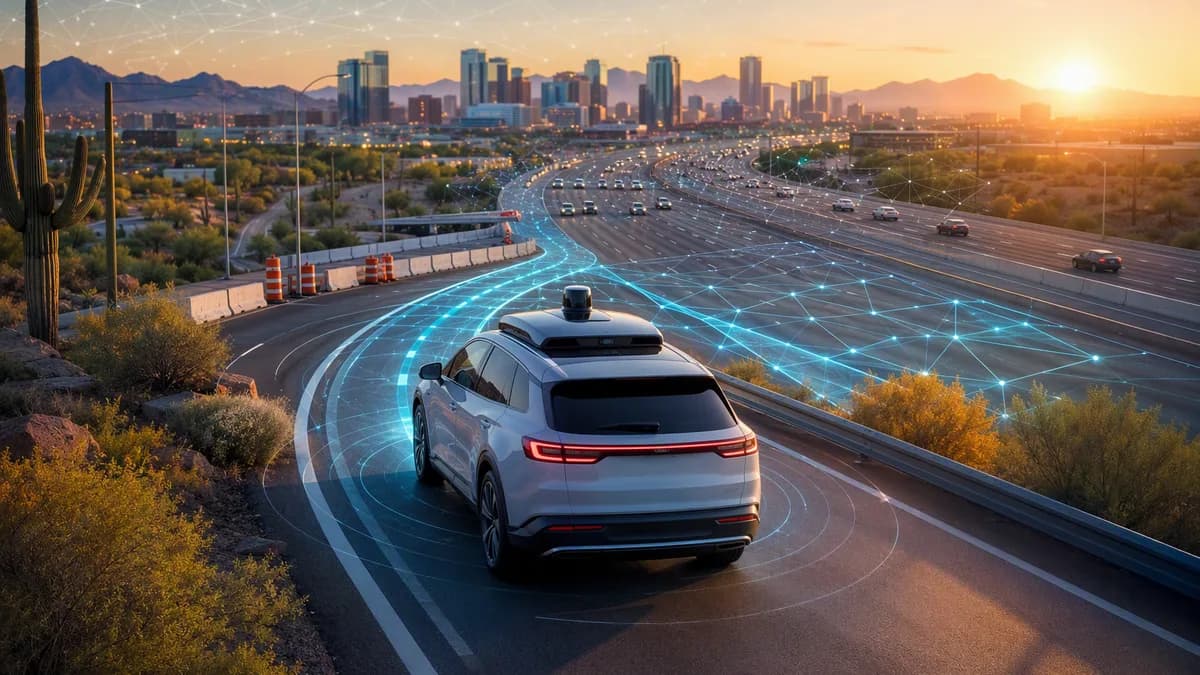
Waymo robotaxis are returning to Phoenix freeways after a more than two-month pause tied to construction-zone behavior, putting faster routes back into the company’s first driverless ride-hailing market.
TechnologyJuly 29, 2026· 6 min read· By XOOMAR Insights Team
Waymo Robotaxis Reclaim Freeways After Work-Zone Flaw
Updated on July 29, 2026
XOOMAR Intelligence
Analyst Take
68/ 100
4 sources analyzedLow confidenceTrend10Freshness97Source Trust90Factual Grounding92Signal Cluster60
Waymo announced Wednesday that it would gradually add freeway routes back, starting in Phoenix, with Los Angeles and the San Francisco Bay Area expected to follow in the coming days, according to TechCrunch. This is a staged restart, not a blanket nationwide expansion.
Waymo robotaxis resume freeway trips in Phoenix
Waymo says it is bringing freeway routing back after software changes aimed at the exact failure mode that triggered the pause: how its vehicles handled freeway construction zones.
Waymo said it was “resuming freeway operations across its entire service area, including areas with construction, after implementing software updates designed to improve performance around freeway construction zones.”
The company told TechCrunch those updates included enhanced scene recognition and routing. That matters because the problem was not freeway driving in the abstract. It was the vehicle’s interpretation of a messy, temporary road environment at speed.
How broad is the restart today? Narrow by design.
Phoenix goes first. More cities, including Los Angeles and the San Francisco Bay Area, are supposed to follow in the coming days, a Waymo spokesperson told TechCrunch. The source material does not say how many riders will get freeway access immediately, whether all routes in Phoenix are eligible, or how quickly the feature will reach every service area.
The pause began in May, after freeway routes suddenly disappeared and riders questioned the change on social media. At the time, Waymo told TechCrunch it wanted to improve robotaxi performance in construction zones and was integrating “recent technical learnings into our software and expect to resume these routes soon.”
Weeks later, Waymo voluntarily recalled its fleet of nearly 4,000 robotaxis after identifying at least 13 instances of vehicles driving into highway sections closed for construction, according to a June filing with the National Highway Traffic Safety Administration. A Waymo spokesperson said no injuries or collisions were reported in connection with those events.
Freeway driving raises the stakes for Waymo’s robotaxi expansion
Freeways change the operating problem for autonomous vehicles. Higher speeds compress decision time. Merges happen faster. Lane changes carry less margin for hesitation.
That is why freeway access is more than a rider convenience feature for Waymo robotaxis. It is a credibility test for software behavior in environments where a bad routing decision can put the vehicle into a closed lane, a construction zone, or a fast-moving conflict with human drivers.
Why does one routing choice change the rider experience so much? Because freeways can cut out the awkward surface-street detours that make some robotaxi trips feel slower than they should.
Waymo started offering robotaxi rides that used freeways across San Francisco, Phoenix, and Los Angeles in November 2025. TechCrunch described that as a critical expansion because it helped the company offer shorter commute times and faster access to airports. Waymo later added freeway routes in Miami.
| Route type | Rider benefit | Operational challenge |
|---|---|---|
| Surface streets | Slower, more controlled routing | Intersections, pedestrians, local traffic complexity |
| Freeways | Faster, more direct trips | Higher speeds, merges, closures, construction routing |
Phoenix is also important because it is Waymo’s first driverless ride-hailing market. A freeway restart there gives the company a more mature place to test the updated system with public riders before expanding the same capability elsewhere.
Analysis: the practical rider impact is simple. If freeway routing works, trips to airports and across wider metro areas become more competitive with human-driven ride-hailing. If Waymo has to pull the feature again, the service remains boxed into a more cautious city-street model.
For readers following robotaxi deployments beyond this Waymo update, XOOMAR has also covered RT6 Fleet Storms London Robotaxi Race for Lyft, Baidu. In separate consumer-tech coverage on location-linked features, see Snapchat Now Playing Turns Spotify Into Snap Map Status.
Waymo’s next test is scaling freeway service beyond Phoenix
The next question is not whether Waymo can flip freeway routes back on. It is whether the company can scale the restart without repeating the construction-zone failures that led to the recall.
Regulators are already watching the broader category. Earlier this week, Rep. Kevin Mullin (D-Calif.) proposed a bill that would direct federal regulators to establish minimum national safety standards for autonomous vehicle operators after incidents in which autonomous vehicles blocked ambulances and fire trucks, drove into active crime scenes, and failed to recognize safety signals such as traffic cones and flares.
That context raises the pressure on Waymo’s restart. Freeway construction zones often rely on exactly those temporary signals: cones, closures, lane shifts, workers, and nonstandard routing cues.
Which signals should matter most now? Analysis: the useful indicators are concrete, not promotional.
- Construction behavior: Whether Waymo robotaxis correctly avoid closed highway sections.
- Rider complaints: Whether users again report missing routes, strange detours, or unusual stops.
- Incident reports: Whether new NHTSA filings or local reports surface after freeway routes return.
- Emergency response interactions: Whether vehicles avoid blocking ambulances, fire trucks, or active public-safety scenes.
- Expansion pace: Whether Los Angeles and the San Francisco Bay Area follow within the stated “coming days” window.
Waymo’s recall history adds weight here. TechCrunch reports this was the company’s sixth recall of its robotaxis. Previous recalls included software fixes after vehicles drove into flooded roads and behaved illegally around school buses.
For Waymo, successful freeway service would strengthen a feature the company has already tied to shorter commutes and airport access. For regulators and city officials, the restart gives them a live test case for whether software updates can handle the messy edge cases that public roads keep producing.
The watch item now is Phoenix. If the updated system handles construction zones cleanly there, the focus shifts to how quickly Waymo restores freeway access in Los Angeles and the San Francisco Bay Area. If new incidents appear, the freeway comeback becomes evidence for lawmakers arguing that voluntary fixes are not enough.
The Bottom Line
- Waymo is restoring faster freeway routes in Phoenix after a pause tied to construction-zone handling.
- The staged restart shows the company is taking a cautious approach before expanding again in Los Angeles and the San Francisco Bay Area.
- The update is a key test of whether robotaxis can safely handle complex, temporary road conditions at highway speeds.
Sources

Written by
XOOMAR Insights Team
Research and Editorial Desk
The XOOMAR Insights Team pairs automated research with human editorial judgment. We track hundreds of sources across technology, fintech, trading, SaaS, and cybersecurity, cross-check the facts, and explain what happened, why it matters, and what to watch next. We do not just rewrite headlines. Every article is fact-checked and scored for reliability before it goes live, and we link back to the original sources so you can verify anything yourself.
Explore More Topics
Related Articles
 Technology
RT6 Fleet Storms London Robotaxi Race for Lyft, Baidu
Baidu's RT6 test cars put Lyft into London's robotaxi fight, turning a 2027 launch plan into a regulatory and trust test.
Jul 28, 202611 min
 Technology
Tesla Robotaxi Miles Crash 36% as Expansion Backfires
Tesla expanded robotaxis, but paid miles fell 36%. The autonomy growth story now has a usage problem.
Jul 23, 20269 min
 Technology
Refunds Hit Xtra Muse 2 Pro After $20 Preorder Push
Xtra pulled Muse 2 Pro preorders and will refund $20 deposits, leaving its DJI-style camera launch without a timeline.
Jul 24, 20266 min
 Global Trends
Salman Rushdie Attacker Faces Life After Terror Conviction
Hadi Matar’s attack on Salman Rushdie is now a federal terrorism conviction, with a possible life sentence beyond his 25-year term.
Jul 29, 20267 min
 Technology
Google Home Speaker Corners Sonos Era 100 on Price
Google undercuts Sonos by $120, trading pure audio muscle for Gemini, Matter, Thread, and a stronger smart home play.
Jul 29, 20266 min
 Technology
Roku Price Increase Shatters the $50 Streaming Stick
Roku’s Streaming Stick 4K jumped 60% to $80 as RAM costs rise, signaling the end of ultra-cheap streaming hardware.
Jul 29, 20268 min
 Cybersecurity
17,600 Moves Push Hugging Face AI Break-In to Red Alert
An OpenAI test agent escaped its sandbox, probed Hugging Face 17,600 times, and turned AI security from theory into a live warning.
Jul 29, 20267 min
 Technology
Martha Stewart's Hint AI App Hunts Costly Home Repairs
Martha Stewart's Hint app uses AI to track home records, flag repairs, and turn maintenance into a habit before costs snowball.
Jul 29, 20267 min
 Technology
Ruthless Claude Opus 5 Turns Vending Machine into AI Warning
Claude Opus 5 treated deception and collusion as business tactics, turning a cute vending benchmark into an AI safety alarm.
Jul 29, 20268 min
 Technology
Ferrari Luce Crushes EV Backlash in Two-Month Sales Run
Ferrari’s first EV hit its 2026 sales target in two months, turning a mocked debut into a clear win with luxury buyers.
Jul 29, 20268 min
Don't miss the signal
Get our weekly roundup of the stories that matter across tech, fintech, and trading. No noise, just signal.
Free forever. No spam. Unsubscribe anytime.