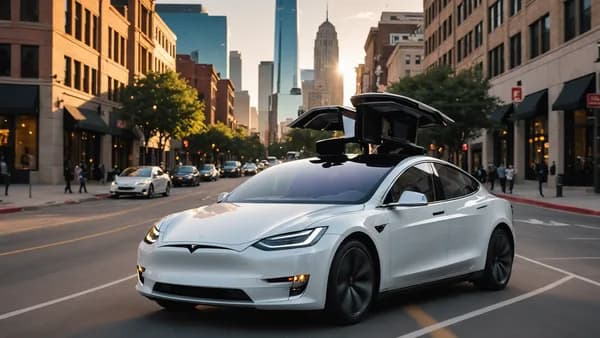
Tesla robotaxis now have a utilization problem, not just a rollout problem: Tesla expanded its paid ride service across more cities, yet its own figures show paid miles fell 36% in the second quarter.
XOOMAR Intelligence
Analyst Take
That decline came from a Tesla chart reviewed by TechCrunch. At first glance, the chart appeared to show cumulative growth. Broken into quarterly performance, however, the picture looked weaker: Tesla’s paid robotaxi miles moved lower rather than higher.
Tesla’s robotaxi story now has a mileage problem
Tesla has spent the past year selling autonomy as the next engine of the company. The pitch is simple: a massive, low-cost, cash-generating Robotaxi fleet could reshape Tesla’s earnings profile.
The new mileage trend cuts straight into that pitch. City count can rise while the real business shrinks. Paid miles are the closest public proxy for whether vehicles are actually carrying paying passengers at useful scale. They blend demand, availability, reliability, safety constraints, and operating intensity into one hard number.
That matters even more because the decline arrived while investors were already scrutinizing Tesla’s core businesses and the company’s broader growth story. Robotaxis are not just a side project in Tesla’s valuation narrative. They are increasingly treated as a central piece of the long-term earnings case.
XOOMAR analysis: the central question is no longer whether Tesla can announce more robotaxi coverage. It can. The question is whether broader coverage produces more monetized usage. So far, Tesla’s own chart suggests the answer was no in the second quarter.
Paid miles matter more than a bigger service map
Tesla has emphasized expansion of its nascent robotaxi operation, but the paid-mile decline makes that expansion harder to interpret. A bigger map is not the same thing as a more productive network, especially when the company has not disclosed enough operating detail to show how many vehicles are active, how often they carry riders, or how much of the service is meaningfully autonomous.
That makes the paid-mile decline difficult to shrug off. A network that adds coverage should, in theory, add more trips, more riders, and more miles. Instead, Tesla’s disclosed trend moved in the opposite direction.
The missing numbers now matter as much as the numbers Tesla disclosed:
- Active vehicles: How many robotaxis were actually available each week?
- Completed rides: Did trip volume fall, or did average trip length shrink?
- Revenue per mile: Are paid miles translating into meaningful revenue?
- Interventions: How often did humans, safety drivers, or teleoperators step in?
- Wait times: Are riders abandoning trips before pickup?
- Repeat usage: Are customers coming back after the novelty wears off?
- Cancellations: Are operational limits blocking demand?
Tesla’s autonomy story has often been told through future scale. Paid miles force the discussion back to present operations.
A robotaxi network can grow on maps while shrinking on streets
There are several plausible reasons paid miles can fall while launch areas increase. Some are operational. Tesla may be constraining service areas, limiting hours, pulling vehicles offline, tightening safety rules, or dealing with local permitting boundaries. Service design also matters because different levels of human oversight can change cost, capacity, and regulatory exposure.
There is also a Tesla-specific product issue. Tesla’s future robotaxi strategy is not only about adapting existing vehicles; it also depends on purpose-built autonomous vehicles proving they can operate reliably in commercial service. That kind of validation is different from showing that consumer cars can collect road data or run driver-assistance software with a human behind the wheel.
That distinction is important because it narrows Tesla’s earlier data advantage argument. Tesla has long pointed to its huge fleet of customer cars as a foundation for autonomy development. But a future Cybercab fleet would still need proof that the vehicle platform, service model, and operating stack can work together in real ride-hailing conditions.
XOOMAR analysis: this is the practical gap between driver-assistance learning and commercial ride service. A consumer car using Full Self-Driving with a human behind the wheel is not the same operating problem as a paid robotaxi that must handle riders, pickup points, edge cases, remote assistance, and local oversight.
Waymo and Tesla now show two different robotaxi lessons
The supplied data supports a clear contrast between Tesla’s camera-first strategy and Waymo’s heavier autonomous vehicle approach. Tesla has continued to argue that autonomy can be achieved without the same sensor-heavy stack used by some rivals.
Waymo, by contrast, is described in the supplied materials as having logged over 127 million miles of autonomous driving. That mileage base gives Waymo a different kind of proof point: accumulated autonomous operation at significant scale.
| Company | Strategy described in source material | Relevant signal |
|---|---|---|
| Tesla | Camera-first autonomy, Model Y robotaxis, future Cybercab fleet | Paid miles fell 36% quarter over quarter |
| Waymo | More sensor-heavy autonomous driving program | Over 127 million autonomous miles logged |
The comparison is not just about sensors. It’s about proof style. Tesla wants to show autonomy can scale through a lower-cost stack. Waymo’s record emphasizes accumulated autonomous miles and operational experience.
That puts Tesla under pressure to publish more than cumulative charts. If the company wants markets to price in robotaxi scale, it needs operating metrics that move in the right direction.
Safety claims now face sharper numerical scrutiny
Tesla executives have framed the slow rollout as caution, arguing that robotaxi expansion must avoid the kind of safety failure that could damage public trust and attract regulatory attention. That is a reasonable concern, but it also raises the standard for disclosure.
The issue is not simply whether Tesla says the service is safe. It is whether outsiders can understand how Tesla defines safety, what incidents are counted, when human assistance is involved, and how the company separates supervised service from more autonomous operation.
That lack of definition matters because robotaxi safety is judged through more than one lens. Investors may focus on utilization and revenue potential. Riders may focus on comfort and reliability. Regulators may focus on incident reporting, remote operation, and whether marketing language matches the actual level of autonomy in service.
XOOMAR analysis: Tesla is now asking investors and regulators to accept two claims at once. First, that its robotaxis are safe enough to expand. Second, that scaling must remain cautious because a single bad incident could reset the program. Those claims can coexist, but they require unusually transparent reporting.
For broader market context, the parallel is simple: when a thesis depends on confidence, data gaps become expensive. Robotaxis are especially vulnerable to that dynamic because trust, safety, and utilization all have to rise together.
Falling paid miles pressure Tesla’s autonomy valuation story
For investors, the 36% drop lands in the worst possible place: the bridge between vision and revenue. Tesla’s robotaxi thesis needs operating proof, not just product language. If robotaxis are central to future earnings, shrinking paid usage makes the timing and revenue model harder to defend.
Riders will judge the service more bluntly. They care whether the vehicle arrives, whether the trip works, whether it feels safe, and whether the service is predictable. Autonomy ideology does not carry a passenger to a destination.
Regulators will read the same data differently. A company expanding coverage while paid miles fall may invite questions about operational maturity, incident reporting, remote operation, and what counts as autonomous service when human oversight is present.
The decline does not prove Tesla robotaxis are failing. Early networks can be lumpy. Safety constraints can suppress miles. Software updates can interrupt deployment. But the burden has shifted. Tesla now needs to show consistent utilization growth, clearer safety definitions, and credible evidence that new markets produce more real rides.
Tesla’s next robotaxi test is sustained mileage, not another launch city
Tesla can still reframe progress around new markets, software improvements, fleet additions, or expanded autonomous capability. But the next test is simpler: paid-mile recovery.
Three scenarios now matter:
- Rebound: Paid miles rise as constraints ease, repeat usage improves, and more vehicles stay active.
- Plateau: Tesla keeps adding coverage, but operations remain tightly limited.
- Deeper skepticism: Paid miles keep falling or safety disclosures remain too vague to support the valuation story.
The evidence that would strengthen Tesla’s case is straightforward: rising paid miles, more completed rides, transparent incident definitions, lower intervention rates, and clear separation between supervised and unsupervised service.
Tesla can still shape the robotaxi market. But the next credible proof won’t be another dot on a coverage map. It’ll be more paying passengers traveling more miles, quarter after quarter.
The Bottom Line
- Tesla’s robotaxi thesis depends on rising paid usage, not just wider geographic availability.
- A 36% drop in paid miles raises questions about demand, reliability, and operating scale.
- The trend could pressure investor confidence in autonomy as a major future earnings driver.
Tesla Robotaxi Expansion vs. Usage
| Metric | Signal |
|---|---|
| Service coverage | Expanded across more cities |
| Paid robotaxi miles | Fell 36% in the second quarter |
| Investor takeaway | A larger map has not yet translated into more monetized usage |
Tesla Paid Robotaxi Miles Change in Q2
Primary Sources & Disclosures

Written by
XOOMAR Insights Team
Research and Editorial Desk
The XOOMAR Insights Team pairs automated research with human editorial judgment. We track hundreds of sources across technology, fintech, trading, SaaS, and cybersecurity, cross-check the facts, and explain what happened, why it matters, and what to watch next. We do not just rewrite headlines. Every article is fact-checked and scored for reliability before it goes live, and we link back to the original sources so you can verify anything yourself.