
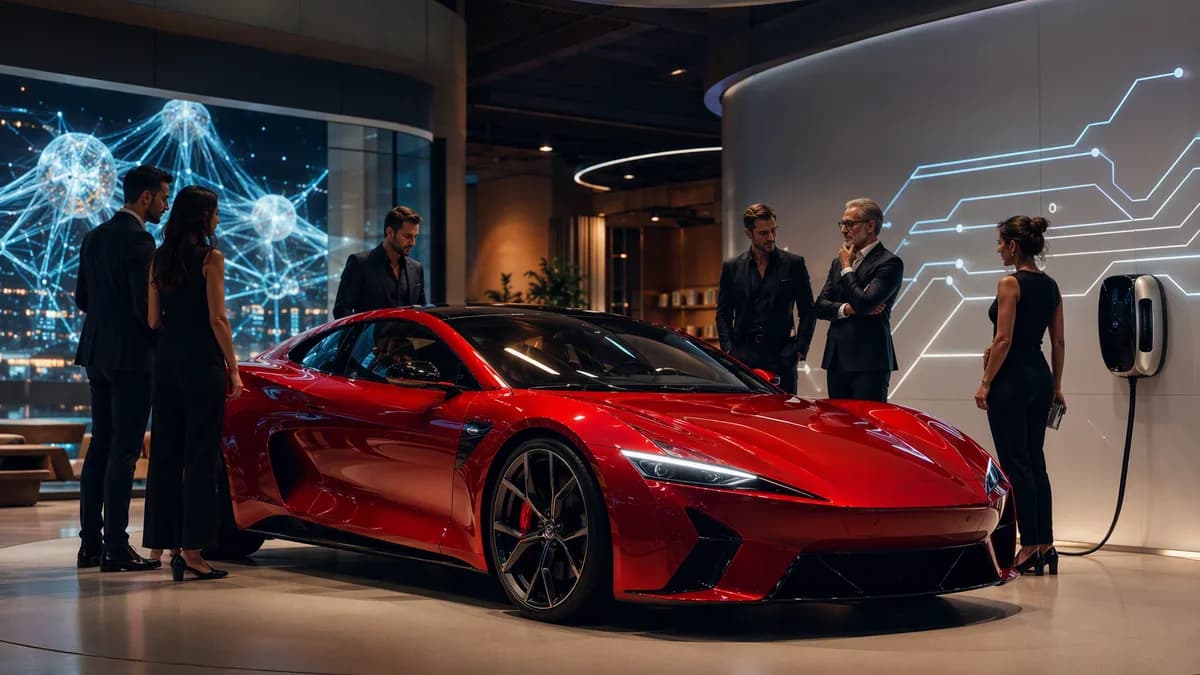
Ferrari hit this year’s sales target for the Ferrari Luce in just two months, which is a blunt answer to everyone who declared the company’s first EV dead on arrival. The car may offend purists, irritate commenters, and confuse anyone who thinks Ferrari buyers make decisions like spreadsheet shoppers. But if the order book is already where Ferrari wanted it to be for the year, the market has spoken louder than the comment section.
TechnologyJuly 29, 2026· 8 min read· By XOOMAR Insights Team
Ferrari Luce Crushes EV Backlash in Two-Month Sales Run
Updated on July 29, 2026
XOOMAR Intelligence
Analyst Take
58/ 100
1 source analyzedLow confidenceTrend10Freshness99Source Trust90Factual Grounding91Signal Cluster20
The Ferrari Luce, a €555,000 ($630,000) five-seater designed largely by Jony Ive and LoveFrom, reached a target of just under 500 units, according to TechCrunch, citing a Financial Times report. That matters because the backlash was immediate and gleeful. Critics mocked the wedge-shaped design, compared it with a Nissan Leaf, argued Chinese EVs would beat it on price and performance, and watched Ferrari’s stock drop 8% the day after the May reveal.
“Ferrari hit this year’s sales target for the Luce in just two months, according to a report by the Financial Times.”
That single sentence punctures the loudest claim around the Ferrari Luce: that electrification would automatically dilute Ferrari’s appeal. It hasn’t, at least not with the buyers Ferrari needed to convince.
Ferrari Luce sales prove the EV panic was always overcooked
The internet treated the Ferrari Luce as a referendum on whether Ferrari had lost its nerve. That was the wrong test. Ferrari didn’t need universal applause. It needed enough buyers willing to pay €555,000 ($630,000) for a first-generation electric Ferrari.
It apparently found them quickly.
The backlash was predictable. Ferrari is one of the few car brands whose fans talk about sound, shape, and feel with near-religious intensity. So when the company showed a five-seat EV with unfamiliar proportions, the reaction was less product critique than cultural alarm.
But Ferrari buyers, not social media spectators, decide whether this car works. A commenter can dislike the Luce for free. A customer has to commit real money. That gap is the whole story.
XOOMAR analysis: the Luce’s reported sales target doesn’t prove every Ferrari customer wants an EV. It proves Ferrari sized the first move correctly. Under 500 units is not a mass-market bet. It’s a controlled test of desire.
Ferrari buyers are paying for more than engine noise
The strongest anti-Luce argument starts with sound. Fair. Ferrari’s combustion drama is central to its emotional pull. Nobody should pretend an EV can copy that exactly.
But the source material points to a broader truth: Ferrari’s appeal isn’t only mechanical. TechCrunch notes that Ferrari has an “enthusiastic and price-insensitive customer base,” and that the company sold more than 13,000 cars last year, a large number for an automaker specializing in six-figure vehicles.
That tells us something about the buyer pool. These customers are not choosing between a Luce and a budget EV. They’re choosing whether an electric Ferrari deserves space next to other high-end cars they may already own.
The badge still matters. So does the theater of owning something rare, expensive, and controversial. In luxury, controversy can even help if the product stays exclusive enough.
The Ferrari Luce also carries the prancing horse on the hood. TechCrunch’s phrasing is sharp because it’s true: for Ferrari, that badge can do a lot of commercial work.
The Ferrari Luce turns electrification into a luxury flex
The source says the Luce seems “tailor-made for the Chinese market,” which favors fast, sleek four-door EVs. Based on previous reports cited by TechCrunch, at least 20% of Luce sales will make their way to China.
That’s not a side note. It’s a clue to why the car exists in this form.
Ferrari didn’t build a minimalist science project. It built a five-seater EV with enough visual aggression to spark arguments and enough badge equity to carry a brutal price. The car doesn’t need to replace every V12 fantasy. It only needs to be desirable enough for a specific slice of Ferrari’s global customer base.
The practical read:
- Target size: Just under 500 units makes success achievable without needing broad approval.
- Price point: €555,000 ($630,000) filters for buyers who are not acting like mainstream EV shoppers.
- Market fit: The China angle matters because the source says that market favors fast, sleek four-door EVs.
- Brand carry: Early reviews suggest it drives like a Ferrari should, according to TechCrunch.
That combination makes the Luce less risky than the backlash implied. It’s a narrow product for a narrow buyer, not a referendum for every person who has ever loved a gated shifter.
Internet outrage keeps misreading how Ferrari actually makes money
The Luce backlash made one basic mistake: it judged Ferrari like a volume automaker.
Ferrari’s own target, as reported, was just under 500 units this year. That is the key number. A product can look niche, strange, and overpriced to outsiders while still being exactly right for the customers Ferrari wants.
The people comparing the Luce to cheaper Chinese EVs may be correct on paper if the metric is raw spec-per-euro. But that isn’t the buying logic described in the source. TechCrunch points directly to Ferrari’s price-insensitive customer base and the likelihood that many buyers already own several models.
That changes the frame. A Luce buyer may not be asking whether this is the best EV in the world at the best price. The question is simpler: is this electric Ferrari special enough to add to the garage?
This is where market narratives often run ahead of hard evidence. We’ve seen that pattern in other sectors XOOMAR covers, from deal perception in 10% Dilution Reset Reframes FirstSun First Foundation Deal to balance-sheet scrutiny in $8.5B Repayment Puts First Citizens SVB Debt on Trial. The lesson is the same: outrage is noisy, but commitments count.
The best argument against the Ferrari Luce still deserves respect
The anti-Luce camp is not stupid. A Ferrari without combustion sound, vibration, and gearshift drama does lose something. If Ferrari shipped an EV that felt generic, heavy in spirit, or anonymous behind the wheel, it would deserve the backlash.
A poorly executed electric Ferrari would be dangerous for the brand. It would look like a tech product wearing a famous badge. That would make the Luce feel cynical rather than ambitious.
But the reported demand undercuts the idea that the concept is doomed. Early reviews, according to TechCrunch, suggest that the Luce “drives like a Ferrari should.” That line matters more than the online styling debate.
Appearance is subjective. TechCrunch also makes a fair point: some cars don’t translate well on screen. The Luce’s wedge-shaped design may have been easy to mock in photos and harder to dismiss in person.
XOOMAR analysis: Ferrari’s challenge is not to fake an engine. That would be embarrassing. The better task is to create a new kind of Ferrari emotion, one built around response, design, rarity, and presence rather than imitation noise.
A successful Ferrari EV makes the supercar future harder to mock
If the Ferrari Luce keeps its reported momentum, the easy joke about electric supercars gets weaker. Not because every performance brand can copy Ferrari. Most can’t. Ferrari starts with an advantage few companies have: buyers who already accept extreme prices and limited access.
Still, the cultural test matters. The Luce shows that electrification can be sold as desire, not apology, if the product has identity. Specs alone won’t do that. A familiar badge alone won’t do it either. The car has to feel deliberate.
The stock drop after the reveal showed how quickly investors and observers can punish a product that violates expectations. The sales report shows the counterweight: actual buyers may be less nostalgic than the loudest fans.
That doesn’t mean Ferrari has solved EVs forever. It means its first shot did not collapse under the weight of its own controversy.
Ferrari should ignore the comment section and build the next obsession
Ferrari should take the Luce’s reported early performance as permission to stop apologizing for the premise. The company doesn’t need to convince every purist that an EV belongs in the same emotional category as its combustion icons. It needs to protect the things the source suggests still work: rarity, price discipline, design drama, and the feeling that a Ferrari is never just transport.
The watch item now is simple: whether Ferrari can turn the Luce from a controversial first EV into a repeatable electric playbook without making the badge feel less selective.
For now, the haters lost the first round. The first Ferrari EV didn’t need permission. It needed buyers, and it seems to have found them.
The Bottom Line
- Ferrari reached its annual Luce sales target in two months despite heavy backlash.
- The strong demand suggests electrification has not weakened Ferrari’s appeal among its core buyers.
- The reaction contrasts with investor skepticism after Ferrari’s stock dropped 8% following the reveal.
Sources

Written by
XOOMAR Insights Team
Research and Editorial Desk
The XOOMAR Insights Team pairs automated research with human editorial judgment. We track hundreds of sources across technology, fintech, trading, SaaS, and cybersecurity, cross-check the facts, and explain what happened, why it matters, and what to watch next. We do not just rewrite headlines. Every article is fact-checked and scored for reliability before it goes live, and we link back to the original sources so you can verify anything yourself.
Explore More Topics
Related Articles
 Technology
Cash Burn Clouds Tesla Q2 Earnings After $28.2B Haul
Tesla's revenue rebound beat expectations, but a $1.1B free cash flow loss leaves investors with a spending problem.
Jul 26, 20267 min
 Technology
Apple Maps Seizes Ford EV Dashboards in $30K Truck Bet
Ford will bake Apple Maps into 2027 EVs, making navigation, charging and battery prep part of its $30K electric truck push.
Jul 23, 202611 min
 Technology
Ford’s $30,000 Electric Truck Forces a Hard EV Reset
Ford’s $30,000 electric truck is its EV reset, a smaller pickup built to prove affordability and profit can coexist.
Jul 20, 202610 min
 Technology
Rivian Drags Trump Tariffs Back to Court for Cash Refund
Rivian wants a full refund on Trump-era tariffs, turning a Supreme Court win into a cash fight as its R2 spending climbs.
Jul 25, 20267 min
 Trading
Gold Price Risks $4,000 Breakdown Before Fed Decision
Gold is slipping near $4,000 as traders wait for the Fed's rate signal, with yields and dollar strength threatening support.
Jul 29, 20268 min
 Technology
Fast Metals Mines Toxic Red Mud for Critical Minerals
Fast Metals raised $4.3M to mine critical minerals from red mud. Now it has to prove the leftover waste is safer.
Jul 29, 202612 min
 SaaS & Tools
Nearly 60 Webinar Tools Expose the Best Webinar Software
Webinar platforms are now judged by pipeline, not polish. Zapier’s 2026 picks show marketers which tools turn attendance into action.
Jul 29, 20268 min
 Trading
$83 Oil Traps USD/CAD Before Pivotal Fed Rate Call
USD/CAD is boxed near 1.4093 as oil supports the loonie, but Fed risk keeps traders from calling a breakout.
Jul 29, 20265 min
 Technology
DoorDash Drone Delivery Seizes FAA Clearance to Fly
DoorDash won FAA clearance for DoorDash Air, signaling a bigger bet on owning delivery from couriers to bots to drones.
Jul 29, 20269 min
 Trading
Swiss Franc Slips as Inflation Math Frees SNB's Hand
Moderate inflation pass-through gives the SNB room to tolerate a weaker franc, sharpening the bull case for EUR/CHF.
Jul 29, 20268 min
Don't miss the signal
Get our weekly roundup of the stories that matter across tech, fintech, and trading. No noise, just signal.
Free forever. No spam. Unsubscribe anytime.