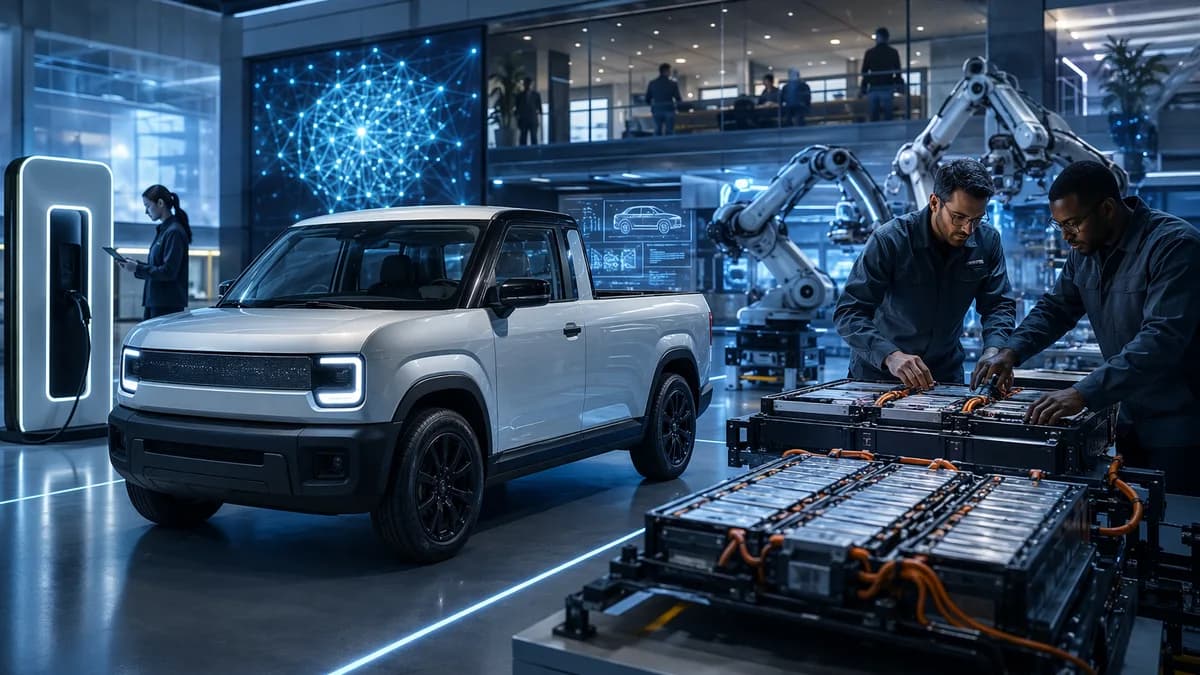
Ford’s $30,000 electric truck is the clearest sign yet that the automaker’s next EV phase will be judged by margin, not muscle.
XOOMAR Intelligence
Analyst Take
That matters most for Ford, its factory teams, and buyers who want an electric pickup without paying full-size truck money. The company is moving on from the Ford F-150 Lightning era and building its reset around the Universal Electric Vehicle Platform, according to The Verge. The connecting thread across Ford’s latest EV news is blunt: bigger batteries, bigger trucks, and higher prices didn’t solve the profit problem.
Ford investors face the core EV reset: profit now outranks pickup bragging rights
Ford still sees EVs as part of its future. The change is that it no longer appears willing to treat every electric truck as a flagship halo product.
The company’s first major electric pickup push, the F-150 Lightning, failed to capture the market the way Ford needed it to. Now Ford is going back to the drawing board with a smaller, cheaper truck that is being engineered around efficiency and profitability from the start.
Can Ford make an EV that buyers can afford and the company can sell without bleeding money?
That is the whole story. The planned $30,000 electric truck is not just another model. It is Ford’s attempt to prove that a legacy automaker can make a low-cost EV family without repeating the losses of its first phase.
Ford still sees EVs as the future, just not oversize ones with “no path to profitability,” as executives say.
Ford product teams get their first real test: a $30,000 electric truck on the Universal EV Platform
The first vehicle on Ford’s Universal Electric Vehicle Platform is expected to be a low-cost electric truck, with a reveal planned for 2027. That makes the Ford $30,000 electric truck the test case for the company’s new platform discipline.
Ford does not want this architecture to support one cheap pickup and stop there. The plan is a broader family of low-cost EVs built at its Kentucky assembly plant, with the truck serving as the first proof point.
The business target is as important as the product target. Ford needs fewer expensive parts, simpler assembly, and a production system that gives the vehicle a clearer path to profitability.
How much can Ford remove from the vehicle without making it feel cheap?
That question will define the platform. A low sticker price helps only if the vehicle still feels like a real Ford pickup and not a cost-cutting exercise with a bed attached.
| Ford’s first EV truck phase | Ford’s new EV truck phase |
|---|---|
| Full-size electric pickup centered on the F-150 Lightning | Smaller low-cost truck built around the Universal EV Platform |
| High-cost EV investment cycle | Profitability-first engineering |
| Big battery, big truck strategy | Efficiency, lower complexity, smaller footprint |
| One major model as proof point | Family of affordable EVs planned around a shared platform |
Ford buyers see the signal: the camouflaged pickup looks smaller, cheaper, and more focused
The heavily camouflaged prototype has already been spotted in the wild. The disguise even used playful emoji-style camouflage, a strange bit of theater for a vehicle whose real mission is cost discipline.
Observers cited by The Verge noted that the truck appears even smaller than the Maverick. If that read is right, Ford is making a sharp break from its traditional pickup playbook, where size has long carried status.
Would buyers accept an electric Ford truck that is smaller than the Maverick if it hits the right price?
That is the bet. A smaller footprint can reduce weight, shrink battery needs, and make the $30,000 target more realistic. It may also force Ford to reset buyer expectations around what an electric pickup is supposed to do.
Ford engineers are trying to cut cost before the truck reaches Kentucky
Ford’s low-cost EV work is happening before the vehicle reaches full production scale. The point is to solve the expensive problems early, not patch them once the truck is already rolling down the line.
The tradeoffs are familiar but unforgiving:
- Battery size: Smaller packs can cut cost, but they tighten range and capability targets.
- Vehicle weight: Every pound matters when Ford is chasing efficiency.
- Materials: Cheaper inputs help only if durability holds.
- Manufacturing complexity: Extra parts and steps can kill the economics before launch.
How many compromises can Ford make before buyers notice?
This is where the Kentucky assembly plant becomes more than a production site. It is the operating test for Ford’s broader EV reset. If the plant can build the truck and future low-cost EVs at the cost structure Ford wants, the platform has a chance. If not, the $30,000 target becomes marketing pressure rather than a business model.
For XOOMAR readers, the cost-control theme should feel familiar. In tech, platform discipline has become its own battleground, as seen in our coverage of the $400 Million Bet Pits Current AI Against Big Tech's Grip. Ford is dealing with a physical version of the same problem: control the stack, or watch costs control you.
Ford’s software teams lose Doug Field at a sensitive moment
The departure of Doug Field, Ford’s EV and software chief, lands at an awkward time. Ford’s next EVs will depend as much on software, electronics, and platform execution as they do on batteries and motors.
That does not derail the plan by itself. It does add pressure.
Can Ford keep software discipline intact while rebuilding its EV hardware strategy?
The new truck is supposed to be affordable, efficient, and profitable. Those goals require tight coordination across vehicle architecture, embedded software, battery management, controls, and manufacturing. Leadership churn makes that harder at the exact moment Ford needs fewer distractions.
The risk is not that one executive leaves and the truck fails. The risk is that Ford’s EV reset needs unusually clean execution, while the organization is already absorbing a major strategic shift.
Ford’s truck designers are fighting physics as much as rivals
Electric trucks have a basic problem: capability tends to mean weight, and weight tends to mean more battery, which means more cost.
That is why Ford’s pivot away from oversize EVs matters. Executives are not merely changing the product mix. They are acknowledging that some electric truck designs may not offer a realistic path to profit.
Can a smaller truck preserve enough utility while avoiding the battery spiral that hurt larger EV pickups?
A compact electric pickup gives Ford a way to reduce the physics problem. Less vehicle can mean less battery, less structural demand, and lower cost. But it also means Ford may have to redefine the electric pickup for buyers who associate trucks with size, towing, and excess capacity.
This is the tightrope. If Ford makes the truck too modest, it risks disappointing pickup buyers. If it overbuilds the truck, it risks recreating the economics it is trying to escape.
Ford finance teams are absorbing the lesson from a $19.5 billion EV hit
Ford’s EV ambitions have already become painfully expensive. The company took a $19.5 billion hit on its EV investments in 2025, according to The Verge’s roundup of Ford’s EV coverage.
That figure explains the pivot toward hybrids and energy storage. Ford is not abandoning electrification. It is trying to spread the strategy across products and business lines that may reduce near-term financial strain.
Is Ford’s new plan an EV retreat or a more sober version of electrification?
The evidence points to the second. Ford still wants EVs, but it no longer appears willing to treat every EV program like a moonshot. The $30,000 truck is the opposite of a blank-check project. It is a controlled experiment in whether affordability and profit can coexist.
That is a healthier standard. It is also a harsher one.
Ford’s China problem makes the $30,000 target more than a domestic price point
Jim Farley’s comments on China and tariffs sit inside the same affordability fight. Ford is not designing this truck in a vacuum. Chinese automakers have changed the benchmark for low-cost EVs, software, and manufacturing speed.
The supplied material does not provide a tariff schedule or Ford’s sourcing map, so the cost impact is still unclear. But the strategic tension is obvious: tariffs can give domestic automakers breathing room, while sourcing choices and pricing targets still have to work inside the vehicle’s bill of materials.
Can Ford build a $30,000 EV that feels competitive against the global standard, not just the U.S. showroom set?
That is the harder test. The truck is Ford’s domestic product, but the pressure behind it is global. China has become a reference point for how quickly vehicle tech and cost structures can move.
XOOMAR has tracked the same China pressure in other sectors, including Beijing forcing Apple Intelligence into an AI trade-off and the $900B China market pushing AI live shopping’s U.S. test. The auto version is now landing on Ford’s factory floor.
Ford manufacturing teams need the new production process to prove itself at scale
Ford’s lower-priced EV plan depends on a new manufacturing approach, not just a new badge. Motor1 reports that Ford’s new architecture uses 20 percent fewer parts and 25 percent fewer fasteners than a typical vehicle, while the platform also requires 40 percent fewer workstations during assembly, according to Motor1.
The wiring harness claim is especially telling. Motor1 reports that the truck’s harness will be 4,000 feet shorter and 22.1 pounds lighter than previous versions, contributing to a 15-percent faster production process. Ford is also promoting a Universal EV Production System built around an “assembly tree,” with three sub-system lines converging into one.
Can Ford turn factory simplification into real margin, not just cleaner diagrams?
That is where the plan either becomes credible or breaks. A cheap EV only matters if Ford can build enough units without losing money. The F-150 Lightning’s profit problem is the warning. The new process is Ford’s answer.
Car and Driver also reported that Ford launched a website with videos following the truck’s development, including prototype testing and production-line footage, according to Car and Driver. In one video, Alan Clarke, vice president of advanced development projects, says the project is “about reimagining how we develop and build vehicles.”
The bigger picture: Ford’s low-cost EV family will test whether Detroit can profit below $30,000
Ford’s overhaul signals a harsher phase for EV strategy. The company is moving from launch spectacle to survival math.
The smaller truck, the Universal EV Platform, the Kentucky production plan, Doug Field’s exit, the hybrid and energy storage pivot, the China pressure, and the new factory process all point to the same problem: Ford needs EVs that can clear the affordability bar without wrecking the income statement.
Can Detroit make a desirable EV below $30,000 and still earn money on it?
That is the watch item now. The next Ford EV era will not be judged by horsepower claims, oversized battery packs, or splashy unveilings. It will be judged by whether the Ford $30,000 electric truck can sell in volume, hold buyer interest, and prove that low-cost EV manufacturing can work for a legacy automaker.
If Ford gets this right, the truck becomes the start of a repeatable affordable EV family. If it misses, the lesson will be just as clear: the market does not reward cheap EV promises unless the factory math works first.
The Bottom Line
- Ford’s next EV phase will be judged by whether it can make affordable electric vehicles profitably.
- A $30,000 electric truck could broaden EV pickup access beyond full-size truck buyers.
- The Universal EV Platform is Ford’s key test of whether legacy automakers can reset their EV economics.
Ford’s EV Strategy Shift
| Old EV Push | New EV Reset |
|---|---|
| F-150 Lightning as a flagship electric pickup | $30,000 electric truck as the first Universal EV Platform test |
| Focused on large electric trucks and halo appeal | Focused on affordability, efficiency, and profitability |
| Bigger batteries, bigger trucks, and higher prices did not solve losses | Smaller, cheaper truck engineered around margin from the start |
| Failed to capture the market Ford needed | Planned reveal in 2027 as Ford’s low-cost EV family proof point |
Primary Sources & Disclosures

Written by
XOOMAR Insights Team
Research and Editorial Desk
The XOOMAR Insights Team pairs automated research with human editorial judgment. We track hundreds of sources across technology, fintech, trading, SaaS, and cybersecurity, cross-check the facts, and explain what happened, why it matters, and what to watch next. We do not just rewrite headlines. Every article is fact-checked and scored for reliability before it goes live, and we link back to the original sources so you can verify anything yourself.